
Homework Answers
Add Answer to:
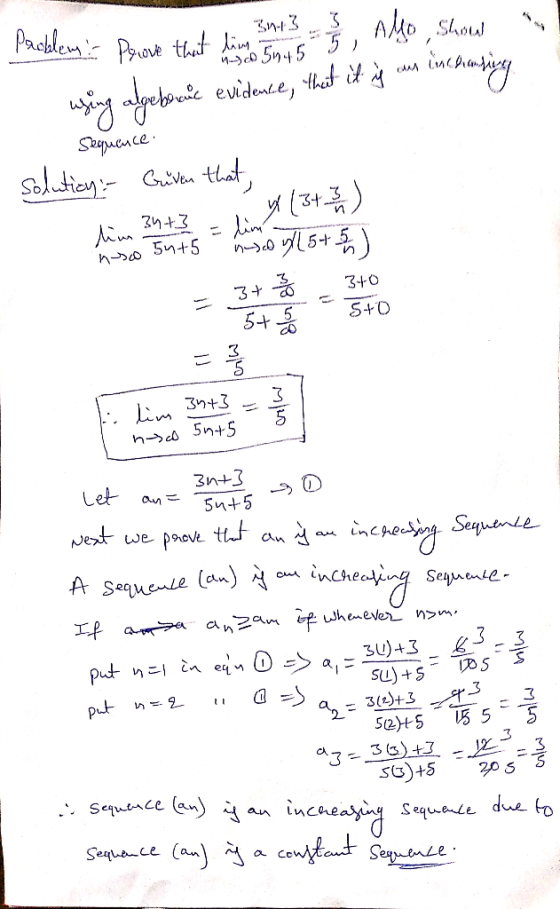
3n+3 3 (i.e. let &>0 and determine a n, to satisfy the definition of convergence.) Prove...
PLEASE ANSWER ALL! SHOWS STEPS 2. (a) Prove by using the definition of convergence only, without using limit theo- (b) Prove by using the definition of continuity, or by using the є_ó property, that 3...
 PLEASE ANSWER ALL! SHOWS STEPS
2. (a) Prove by using the definition of convergence only, without using limit theo- (b) Prove by using the definition of continuity, or by using the є_ó property, that 3. Let f be a twice differentiable function defined on the closed interval [0, 1]. Suppose rems, that if (S) is a sequence converging to s, then lim, 10 2 f (x) is a continuous function on R r,s,t e [0,1] are defined so that r...
PLEASE ANSWER ALL! SHOWS STEPS
2. (a) Prove by using the definition of convergence only, without using limit theo- (b) Prove by using the definition of continuity, or by using the є_ó property, that 3. Let f be a twice differentiable function defined on the closed interval [0, 1]. Suppose rems, that if (S) is a sequence converging to s, then lim, 10 2 f (x) is a continuous function on R r,s,t e [0,1] are defined so that r...
Use the definition of 0 to show that 5n^5 +4n^4 + 3n^3 + 2n^2 + n...
 Use the definition of 0 to show that 5n^5 +4n^4 + 3n^3 + 2n^2 + n 0(n^5).Use the definition of 0 to show that 2n^2 - n+ 3 0(n^2).Let f,g,h : N 1R*. Use the definition of big-Oh to prove that if/(n) 6 0(g{n)) and g(n) 0(h{n)) then/(n) 0(/i(n)). You should use different letters for the constants (i.e. don't use c to denote the constant for each big-Oh).
(3) Use the definition of convergence to prove each of the following (a) 1 is not...
 (3) Use the definition of convergence to prove each of the following (a) 1 is not the limit of the sequence sn (-1)" (b) lim = 1/2 2n (c) Suppose that lim an = a. Prove that lim 3 . an За.
6. Let si = 4 and sn +1 (sn +-) for n > 0. Prove lim...
 6. Let si = 4 and sn +1 (sn +-) for n > 0. Prove lim n→oo sn exists and find limn-oo Sn. (Hint: First use induction to show sn 2 2 and the.show (sn) is decreasing)
2) Prove that 1 + 3n < 4n for all n > 1. /5 Marks/
 2) Prove that 1 + 3n < 4n for all n > 1. /5 Marks/
T1 20J. Prove that XCY 3. Let A - 3 312 +3n I n 20) and...
 T1 20J. Prove that XCY 3. Let A - 3 312 +3n I n 20) and Y In3-1ln 0),. Prove that X - Y. ve DeMorgan's Laws. Use the definition of set equality to establish the ider
(b) Suppose that en is a sequence such that 0 <In < 2011 for all n...
 (b) Suppose that en is a sequence such that 0 <In < 2011 for all n e N. Does lim an exist? If it exists, prove it. If not, give a counterexample. (c) Suppose that in is a sequence such that 0 < < 21 for all n E N.Does lim exist? If it exists, prove it. If not, give a counterexample. 20
11.) Use the Ratio Test to determine the convergence or divergence of the series (3n)! n=0...
 11.) Use the Ratio Test to determine the convergence or divergence of the series (3n)! n=0 12.) Use the Root Test to determine the convergence or divergence of the series Š n =1
Please help me solve 3,4,5 3- For all n € N, let an = 1. Let...
 Please help me solve 3,4,5
3- For all n € N, let an = 1. Let S = {an in€ N}. 3-1) Use the fact that lim - = 0 and the result of Exercise 1 to show that 0 ES'. Ron 3-2) Use the result of Exercise 2 to show that S = {0}. 4- Prove that 4-1) N' = 0. 4-2) Q =R. 5- Recall that a set KCR is said to be compact if every open cover...
Please help me solve 3,4,5
3- For all n € N, let an = 1. Let S = {an in€ N}. 3-1) Use the fact that lim - = 0 and the result of Exercise 1 to show that 0 ES'. Ron 3-2) Use the result of Exercise 2 to show that S = {0}. 4- Prove that 4-1) N' = 0. 4-2) Q =R. 5- Recall that a set KCR is said to be compact if every open cover...
Suppose that a sequence {Zn} satisfies Izn+1-Znl < 2-n for all n e N. Prove that...
 Suppose that a sequence {Zn} satisfies Izn+1-Znl < 2-n for all n e N. Prove that {z.) is Cauchy. Is this result true under the condition Irn +1-Fml < rt Let xi = 1 and xn +1 = (Zn + 1)/3 for all n e N. Find the first five terms in this sequence. Use induction to show that rn > 1/2 for all n and find the limit N. Prove that this sequence is non-increasing, convergent,
 PLEASE ANSWER ALL! SHOWS STEPS
2. (a) Prove by using the definition of convergence only, without using limit theo- (b) Prove by using the definition of continuity, or by using the є_ó property, that 3. Let f be a twice differentiable function defined on the closed interval [0, 1]. Suppose rems, that if (S) is a sequence converging to s, then lim, 10 2 f (x) is a continuous function on R r,s,t e [0,1] are defined so that r...
PLEASE ANSWER ALL! SHOWS STEPS
2. (a) Prove by using the definition of convergence only, without using limit theo- (b) Prove by using the definition of continuity, or by using the є_ó property, that 3. Let f be a twice differentiable function defined on the closed interval [0, 1]. Suppose rems, that if (S) is a sequence converging to s, then lim, 10 2 f (x) is a continuous function on R r,s,t e [0,1] are defined so that r...
 Use the definition of 0 to show that 5n^5 +4n^4 + 3n^3 + 2n^2 + n 0(n^5).Use the definition of 0 to show that 2n^2 - n+ 3 0(n^2).Let f,g,h : N 1R*. Use the definition of big-Oh to prove that if/(n) 6 0(g{n)) and g(n) 0(h{n)) then/(n) 0(/i(n)). You should use different letters for the constants (i.e. don't use c to denote the constant for each big-Oh).
 (3) Use the definition of convergence to prove each of the following (a) 1 is not the limit of the sequence sn (-1)" (b) lim = 1/2 2n (c) Suppose that lim an = a. Prove that lim 3 . an За.
 6. Let si = 4 and sn +1 (sn +-) for n > 0. Prove lim n→oo sn exists and find limn-oo Sn. (Hint: First use induction to show sn 2 2 and the.show (sn) is decreasing)
 2) Prove that 1 + 3n < 4n for all n > 1. /5 Marks/
 T1 20J. Prove that XCY 3. Let A - 3 312 +3n I n 20) and Y In3-1ln 0),. Prove that X - Y. ve DeMorgan's Laws. Use the definition of set equality to establish the ider
 (b) Suppose that en is a sequence such that 0 <In < 2011 for all n e N. Does lim an exist? If it exists, prove it. If not, give a counterexample. (c) Suppose that in is a sequence such that 0 < < 21 for all n E N.Does lim exist? If it exists, prove it. If not, give a counterexample. 20
 11.) Use the Ratio Test to determine the convergence or divergence of the series (3n)! n=0 12.) Use the Root Test to determine the convergence or divergence of the series Š n =1
 Please help me solve 3,4,5
3- For all n € N, let an = 1. Let S = {an in€ N}. 3-1) Use the fact that lim - = 0 and the result of Exercise 1 to show that 0 ES'. Ron 3-2) Use the result of Exercise 2 to show that S = {0}. 4- Prove that 4-1) N' = 0. 4-2) Q =R. 5- Recall that a set KCR is said to be compact if every open cover...
Please help me solve 3,4,5
3- For all n € N, let an = 1. Let S = {an in€ N}. 3-1) Use the fact that lim - = 0 and the result of Exercise 1 to show that 0 ES'. Ron 3-2) Use the result of Exercise 2 to show that S = {0}. 4- Prove that 4-1) N' = 0. 4-2) Q =R. 5- Recall that a set KCR is said to be compact if every open cover...
 Suppose that a sequence {Zn} satisfies Izn+1-Znl < 2-n for all n e N. Prove that {z.) is Cauchy. Is this result true under the condition Irn +1-Fml < rt Let xi = 1 and xn +1 = (Zn + 1)/3 for all n e N. Find the first five terms in this sequence. Use induction to show that rn > 1/2 for all n and find the limit N. Prove that this sequence is non-increasing, convergent,
Most questions answered within 3 hours.
-
Where is the error in this code sequence?
String s1 = "Hello";
String s2 = "ello";...
asked 11 months ago -
Financial data for Joel de Paris, Inc., for last year
follow:
Joel de Paris, Inc.
Balance...
asked 11 months ago -
Consider this reaction:
Al2(SO4)3 (aq)+ BaCl3
(aq) Al2Cl6 (aq)- +
3BaSO4(s) . What is the...
asked 11 months ago -
Suppose that Savneet is considering increasing her
recent random sample from 20 car rentals to 40...
asked 11 months ago -
Trucks arrive at an unloading terminal at an average rate of 120
per hour.
Trucks arrive...
asked 11 months ago -
Why are methanol and ethanol completely soluble in water while
octanol is not very little soluble....
asked 11 months ago -
A facilities manager at a university reads in a research report
that the mean amount of...
asked 11 months ago -
When the CuSO4 is rehydrated by adding water to the anhydrous
compound, is this an endothermic...
asked 11 months ago -
A ray of sunlight is passing from diamond into crown glass; the
angle of incidence is...
asked 11 months ago -
A block of mass 0.249 kg is placed on top of a light, vertical
spring of...
asked 11 months ago -
how do the kidneys compensate in the presences of acidosis
a) trigger hyperventilate
b) reserve acid...
asked 11 months ago -
Question 501 pts
The rental rate of capital to the firm increases. Which of the
following...
asked 11 months ago