
Homework Answers
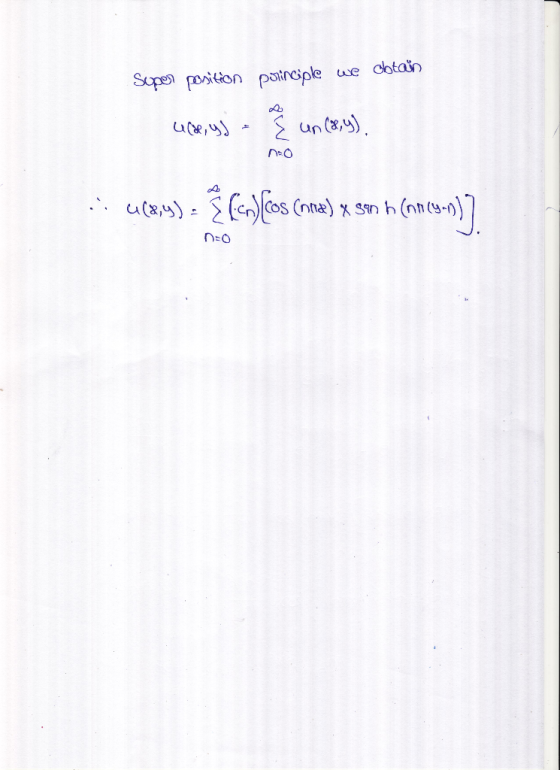
use eigenvalues and eigenfunction expansion to solve the mixed Dirchlet Neumann problem for the Laplace equation
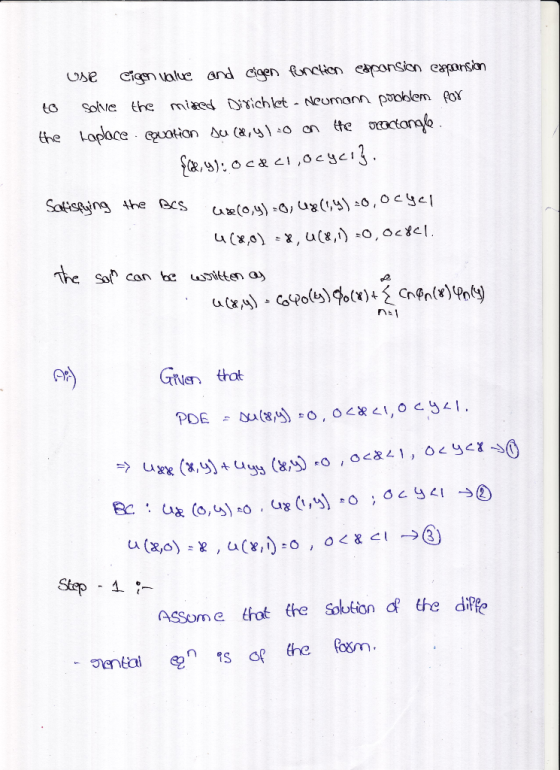
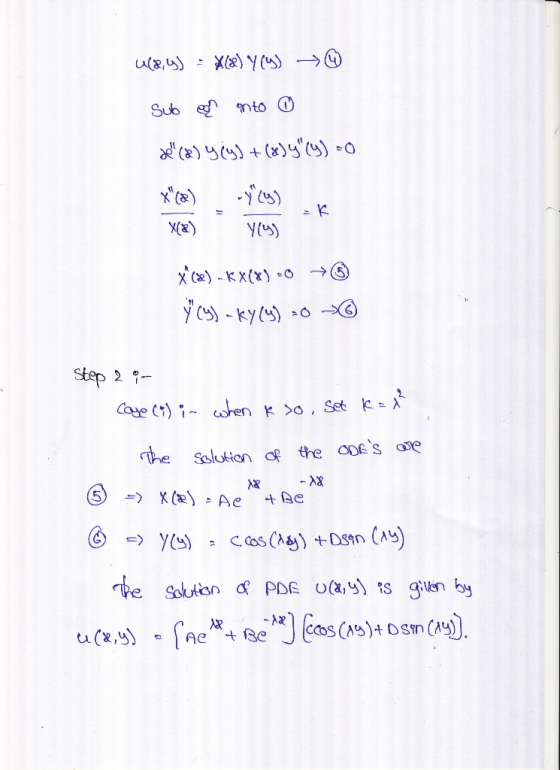
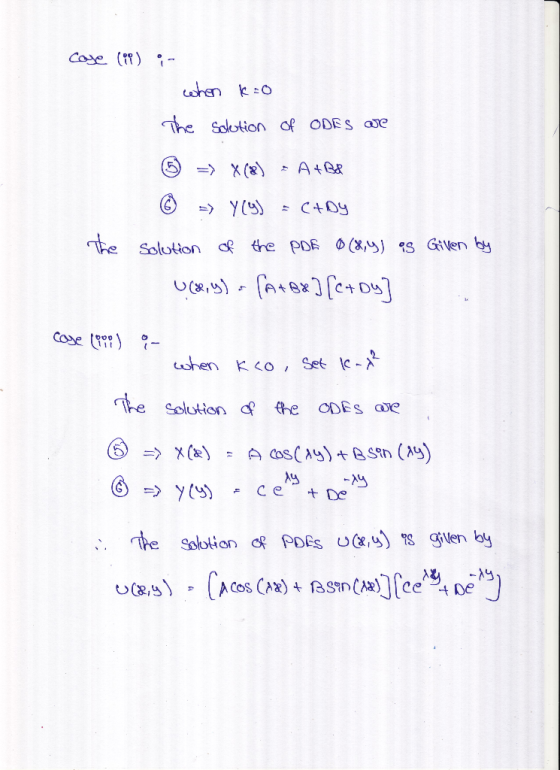
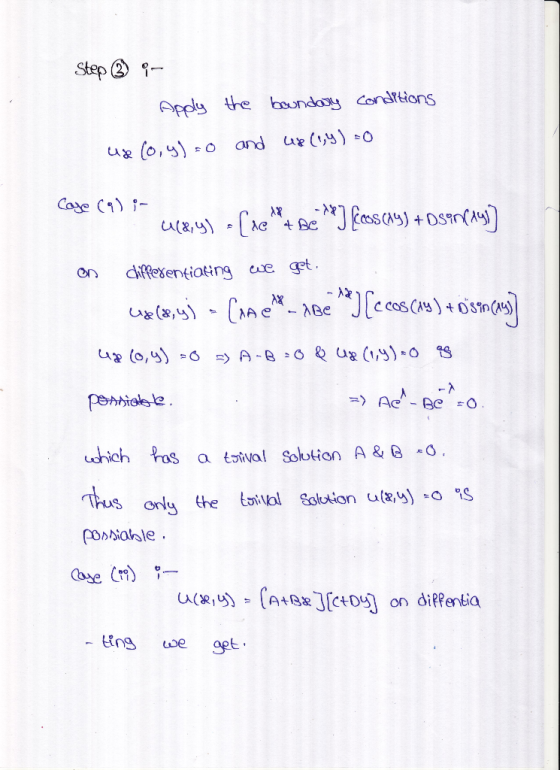
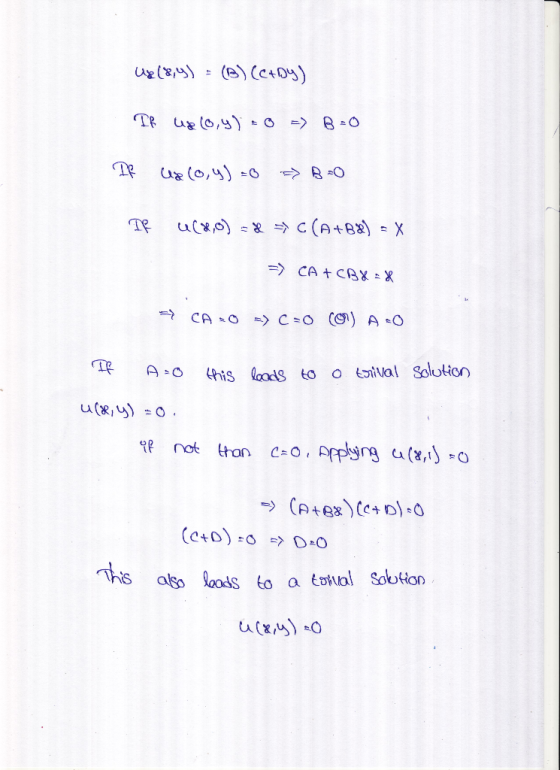
![Case (0) - 478,4) = (a cos(4x) + Bsen(x2)+fee met de nyy diffentiate both sides we get 48 (8.4) - (-RASAD (18) + BACOS CA] [c](http://img.homeworklib.com/questions/762add60-6691-11eb-b8af-db50c6fb7729.png?x-oss-process=image/resize,w_560)
![③ u18, 1) =0 un (8,1) = cos Childe] (enettone) -o a che + Dne no © à non ty) → un (8,4) - cos (one) [cnecne xes = cos(ne (c](http://img.homeworklib.com/questions/76e3a7c0-6691-11eb-bad5-67140fb403e1.png?x-oss-process=image/resize,w_560)
Add Answer to:
(1 point) Use eigenvalues and elgenfunction expansion expansion to solve the mixed Dirichlet- Neumann problem for...
(3 points) Use eigenvalues and eigenfunction expansion expansion to solve the Dirichlet problem Δ...
 (3 points) Use eigenvalues and eigenfunction expansion expansion to solve the Dirichlet problem Δυ(x,y)-0 on the rectangle {(x, y):0
Partial Differential Equations. Let be the upper half of a disk of radius 1. Solve the Dirichlet problem for the Lapla...
Partial Differential Equations. Let be the upper half of a disk of radius 1. Solve the Dirichlet problem for the Laplace equation: in for -1 < x <1 and y = 0 for We were unable to transcribe this imageu : We were unable to transcribe this imageWe were unable to transcribe this imageu = y We were unable to transcribe this image u : u = y
Given the following heat conduction initial-boundary value problem of a thin homogeneous rod, where u(x, t)...
 Given the following heat conduction initial-boundary value problem of a thin homogeneous rod, where u(x, t) represents the temperature. 9uxx = Uti 0<x< 6; t> 0; B.C.: ux(0,t) = 0; ux(6,t) = 0; t> 0; 1. C.: u(x, 0) = 12 + scos (6x) – 4cos(21x); 0<x< 6 (a) When t = 0, what would be the temperature at x = 3? (Use the initial condition.) (3 marks) (b) Determine whether the boundary conditions in this case is Dirichlet, Neumann,...
x < n with BCs y(0)= 0 and y(z) 0. (1 point) Find the eigenvalues and...
 x < n with BCs y(0)= 0 and y(z) 0. (1 point) Find the eigenvalues and eigenfunctions for y" = Ay on 0 Note that any constant times an eigenfunction is also an eigenfunction. In order to obtain a unique solution find (x) so that x) dx 1 First find the eigenvalues and orthonormal eigenfunctions for n 1, i.e., An, >,(x). For n 0 there may or may not be an eigenpair. Give all these as a comma separated list....
Q2 Given the following heat conduction initial-boundary value problem of a thin homogeneous rod, where u(x,t)...
 Q2 Given the following heat conduction initial-boundary value problem of a thin homogeneous rod, where u(x,t) represents the temperature. 9uxx = ut; 0<x< 6; t> 0; B.C.: Ux(0,t) = 0; Ux(6,t) = 0; t> 0; 1.C.: u(x,0) = 12 + Scos (x) – 4cos(21x); 0 < x < 6 (a) When t = 0, what would be the temperature at x = 3? (Use the initial condition.) (3 marks) (b) Determine whether the boundary conditions in this case is Dirichlet,...
Q2 Given the following heat conduction initial-boundary value problem of a thin homogeneous rod, where ?(?,?)...
 Q2 Given the following heat conduction initial-boundary value
problem of a thin homogeneous rod, where ?(?,?) represents the
temperature. 9??? = ?? ; 0 < ? < 6; ? > 0; B. C. : ??
(0,?) = 0; ?? (6,?) = 0; ? > 0; I. C. : ?(?, 0) = 12 + 5??? ( ?
6 ?) − 4???(2??); 0 < ? < 6 (a) When ? = 0, what would be the
temperature at ? = 3? (Use...
Q2 Given the following heat conduction initial-boundary value
problem of a thin homogeneous rod, where ?(?,?) represents the
temperature. 9??? = ?? ; 0 < ? < 6; ? > 0; B. C. : ??
(0,?) = 0; ?? (6,?) = 0; ? > 0; I. C. : ?(?, 0) = 12 + 5??? ( ?
6 ?) − 4???(2??); 0 < ? < 6 (a) When ? = 0, what would be the
temperature at ? = 3? (Use...
12. Consider the unusual eigenvalue problem ux(0) = ur(l) = v(1)-U(0) (a) Show that 2 0 is a double eigenvalue. (b) Get an equation for the positive eigenvalues a>0. 102 CHAPTER 4 BOUNDARY PROBLEM...
 12. Consider the unusual eigenvalue problem ux(0) = ur(l) = v(1)-U(0) (a) Show that 2 0 is a double eigenvalue. (b) Get an equation for the positive eigenvalues a>0. 102 CHAPTER 4 BOUNDARY PROBLEMS (c) Letting γ-IVA, reduce the equation in part (b) to the equation γ sin γ cos γ = sin (d) Use part (c) to find half of the eigenvalues explicitly and half of (e) Assuming that all the eigenvalues are nonnegative, make a list of (t)...
1. Wave equation. Consider the wave equation on the finite interval (0, L) PDE BC where Neumann b...
 1. Wave equation. Consider the wave equation on the finite interval (0, L) PDE BC where Neumann boundary conditions are specified Physically, with Neumann boundary conditions, u(r, t) could represent the height of a fluid that sloshes between two walls. (a) Find the general Fourier series solution by repeating the derivation from class now considering Neumann instead of Dirichlet boundary conditions. Your final solution should be (b) Consider the following general initial conditions u(x, 0)x) IC IC Derive formulas that...
2. Use eigenfunction expansion to solve the following IBVP: please answer v) (fifth one) 2. Use...
 2. Use eigenfunction expansion to solve the following IBVP:
please answer v) (fifth one)
2. Use eigenfunction expansion to solve the following IBVP u,(x.t)-u(x.t)+(t-1)sin(a) 0<x<1 t>0 u(0,t)0, u(l,r) 0, t>0 u,(x,t)(x) cos(z), 0 <x<1 t>0 n(x,0) = 2-cos(32t) 0 < x < 1 u(0,0, u(l,t) 0, t>0 n(x,0) = 1 u,(x,0) = 0 0 < x < 1 IV Hm(x,y)+u" (x,y)--r', 0<x<1 0<y<2 u(x,0) = 0, u(x2) =-x 0 < x < 1 v) 7" 11(0,8) bounded , -π<θ<π
2. Use eigenfunction expansion to solve the following IBVP:
please answer v) (fifth one)
2. Use eigenfunction expansion to solve the following IBVP u,(x.t)-u(x.t)+(t-1)sin(a) 0<x<1 t>0 u(0,t)0, u(l,r) 0, t>0 u,(x,t)(x) cos(z), 0 <x<1 t>0 n(x,0) = 2-cos(32t) 0 < x < 1 u(0,0, u(l,t) 0, t>0 n(x,0) = 1 u,(x,0) = 0 0 < x < 1 IV Hm(x,y)+u" (x,y)--r', 0<x<1 0<y<2 u(x,0) = 0, u(x2) =-x 0 < x < 1 v) 7" 11(0,8) bounded , -π<θ<π
Q2 Given the following heat conduction initial-boundary value problem of a thin homogeneous rod, where u(x,t)...
 Q2 Given the following heat conduction initial-boundary value problem of a thin homogeneous rod, where u(x,t) represents the temperature. 9uxx = upi 0<x< 6; t> 0; B.C.: uz(0,t) = 0; ux, t) = 0; t> 0; 1.C.:u(x,0) = 12 + 5cos 6 x) – 4cos(26x); 0<x<6 (a) When t = 0, what would be the temperature at x = 3? (Use the initial condition.) (3 marks) (b) Determine whether the boundary conditions in this case is Dirichlet, Neumann, or mixed...
 (3 points) Use eigenvalues and eigenfunction expansion expansion to solve the Dirichlet problem Δυ(x,y)-0 on the rectangle {(x, y):0
 Given the following heat conduction initial-boundary value problem of a thin homogeneous rod, where u(x, t) represents the temperature. 9uxx = Uti 0<x< 6; t> 0; B.C.: ux(0,t) = 0; ux(6,t) = 0; t> 0; 1. C.: u(x, 0) = 12 + scos (6x) – 4cos(21x); 0<x< 6 (a) When t = 0, what would be the temperature at x = 3? (Use the initial condition.) (3 marks) (b) Determine whether the boundary conditions in this case is Dirichlet, Neumann,...
 x < n with BCs y(0)= 0 and y(z) 0. (1 point) Find the eigenvalues and eigenfunctions for y" = Ay on 0 Note that any constant times an eigenfunction is also an eigenfunction. In order to obtain a unique solution find (x) so that x) dx 1 First find the eigenvalues and orthonormal eigenfunctions for n 1, i.e., An, >,(x). For n 0 there may or may not be an eigenpair. Give all these as a comma separated list....
 Q2 Given the following heat conduction initial-boundary value problem of a thin homogeneous rod, where u(x,t) represents the temperature. 9uxx = ut; 0<x< 6; t> 0; B.C.: Ux(0,t) = 0; Ux(6,t) = 0; t> 0; 1.C.: u(x,0) = 12 + Scos (x) – 4cos(21x); 0 < x < 6 (a) When t = 0, what would be the temperature at x = 3? (Use the initial condition.) (3 marks) (b) Determine whether the boundary conditions in this case is Dirichlet,...
 Q2 Given the following heat conduction initial-boundary value
problem of a thin homogeneous rod, where ?(?,?) represents the
temperature. 9??? = ?? ; 0 < ? < 6; ? > 0; B. C. : ??
(0,?) = 0; ?? (6,?) = 0; ? > 0; I. C. : ?(?, 0) = 12 + 5??? ( ?
6 ?) − 4???(2??); 0 < ? < 6 (a) When ? = 0, what would be the
temperature at ? = 3? (Use...
Q2 Given the following heat conduction initial-boundary value
problem of a thin homogeneous rod, where ?(?,?) represents the
temperature. 9??? = ?? ; 0 < ? < 6; ? > 0; B. C. : ??
(0,?) = 0; ?? (6,?) = 0; ? > 0; I. C. : ?(?, 0) = 12 + 5??? ( ?
6 ?) − 4???(2??); 0 < ? < 6 (a) When ? = 0, what would be the
temperature at ? = 3? (Use...
 12. Consider the unusual eigenvalue problem ux(0) = ur(l) = v(1)-U(0) (a) Show that 2 0 is a double eigenvalue. (b) Get an equation for the positive eigenvalues a>0. 102 CHAPTER 4 BOUNDARY PROBLEMS (c) Letting γ-IVA, reduce the equation in part (b) to the equation γ sin γ cos γ = sin (d) Use part (c) to find half of the eigenvalues explicitly and half of (e) Assuming that all the eigenvalues are nonnegative, make a list of (t)...
 1. Wave equation. Consider the wave equation on the finite interval (0, L) PDE BC where Neumann boundary conditions are specified Physically, with Neumann boundary conditions, u(r, t) could represent the height of a fluid that sloshes between two walls. (a) Find the general Fourier series solution by repeating the derivation from class now considering Neumann instead of Dirichlet boundary conditions. Your final solution should be (b) Consider the following general initial conditions u(x, 0)x) IC IC Derive formulas that...
 2. Use eigenfunction expansion to solve the following IBVP:
please answer v) (fifth one)
2. Use eigenfunction expansion to solve the following IBVP u,(x.t)-u(x.t)+(t-1)sin(a) 0<x<1 t>0 u(0,t)0, u(l,r) 0, t>0 u,(x,t)(x) cos(z), 0 <x<1 t>0 n(x,0) = 2-cos(32t) 0 < x < 1 u(0,0, u(l,t) 0, t>0 n(x,0) = 1 u,(x,0) = 0 0 < x < 1 IV Hm(x,y)+u" (x,y)--r', 0<x<1 0<y<2 u(x,0) = 0, u(x2) =-x 0 < x < 1 v) 7" 11(0,8) bounded , -π<θ<π
2. Use eigenfunction expansion to solve the following IBVP:
please answer v) (fifth one)
2. Use eigenfunction expansion to solve the following IBVP u,(x.t)-u(x.t)+(t-1)sin(a) 0<x<1 t>0 u(0,t)0, u(l,r) 0, t>0 u,(x,t)(x) cos(z), 0 <x<1 t>0 n(x,0) = 2-cos(32t) 0 < x < 1 u(0,0, u(l,t) 0, t>0 n(x,0) = 1 u,(x,0) = 0 0 < x < 1 IV Hm(x,y)+u" (x,y)--r', 0<x<1 0<y<2 u(x,0) = 0, u(x2) =-x 0 < x < 1 v) 7" 11(0,8) bounded , -π<θ<π
 Q2 Given the following heat conduction initial-boundary value problem of a thin homogeneous rod, where u(x,t) represents the temperature. 9uxx = upi 0<x< 6; t> 0; B.C.: uz(0,t) = 0; ux, t) = 0; t> 0; 1.C.:u(x,0) = 12 + 5cos 6 x) – 4cos(26x); 0<x<6 (a) When t = 0, what would be the temperature at x = 3? (Use the initial condition.) (3 marks) (b) Determine whether the boundary conditions in this case is Dirichlet, Neumann, or mixed...
Most questions answered within 3 hours.
-
Where is the error in this code sequence?
String s1 = "Hello";
String s2 = "ello";...
asked 10 months ago -
Financial data for Joel de Paris, Inc., for last year
follow:
Joel de Paris, Inc.
Balance...
asked 10 months ago -
Consider this reaction:
Al2(SO4)3 (aq)+ BaCl3
(aq) Al2Cl6 (aq)- +
3BaSO4(s) . What is the...
asked 10 months ago -
Suppose that Savneet is considering increasing her
recent random sample from 20 car rentals to 40...
asked 10 months ago -
Trucks arrive at an unloading terminal at an average rate of 120
per hour.
Trucks arrive...
asked 10 months ago -
Why are methanol and ethanol completely soluble in water while
octanol is not very little soluble....
asked 10 months ago -
A facilities manager at a university reads in a research report
that the mean amount of...
asked 10 months ago -
When the CuSO4 is rehydrated by adding water to the anhydrous
compound, is this an endothermic...
asked 10 months ago -
A ray of sunlight is passing from diamond into crown glass; the
angle of incidence is...
asked 10 months ago -
A block of mass 0.249 kg is placed on top of a light, vertical
spring of...
asked 10 months ago -
how do the kidneys compensate in the presences of acidosis
a) trigger hyperventilate
b) reserve acid...
asked 10 months ago -
Question 501 pts
The rental rate of capital to the firm increases. Which of the
following...
asked 10 months ago