
Homework Answers

![- L = Lath > 0 =9-1 → a=l och = w[st u-I] - Tz - We do . Non dimensional parameters are t=2 and t = woo which govern the dyn](http://img.homeworklib.com/questions/3c867bc0-6713-11eb-872d-a1f00face58f.png?x-oss-process=image/resize,w_560)
Add Answer to:
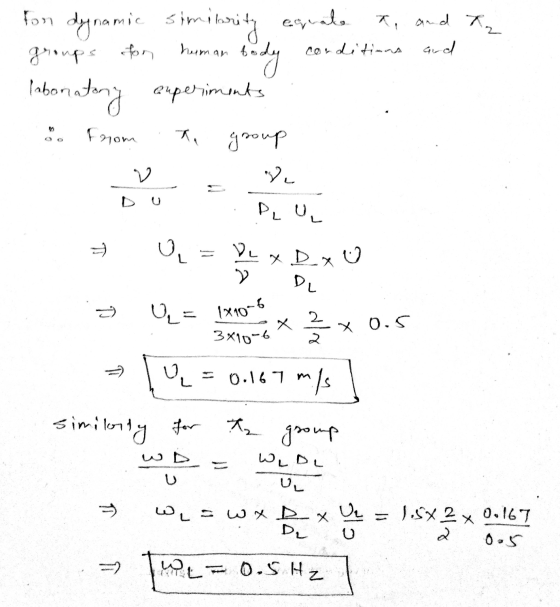
In the human body, the aorta is the major artery that conducts blood from the heart...
1. The aorta is the largest artery in the body. Where the aorta leaves the heart,...
1. The aorta is the largest artery in the body. Where the aorta leaves the heart, it has a diameter of about 3.2cm (that's a radius of 0.016m, area of 0.0008 m^2). The blood flow speed through the aorta near the heart is about 0.30 m/s. a) Calculate the flow rate in the aorta in m^3/s b) by the time the aorta reaches the abdomen the diameter is smaller, only about 2.4cm (that's a radius of 0.012m, area of 0.0004m^2)....
The aorta is a major artery, rising upward from the left ventricle of the heart and...
The aorta is a major artery, rising upward from the left ventricle of the heart and curving down to carry blood to the abdomen and lower half of the body. The curved artery can be approximated as a semicircular arch whose diameter is 4.0 cm. If blood flows through the aortic arch at a speed of 0.34 m/s, what is the magnitude (in m/s2) of the blood's centripetal acceleration?
The aorta is a major artery, rising upward from the left ventricle of the heart and...
The aorta is a major artery, rising upward from the left ventricle of the heart and curving down to carry blood to the abdomen and lower half of the body. The curved artery can be approximated as a semicircular arch whose diameter is 4.0 cm. If blood flows through the aortic arch at a speed of 0.33 m/s, what is the magnitude (in m/s2) of the blood's centripetal acceleration? m/s2
FLUIDS QUESTION ?Blood from a supine patient flowing through the internal carotid artery is measured to...
 FLUIDS QUESTION
?Blood from a supine patient
flowing through the internal carotid artery is measured to be
42.6 cm/s. The base of the artery measures 4.85 mm and the blood
pressure at this point is
92.56 mmHg. There is an aneurysm in the vessel with a diameter
measuring 16.1 mm. The
density of the patient’s whole blood was determined to be 1.04 x
10
3
kg/m
3
. Assuming
steady-state, inviscid flow (in large diameter vessels) and no
hydrostatic effects,...
FLUIDS QUESTION
?Blood from a supine patient
flowing through the internal carotid artery is measured to be
42.6 cm/s. The base of the artery measures 4.85 mm and the blood
pressure at this point is
92.56 mmHg. There is an aneurysm in the vessel with a diameter
measuring 16.1 mm. The
density of the patient’s whole blood was determined to be 1.04 x
10
3
kg/m
3
. Assuming
steady-state, inviscid flow (in large diameter vessels) and no
hydrostatic effects,...
Microscopic Structure of the Blood Vessels l views of an artery and of a vein are shown here Identily each, on the lines to the sides, note the structural details that enabled you...
 Microscopic Structure of the Blood Vessels l views of an artery and of a vein are shown here Identily each, on the lines to the sides, note the structural details that enabled you to make these identifications (vessel type) (vessel type) Now descibe each tunic more fully by selecting ts characteristics from the key below and placing the approprate key lettes on the answer lines Tunica intima Tunica media Tunica externa Key: a innermost tunic b. most superficial tunic regulates...
 FLUIDS QUESTION
?Blood from a supine patient
flowing through the internal carotid artery is measured to be
42.6 cm/s. The base of the artery measures 4.85 mm and the blood
pressure at this point is
92.56 mmHg. There is an aneurysm in the vessel with a diameter
measuring 16.1 mm. The
density of the patient’s whole blood was determined to be 1.04 x
10
3
kg/m
3
. Assuming
steady-state, inviscid flow (in large diameter vessels) and no
hydrostatic effects,...
FLUIDS QUESTION
?Blood from a supine patient
flowing through the internal carotid artery is measured to be
42.6 cm/s. The base of the artery measures 4.85 mm and the blood
pressure at this point is
92.56 mmHg. There is an aneurysm in the vessel with a diameter
measuring 16.1 mm. The
density of the patient’s whole blood was determined to be 1.04 x
10
3
kg/m
3
. Assuming
steady-state, inviscid flow (in large diameter vessels) and no
hydrostatic effects,...
 Microscopic Structure of the Blood Vessels l views of an artery and of a vein are shown here Identily each, on the lines to the sides, note the structural details that enabled you to make these identifications (vessel type) (vessel type) Now descibe each tunic more fully by selecting ts characteristics from the key below and placing the approprate key lettes on the answer lines Tunica intima Tunica media Tunica externa Key: a innermost tunic b. most superficial tunic regulates...
Most questions answered within 3 hours.
-
Where is the error in this code sequence?
String s1 = "Hello";
String s2 = "ello";...
asked 11 months ago -
Financial data for Joel de Paris, Inc., for last year
follow:
Joel de Paris, Inc.
Balance...
asked 11 months ago -
Consider this reaction:
Al2(SO4)3 (aq)+ BaCl3
(aq) Al2Cl6 (aq)- +
3BaSO4(s) . What is the...
asked 11 months ago -
Suppose that Savneet is considering increasing her
recent random sample from 20 car rentals to 40...
asked 11 months ago -
Trucks arrive at an unloading terminal at an average rate of 120
per hour.
Trucks arrive...
asked 11 months ago -
Why are methanol and ethanol completely soluble in water while
octanol is not very little soluble....
asked 11 months ago -
A facilities manager at a university reads in a research report
that the mean amount of...
asked 11 months ago -
When the CuSO4 is rehydrated by adding water to the anhydrous
compound, is this an endothermic...
asked 11 months ago -
A ray of sunlight is passing from diamond into crown glass; the
angle of incidence is...
asked 11 months ago -
A block of mass 0.249 kg is placed on top of a light, vertical
spring of...
asked 11 months ago -
how do the kidneys compensate in the presences of acidosis
a) trigger hyperventilate
b) reserve acid...
asked 11 months ago -
Question 501 pts
The rental rate of capital to the firm increases. Which of the
following...
asked 11 months ago