An aluminum wire has a mobile charge density is 8.0e28 electrons/m3, and a cross-sectional area of...
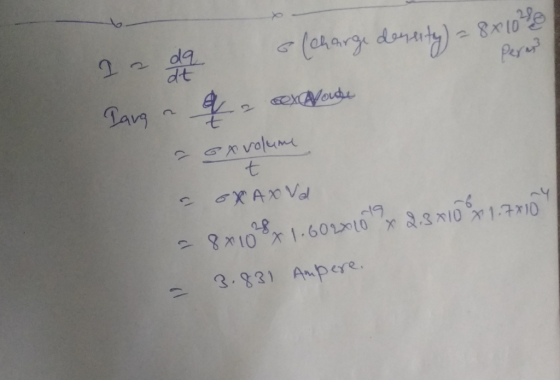
An aluminum wire has a mobile charge density is 8.0e28 electrons/m3, and a cross-sectional area of 2.3e-6 m2. When a current flows through the wire, the average drift speed of the electrons is 1.7e-4 m/s. What is the current in the wire?
Homework Answers
Add Answer to:
An aluminum wire has a mobile charge density is 8.0e28
electrons/m3, and a cross-sectional area of...
An aluminum wire having a cross-sectional area of 6.00 ✕ 10-6 m2 carries a current of...
An aluminum wire having a cross-sectional area of 6.00 ✕ 10-6 m2 carries a current of 8.00 A. Find the drift speed of the electrons in the wire. The density of aluminum is 2.70 g/cm3. Assume each aluminum atom supplies one conduction electron. mm/s
An aluminum wire having a cross-sectional area of 4.70 ✕ 10−6 m2 carries a current of...
An aluminum wire having a cross-sectional area of 4.70 ✕ 10−6 m2 carries a current of 4.50 A. The density of aluminum is 2.70 g/cm3. Assume each aluminum atom supplies one conduction electron per atom. Find the drift speed of the electrons in the wire. mm/s
An aluminum wire having a cross-sectional area of 2.50 ✕ 10−6 m2 carries a current of...
An aluminum wire having a cross-sectional area of 2.50 ✕ 10−6 m2 carries a current of 3.00 A. The density of aluminum is 2.70 g/cm3. Assume each aluminum atom supplies one conduction electron per atom. Find the drift speed of the electrons in the wire.
An iron wire has a cross-sectional area of 7.50 ✕ 10−6 m2. Carry out steps (a)...
An iron wire has a cross-sectional area of 7.50 ✕ 10−6 m2. Carry out steps (a) through (e) to compute the drift speed of the conduction electrons in the wire. (a) How many kilograms are there in 1 mole of iron? kg/mol (b) Starting with the density of iron and the result of part (a), compute the molar density of iron (the number of moles of iron per cubic meter). mol/m3 (c) Calculate the number density of iron atoms using...
1. An aluminum wire having a cross-sectional area equal to 3.50 10-6 m2 carries a current...
1. An aluminum wire having a cross-sectional area equal to 3.50 10-6 m2 carries a current of 6.50 A. The density of aluminum is 2.70 g/cm3. Assume each aluminum atom supplies one conduction electron per atom. Find the drift speed of the electrons in the wire. 0.000193452 Incorrect: Your answer is incorrect. The equation for the drift velocity includes the number of charge carriers per volume, which in this case is equal to the number of atoms per volume. How...
An aluminum wire having a cross-sectional area equal to 4.90 10-6 m2 carries a current of 4.00...
An aluminum wire having a cross-sectional area equal to 4.90 10-6 m2 carries a current of 4.00 A. The density of aluminum is 2.70 g/cm3. Assume each aluminum atom supplies one conduction electron per atom. Find the drift speed of the electrons in the wire.
An aluminum wire carrying a current of 1.80 A has a cross-sectional area of 2.5x10⁻⁶ m2....
An aluminum wire carrying a current of 1.80 A has a cross-sectional area of 2.5x10⁻⁶ m2. The density of aluminum is 2.7 g/cm3. (Assume three electrons are supplied by each atom.) (a) Find the charge density, n, for aluminum?
An iron wire has a cross-sectional area of 6.90 ✕ 10−6 m2. Carry out steps (a)...
An iron wire has a cross-sectional area of 6.90 ✕ 10−6 m2. Carry out steps (a) through (e) to compute the drift speed of the conduction electrons in the wire. (a) How many kilograms are there in 1 mole of iron? kg/mol (b) Starting with the density of iron and the result of part (a), compute the molar density of iron (the number of moles of iron per cubic meter). mol/m3 (c) Calculate the number density of iron atoms using...
An iron wire has a cross-sectional area of 5.80 ✕ 10−6 m2. Carry out steps (a) through (e) to compute the drift speed of...
An iron wire has a cross-sectional area of 5.80 ✕ 10−6 m2. Carry out steps (a) through (e) to compute the drift speed of the conduction electrons in the wire. (a) How many kilograms are there in 1 mole of iron? kg/mol (b) Starting with the density of iron and the result of part (a), compute the molar density of iron (the number of moles of iron per cubic meter). mol/m3 (c) Calculate the number density of iron atoms using...
A copper wire has a circular cross section with a radius of 1.36 mm. HINT (a)...
A copper wire has a circular cross section with a radius of 1.36 mm. HINT (a) If the wire carries a current of 3.13 A, find the drift speed (in m/s) of electrons in the wire. (Take the density of mobile charge carriers in copper to be n = 1.10 ✕ 1029 electrons/m3.) m/s (b) For the same wire size and current, find the drift speed (in m/s) of electrons if the wire is made of aluminum with n =...
Most questions answered within 3 hours.
-
Where is the error in this code sequence?
String s1 = "Hello";
String s2 = "ello";...
asked 10 months ago -
Financial data for Joel de Paris, Inc., for last year
follow:
Joel de Paris, Inc.
Balance...
asked 10 months ago -
Consider this reaction:
Al2(SO4)3 (aq)+ BaCl3
(aq) Al2Cl6 (aq)- +
3BaSO4(s) . What is the...
asked 10 months ago -
Suppose that Savneet is considering increasing her
recent random sample from 20 car rentals to 40...
asked 10 months ago -
Trucks arrive at an unloading terminal at an average rate of 120
per hour.
Trucks arrive...
asked 10 months ago -
Why are methanol and ethanol completely soluble in water while
octanol is not very little soluble....
asked 10 months ago -
A facilities manager at a university reads in a research report
that the mean amount of...
asked 10 months ago -
When the CuSO4 is rehydrated by adding water to the anhydrous
compound, is this an endothermic...
asked 10 months ago -
A ray of sunlight is passing from diamond into crown glass; the
angle of incidence is...
asked 10 months ago -
A block of mass 0.249 kg is placed on top of a light, vertical
spring of...
asked 10 months ago -
how do the kidneys compensate in the presences of acidosis
a) trigger hyperventilate
b) reserve acid...
asked 10 months ago -
Question 501 pts
The rental rate of capital to the firm increases. Which of the
following...
asked 10 months ago