
Homework Answers
Dear student we can provide you with the solution of one type of question at a time.
Add Answer to:
The proportion of college graduates who get jobs by networking after graduation is greater than 0.5,...
The proportion of college graduates who get jobs by networking after graduation is at least 45%...
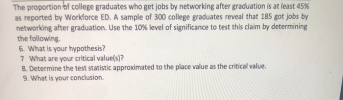 The proportion of college graduates who get jobs by networking after graduation is at least 45% as reported by Workforce ED. A sample of 300 college graduates reveal that 185 got jobs by networking after graduation. Use the 10% level of significance to test this claim by determining the following 6. What is your hypothesis? 7 What are your critical value(s)? 8. Determine the test statistic approximated to the place value as the critical value. 9. What is your conclusion.
A researcher claims that the proportion of college students who plan to participate in community service...
A researcher claims that the proportion of college students who plan to participate in community service after graduation is greater than 35%. To test this claim, a survey asked 500 randomly selected college students if they planned to perform community service after graduation. Of those students, 195 indicated they planned to perform community service. The following is the setup m the following hypothesis test: H0:p=0.35 Ha:p>0.35 In this example, the p-value was determined to be 0.030. Come to a conclusion...
A recent article reported that a job awaits only one in three (0.33) new college graduates....
A recent article reported that a job awaits only one in three (0.33) new college graduates. The major reasons given were an overabundance of college graduates and a weak economy. A survey of 200 recent graduates from your school revealed that 80 students had jobs. At the .01 significance level, can we conclude that a larger proportion of students at your school have jobs? A The Null Hypothesis is: a Job awaiting new college graduates is _______. b Job awaiting...
The dean of a college is interested in the proportion of graduates from his college who...
The dean of a college is interested in the proportion of graduates from his college who have a job offer on graduation day. He is particularly interested in seeing if there is a difference in this proportion for accounting and economics majors. In a random sample of 200 of each type of major at graduation, he found that 72 accounting majors and 52 economics majors had job offers. Assume pooled estimate of the population proportion and a level of significance...
1.A recent article reported that a job awaits only one in three new college graduates. (1...
1.A recent article reported that a job awaits only one in three new college graduates. (1 in 3 means the proportion is .333) A survey of 200 recent graduates revealed that 80 graduates had jobs. At the .02 significance level, we will conduct a hypothesis test to determine if we can conclude if a larger proportion of graduates have jobs than previously reported. What will be the value of our critical value? 2..A recent article reported that a job awaits...
It seems these days that college graduates who are employed full-time work more than 40-hour weeks....
 It seems these days that college graduates who are employed full-time work more than 40-hour weeks. Data are available that can help us decide if this is true. A survey was recently sent to a group of adults selected at random. There were 11 respondents who were college graduates employed full-time. The mean number of hours worked per week by these 11 respondents was 46 hours, with a standard deviation of 9 hours. Assume that the population of hours worked...
Problem 3 The dean of a college is interested in the proportion of graduates from his...
Problem 3 The dean of a college is interested in the proportion of graduates from his college who have a job offer on graduation day. He is particularly interested in seeing if there is a difference in this proportion for accounting and economics majors. In a random sample of 100 of each type of major at graduation, he found that 65 accounting majors and 52 economics majors had job offers. If the accounting majors are designated as "Group 1" and...
It seems these days that college graduates who are employed full-time work more than 40-hour weeks....
 It seems these days that college graduates who are employed full-time work more than 40-hour weeks. Data are available that can help us decide if this is true. A survey was recently sent to a group of adults selected at random. There were 15 respondents who were college graduates employed full-time. The mean number of hours worked per week by these 15 respondents was 45 hours, with a standard deviation of 9 hours. Assume that the population of hours worked...
Question 2 25 points Save Answer Problem Solving #2. (Finding a Job Through Networking in a...
 Question 2 25 points Save Answer Problem Solving #2. (Finding a Job Through Networking in a survey of randomly selected 40 workers, to the question what is the strategy for finding jobs after graduation?. their answers are given as follows: N-Networking R-Regular application A Advertisement 0Other means TRN N NON ANNNN O NA NRN N N N N N N N N N N (a) What is the underlying population of interest? What is the variable is the variable qualitative...
A recent study at a local college claimed that the proportion, p, of students who commute...
 A recent study at a local college claimed that the proportion, p, of students who commute more than fifteen miles to school is no more than 15%. If a random sample of 275 students at this college is selected, and it is found that 55 commute more than fifteen miles to school, can we reject the college's claim at the 0.1 level of significance? Perform a one-tailed test. Then fill in the table below Carry your intermediate computations to at...
 The proportion of college graduates who get jobs by networking after graduation is at least 45% as reported by Workforce ED. A sample of 300 college graduates reveal that 185 got jobs by networking after graduation. Use the 10% level of significance to test this claim by determining the following 6. What is your hypothesis? 7 What are your critical value(s)? 8. Determine the test statistic approximated to the place value as the critical value. 9. What is your conclusion.
 It seems these days that college graduates who are employed full-time work more than 40-hour weeks. Data are available that can help us decide if this is true. A survey was recently sent to a group of adults selected at random. There were 11 respondents who were college graduates employed full-time. The mean number of hours worked per week by these 11 respondents was 46 hours, with a standard deviation of 9 hours. Assume that the population of hours worked...
 It seems these days that college graduates who are employed full-time work more than 40-hour weeks. Data are available that can help us decide if this is true. A survey was recently sent to a group of adults selected at random. There were 15 respondents who were college graduates employed full-time. The mean number of hours worked per week by these 15 respondents was 45 hours, with a standard deviation of 9 hours. Assume that the population of hours worked...
 Question 2 25 points Save Answer Problem Solving #2. (Finding a Job Through Networking in a survey of randomly selected 40 workers, to the question what is the strategy for finding jobs after graduation?. their answers are given as follows: N-Networking R-Regular application A Advertisement 0Other means TRN N NON ANNNN O NA NRN N N N N N N N N N N (a) What is the underlying population of interest? What is the variable is the variable qualitative...
 A recent study at a local college claimed that the proportion, p, of students who commute more than fifteen miles to school is no more than 15%. If a random sample of 275 students at this college is selected, and it is found that 55 commute more than fifteen miles to school, can we reject the college's claim at the 0.1 level of significance? Perform a one-tailed test. Then fill in the table below Carry your intermediate computations to at...
Most questions answered within 3 hours.
-
Where is the error in this code sequence?
String s1 = "Hello";
String s2 = "ello";...
asked 11 months ago -
Financial data for Joel de Paris, Inc., for last year
follow:
Joel de Paris, Inc.
Balance...
asked 11 months ago -
Consider this reaction:
Al2(SO4)3 (aq)+ BaCl3
(aq) Al2Cl6 (aq)- +
3BaSO4(s) . What is the...
asked 11 months ago -
Suppose that Savneet is considering increasing her
recent random sample from 20 car rentals to 40...
asked 11 months ago -
Trucks arrive at an unloading terminal at an average rate of 120
per hour.
Trucks arrive...
asked 11 months ago -
Why are methanol and ethanol completely soluble in water while
octanol is not very little soluble....
asked 11 months ago -
A facilities manager at a university reads in a research report
that the mean amount of...
asked 11 months ago -
When the CuSO4 is rehydrated by adding water to the anhydrous
compound, is this an endothermic...
asked 11 months ago -
A ray of sunlight is passing from diamond into crown glass; the
angle of incidence is...
asked 11 months ago -
A block of mass 0.249 kg is placed on top of a light, vertical
spring of...
asked 11 months ago -
how do the kidneys compensate in the presences of acidosis
a) trigger hyperventilate
b) reserve acid...
asked 11 months ago -
Question 501 pts
The rental rate of capital to the firm increases. Which of the
following...
asked 11 months ago