1. The moment of inertia (sometimes referred to as a “swing weight”) is a measure of...
1. The moment of inertia (sometimes referred to as a “swing
weight”) is a measure of the resistance to rotation about a
particular axis. It is often expressed as Ia = mka2 where m is the
mass of the object and ka is the radius of gyration about the axis
of rotation.
The radius of gyration ka for the arm about its COM = 0.368*(arm
length). Compute the moment of inertia of the arm in the extended
position about its own COG. The mass of the human is 70 kg
total.
| Joint | X (cm) | Y (cm) |
| Shoulder | 0 | 0 |
| Wrist | 58 | 0 |
The arm weighs 5% of the body mass and the COM of the arm is 53% from the proximal joint.
2. Compute the moment of inertia of the arm about the shoulder joint using the parallel axes theorem. Parallel axes theorem Ia = Icg + mr2
Homework Answers
1. mass = 0.05 M = 0.05 x 70 = 3.5 kg
Icm = m K^2
= (3.5)(0.368 x 0.58)^2
= 0.16 kg m^2 .......Ans
2. I = Icm + m d^2
d = 0.53 x 0.58 m = 0.3074 m
I = (0.16) + (3.5)(0.3074^2)
I = 0.49 kg m^2
Add Answer to:
1. The moment of inertia (sometimes referred to as a “swing
weight”) is a measure of...
Definitions and Equations: Moment of Inertia (D): Tendency to resist angular acceleration; the angular equivalent of...
 Definitions and Equations: Moment of Inertia (D): Tendency to resist angular acceleration; the angular equivalent of mass. In practical terms it is a measure of how hard it is to rotate an object or segment, like a baseball bat or a body segment. It is the sum of the products of the mass (m) with the square of its distance from the axis of rotation (ka). SEE FINAL TWO PAGES OF THIS LAB EOR CHARTS NEEDED TO CALCULATE L. 1...
Determine the Moment of Inertia Ix and Iy of the composite cross section about the centroidal x and y axes. Parallel Axis Theorem I = I + Ad2
 Determine the Moment of Inertia Ix and Iy of the composite cross section about the centroidal x and y axes. Parallel Axis Theorem I = I + Ad2 HINT: 1st find the composite centroidal x and y axes, 2nd find the distance from the centroids of each section to the new composite centroidal axis, 3rd calculate the centroidal Ix and ly and areas using formulas for common shapes, 4th use the parallel axis theorem to calculate the moment of inertia. Also find...
The parallel axis theorem provides a useful way to calculate the moment of inertia I about...
The parallel axis theorem provides a useful way to calculate the moment of inertia I about an arbitrary axis. The theorem states that I = Icm + Mh2, where Icm is the moment of inertia of the object relative to an axis that passes through the center of mass and is parallel to the axis of interest, M is the total mass of the object, and h is the perpendicular distance between the two axes. Use this theorem and information...
The Parallel-Axis Theorem allows one to find the moment of inertia of an object if the...
The Parallel-Axis Theorem allows one to find the moment of inertia of an object if the moment of inertia through the center of mass (c.o.m.) is known and the second axis is parallel to the axis through the c.o.m.. The equation is given by I= Icom +md2, where Icom is the moment of inertia about an axis through the c.o.m., m is the mass of the object, d is the perpendicular distance from the axis through the c.o.m. to the...
Calculate the moment of inertia of a ring of mass 4.1 kg, inner radius 7 cm,...
Calculate the moment of inertia of a ring of mass 4.1 kg, inner radius 7 cm, and outer radius 12 cm, about the axis passing through its center of mass and parallel to the axis of symmetry. Give your answer in kg.m2.
2. Determine the area moment of inertia about the x and y axes. Use the parallel...
 2. Determine the area moment of inertia about the x and y axes. Use the parallel axis theorem. Show all work, including drawings to receive credit.
What does the principal-axis theorem suggest about the moment of inertia of an object with a...
What does the principal-axis theorem suggest about the moment of inertia of an object with a spin axis that’s parallel but offset from one that’s through the center of mass vs. the moment of inertia of an object with a spin axis that’s through the center of mass? Can such a moment of inertia ever be smaller?
10.24 ** (a) If Icm denotes the moment of inertia tensor of a rigid body (mass...
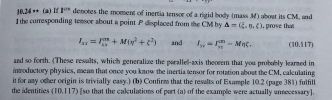 10.24 ** (a) If Icm denotes the moment of inertia tensor of a rigid body (mass M) about its CM, and I the corresponding tensor about a point P displaced from the C M by Δ (ξ, η, ζ), prove that and 1ImMnt, (10.117) yz and so forth. (These results, which generalize the parallel-axis theorem that you probably learned in introductory physics, mean that once you know the inertia tensor for rotation about the CM, calculating it for any other...
6. Calculate the moment of inertia of a baseball bat about the handle (in kgm) given...
 6. Calculate the moment of inertia of a baseball bat about the handle (in kgm) given that the mass is 5kg and radius of gyration is 20 cm.
1) The parallel axis theorem provides a useful way to calculate the moment of inertia I...
1) The parallel axis theorem provides a useful way to calculate the moment of inertia I about an arbitrary axis. The theorem states that I = Icm + Mh2, where Icm is the moment of inertia of the object relative to an axis that passes through the center of mass and is parallel to the axis of interest, M is the total mass of the object, and h is the perpendicular distance between the two axes. Use this theorem and...
 Definitions and Equations: Moment of Inertia (D): Tendency to resist angular acceleration; the angular equivalent of mass. In practical terms it is a measure of how hard it is to rotate an object or segment, like a baseball bat or a body segment. It is the sum of the products of the mass (m) with the square of its distance from the axis of rotation (ka). SEE FINAL TWO PAGES OF THIS LAB EOR CHARTS NEEDED TO CALCULATE L. 1...
 2. Determine the area moment of inertia about the x and y axes. Use the parallel axis theorem. Show all work, including drawings to receive credit.
 10.24 ** (a) If Icm denotes the moment of inertia tensor of a rigid body (mass M) about its CM, and I the corresponding tensor about a point P displaced from the C M by Δ (ξ, η, ζ), prove that and 1ImMnt, (10.117) yz and so forth. (These results, which generalize the parallel-axis theorem that you probably learned in introductory physics, mean that once you know the inertia tensor for rotation about the CM, calculating it for any other...
 6. Calculate the moment of inertia of a baseball bat about the handle (in kgm) given that the mass is 5kg and radius of gyration is 20 cm.
Most questions answered within 3 hours.
-
Where is the error in this code sequence?
String s1 = "Hello";
String s2 = "ello";...
asked 11 months ago -
Financial data for Joel de Paris, Inc., for last year
follow:
Joel de Paris, Inc.
Balance...
asked 11 months ago -
Consider this reaction:
Al2(SO4)3 (aq)+ BaCl3
(aq) Al2Cl6 (aq)- +
3BaSO4(s) . What is the...
asked 11 months ago -
Suppose that Savneet is considering increasing her
recent random sample from 20 car rentals to 40...
asked 11 months ago -
Trucks arrive at an unloading terminal at an average rate of 120
per hour.
Trucks arrive...
asked 11 months ago -
Why are methanol and ethanol completely soluble in water while
octanol is not very little soluble....
asked 11 months ago -
A facilities manager at a university reads in a research report
that the mean amount of...
asked 11 months ago -
When the CuSO4 is rehydrated by adding water to the anhydrous
compound, is this an endothermic...
asked 11 months ago -
A ray of sunlight is passing from diamond into crown glass; the
angle of incidence is...
asked 11 months ago -
A block of mass 0.249 kg is placed on top of a light, vertical
spring of...
asked 11 months ago -
how do the kidneys compensate in the presences of acidosis
a) trigger hyperventilate
b) reserve acid...
asked 11 months ago -
Question 501 pts
The rental rate of capital to the firm increases. Which of the
following...
asked 11 months ago