
Homework Answers
1)it is derived using fermat principle.
assume the refractive index of medium 1 and medium 2 are [n1] and [n2] respectively. Light enters medium 2 from medium 1 via point O.
[theta1] is the angle of incidence, [theta2] is the angle of refraction.
The traveling velocities of light in medium 1 and medium 2 are
[v1=c/n1] and
[v2=c/n2] respectively.
[c] is the speed of light in vacuum.
Let T be the time required for the light to travel from point Q to point P.
[T=\frac{\sqrt{x^2 + a^2}}{v1} + \frac{\sqrt{b^2 + (l - x)^2}}{v2}]
[\frac{dT}{dx}=\frac{x}{v1\sqrt{x^2 + a^2}} + \frac{ - (l - x)}{v2\sqrt{(l-x)^2 + b^2}}=0] (stationary point)
Note that [\frac{x}{\sqrt{x^2 + a^2}} =\sin theta1]
[\frac{ l - x}{\sqrt{(l-x)^2 + b^2}}=sin theta2]
[frac{dT}{dx}=frac{sin theta1}{v1} - frac{sin theta2}{v2}=0]
[{n1*sin theta1}*{c}={n2*sin theta2}*{c}]
[n1*sin theta1=n2*sin theta2]
2)sin thetha1/sin thetha2= n2/n1=c*v1/c*v2=v1/v2
3) v2=v1/2
when thetha1=10°
Sin10/sin thetha2= v1/(v1/2)
a)Sin thetha2=2/sin10=11.51
b)sin thetha2=2/sin20=5.85
c)sin thetha2=2/sin40=3.11
d)sin thetha2=2/sin 80=2.03
Add Answer to:
ATION AND REFRACTION OF PERIODIC WAVES he c as it ropagates from a mediunm maller wave...
8. A ripple tank wave passes from a shallow to a deep section with an incident...
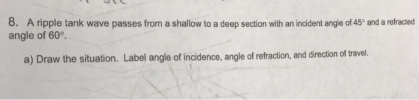 8. A ripple tank wave passes from a shallow to a deep section with an incident angle of 45° and a refracted angle of 60° a) Draw the situation. Label angle of incidence, angle of refraction, and direction of travel.
mainly just looking for clarification of part c) a= cos theta t / cos theta i , b=sin theta i/ sin theta t 5. A plane electrom netic wave is obliquely incident upon an infinite plane boundary two die...
 mainly just looking for clarification of part c)
a= cos theta t / cos theta i , b=sin theta i/ sin theta t
5. A plane electrom netic wave is obliquely incident upon an infinite plane boundary two dielectrics with refractive indices, permittivities and permeabilities m. ει, μι and respectively. In terms of the angles of incidence, O, and refraction, e, define n2-E2, μ2 sin θ sin6, (a) State succinctly what assumptions have been made about the materials to write...
mainly just looking for clarification of part c)
a= cos theta t / cos theta i , b=sin theta i/ sin theta t
5. A plane electrom netic wave is obliquely incident upon an infinite plane boundary two dielectrics with refractive indices, permittivities and permeabilities m. ει, μι and respectively. In terms of the angles of incidence, O, and refraction, e, define n2-E2, μ2 sin θ sin6, (a) State succinctly what assumptions have been made about the materials to write...
Can you please answer all questions completely. Refraction, Wave speed and Snell's Law i. A pond...
 Can you please answer all questions
completely.
Refraction, Wave speed and Snell's Law i. A pond with a total depth (water ice) of 3.00 m is covered by a transparent layer of ice 0.32 m thick. Find the time required for light to travel vertically from the top ofthe ice to the bottom of the pond. ice- o 32,n Wate 3-0.32 2.68 m 2. A beam of light is incident on the interface between glass (nr 32) and water (nr...
Can you please answer all questions
completely.
Refraction, Wave speed and Snell's Law i. A pond with a total depth (water ice) of 3.00 m is covered by a transparent layer of ice 0.32 m thick. Find the time required for light to travel vertically from the top ofthe ice to the bottom of the pond. ice- o 32,n Wate 3-0.32 2.68 m 2. A beam of light is incident on the interface between glass (nr 32) and water (nr...
Please answer all parts of the question (a,b,c,d,e) Consider the case of oblique incidence of electromagnetic plane waves going from medium 1 to a. Draw a diagram showing the wavevectors and the direc...
 Please answer all parts of the
question (a,b,c,d,e)
Consider the case of oblique incidence of electromagnetic plane waves going from medium 1 to a. Draw a diagram showing the wavevectors and the directions of the electric and magnetic b. Using the appropriate boundary conditions, obtain the Fresnel equations for the reflected 1. medium 2 with the polarization perpendicular to the plane of incidence. fields of the incident, reflected, and transmitted waves for an angle of incidence θ| and transmitted complex...
Please answer all parts of the
question (a,b,c,d,e)
Consider the case of oblique incidence of electromagnetic plane waves going from medium 1 to a. Draw a diagram showing the wavevectors and the directions of the electric and magnetic b. Using the appropriate boundary conditions, obtain the Fresnel equations for the reflected 1. medium 2 with the polarization perpendicular to the plane of incidence. fields of the incident, reflected, and transmitted waves for an angle of incidence θ| and transmitted complex...
Partner: Date Name 11 Snell's Law Introduction When light passes from one material to another it ...
 Partner: Date Name 11 Snell's Law Introduction When light passes from one material to another it is always bent away from its original path. This process is known as refraction and the change in direction depends on the change in optical density (or refractive index) of the two materials. A larger change in refractive index results in a larger change in angle between incoming and outgoing light beams. A light beam bends closer to the normal in the material with...
 8. A ripple tank wave passes from a shallow to a deep section with an incident angle of 45° and a refracted angle of 60° a) Draw the situation. Label angle of incidence, angle of refraction, and direction of travel.
 mainly just looking for clarification of part c)
a= cos theta t / cos theta i , b=sin theta i/ sin theta t
5. A plane electrom netic wave is obliquely incident upon an infinite plane boundary two dielectrics with refractive indices, permittivities and permeabilities m. ει, μι and respectively. In terms of the angles of incidence, O, and refraction, e, define n2-E2, μ2 sin θ sin6, (a) State succinctly what assumptions have been made about the materials to write...
mainly just looking for clarification of part c)
a= cos theta t / cos theta i , b=sin theta i/ sin theta t
5. A plane electrom netic wave is obliquely incident upon an infinite plane boundary two dielectrics with refractive indices, permittivities and permeabilities m. ει, μι and respectively. In terms of the angles of incidence, O, and refraction, e, define n2-E2, μ2 sin θ sin6, (a) State succinctly what assumptions have been made about the materials to write...
 Can you please answer all questions
completely.
Refraction, Wave speed and Snell's Law i. A pond with a total depth (water ice) of 3.00 m is covered by a transparent layer of ice 0.32 m thick. Find the time required for light to travel vertically from the top ofthe ice to the bottom of the pond. ice- o 32,n Wate 3-0.32 2.68 m 2. A beam of light is incident on the interface between glass (nr 32) and water (nr...
Can you please answer all questions
completely.
Refraction, Wave speed and Snell's Law i. A pond with a total depth (water ice) of 3.00 m is covered by a transparent layer of ice 0.32 m thick. Find the time required for light to travel vertically from the top ofthe ice to the bottom of the pond. ice- o 32,n Wate 3-0.32 2.68 m 2. A beam of light is incident on the interface between glass (nr 32) and water (nr...
 Please answer all parts of the
question (a,b,c,d,e)
Consider the case of oblique incidence of electromagnetic plane waves going from medium 1 to a. Draw a diagram showing the wavevectors and the directions of the electric and magnetic b. Using the appropriate boundary conditions, obtain the Fresnel equations for the reflected 1. medium 2 with the polarization perpendicular to the plane of incidence. fields of the incident, reflected, and transmitted waves for an angle of incidence θ| and transmitted complex...
Please answer all parts of the
question (a,b,c,d,e)
Consider the case of oblique incidence of electromagnetic plane waves going from medium 1 to a. Draw a diagram showing the wavevectors and the directions of the electric and magnetic b. Using the appropriate boundary conditions, obtain the Fresnel equations for the reflected 1. medium 2 with the polarization perpendicular to the plane of incidence. fields of the incident, reflected, and transmitted waves for an angle of incidence θ| and transmitted complex...
 Partner: Date Name 11 Snell's Law Introduction When light passes from one material to another it is always bent away from its original path. This process is known as refraction and the change in direction depends on the change in optical density (or refractive index) of the two materials. A larger change in refractive index results in a larger change in angle between incoming and outgoing light beams. A light beam bends closer to the normal in the material with...
Most questions answered within 3 hours.
-
Where is the error in this code sequence?
String s1 = "Hello";
String s2 = "ello";...
asked 11 months ago -
Financial data for Joel de Paris, Inc., for last year
follow:
Joel de Paris, Inc.
Balance...
asked 11 months ago -
Consider this reaction:
Al2(SO4)3 (aq)+ BaCl3
(aq) Al2Cl6 (aq)- +
3BaSO4(s) . What is the...
asked 11 months ago -
Suppose that Savneet is considering increasing her
recent random sample from 20 car rentals to 40...
asked 11 months ago -
Trucks arrive at an unloading terminal at an average rate of 120
per hour.
Trucks arrive...
asked 11 months ago -
Why are methanol and ethanol completely soluble in water while
octanol is not very little soluble....
asked 11 months ago -
A facilities manager at a university reads in a research report
that the mean amount of...
asked 11 months ago -
When the CuSO4 is rehydrated by adding water to the anhydrous
compound, is this an endothermic...
asked 11 months ago -
A ray of sunlight is passing from diamond into crown glass; the
angle of incidence is...
asked 11 months ago -
A block of mass 0.249 kg is placed on top of a light, vertical
spring of...
asked 11 months ago -
how do the kidneys compensate in the presences of acidosis
a) trigger hyperventilate
b) reserve acid...
asked 11 months ago -
Question 501 pts
The rental rate of capital to the firm increases. Which of the
following...
asked 11 months ago