
Homework Answers
Add Answer to:
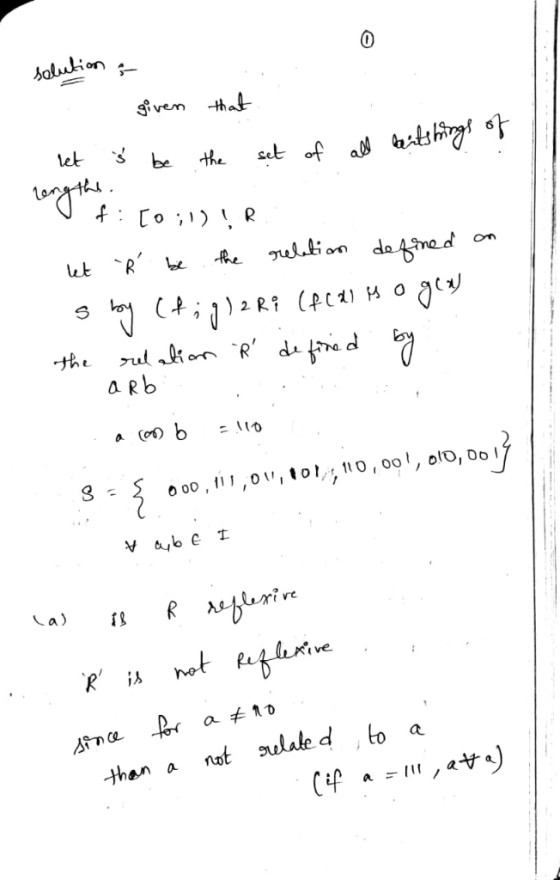
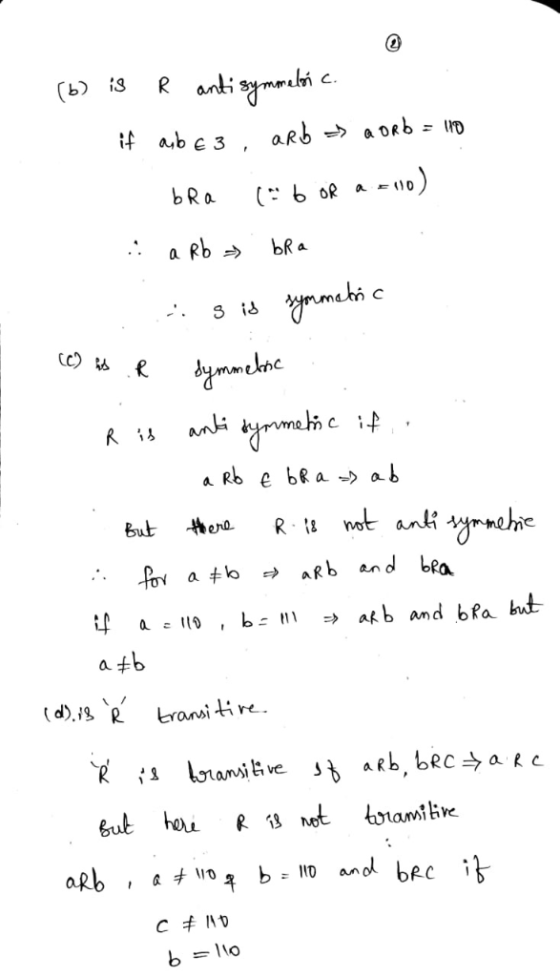
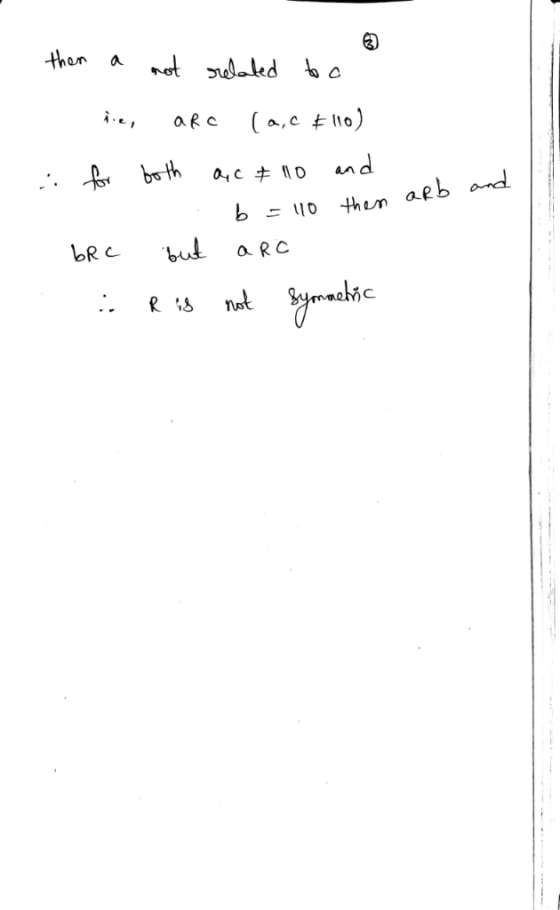
4. Let S be the set of continuous function f: [0;1) ! R. Let R be...
(17) (20pt) Let F be the set of functions f : R+ → R. Prove that the binary relation "f is 0(g)" on F is: (a) (4pt) Write down the definition for "f is O(g)". (b) (4pt) Prove that the...
 (17) (20pt) Let F be the set of functions f : R+ → R. Prove that the binary relation "f is 0(g)" on F is: (a) (4pt) Write down the definition for "f is O(g)". (b) (4pt) Prove that the relation is reflexive (c) (6pt) Prove that the relation is not symmetric. (d) (6pt) Prove that the relation is transitive.
(17) (20pt) Let F be the set of functions f : R+ → R. Prove that the binary relation "f...
(17) (20pt) Let F be the set of functions f : R+ → R. Prove that the binary relation "f is 0(g)" on F is: (a) (4pt) Write down the definition for "f is O(g)". (b) (4pt) Prove that the relation is reflexive (c) (6pt) Prove that the relation is not symmetric. (d) (6pt) Prove that the relation is transitive.
(17) (20pt) Let F be the set of functions f : R+ → R. Prove that the binary relation "f...
QI. Let A-(-4-3-2-1,0,1,2,3,4]. R İs defined on A as follows: For all (m, n) E A,...
 QI. Let A-(-4-3-2-1,0,1,2,3,4]. R İs defined on A as follows: For all (m, n) E A, mRn㈠4](rn2_n2) Show that the relation R is an equivalence relation on the set A by drawing the graph of relation Find the distinct equivalence classes of R. Q2. Find examples of relations with the following properties a) Reflexive, but not symmetric and not transitive. b) Symmetric, but not reflexive and not transitive. c) Transitive, but not reflexive and not symmetric. d) Reflexive and symmetric,...
Let R be the relation defined on Z (integers): a R b iff a + b...
Let R be the relation defined on Z (integers): a R b iff a + b is even. R is an equivalence relation since R is: Group of answer choices Reflexive, Symmetric and Transitive Symmetric and Reflexive or Transitive Reflexive or Transitive Symmetric and Transitive None of the above
Q4 Let F denote a countably infinite set of functions such that each f; e F...
 Q4 Let F denote a countably infinite set of functions such that each f; e F is a function from Z+ to R+, and let R be a homogeneous binary relation on F where R = {(fa, fb) | fa(n) € (fo(n))}. Prove that R is a reflexive relation. In your proof, you may not use a Big-12, Big-0, or Big- property to directly justify a relational property with the same name; instead, utilize the definition of Big-12, Big-O, and...
Let R be the relation defined on Z (integers): a R b iff a + b...
Let R be the relation defined on Z (integers): a R b iff a + b is even. Suppose that 'even' is replaced by 'odd' . Which of the properties reflexive, symmetric and transitive does R possess? Group of answer choices Reflexive, Symmetric and Transitive Symmetric Symmetric and Reflexive Symmetric and Transitive None of the above
10. Represent the following relation R on the set (. t,s t) as a digraph and...
 10. Represent the following relation R on the set (. t,s t) as a digraph and as a acro-ooe ati eachi b) Circle the properties of R antisymmetric itive 2 peins) reflexive symmetric 떼 1 find the symmetric and transitive closures ofS (4 pirtepi 1 c)If Ms-10 Transitive Closure Symmetric Closure_-
Let X, be the set {x € Z|3 SXS 9} and relation M on Xz defined...
 Let X, be the set {x € Z|3 SXS 9} and relation M on Xz defined by: xMy – 31(x - y). (Note: Unless you are explaining “Why not,” explanations are not required.) a. Draw the directed graph of M. b. Is M reflexive? If not, why not? C. Is M symmetric? If not, why not? d. Is M antisymmetric? If not, why not? e. Is M transitive? If not, why not? f. Is M an equivalence relation, partial order...
1) Let R be the relation defined on N N as follows: (m, n)R(p, q) if...
 1) Let R be the relation defined on N N as follows: (m, n)R(p, q) if and only if m - pis divisible by 3 and n - q is divisible by 5. For example, (2, 19)R(8,4). 1. Identify two elements of N X N which are related under R to (6, 45). II. Is R reflexive? Justify your answer. III. Is R symmetric? Justify your answer. IV. Is R transitive? Justify your answer. V.Is R an equivalence relation? Justify...
Determine whether the relation R on the set of all real numbers is reflexive, symmetric,...
Determine whether the relation R on the set of all real numbers is reflexive, symmetric, antisymmetric, and/or transitive, where (x, y) ∈ R if and only if a) x + y = 0 b) x= ±y. c) x-y is a rational number. d) = 2y. e) xy ≥ 0. f) xy = 0. g) x=l. h) r=1 or y = 1
Question 2 For each of the following relations R, determine (and explain) whether R is: (1) reflexive (2) symmetric (3) antisymmetric (4) transitive (a) R-(x, y):x +2y 3), defined on the set A 10...
 Question 2 For each of the following relations R, determine (and explain) whether R is: (1) reflexive (2) symmetric (3) antisymmetric (4) transitive (a) R-(x, y):x +2y 3), defined on the set A 10, 1,2,3) (b) R-I(x, y): xy 4), defined on the set A (0,1,2,3,4 (c) R-(x, y): xy 4), defined on the set A-0,,2,3)
Question 2 For each of the following relations R, determine (and explain) whether R is: (1) reflexive (2) symmetric (3) antisymmetric (4) transitive (a)...
Question 2 For each of the following relations R, determine (and explain) whether R is: (1) reflexive (2) symmetric (3) antisymmetric (4) transitive (a) R-(x, y):x +2y 3), defined on the set A 10, 1,2,3) (b) R-I(x, y): xy 4), defined on the set A (0,1,2,3,4 (c) R-(x, y): xy 4), defined on the set A-0,,2,3)
Question 2 For each of the following relations R, determine (and explain) whether R is: (1) reflexive (2) symmetric (3) antisymmetric (4) transitive (a)...
 (17) (20pt) Let F be the set of functions f : R+ → R. Prove that the binary relation "f is 0(g)" on F is: (a) (4pt) Write down the definition for "f is O(g)". (b) (4pt) Prove that the relation is reflexive (c) (6pt) Prove that the relation is not symmetric. (d) (6pt) Prove that the relation is transitive.
(17) (20pt) Let F be the set of functions f : R+ → R. Prove that the binary relation "f...
(17) (20pt) Let F be the set of functions f : R+ → R. Prove that the binary relation "f is 0(g)" on F is: (a) (4pt) Write down the definition for "f is O(g)". (b) (4pt) Prove that the relation is reflexive (c) (6pt) Prove that the relation is not symmetric. (d) (6pt) Prove that the relation is transitive.
(17) (20pt) Let F be the set of functions f : R+ → R. Prove that the binary relation "f...
 QI. Let A-(-4-3-2-1,0,1,2,3,4]. R İs defined on A as follows: For all (m, n) E A, mRn㈠4](rn2_n2) Show that the relation R is an equivalence relation on the set A by drawing the graph of relation Find the distinct equivalence classes of R. Q2. Find examples of relations with the following properties a) Reflexive, but not symmetric and not transitive. b) Symmetric, but not reflexive and not transitive. c) Transitive, but not reflexive and not symmetric. d) Reflexive and symmetric,...
 Q4 Let F denote a countably infinite set of functions such that each f; e F is a function from Z+ to R+, and let R be a homogeneous binary relation on F where R = {(fa, fb) | fa(n) € (fo(n))}. Prove that R is a reflexive relation. In your proof, you may not use a Big-12, Big-0, or Big- property to directly justify a relational property with the same name; instead, utilize the definition of Big-12, Big-O, and...
 10. Represent the following relation R on the set (. t,s t) as a digraph and as a acro-ooe ati eachi b) Circle the properties of R antisymmetric itive 2 peins) reflexive symmetric 떼 1 find the symmetric and transitive closures ofS (4 pirtepi 1 c)If Ms-10 Transitive Closure Symmetric Closure_-
 Let X, be the set {x € Z|3 SXS 9} and relation M on Xz defined by: xMy – 31(x - y). (Note: Unless you are explaining “Why not,” explanations are not required.) a. Draw the directed graph of M. b. Is M reflexive? If not, why not? C. Is M symmetric? If not, why not? d. Is M antisymmetric? If not, why not? e. Is M transitive? If not, why not? f. Is M an equivalence relation, partial order...
 1) Let R be the relation defined on N N as follows: (m, n)R(p, q) if and only if m - pis divisible by 3 and n - q is divisible by 5. For example, (2, 19)R(8,4). 1. Identify two elements of N X N which are related under R to (6, 45). II. Is R reflexive? Justify your answer. III. Is R symmetric? Justify your answer. IV. Is R transitive? Justify your answer. V.Is R an equivalence relation? Justify...
 Question 2 For each of the following relations R, determine (and explain) whether R is: (1) reflexive (2) symmetric (3) antisymmetric (4) transitive (a) R-(x, y):x +2y 3), defined on the set A 10, 1,2,3) (b) R-I(x, y): xy 4), defined on the set A (0,1,2,3,4 (c) R-(x, y): xy 4), defined on the set A-0,,2,3)
Question 2 For each of the following relations R, determine (and explain) whether R is: (1) reflexive (2) symmetric (3) antisymmetric (4) transitive (a)...
Question 2 For each of the following relations R, determine (and explain) whether R is: (1) reflexive (2) symmetric (3) antisymmetric (4) transitive (a) R-(x, y):x +2y 3), defined on the set A 10, 1,2,3) (b) R-I(x, y): xy 4), defined on the set A (0,1,2,3,4 (c) R-(x, y): xy 4), defined on the set A-0,,2,3)
Question 2 For each of the following relations R, determine (and explain) whether R is: (1) reflexive (2) symmetric (3) antisymmetric (4) transitive (a)...
Most questions answered within 3 hours.
-
Where is the error in this code sequence?
String s1 = "Hello";
String s2 = "ello";...
asked 10 months ago -
Financial data for Joel de Paris, Inc., for last year
follow:
Joel de Paris, Inc.
Balance...
asked 10 months ago -
Consider this reaction:
Al2(SO4)3 (aq)+ BaCl3
(aq) Al2Cl6 (aq)- +
3BaSO4(s) . What is the...
asked 10 months ago -
Suppose that Savneet is considering increasing her
recent random sample from 20 car rentals to 40...
asked 10 months ago -
Trucks arrive at an unloading terminal at an average rate of 120
per hour.
Trucks arrive...
asked 10 months ago -
Why are methanol and ethanol completely soluble in water while
octanol is not very little soluble....
asked 10 months ago -
A facilities manager at a university reads in a research report
that the mean amount of...
asked 10 months ago -
When the CuSO4 is rehydrated by adding water to the anhydrous
compound, is this an endothermic...
asked 10 months ago -
A ray of sunlight is passing from diamond into crown glass; the
angle of incidence is...
asked 10 months ago -
A block of mass 0.249 kg is placed on top of a light, vertical
spring of...
asked 10 months ago -
how do the kidneys compensate in the presences of acidosis
a) trigger hyperventilate
b) reserve acid...
asked 10 months ago -
Question 501 pts
The rental rate of capital to the firm increases. Which of the
following...
asked 10 months ago