
Homework Answers

Add Answer to:
List 5 possible ways that the rate of the following reaction could be measured: Paragraph Path:...
1) Read the following case study 2) List two possible pathologies that could be causing the...
 1) Read the following case study 2) List two possible pathologies that could be causing the patients signs and symptoms (this is called a differential diagnosis list) 3) Explain what test or tests should be preformed on the patient in order to determine which pathology is the proper diagnosis 4) Pick one of the possible pathologies that you listed and describe what the treatment and prognosis would be Case Study -Week 7 A 57 year old male presents with a...
Coal gas is being produced at a gasworks and there are pollutants in the gas which are removed by scrubbers which become less efficient as time goes by. The pollutant rate is measured in tons per mon...
 Coal gas is being produced at a gasworks and there are pollutants in the gas which are removed by scrubbers which become less efficient as time goes by. The pollutant rate is measured in tons per month at the start of every other month for a year and is given in the table below. Since the scrubbers are becoming less efficient we can assume that the pollutant rate is always increasing onth ate 4 10 12 3.7 4.9 Estimate the...
A) Give THREE ways you could convert a ketone to a secondary alcohol. List all necessary...
 A)
Give THREE ways you could convert a ketone to a secondary alcohol.
List all necessary reagents.
B) Give one way you could produce 4-methyl-1-pentanol by
reduction of a carboxylic acid. Give all necessary reagents.
C) What is the structure of the product formed when 1-hexanol
is reacted with PCC in dichloromethane?
D) What is the structure of the product formed when 1-butanol
is reacted with acetic acid (CH3COOH) in the presence of HCl?
E) Give the name of the...
A)
Give THREE ways you could convert a ketone to a secondary alcohol.
List all necessary reagents.
B) Give one way you could produce 4-methyl-1-pentanol by
reduction of a carboxylic acid. Give all necessary reagents.
C) What is the structure of the product formed when 1-hexanol
is reacted with PCC in dichloromethane?
D) What is the structure of the product formed when 1-butanol
is reacted with acetic acid (CH3COOH) in the presence of HCl?
E) Give the name of the...
For the reaction A+B+C→D+E, the initial reaction rate was measured for various initial concentrations of reactants....
For the reaction A+B+C→D+E, the initial reaction rate was measured for various initial concentrations of reactants. The following data were collected: Trial [A] (M) [B] (M) [C] (M) Initial rate (M/s) 1 0.30 0.30 0.30 9.0×10⁻⁵ 2 0.30 0.30 0.90 2.7×10⁻⁴ 3 0.60 0.30 0.30 3.6×10⁻⁴ 4 0.60 0.60 0.30 3.6×10⁻⁴ What is the value of the rate constant k for this reaction?
Need help with questions 1-5 D Determine whether each redox reaction occurs spontane- ously in the...
 Need help with questions 1-5
D Determine whether each redox reaction occurs spontane- ously in the forward direction. (a) Ca2+(aq) + Zn(s)-Ca(s) + Zr"(al) (b) 2 Ag+(aq) + Ni(s)--2 Ag(s) + N产(aq) (c) Fe(s) +Mn2 (aą)- Fe (aą)Mn(s) (d) 2 Al(s) + 3 Pb2+(aq) → 2 AP"(aq) + 3 Pb(s) Suppose you wanted to cause Pb ions to come out of solu- tion as solid Pb. What metal could you use to accomplish this? Make a sketch of an electrochemical...
Need help with questions 1-5
D Determine whether each redox reaction occurs spontane- ously in the forward direction. (a) Ca2+(aq) + Zn(s)-Ca(s) + Zr"(al) (b) 2 Ag+(aq) + Ni(s)--2 Ag(s) + N产(aq) (c) Fe(s) +Mn2 (aą)- Fe (aą)Mn(s) (d) 2 Al(s) + 3 Pb2+(aq) → 2 AP"(aq) + 3 Pb(s) Suppose you wanted to cause Pb ions to come out of solu- tion as solid Pb. What metal could you use to accomplish this? Make a sketch of an electrochemical...
All the following are true about reaction rates except: 1. A reaction rate can be measured...
All the following are true about reaction rates except: 1. A reaction rate can be measured by change in concentration and time. 2. Reaction rates can be estimated with the coefficients of the balanced reaction. 3. Reaction rates change with temperature. 4. Reaction rates change with the presence of a catalyst.
For the reaction A+B+C→D+E, the initial reaction rate was measured for various initial concentrations of reactants....
For the reaction A+B+C→D+E, the initial reaction rate was measured for various initial concentrations of reactants. What is the reaction order with respect to B? Also, how do you find the value of the rate constant k for this reaction? Trial [A] (M) [B] (M) [C] (M) Initial rate (M/s) 1 0.30 0.30 0.30 9.0×10⁻⁵ 2 0.30 0.30 0.90 2.7×10⁻⁴ 3 0.60 0.30 0.30 3.6×10⁻⁴ 4 0.60 0.60 0.30 3.6×10⁻⁴
வேயோடு 5 For the reaction Ag+28% - 200+ 206 me following data were collected at constant...
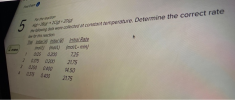 வேயோடு 5 For the reaction Ag+28% - 200+ 206 me following data were collected at constant temperature. Determine the correct rate low this reaction The A Initial Initial Rate moll) (moll) (moll. min) 0.125 0.200 0.375 0.200 3 0.250 0.400 ܝܠ 7.25 21.75 14.50 21.75 4 0.375 0.400
For the reaction A+B+C→D+E the initial reaction rate was measured for various initial concentrations of reactants....
For the reaction A+B+C→D+E the initial reaction rate was measured for various initial concentrations of reactants. The following data were collected: Trial [A] (M) [B] (M) [C] (M) Initial rate (M/s) 1 0.50 0.50 0.50 1.5×10⁻⁴ 2 0.50 0.50 1.50 4.5×10⁻⁴ 3 1.00 0.50 0.50 6.0×10⁻⁴ 4 1.00 1.00 0.50 6.0×10⁻⁴ What is the value of the rate constant k for this reaction?
Which of the following could represent the rate law for an SN1 reaction? a) Rate =...
Which of the following could represent the rate law for an SN1 reaction? a) Rate = k[A] b) Rate = k[A]2 c) Rate = k[A][B] d) Rate = k[A][B]2 e) Rate = k[A]2 [B]2 Please explain which is the correct answer and why? Thanks
 1) Read the following case study 2) List two possible pathologies that could be causing the patients signs and symptoms (this is called a differential diagnosis list) 3) Explain what test or tests should be preformed on the patient in order to determine which pathology is the proper diagnosis 4) Pick one of the possible pathologies that you listed and describe what the treatment and prognosis would be Case Study -Week 7 A 57 year old male presents with a...
 Coal gas is being produced at a gasworks and there are pollutants in the gas which are removed by scrubbers which become less efficient as time goes by. The pollutant rate is measured in tons per month at the start of every other month for a year and is given in the table below. Since the scrubbers are becoming less efficient we can assume that the pollutant rate is always increasing onth ate 4 10 12 3.7 4.9 Estimate the...
 A)
Give THREE ways you could convert a ketone to a secondary alcohol.
List all necessary reagents.
B) Give one way you could produce 4-methyl-1-pentanol by
reduction of a carboxylic acid. Give all necessary reagents.
C) What is the structure of the product formed when 1-hexanol
is reacted with PCC in dichloromethane?
D) What is the structure of the product formed when 1-butanol
is reacted with acetic acid (CH3COOH) in the presence of HCl?
E) Give the name of the...
A)
Give THREE ways you could convert a ketone to a secondary alcohol.
List all necessary reagents.
B) Give one way you could produce 4-methyl-1-pentanol by
reduction of a carboxylic acid. Give all necessary reagents.
C) What is the structure of the product formed when 1-hexanol
is reacted with PCC in dichloromethane?
D) What is the structure of the product formed when 1-butanol
is reacted with acetic acid (CH3COOH) in the presence of HCl?
E) Give the name of the...
 Need help with questions 1-5
D Determine whether each redox reaction occurs spontane- ously in the forward direction. (a) Ca2+(aq) + Zn(s)-Ca(s) + Zr"(al) (b) 2 Ag+(aq) + Ni(s)--2 Ag(s) + N产(aq) (c) Fe(s) +Mn2 (aą)- Fe (aą)Mn(s) (d) 2 Al(s) + 3 Pb2+(aq) → 2 AP"(aq) + 3 Pb(s) Suppose you wanted to cause Pb ions to come out of solu- tion as solid Pb. What metal could you use to accomplish this? Make a sketch of an electrochemical...
Need help with questions 1-5
D Determine whether each redox reaction occurs spontane- ously in the forward direction. (a) Ca2+(aq) + Zn(s)-Ca(s) + Zr"(al) (b) 2 Ag+(aq) + Ni(s)--2 Ag(s) + N产(aq) (c) Fe(s) +Mn2 (aą)- Fe (aą)Mn(s) (d) 2 Al(s) + 3 Pb2+(aq) → 2 AP"(aq) + 3 Pb(s) Suppose you wanted to cause Pb ions to come out of solu- tion as solid Pb. What metal could you use to accomplish this? Make a sketch of an electrochemical...
 வேயோடு 5 For the reaction Ag+28% - 200+ 206 me following data were collected at constant temperature. Determine the correct rate low this reaction The A Initial Initial Rate moll) (moll) (moll. min) 0.125 0.200 0.375 0.200 3 0.250 0.400 ܝܠ 7.25 21.75 14.50 21.75 4 0.375 0.400
Most questions answered within 3 hours.
-
Where is the error in this code sequence?
String s1 = "Hello";
String s2 = "ello";...
asked 11 months ago -
Financial data for Joel de Paris, Inc., for last year
follow:
Joel de Paris, Inc.
Balance...
asked 11 months ago -
Consider this reaction:
Al2(SO4)3 (aq)+ BaCl3
(aq) Al2Cl6 (aq)- +
3BaSO4(s) . What is the...
asked 11 months ago -
Suppose that Savneet is considering increasing her
recent random sample from 20 car rentals to 40...
asked 11 months ago -
Trucks arrive at an unloading terminal at an average rate of 120
per hour.
Trucks arrive...
asked 11 months ago -
Why are methanol and ethanol completely soluble in water while
octanol is not very little soluble....
asked 11 months ago -
A facilities manager at a university reads in a research report
that the mean amount of...
asked 11 months ago -
When the CuSO4 is rehydrated by adding water to the anhydrous
compound, is this an endothermic...
asked 11 months ago -
A ray of sunlight is passing from diamond into crown glass; the
angle of incidence is...
asked 11 months ago -
A block of mass 0.249 kg is placed on top of a light, vertical
spring of...
asked 11 months ago -
how do the kidneys compensate in the presences of acidosis
a) trigger hyperventilate
b) reserve acid...
asked 11 months ago -
Question 501 pts
The rental rate of capital to the firm increases. Which of the
following...
asked 11 months ago