
Homework Answers

Add Answer to:
.. At room temperature (20°C) a 0.5-mm gap exists between the of the rods shown. At...
2- Knowing that a 0.5-mm gap exists between the rods shown below when the temperature is...
 2- Knowing that a 0.5-mm gap exists between the rods shown below when the temperature is 20 °C, determine: (a) The temperature at which the normal stress in the stainless steel rod will be o = -150 MPa, (b) The corresponding exact length of the stainless steel rod 0.5 mm 300 mm- - 250 mm A В Aluminum Stainless steel A = 2000 mm2 E = 70 GPa 23 x 10-/C A = 800 mm2 E = 190 GPa 18...
3.- At the ambient temperature of 20 ° C, there is a 1.5 mm gap between...
 3.- At the ambient temperature of 20 ° C, there is a 1.5 mm gap
between the ends of the rods shown below when the temperature
reaches 140 ° C. Find:
a) the normal stress on the aluminum rod,
b) changing length of aluminum rod.
Make the free body diagram and explain step by step
1.5 mm 325 mm 225 mm A B Aluminum A = 2000 mm E = 75 CPA a = 23 x 10-6/C Stainless steel Acero...
3.- At the ambient temperature of 20 ° C, there is a 1.5 mm gap
between the ends of the rods shown below when the temperature
reaches 140 ° C. Find:
a) the normal stress on the aluminum rod,
b) changing length of aluminum rod.
Make the free body diagram and explain step by step
1.5 mm 325 mm 225 mm A B Aluminum A = 2000 mm E = 75 CPA a = 23 x 10-6/C Stainless steel Acero...
0.7 mm 6 BL Problem 3 - Thermal Stress (25 pts) The center rod CD of...
 0.7 mm 6 BL Problem 3 - Thermal Stress (25 pts) The center rod CD of the assembly is heated from T, = 25°C to T2 = 200°C using electrical resistance heating. At the lower temperature T, the gap between C and the rigid bar is 0.7 mm. Determine the force in the rods AB and EF caused by the increase in temperature. Rods AB and EF are made of steel, and each has a cross-sectional area of 125 mm²....
The assembly consists of two red brass C83400 copper rods AB and CD of diameter 30 mm, a stainless 304 steel alloy rod EF of diameter 40 mm, and a rigid cap G. The supports at A, C and F are rigid.
 The assembly consists of two red brass C83400 copper rods ABAB and CDCD of diameter 30 mmmm, a stainless 304 steel alloy rod EFEF of diameter 40 mmmm, and a rigid cap GG. The supports at AA, CC and FF are rigid.Modul of elasticy for the copper is EcopperEcopper = 101 GPaGPa. Modul of elasticity for the steel is EsteelEsteel = 193 GPaGPa.(a) Determine the average normal stress developed in the rod ABAB.(b) Determine the average normal stress developed in the rod CDCD.
A gap of 0.02 in. exists between the composite rod and the wall when the temperature...
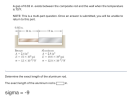 A gap of 0.02 in. exists between the composite rod and the wall when the temperature is 75°F. NOTE: This is a multi-part question. Once an answer is submitted, you will be unable to return to this part. 0.02 in. 14 in 18 in. - Bronze A - 2.4 in E = 15 X 10 psi a = 12 x 10-6/°F Aluminum A = 2.8 in? E= 10.6 X 10psi a = 12.9 x 10⁻⁶/°F Determine the exact length of...
M5.14 Coaxial bars with temperature change scenes AT-105°C 110 mm2 160 GPa 17.71א / 2600 mm...
 M5.14 Coaxial bars with temperature change scenes AT-105°C 110 mm2 160 GPa 17.71א / 2600 mm 450 mm (1) 40 GPa 1300 mm 1300 mm (2) 23.7x10 /oC (2) A (kN) F. P= 15 kN A rigid horizontal bar ABC is supported by three vertical rods (properties given). The system is stress free before the load is applied. After the load P is applied, the temperature of all three rods is raised by the indicated AT. Determine: the internal force...
Chapter 2, Reserve Problem 036 At a temperature of 54°F, a 0.12 in. gap exists between...
 Chapter 2, Reserve Problem 036 At a temperature of 54°F, a 0.12 in. gap exists between the ends of the two bars shown. Bar (1) is an aluminum alloy (a = 12.4 x 10⁻⁶/°F] and bar (2) is stainless steel [a = 8.3 x 10⁻⁶/F]. The supports at A and C are rigid. Determine the lowest temperature at which the two bars contact each other. Assume L1 = 45 in., L2 = 63 in. (1) Answer: Final temperature = the...
A steel rod whose diameter is equal to 15 mm is held between rigid walls with...
 A steel rod whose diameter is equal to 15 mm is held between
rigid walls with no initial stress, see 2(a). The steel properties are ? = 12 × 10?6/ oC
and E = 200 GPa.
(a) What is the temperature drop
?T (in degrees Celsius) at which the average shear stress in the
12-mm diameter bolt becomes 55 MPa.
(b) At the temperature that you defined in (a), what is the
normal stress in the rod?
(c) What are...
A steel rod whose diameter is equal to 15 mm is held between
rigid walls with no initial stress, see 2(a). The steel properties are ? = 12 × 10?6/ oC
and E = 200 GPa.
(a) What is the temperature drop
?T (in degrees Celsius) at which the average shear stress in the
12-mm diameter bolt becomes 55 MPa.
(b) At the temperature that you defined in (a), what is the
normal stress in the rod?
(c) What are...
The switch shown is designed to close as the temperature rises causing AB and CD to...
 The switch shown is designed to close as the temperature rises causing AB and CD to expand and making point E come in contact with point F. Arm AB is made of steel with a CTE of ast12x106 /oC, and arm CD is made of aluminum with a CTE of aal = 24x10-6 /°C, At 20 °C, arm BDE is vertical as shown. Determine the required gap, s, (at 20 °C) if the switch is to close at 110 C,...
Question 1 The stepped flat bar has a constant thickness of 8.0 mm. It carries three concentrated loads as shown...
 Question 1 The stepped flat bar has a constant thickness of 8.0 mm. It carries three concentrated loads as shown. Let P 200 N, L 180 mm, L, = 80 mm, and Ls 40 mm. Compute the maximum stress due to bending and state where it occurs. Note: The bar is braced against lateral bending and twisting. 100 mm 140 mm 1CX) mm 140 mm 2P Flat plate r3 mm t8 mm typical 12 m 24 mm-36 mm 48 mm...
 2- Knowing that a 0.5-mm gap exists between the rods shown below when the temperature is 20 °C, determine: (a) The temperature at which the normal stress in the stainless steel rod will be o = -150 MPa, (b) The corresponding exact length of the stainless steel rod 0.5 mm 300 mm- - 250 mm A В Aluminum Stainless steel A = 2000 mm2 E = 70 GPa 23 x 10-/C A = 800 mm2 E = 190 GPa 18...
 3.- At the ambient temperature of 20 ° C, there is a 1.5 mm gap
between the ends of the rods shown below when the temperature
reaches 140 ° C. Find:
a) the normal stress on the aluminum rod,
b) changing length of aluminum rod.
Make the free body diagram and explain step by step
1.5 mm 325 mm 225 mm A B Aluminum A = 2000 mm E = 75 CPA a = 23 x 10-6/C Stainless steel Acero...
3.- At the ambient temperature of 20 ° C, there is a 1.5 mm gap
between the ends of the rods shown below when the temperature
reaches 140 ° C. Find:
a) the normal stress on the aluminum rod,
b) changing length of aluminum rod.
Make the free body diagram and explain step by step
1.5 mm 325 mm 225 mm A B Aluminum A = 2000 mm E = 75 CPA a = 23 x 10-6/C Stainless steel Acero...
 0.7 mm 6 BL Problem 3 - Thermal Stress (25 pts) The center rod CD of the assembly is heated from T, = 25°C to T2 = 200°C using electrical resistance heating. At the lower temperature T, the gap between C and the rigid bar is 0.7 mm. Determine the force in the rods AB and EF caused by the increase in temperature. Rods AB and EF are made of steel, and each has a cross-sectional area of 125 mm²....
 A gap of 0.02 in. exists between the composite rod and the wall when the temperature is 75°F. NOTE: This is a multi-part question. Once an answer is submitted, you will be unable to return to this part. 0.02 in. 14 in 18 in. - Bronze A - 2.4 in E = 15 X 10 psi a = 12 x 10-6/°F Aluminum A = 2.8 in? E= 10.6 X 10psi a = 12.9 x 10⁻⁶/°F Determine the exact length of...
 M5.14 Coaxial bars with temperature change scenes AT-105°C 110 mm2 160 GPa 17.71א / 2600 mm 450 mm (1) 40 GPa 1300 mm 1300 mm (2) 23.7x10 /oC (2) A (kN) F. P= 15 kN A rigid horizontal bar ABC is supported by three vertical rods (properties given). The system is stress free before the load is applied. After the load P is applied, the temperature of all three rods is raised by the indicated AT. Determine: the internal force...
 Chapter 2, Reserve Problem 036 At a temperature of 54°F, a 0.12 in. gap exists between the ends of the two bars shown. Bar (1) is an aluminum alloy (a = 12.4 x 10⁻⁶/°F] and bar (2) is stainless steel [a = 8.3 x 10⁻⁶/F]. The supports at A and C are rigid. Determine the lowest temperature at which the two bars contact each other. Assume L1 = 45 in., L2 = 63 in. (1) Answer: Final temperature = the...
 A steel rod whose diameter is equal to 15 mm is held between
rigid walls with no initial stress, see 2(a). The steel properties are ? = 12 × 10?6/ oC
and E = 200 GPa.
(a) What is the temperature drop
?T (in degrees Celsius) at which the average shear stress in the
12-mm diameter bolt becomes 55 MPa.
(b) At the temperature that you defined in (a), what is the
normal stress in the rod?
(c) What are...
A steel rod whose diameter is equal to 15 mm is held between
rigid walls with no initial stress, see 2(a). The steel properties are ? = 12 × 10?6/ oC
and E = 200 GPa.
(a) What is the temperature drop
?T (in degrees Celsius) at which the average shear stress in the
12-mm diameter bolt becomes 55 MPa.
(b) At the temperature that you defined in (a), what is the
normal stress in the rod?
(c) What are...
 The switch shown is designed to close as the temperature rises causing AB and CD to expand and making point E come in contact with point F. Arm AB is made of steel with a CTE of ast12x106 /oC, and arm CD is made of aluminum with a CTE of aal = 24x10-6 /°C, At 20 °C, arm BDE is vertical as shown. Determine the required gap, s, (at 20 °C) if the switch is to close at 110 C,...
 Question 1 The stepped flat bar has a constant thickness of 8.0 mm. It carries three concentrated loads as shown. Let P 200 N, L 180 mm, L, = 80 mm, and Ls 40 mm. Compute the maximum stress due to bending and state where it occurs. Note: The bar is braced against lateral bending and twisting. 100 mm 140 mm 1CX) mm 140 mm 2P Flat plate r3 mm t8 mm typical 12 m 24 mm-36 mm 48 mm...
Most questions answered within 3 hours.
-
Where is the error in this code sequence?
String s1 = "Hello";
String s2 = "ello";...
asked 11 months ago -
Financial data for Joel de Paris, Inc., for last year
follow:
Joel de Paris, Inc.
Balance...
asked 11 months ago -
Consider this reaction:
Al2(SO4)3 (aq)+ BaCl3
(aq) Al2Cl6 (aq)- +
3BaSO4(s) . What is the...
asked 11 months ago -
Suppose that Savneet is considering increasing her
recent random sample from 20 car rentals to 40...
asked 11 months ago -
Trucks arrive at an unloading terminal at an average rate of 120
per hour.
Trucks arrive...
asked 11 months ago -
Why are methanol and ethanol completely soluble in water while
octanol is not very little soluble....
asked 11 months ago -
A facilities manager at a university reads in a research report
that the mean amount of...
asked 11 months ago -
When the CuSO4 is rehydrated by adding water to the anhydrous
compound, is this an endothermic...
asked 11 months ago -
A ray of sunlight is passing from diamond into crown glass; the
angle of incidence is...
asked 11 months ago -
A block of mass 0.249 kg is placed on top of a light, vertical
spring of...
asked 11 months ago -
how do the kidneys compensate in the presences of acidosis
a) trigger hyperventilate
b) reserve acid...
asked 11 months ago -
Question 501 pts
The rental rate of capital to the firm increases. Which of the
following...
asked 11 months ago