Consider an economy where the government specifes each worker's joband their hours of work. Suppose this...
Homework Answers
Implementation of caps on work hours and consumption and incomes lead to reduced employees productivity and efficiency based on income substitutions effects as employees put in efforts based on wages offered and thus driving down any potential for innovation to firms.
Moreover, curbs on rise in wages and consumption limits puts breaks on overall consumption functionality which reduces aggregate demand and thus economic growth declines considerably.
PLEASE UPVOTE INCASE YOU LIKED THE ANSWER WILL BE ENCOURAGING FOR US THANKYOU VERY MUCH ALL THE BEST IN FUTURE
Add Answer to:
Consider an economy where the government specifes each
worker's joband their hours of work. Suppose this...
1) Consider an economy having a Cobb Douglas production function, where the share of capital income...
 1) Consider an economy having a Cobb Douglas production
function, where the share of capital income in total income is 1/2.
The depreciation rate is
, population growth rate is n = 0.02
2) Assume a general savings rate
, depreciation rate
and a production per worker
, where 0< <1.
Suppose the savings rate increases. What happens to the golden rule
level of capital?
3) Consider an economy that is described by the production
function
. The depreciation rate...
1) Consider an economy having a Cobb Douglas production
function, where the share of capital income in total income is 1/2.
The depreciation rate is
, population growth rate is n = 0.02
2) Assume a general savings rate
, depreciation rate
and a production per worker
, where 0< <1.
Suppose the savings rate increases. What happens to the golden rule
level of capital?
3) Consider an economy that is described by the production
function
. The depreciation rate...
Suppose we introduce government purchases into the Solow Growth model. The production technology is given by...
 Suppose we introduce government purchases into the Solow Growth
model. The production technology
is given by
1. Suppose we introduce government purchases into the Solow Growth model. The production technology is given by Y = AK N- where A is some measure of total factor productivity, K, is the level of capital and N is the size of the labor force. Output is split between consumption, C, investment, I, and Government purchases, G. according to Y=C +I+G. Assume that government...
Suppose we introduce government purchases into the Solow Growth
model. The production technology
is given by
1. Suppose we introduce government purchases into the Solow Growth model. The production technology is given by Y = AK N- where A is some measure of total factor productivity, K, is the level of capital and N is the size of the labor force. Output is split between consumption, C, investment, I, and Government purchases, G. according to Y=C +I+G. Assume that government...
Here with the chp6 21 Question 5. (4 points each) Consider the Solow model in Chapter...
 Here with the chp6 21
Question 5. (4 points each) Consider the Solow model in Chapter 6. Production function is given by 1 1 YA = A_KŽ NĚ The notations of variables are the same as the slides for Ch.6. The depreciation rate d is 0.1, the population growth rate n is 0.1, and the saving rate s is 0.2. The level of productivity is constant, so At = 2 all the time. (5) What is the Growth Accounting equation...
Here with the chp6 21
Question 5. (4 points each) Consider the Solow model in Chapter 6. Production function is given by 1 1 YA = A_KŽ NĚ The notations of variables are the same as the slides for Ch.6. The depreciation rate d is 0.1, the population growth rate n is 0.1, and the saving rate s is 0.2. The level of productivity is constant, so At = 2 all the time. (5) What is the Growth Accounting equation...
Consider a hypothetical economy where there are no taxes and no international trade. Households spend $0.90...
Consider a hypothetical economy where there are no taxes and no international trade. Households spend $0.90 of each additional dollar they earn and save the remaining $0.10. If there are no taxes and no international trade, the oversimplified multiplier for this economy is. Suppose investment spending in this economy decreases by $150 billion. The decrease in investment will lead to a decrease in income, generating a decrease in consumption that decreases income yet again, and so on. Fill in the...
2. (a) Suppose that the government in country A cuts down a large part of the...
2. (a) Suppose that the government in country A cuts down a large part of the country’s forested area to make land available for productive purposes. Using the Specific Factors model, examine the implications of this “deforestation” on the economy’s resource allocation and relative prices. (Assume that the economy produces two goods: manufacturing and food, and owns three factors of production: land, which is specific to the food industry; capital, which is specific to the manufacturing industry; and labor, which...
16.8 Business Application: Valuing Land in Equilibrium Suppose we consider a Robinson Crusoe economy with one...
 16.8 Business Application: Valuing Land in Equilibrium Suppose we consider a Robinson Crusoe economy with one worker who has preferences over leisure and consumption and one firm that uses a constant returns to scale production process with inputs land and labor A. Suppose that the worker owns the fixed supply of land that is available for production. Throughout the problem, normalize the price of output to 1 Explain why we can normalize one of the three prices in this economy...
MALTHUS AND SOLOW GROWTH MODEL
Malthusian Model of Growth Notation: Yt Aggregate output; Nt Population size; L¯ Land (fixed); ct Per capita consumption Production: Aggregate production function is Yt = F(Nt , Lt) = zN2/3 t L 1/3 t Population Dynamics: Nt+1 = g(ct)Nt Population growth function: g(ct) = (3ct) 1/3 Parameter Values: Land: L¯ = 1000 for all t. Productivity parameter: z = 1 ...
Economic Growth I – Work It Out Question 2 Consider an economy described by the production...
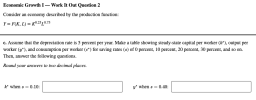 Economic Growth I – Work It Out Question 2 Consider an economy described by the production function: Y=F(K, L) = 0.25% 0.75 c. Assume that the depreciation rate is 5 percent per year. Make a table showing steady-state capital per worker (k*), output per worker (y), and consumption per worker (c*) for saving rates (8) of 0 percent, 10 percent, 20 percent, 30 percent, and so on. Then, answer the following questions. Round your answers to two decimal places. k*...
Section B (LONG QUESTIONS): Answer any THREE (3) of the following four ques tions. Each question...
 Section B (LONG QUESTIONS): Answer any THREE (3) of the following four ques tions. Each question is worth 25 marks for a total of 75 marks. B1. Solow (neoclassical) growth model: Consider the Solow (neoclassical) growth model seen in class where y denotes output per worker, k physical capital per worker, and A total factor productivity. Suppose that at any point in time the production function in per-worker terms is represented by where f(k) is increasing in k and there...
19. Consider a closed economy where the consumption function is C = 100+ 0.8(Y – T),...
 19. Consider a closed economy where the consumption function is C = 100+ 0.8(Y – T), where T represents lump sum taxes. Investment is fixed at 100, and government spending is also 100. a. Assuming that the budget is balanced, calculate the equilibrium income for this economy. b. Suppose the government is committed to a balanced budget, but it sees that the economy is overheating (growing too fast). It decides to lower both government spending and taxes by 50 each....
 1) Consider an economy having a Cobb Douglas production
function, where the share of capital income in total income is 1/2.
The depreciation rate is
, population growth rate is n = 0.02
2) Assume a general savings rate
, depreciation rate
and a production per worker
, where 0< <1.
Suppose the savings rate increases. What happens to the golden rule
level of capital?
3) Consider an economy that is described by the production
function
. The depreciation rate...
1) Consider an economy having a Cobb Douglas production
function, where the share of capital income in total income is 1/2.
The depreciation rate is
, population growth rate is n = 0.02
2) Assume a general savings rate
, depreciation rate
and a production per worker
, where 0< <1.
Suppose the savings rate increases. What happens to the golden rule
level of capital?
3) Consider an economy that is described by the production
function
. The depreciation rate...
 Suppose we introduce government purchases into the Solow Growth
model. The production technology
is given by
1. Suppose we introduce government purchases into the Solow Growth model. The production technology is given by Y = AK N- where A is some measure of total factor productivity, K, is the level of capital and N is the size of the labor force. Output is split between consumption, C, investment, I, and Government purchases, G. according to Y=C +I+G. Assume that government...
Suppose we introduce government purchases into the Solow Growth
model. The production technology
is given by
1. Suppose we introduce government purchases into the Solow Growth model. The production technology is given by Y = AK N- where A is some measure of total factor productivity, K, is the level of capital and N is the size of the labor force. Output is split between consumption, C, investment, I, and Government purchases, G. according to Y=C +I+G. Assume that government...
 Here with the chp6 21
Question 5. (4 points each) Consider the Solow model in Chapter 6. Production function is given by 1 1 YA = A_KŽ NĚ The notations of variables are the same as the slides for Ch.6. The depreciation rate d is 0.1, the population growth rate n is 0.1, and the saving rate s is 0.2. The level of productivity is constant, so At = 2 all the time. (5) What is the Growth Accounting equation...
Here with the chp6 21
Question 5. (4 points each) Consider the Solow model in Chapter 6. Production function is given by 1 1 YA = A_KŽ NĚ The notations of variables are the same as the slides for Ch.6. The depreciation rate d is 0.1, the population growth rate n is 0.1, and the saving rate s is 0.2. The level of productivity is constant, so At = 2 all the time. (5) What is the Growth Accounting equation...
 16.8 Business Application: Valuing Land in Equilibrium Suppose we consider a Robinson Crusoe economy with one worker who has preferences over leisure and consumption and one firm that uses a constant returns to scale production process with inputs land and labor A. Suppose that the worker owns the fixed supply of land that is available for production. Throughout the problem, normalize the price of output to 1 Explain why we can normalize one of the three prices in this economy...
 Economic Growth I – Work It Out Question 2 Consider an economy described by the production function: Y=F(K, L) = 0.25% 0.75 c. Assume that the depreciation rate is 5 percent per year. Make a table showing steady-state capital per worker (k*), output per worker (y), and consumption per worker (c*) for saving rates (8) of 0 percent, 10 percent, 20 percent, 30 percent, and so on. Then, answer the following questions. Round your answers to two decimal places. k*...
 Section B (LONG QUESTIONS): Answer any THREE (3) of the following four ques tions. Each question is worth 25 marks for a total of 75 marks. B1. Solow (neoclassical) growth model: Consider the Solow (neoclassical) growth model seen in class where y denotes output per worker, k physical capital per worker, and A total factor productivity. Suppose that at any point in time the production function in per-worker terms is represented by where f(k) is increasing in k and there...
 19. Consider a closed economy where the consumption function is C = 100+ 0.8(Y – T), where T represents lump sum taxes. Investment is fixed at 100, and government spending is also 100. a. Assuming that the budget is balanced, calculate the equilibrium income for this economy. b. Suppose the government is committed to a balanced budget, but it sees that the economy is overheating (growing too fast). It decides to lower both government spending and taxes by 50 each....
Most questions answered within 3 hours.
-
Where is the error in this code sequence?
String s1 = "Hello";
String s2 = "ello";...
asked 11 months ago -
Financial data for Joel de Paris, Inc., for last year
follow:
Joel de Paris, Inc.
Balance...
asked 11 months ago -
Consider this reaction:
Al2(SO4)3 (aq)+ BaCl3
(aq) Al2Cl6 (aq)- +
3BaSO4(s) . What is the...
asked 11 months ago -
Suppose that Savneet is considering increasing her
recent random sample from 20 car rentals to 40...
asked 11 months ago -
Trucks arrive at an unloading terminal at an average rate of 120
per hour.
Trucks arrive...
asked 11 months ago -
Why are methanol and ethanol completely soluble in water while
octanol is not very little soluble....
asked 11 months ago -
A facilities manager at a university reads in a research report
that the mean amount of...
asked 11 months ago -
When the CuSO4 is rehydrated by adding water to the anhydrous
compound, is this an endothermic...
asked 11 months ago -
A ray of sunlight is passing from diamond into crown glass; the
angle of incidence is...
asked 11 months ago -
A block of mass 0.249 kg is placed on top of a light, vertical
spring of...
asked 11 months ago -
how do the kidneys compensate in the presences of acidosis
a) trigger hyperventilate
b) reserve acid...
asked 11 months ago -
Question 501 pts
The rental rate of capital to the firm increases. Which of the
following...
asked 11 months ago