
Homework Answers
Q-13
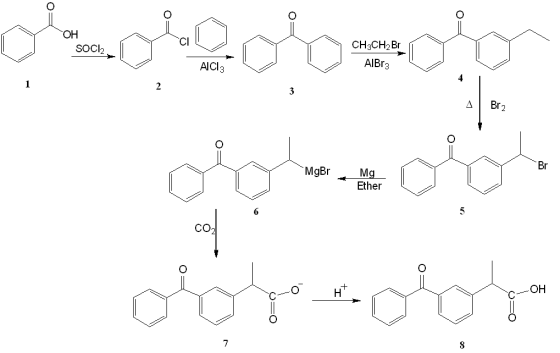
Reaction of benzoic acid(1) with SOCl2 converts the acid to acyl chloride. The reaction of the acyl chloride(2) with benzene and AlCl3(lewis acid) is the friedel-crafts acylation reaction. The reaction of benzophenone(3) with ethyl bromide and AlBr3 is the friedel-crafts alkylation reaction. The reaction of compound-5 with Mg leads to the formation of a grignard reagent which then reacts with CO2 to give the compound-7, this on hydrolysis gives the final product(8).
Q-14
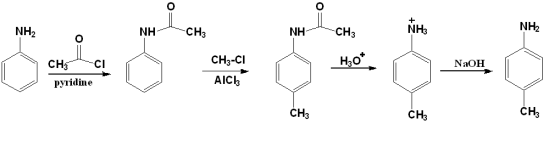
Step-1 - Protection of aniline -NH2 group with AcCl. (This is done because friedel-crafts reaction is not possible with aniline. In aniline ,the -NH2 nitrogen reacts with the lewis acid, this changes the activating -NH2 group to a deactivating group and thus friedel-crafts reaction cannot occur on the ring.)
Step-2 - Friedel-crafts alkylation with methyl chloride and AlCl3(lewis acid).
Step-3- Removal of the protecting group by hydrolysis of amide.
Add Answer to:
Section C: Predicting mechanisms and miscellaneous (5 x 10 = 50 pts) 13. An Organic Chemistry...
please help with organic chemistry! mechanisms? 5) The reaction of 2-bromo-1,1-dimethylcyclohexane with methanol gives the following...
 please help with organic chemistry! mechanisms?
5) The reaction of 2-bromo-1,1-dimethylcyclohexane with methanol gives the following products. Please provide a detailed explanation to the formation of each product. You should use structures of intermediates in your answer. (8 points). осн, CH,он OCH Br + 6) There are a variety of isomeric 1,2,3,4,5,6-hexachlorocyclohexanes, but one of them does not react with CH3CH20' to give an elimination product. Provide the structure of this compound and briefly explain why it does not react...
please help with organic chemistry! mechanisms?
5) The reaction of 2-bromo-1,1-dimethylcyclohexane with methanol gives the following products. Please provide a detailed explanation to the formation of each product. You should use structures of intermediates in your answer. (8 points). осн, CH,он OCH Br + 6) There are a variety of isomeric 1,2,3,4,5,6-hexachlorocyclohexanes, but one of them does not react with CH3CH20' to give an elimination product. Provide the structure of this compound and briefly explain why it does not react...
Organic chemistry mechanisms i need help with systheses questions 6,7,8,9 2-hydroxybenzoic (3 pts) 5. Provide an...
 Organic chemistry mechanisms
i need help with systheses questions 6,7,8,9
2-hydroxybenzoic (3 pts) 5. Provide an appropriate structure for: 3,3-dimethylcyclobutanecarbonitrile. (4 pts each, unless otherwise noted, 12 pts total) 6-8. Syntheses: draw / provide the likely organic product(s) generated in each of the reactions (or reaction sequences) below. As appropriate, pay attention to regiospecificity (new bond formation and location in the product formed) and stereochemistry (direction in space of new bond(s) formed). Indicate ALL likely products: where one product does...
Organic chemistry mechanisms
i need help with systheses questions 6,7,8,9
2-hydroxybenzoic (3 pts) 5. Provide an appropriate structure for: 3,3-dimethylcyclobutanecarbonitrile. (4 pts each, unless otherwise noted, 12 pts total) 6-8. Syntheses: draw / provide the likely organic product(s) generated in each of the reactions (or reaction sequences) below. As appropriate, pay attention to regiospecificity (new bond formation and location in the product formed) and stereochemistry (direction in space of new bond(s) formed). Indicate ALL likely products: where one product does...
 please help with organic chemistry! mechanisms?
5) The reaction of 2-bromo-1,1-dimethylcyclohexane with methanol gives the following products. Please provide a detailed explanation to the formation of each product. You should use structures of intermediates in your answer. (8 points). осн, CH,он OCH Br + 6) There are a variety of isomeric 1,2,3,4,5,6-hexachlorocyclohexanes, but one of them does not react with CH3CH20' to give an elimination product. Provide the structure of this compound and briefly explain why it does not react...
please help with organic chemistry! mechanisms?
5) The reaction of 2-bromo-1,1-dimethylcyclohexane with methanol gives the following products. Please provide a detailed explanation to the formation of each product. You should use structures of intermediates in your answer. (8 points). осн, CH,он OCH Br + 6) There are a variety of isomeric 1,2,3,4,5,6-hexachlorocyclohexanes, but one of them does not react with CH3CH20' to give an elimination product. Provide the structure of this compound and briefly explain why it does not react...
 Organic chemistry mechanisms
i need help with systheses questions 6,7,8,9
2-hydroxybenzoic (3 pts) 5. Provide an appropriate structure for: 3,3-dimethylcyclobutanecarbonitrile. (4 pts each, unless otherwise noted, 12 pts total) 6-8. Syntheses: draw / provide the likely organic product(s) generated in each of the reactions (or reaction sequences) below. As appropriate, pay attention to regiospecificity (new bond formation and location in the product formed) and stereochemistry (direction in space of new bond(s) formed). Indicate ALL likely products: where one product does...
Organic chemistry mechanisms
i need help with systheses questions 6,7,8,9
2-hydroxybenzoic (3 pts) 5. Provide an appropriate structure for: 3,3-dimethylcyclobutanecarbonitrile. (4 pts each, unless otherwise noted, 12 pts total) 6-8. Syntheses: draw / provide the likely organic product(s) generated in each of the reactions (or reaction sequences) below. As appropriate, pay attention to regiospecificity (new bond formation and location in the product formed) and stereochemistry (direction in space of new bond(s) formed). Indicate ALL likely products: where one product does...
Most questions answered within 3 hours.
-
Where is the error in this code sequence?
String s1 = "Hello";
String s2 = "ello";...
asked 10 months ago -
Financial data for Joel de Paris, Inc., for last year
follow:
Joel de Paris, Inc.
Balance...
asked 10 months ago -
Consider this reaction:
Al2(SO4)3 (aq)+ BaCl3
(aq) Al2Cl6 (aq)- +
3BaSO4(s) . What is the...
asked 10 months ago -
Suppose that Savneet is considering increasing her
recent random sample from 20 car rentals to 40...
asked 10 months ago -
Trucks arrive at an unloading terminal at an average rate of 120
per hour.
Trucks arrive...
asked 10 months ago -
Why are methanol and ethanol completely soluble in water while
octanol is not very little soluble....
asked 10 months ago -
A facilities manager at a university reads in a research report
that the mean amount of...
asked 10 months ago -
When the CuSO4 is rehydrated by adding water to the anhydrous
compound, is this an endothermic...
asked 10 months ago -
A ray of sunlight is passing from diamond into crown glass; the
angle of incidence is...
asked 10 months ago -
A block of mass 0.249 kg is placed on top of a light, vertical
spring of...
asked 10 months ago -
how do the kidneys compensate in the presences of acidosis
a) trigger hyperventilate
b) reserve acid...
asked 10 months ago -
Question 501 pts
The rental rate of capital to the firm increases. Which of the
following...
asked 10 months ago