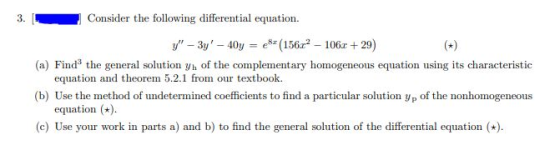
THIS IS ONE WHOLE QUESTION PLEASE ANSWER ALL OF THEM THANK YOU.
Homework Answers
Request Answer!
We need at least 10 more requests to produce the answer.
0 / 10 have requested this problem solution
The more requests, the faster the answer.
Add Answer to:
THIS IS ONE WHOLE QUESTION PLEASE ANSWER ALL OF THEM THANK
YOU.
3. Consider the following...
(27 points) Find the general solution of the associated homogeneous equation for each nonhomogeneous differential equation...
 (27 points) Find the general solution of the associated homogeneous equation for each nonhomogeneous differential equation below. Then determine the form of a particular solution ур of the nonhomogeneous equation. Do not solve for the undetermined coefficients in yp (a) (10 points) y" – 9y' – 22 y = 5xe -2x (b) (10 points) y" – 4y' + 29 y = 8x sin 3x
(27 points) Find the general solution of the associated homogeneous equation for each nonhomogeneous differential equation...
 (27 points) Find the general solution of the associated homogeneous equation for each nonhomogeneous differential equation below. Then determine the form of a particular solution y, of the nonhomogeneous equation. Do not solve for the undetermined coefficients in yp: (a) (10 points) y" - 9y' - 22y = 5xe-2x (b) (10 points) y" – 4y' + 29 y = 8x sin 3x
We consider the non-homogeneous problem y' = 30(18x – 2x4) First we consider the homogeneous problem...
 We consider the non-homogeneous problem y' = 30(18x – 2x4) First we consider the homogeneous problem y'' = 0 : 1) the auxiliary equation is ar2 + br +c= = 0. 2) The roots of the auxiliary equation are (enter answers as a comma separated list). 3) A fundamental set of solutions is (enter answers as a comma separated list). Using these we obtain the the complementary solution yc = C1y1 + C2y2 for arbitrary constants ci and C2- Next...
(1 point) We consider the non-homogeneous problem y" – y'=1 – 10 cos(2x) First we consider...
 (1 point) We consider the non-homogeneous problem y" – y'=1 – 10 cos(2x) First we consider the homogeneous problem y" – y' = 0; 1) the auxiliary equation is ar? + br +c= = 0 2) The roots of the auxiliary equation are (enter answers as a comma separated list). (enter answers as a comma separated list). Using these we obtain the the complementary solution yc = Ciyi + C2y2 for arbitrary 3) A fundamental set of solutions is constants...
#2 part a b and c please. please write solutions neatly 2. (27 points) Find the...
 #2 part a b and c please. please write solutions neatly
2. (27 points) Find the general solution of the associated homogeneous equation for each nonhomogeneous differential equation below. Then determine the form of a particular solution y, of the nonhomogeneous equation. Do not solve for the undetermined coefficients in y, (a) (10 points) y" - 9 - 22 y 3x2 (b) (10 points) y" - 4y' + 29y = 8r sin 3x 3 2. (c)points) Find a homogeneous linear...
#2 part a b and c please. please write solutions neatly
2. (27 points) Find the general solution of the associated homogeneous equation for each nonhomogeneous differential equation below. Then determine the form of a particular solution y, of the nonhomogeneous equation. Do not solve for the undetermined coefficients in y, (a) (10 points) y" - 9 - 22 y 3x2 (b) (10 points) y" - 4y' + 29y = 8r sin 3x 3 2. (c)points) Find a homogeneous linear...
(1 point) a. Find a particular solution to the nonhomogeneous differential equation y" + 3y -...
 (1 point) a. Find a particular solution to the nonhomogeneous differential equation y" + 3y - 10y = ex. yp = help (formulas) b. Find the most general solution to the associated homogeneous differential equation. Use cy and c2 in your answer to denote arbitrary constants, and enter them as c1 and c2. Yh = help (formulas) c. Find the most general solution to the original nonhomogeneous differential equation. Use cy and C2 in your answer to denote arbitrary constants....
2. (27 points) Find the general solution of the associated homogeneous equation for each nonhomogeneous differential...
 2. (27 points) Find the general solution of the associated homogeneous equation for each nonhomogeneous differential equation below. Then determine the form of a particular solution y, of the nonhomogeneous equation. Do not solve for the undetermined coefficients in y, (a) (10 points) y" – 9y' - 22y = 5xe -2x (b) (10 points) y" - 4y + 29 y = 8xsin 3x
Find a second order linear equation L(y) = f(t) with constant coefficients whose general solution is:...
 Find a second order linear equation L(y) = f(t) with constant coefficients whose general solution is: @ y=Cje24 + C261 + te3t @ (a) The solution contains three parts, so it must come from a nonhomogeneous equation. Using the two terms with undefined constant coefficients, find the characteristic equation for the homogeneous equation. (b) Using the characteristic equation find the homogeneous differential equation. This should be the L(y) we're looking for. (c) Since we have used two terms from the...
Question Three: (7 marks) (a) Find the general solution of the following homogeneous equation. (b) Apply the method of Undetermined Coefficients to write ONLY the form of the particular solution of t...
 Question Three: (7 marks) (a) Find the general solution of the following homogeneous equation. (b) Apply the method of Undetermined Coefficients to write ONLY the form of the particular solution of the following nonhomogeneous equation "-2y+5y 24re* cos(2x).
Question Three: (7 marks) (a) Find the general solution of the following homogeneous equation. (b) Apply the method of Undetermined Coefficients to write ONLY the form of the particular solution of the following nonhomogeneous equation "-2y+5y 24re* cos(2x).
Question Three: (7 marks) (a) Find the general solution of the following homogeneous equation. (b) Apply the method of Undetermined Coefficients to write ONLY the form of the particular solution of the following nonhomogeneous equation "-2y+5y 24re* cos(2x).
(1 point) We consider the non-homogeneous problem y" + 4y = -32(3x + 1) First we...
 (1 point) We consider the non-homogeneous problem y" + 4y = -32(3x + 1) First we consider the homogeneous problem y" + 4y = 0: 1) the auxiliary equation is ar? + br +c= r^2+4r = 0. 2) The roots of the auxiliary equation are 0,4 (enter answers as a comma separated list). (enter answers as a comma separated list). Using these we obtain the the complementary 3) A fundamental set of solutions is 1,e^(-4x) solution yc = cyı +...
 (27 points) Find the general solution of the associated homogeneous equation for each nonhomogeneous differential equation below. Then determine the form of a particular solution ур of the nonhomogeneous equation. Do not solve for the undetermined coefficients in yp (a) (10 points) y" – 9y' – 22 y = 5xe -2x (b) (10 points) y" – 4y' + 29 y = 8x sin 3x
 (27 points) Find the general solution of the associated homogeneous equation for each nonhomogeneous differential equation below. Then determine the form of a particular solution y, of the nonhomogeneous equation. Do not solve for the undetermined coefficients in yp: (a) (10 points) y" - 9y' - 22y = 5xe-2x (b) (10 points) y" – 4y' + 29 y = 8x sin 3x
 We consider the non-homogeneous problem y' = 30(18x – 2x4) First we consider the homogeneous problem y'' = 0 : 1) the auxiliary equation is ar2 + br +c= = 0. 2) The roots of the auxiliary equation are (enter answers as a comma separated list). 3) A fundamental set of solutions is (enter answers as a comma separated list). Using these we obtain the the complementary solution yc = C1y1 + C2y2 for arbitrary constants ci and C2- Next...
 (1 point) We consider the non-homogeneous problem y" – y'=1 – 10 cos(2x) First we consider the homogeneous problem y" – y' = 0; 1) the auxiliary equation is ar? + br +c= = 0 2) The roots of the auxiliary equation are (enter answers as a comma separated list). (enter answers as a comma separated list). Using these we obtain the the complementary solution yc = Ciyi + C2y2 for arbitrary 3) A fundamental set of solutions is constants...
 #2 part a b and c please. please write solutions neatly
2. (27 points) Find the general solution of the associated homogeneous equation for each nonhomogeneous differential equation below. Then determine the form of a particular solution y, of the nonhomogeneous equation. Do not solve for the undetermined coefficients in y, (a) (10 points) y" - 9 - 22 y 3x2 (b) (10 points) y" - 4y' + 29y = 8r sin 3x 3 2. (c)points) Find a homogeneous linear...
#2 part a b and c please. please write solutions neatly
2. (27 points) Find the general solution of the associated homogeneous equation for each nonhomogeneous differential equation below. Then determine the form of a particular solution y, of the nonhomogeneous equation. Do not solve for the undetermined coefficients in y, (a) (10 points) y" - 9 - 22 y 3x2 (b) (10 points) y" - 4y' + 29y = 8r sin 3x 3 2. (c)points) Find a homogeneous linear...
 (1 point) a. Find a particular solution to the nonhomogeneous differential equation y" + 3y - 10y = ex. yp = help (formulas) b. Find the most general solution to the associated homogeneous differential equation. Use cy and c2 in your answer to denote arbitrary constants, and enter them as c1 and c2. Yh = help (formulas) c. Find the most general solution to the original nonhomogeneous differential equation. Use cy and C2 in your answer to denote arbitrary constants....
 2. (27 points) Find the general solution of the associated homogeneous equation for each nonhomogeneous differential equation below. Then determine the form of a particular solution y, of the nonhomogeneous equation. Do not solve for the undetermined coefficients in y, (a) (10 points) y" – 9y' - 22y = 5xe -2x (b) (10 points) y" - 4y + 29 y = 8xsin 3x
 Find a second order linear equation L(y) = f(t) with constant coefficients whose general solution is: @ y=Cje24 + C261 + te3t @ (a) The solution contains three parts, so it must come from a nonhomogeneous equation. Using the two terms with undefined constant coefficients, find the characteristic equation for the homogeneous equation. (b) Using the characteristic equation find the homogeneous differential equation. This should be the L(y) we're looking for. (c) Since we have used two terms from the...
 Question Three: (7 marks) (a) Find the general solution of the following homogeneous equation. (b) Apply the method of Undetermined Coefficients to write ONLY the form of the particular solution of the following nonhomogeneous equation "-2y+5y 24re* cos(2x).
Question Three: (7 marks) (a) Find the general solution of the following homogeneous equation. (b) Apply the method of Undetermined Coefficients to write ONLY the form of the particular solution of the following nonhomogeneous equation "-2y+5y 24re* cos(2x).
Question Three: (7 marks) (a) Find the general solution of the following homogeneous equation. (b) Apply the method of Undetermined Coefficients to write ONLY the form of the particular solution of the following nonhomogeneous equation "-2y+5y 24re* cos(2x).
 (1 point) We consider the non-homogeneous problem y" + 4y = -32(3x + 1) First we consider the homogeneous problem y" + 4y = 0: 1) the auxiliary equation is ar? + br +c= r^2+4r = 0. 2) The roots of the auxiliary equation are 0,4 (enter answers as a comma separated list). (enter answers as a comma separated list). Using these we obtain the the complementary 3) A fundamental set of solutions is 1,e^(-4x) solution yc = cyı +...
Most questions answered within 3 hours.
-
Where is the error in this code sequence?
String s1 = "Hello";
String s2 = "ello";...
asked 10 months ago -
Financial data for Joel de Paris, Inc., for last year
follow:
Joel de Paris, Inc.
Balance...
asked 10 months ago -
Consider this reaction:
Al2(SO4)3 (aq)+ BaCl3
(aq) Al2Cl6 (aq)- +
3BaSO4(s) . What is the...
asked 10 months ago -
Suppose that Savneet is considering increasing her
recent random sample from 20 car rentals to 40...
asked 10 months ago -
Trucks arrive at an unloading terminal at an average rate of 120
per hour.
Trucks arrive...
asked 10 months ago -
Why are methanol and ethanol completely soluble in water while
octanol is not very little soluble....
asked 10 months ago -
A facilities manager at a university reads in a research report
that the mean amount of...
asked 10 months ago -
When the CuSO4 is rehydrated by adding water to the anhydrous
compound, is this an endothermic...
asked 10 months ago -
A ray of sunlight is passing from diamond into crown glass; the
angle of incidence is...
asked 10 months ago -
A block of mass 0.249 kg is placed on top of a light, vertical
spring of...
asked 10 months ago -
how do the kidneys compensate in the presences of acidosis
a) trigger hyperventilate
b) reserve acid...
asked 10 months ago -
Question 501 pts
The rental rate of capital to the firm increases. Which of the
following...
asked 10 months ago