
Homework Answers
Add Answer to:
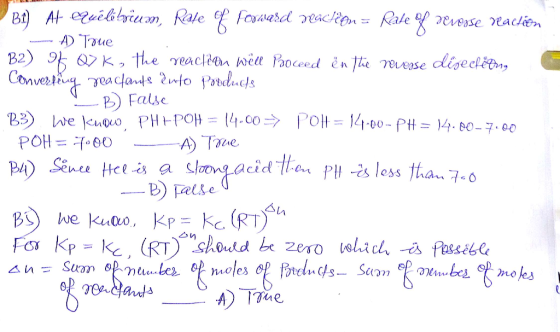
BONUS QUESTIONS B1) When a system reaches equilibrium, the forward and reverse reactions stop. A) True...
Give an example of a reversible reaction and an irreversible reaction. 2. Explain how they are...
Give an example of a reversible reaction and an irreversible reaction. 2. Explain how they are fundamentally different. Equilibrium is a dynamic process. Explain what this means. 3. Determine whether the following statements are true or false. Correct the false statements. a. When a chemical reaction reaches equilibrium, the reaction completely stops. b. When a chemical reaction reaches equilibrium, the forward reaction stops and the reverse reaction begins. 4. Determine whether the following statements are true or false. Correct the...
answer all 6) cernents is true? equilibrium co the right 5) Determine the value of Ke...
 answer all
6) cernents is true? equilibrium co the right 5) Determine the value of Ke for the following reaction if the equilibrium concentrations are as follows: (NO Joy -0.85 M and [NO_Jeg -0.38 M. 2 NO:(8) - N,Od D) 0.22 E) 0.53 A) 2.2 C) 0.022 B) 19 6) Which of the following statements is true? A) 10-K, it means the reaction is not at equilibrium. B) TOK, it means the forward reaction will proceed to the right to...
answer all
6) cernents is true? equilibrium co the right 5) Determine the value of Ke for the following reaction if the equilibrium concentrations are as follows: (NO Joy -0.85 M and [NO_Jeg -0.38 M. 2 NO:(8) - N,Od D) 0.22 E) 0.53 A) 2.2 C) 0.022 B) 19 6) Which of the following statements is true? A) 10-K, it means the reaction is not at equilibrium. B) TOK, it means the forward reaction will proceed to the right to...
6) Which of the following statements is true? A) If Q = K, it means the reaction is not at equilibrium B) If Q<...
 6) Which of the following statements is true? A) If Q = K, it means the reaction is not at equilibrium B) If Q< K, it means the forward reaction will proceed (to the right) to form more reactants. C) If Q< K, it means the reverse reaction will proceed (to the left) to form more reactants. D) If Q> K, it means the forward reaction will proceed (to the right) to form more reactants E) If Q> K, it...
R-0.08206 (atm - L)(mol - K)= 8.314 J/(mol-K) pH = -log[H30) pOH = -log(OH) pX=-logX [HO'] = 10 Ph. K, EK.(RT) pH +...
 R-0.08206 (atm - L)(mol - K)= 8.314 J/(mol-K) pH = -log[H30) pOH = -log(OH) pX=-logX [HO'] = 10 Ph. K, EK.(RT) pH + pOH = 14 = pK+pKb [OH (H:0= 10-14 = K, * Ks (in water at 25°C) pH =pK, + log([base)/(acid]) pOH =pKy + log (acid]/[base]) Molar Solubility = (*+ m for a salt that dissociates into ions with coefficients of n and m - b b -4ac where 0 = ax + bx+c VA= A/ X=- 1)...
Problem Set 1: Chemical Equilibrium: Clave A) al chemical reactions have ceased B) the rates of...
 Problem Set 1: Chemical Equilibrium: Clave A) al chemical reactions have ceased B) the rates of the forward and reverse reactions are equal C) the rate constants of the forward and reverse reactions are equal D) the value of the equilbrium constant is 1 E) the limiting reagent has been consumed 6) The value of Kfor the equlbrium s794 at25 "C. What is the value o K for the equilbrium below? A) 397 B) 0035 2) Which one of the...
answer all DIRECTIONS: A COMPLETE THE ANSWER SHEET: Write your name. banner id # and the...
 answer all
DIRECTIONS: A COMPLETE THE ANSWER SHEET: Write your name. banner id # and the date in the space the scantron. All answers must be on the seantron and this exam. Read each item carefully select the word phrase or expression that best completes the fest item. Indicate the answer by blackening the appropriate space on your answer sheet You MUST erase completely to receive credit for an erased item. This AND the scantron must be turned in. All...
answer all
DIRECTIONS: A COMPLETE THE ANSWER SHEET: Write your name. banner id # and the date in the space the scantron. All answers must be on the seantron and this exam. Read each item carefully select the word phrase or expression that best completes the fest item. Indicate the answer by blackening the appropriate space on your answer sheet You MUST erase completely to receive credit for an erased item. This AND the scantron must be turned in. All...
5) Determine the value of Kc for the following reaction if the equilibrium concentrations are as...
 5) Determine the value of Kc for the following reaction if the equilibrium concentrations are as follows: [NO2]eq = 0.85 M and [NO]eq=0.38 M. 2 NO2(g) - N2048) A) 2.2 B) 1.9 C) 0.022 D) 0.22 E) 0.53 6) Which of the following statements is true? A) If Q=K, it means the reaction is not at equilibrium. B) If Q<K, it means the forward reaction will proceed to the right) to form more reactants. C) IFO <K, it means the...
1.The spontaneity of system or a biochemical reaction can be determined by: A) Enthalpy alone B)...
1.The spontaneity of system or a biochemical reaction can be determined by: A) Enthalpy alone B) Entropy alone C) Gibbs Free energy D) Temperature and heat 2.A reaction in equilibrium where both forward and reverse reactions are proceeding equally, will have a DELTA G value of: A) Positive B) Zero C) Negative 3.A reaction was originally endergonic, but became exergonic after reducing the temperature. Therefore, this reaction originally had __________ deltaH and a ______ delta S. A) small positive, large...
1. Which of the followi ch of the following reactions is not readily explained by the...
 1. Which of the followi ch of the following reactions is not readily explained by the Arrhenius concept of acids and bases? a. A. HCl(aq) + NaOH(aq) - NaCl(aq) + H20() b. H30(aq) + OH-(aq) + 2H20(1) c. HCI(g) + NH3(g) - NH4Cl(s) d. HC2H302(aq) + H2O(l) H30*(aq) + C2H302-(ag) e. H30 (aq) + OH-(aq) + 2H2O(aq) 2. Classify each of the following species as Brønsted acid or base or both: a) H20, b) OH", c) H30, d) NH3, e)...
1. Which of the followi ch of the following reactions is not readily explained by the Arrhenius concept of acids a...
 1. Which of the followi ch of the following reactions is not readily explained by the Arrhenius concept of acids and bases? a. A. HCl(aq) + NaOH(aq) - NaCl(aq) + H20() b. H30(aq) + OH-(aq) + 2H20(1) c. HCI(g) + NH3(g) - NH4Cl(s) d. HC2H302(aq) + H2O(l) H30*(aq) + C2H302-(ag) e. H30 (aq) + OH-(aq) + 2H2O(aq) 2. Classify each of the following species as Brønsted acid or base or both: a) H20, b) OH", c) H30, d) NH3, e)...
 answer all
6) cernents is true? equilibrium co the right 5) Determine the value of Ke for the following reaction if the equilibrium concentrations are as follows: (NO Joy -0.85 M and [NO_Jeg -0.38 M. 2 NO:(8) - N,Od D) 0.22 E) 0.53 A) 2.2 C) 0.022 B) 19 6) Which of the following statements is true? A) 10-K, it means the reaction is not at equilibrium. B) TOK, it means the forward reaction will proceed to the right to...
answer all
6) cernents is true? equilibrium co the right 5) Determine the value of Ke for the following reaction if the equilibrium concentrations are as follows: (NO Joy -0.85 M and [NO_Jeg -0.38 M. 2 NO:(8) - N,Od D) 0.22 E) 0.53 A) 2.2 C) 0.022 B) 19 6) Which of the following statements is true? A) 10-K, it means the reaction is not at equilibrium. B) TOK, it means the forward reaction will proceed to the right to...
 6) Which of the following statements is true? A) If Q = K, it means the reaction is not at equilibrium B) If Q< K, it means the forward reaction will proceed (to the right) to form more reactants. C) If Q< K, it means the reverse reaction will proceed (to the left) to form more reactants. D) If Q> K, it means the forward reaction will proceed (to the right) to form more reactants E) If Q> K, it...
 R-0.08206 (atm - L)(mol - K)= 8.314 J/(mol-K) pH = -log[H30) pOH = -log(OH) pX=-logX [HO'] = 10 Ph. K, EK.(RT) pH + pOH = 14 = pK+pKb [OH (H:0= 10-14 = K, * Ks (in water at 25°C) pH =pK, + log([base)/(acid]) pOH =pKy + log (acid]/[base]) Molar Solubility = (*+ m for a salt that dissociates into ions with coefficients of n and m - b b -4ac where 0 = ax + bx+c VA= A/ X=- 1)...
 Problem Set 1: Chemical Equilibrium: Clave A) al chemical reactions have ceased B) the rates of the forward and reverse reactions are equal C) the rate constants of the forward and reverse reactions are equal D) the value of the equilbrium constant is 1 E) the limiting reagent has been consumed 6) The value of Kfor the equlbrium s794 at25 "C. What is the value o K for the equilbrium below? A) 397 B) 0035 2) Which one of the...
 answer all
DIRECTIONS: A COMPLETE THE ANSWER SHEET: Write your name. banner id # and the date in the space the scantron. All answers must be on the seantron and this exam. Read each item carefully select the word phrase or expression that best completes the fest item. Indicate the answer by blackening the appropriate space on your answer sheet You MUST erase completely to receive credit for an erased item. This AND the scantron must be turned in. All...
answer all
DIRECTIONS: A COMPLETE THE ANSWER SHEET: Write your name. banner id # and the date in the space the scantron. All answers must be on the seantron and this exam. Read each item carefully select the word phrase or expression that best completes the fest item. Indicate the answer by blackening the appropriate space on your answer sheet You MUST erase completely to receive credit for an erased item. This AND the scantron must be turned in. All...
 5) Determine the value of Kc for the following reaction if the equilibrium concentrations are as follows: [NO2]eq = 0.85 M and [NO]eq=0.38 M. 2 NO2(g) - N2048) A) 2.2 B) 1.9 C) 0.022 D) 0.22 E) 0.53 6) Which of the following statements is true? A) If Q=K, it means the reaction is not at equilibrium. B) If Q<K, it means the forward reaction will proceed to the right) to form more reactants. C) IFO <K, it means the...
 1. Which of the followi ch of the following reactions is not readily explained by the Arrhenius concept of acids and bases? a. A. HCl(aq) + NaOH(aq) - NaCl(aq) + H20() b. H30(aq) + OH-(aq) + 2H20(1) c. HCI(g) + NH3(g) - NH4Cl(s) d. HC2H302(aq) + H2O(l) H30*(aq) + C2H302-(ag) e. H30 (aq) + OH-(aq) + 2H2O(aq) 2. Classify each of the following species as Brønsted acid or base or both: a) H20, b) OH", c) H30, d) NH3, e)...
 1. Which of the followi ch of the following reactions is not readily explained by the Arrhenius concept of acids and bases? a. A. HCl(aq) + NaOH(aq) - NaCl(aq) + H20() b. H30(aq) + OH-(aq) + 2H20(1) c. HCI(g) + NH3(g) - NH4Cl(s) d. HC2H302(aq) + H2O(l) H30*(aq) + C2H302-(ag) e. H30 (aq) + OH-(aq) + 2H2O(aq) 2. Classify each of the following species as Brønsted acid or base or both: a) H20, b) OH", c) H30, d) NH3, e)...
Most questions answered within 3 hours.
-
Where is the error in this code sequence?
String s1 = "Hello";
String s2 = "ello";...
asked 10 months ago -
Financial data for Joel de Paris, Inc., for last year
follow:
Joel de Paris, Inc.
Balance...
asked 10 months ago -
Consider this reaction:
Al2(SO4)3 (aq)+ BaCl3
(aq) Al2Cl6 (aq)- +
3BaSO4(s) . What is the...
asked 10 months ago -
Suppose that Savneet is considering increasing her
recent random sample from 20 car rentals to 40...
asked 10 months ago -
Trucks arrive at an unloading terminal at an average rate of 120
per hour.
Trucks arrive...
asked 10 months ago -
Why are methanol and ethanol completely soluble in water while
octanol is not very little soluble....
asked 10 months ago -
A facilities manager at a university reads in a research report
that the mean amount of...
asked 10 months ago -
When the CuSO4 is rehydrated by adding water to the anhydrous
compound, is this an endothermic...
asked 10 months ago -
A ray of sunlight is passing from diamond into crown glass; the
angle of incidence is...
asked 10 months ago -
A block of mass 0.249 kg is placed on top of a light, vertical
spring of...
asked 10 months ago -
how do the kidneys compensate in the presences of acidosis
a) trigger hyperventilate
b) reserve acid...
asked 10 months ago -
Question 501 pts
The rental rate of capital to the firm increases. Which of the
following...
asked 10 months ago