
Homework Answers
Add Answer to:
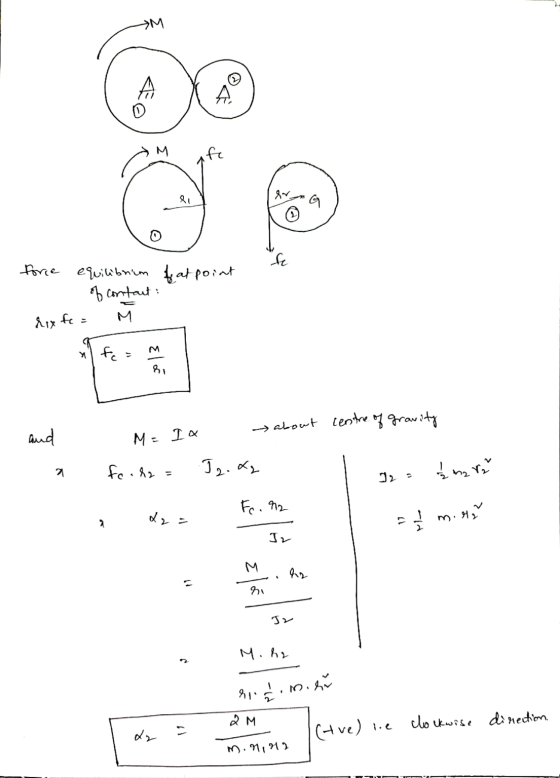
5. Two gears of radius rl and r2 and mass of (2m) and (m), respectively, are...
Each of the gears A and B has a mass of 3.2 kg and a radius...
 Each of the gears A and B has a mass of 3.2 kg and a radius of gyration of 60 mm, while gear C has a mass of 12 kg and a radius of gyration of 150 mm. A couple M of constant magnitude 10 N*m is applied to gear B. Determine the number of revolutions of gear C required for its angular velocity to increase from 100 to 450 rpm and the corresponding tangential force acting on gear A....
Each of the gears A and B has a mass of 1.6 kg and a radius...
 Each of the gears A and B has a mass of 1.6 kg and a radius of gyration of 60 mm, while gear C has a mass of 12 kg and a radius of gyration of 150 mm. A couple M of constant magnitude 10 N·m is applied to gear C. Determine the number of revolutions of gear C required for its angular velocity to increase from 100 to 450 rpm and the corresponding tangential force acting on gear A....
(6 Points) - Problem 5: Each of the gears A and B has a mass of...
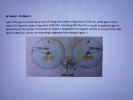 (6 Points) - Problem 5: Each of the gears A and B has a mass of 10 kg and a radius of gyration of 190 mm, while gear C has a mass of 2.5 kg and a radius of gyration of 80 mm. Assuming that the 6 N-m couple is applied to gear B. determine (a) the number of revolutions of gear C required for its angular velocity to increase from 450 rpm to 1800 rpm, (b) the corresponding tangential...
3. The two gears A and B in the figure have radii R and 2R, and...
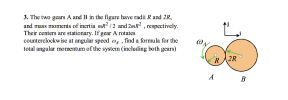 3. The two gears A and B in the figure have radii R and 2R, and mass moments of inertia mR2/2 and 2mR2 , respectively. Their centers are stationary. If gear A rotates counterclockwise at angular speed aA , find a formula for the total angular momentum of the system (including both gears) ω
A mechanical device consists of two circular gears, one of radius 2 centered at (0, -2)...
A mechanical device consists of two circular gears, one of radius 2 centered at (0, -2) and the other radius 1 centered at (0, 1). The gear of radius 2 rotates clockwise at unit angular velocity (1 radian per second), while the gear of radius 1 rotates counterclockwise without slipping at the contact point. The two gears each carry a small peg on their circumference, and these pegs are connected together by an elastic band. Initially, both pegs are at...
A uniform disk of radius 0.455 m0.455 m and unknown mass is constrained to rotate about...
 A uniform disk of radius 0.455 m0.455 m and unknown mass is
constrained to rotate about a perpendicular axis through its
center. A ring with the same mass as the disk is attached around
the disk's rim. A tangential force of 0.237 N0.237 N applied at the
rim causes an angular acceleration of 0.129 rad/s2.0.129 rad/s2.
Find the mass of the disk.Why is this wrong?
A uniform disk of radius 0.455 m and unknown mass is constrained to rotate about...
A uniform disk of radius 0.455 m0.455 m and unknown mass is
constrained to rotate about a perpendicular axis through its
center. A ring with the same mass as the disk is attached around
the disk's rim. A tangential force of 0.237 N0.237 N applied at the
rim causes an angular acceleration of 0.129 rad/s2.0.129 rad/s2.
Find the mass of the disk.Why is this wrong?
A uniform disk of radius 0.455 m and unknown mass is constrained to rotate about...
1. The drive components of a two-speed bicycle are constructed as follows: • The rear wheel has a radius of 50 cm • The front gear has a radius of 10 cm, and is connected to the pedals • There are two...
1. The drive components of a two-speed bicycle are constructed as follows: • The rear wheel has a radius of 50 cm • The front gear has a radius of 10 cm, and is connected to the pedals • There are two rear gears: one with a radius of 5 cm (“high gear”), and one with a radius of 10 cm (“low gear”) • A chain connects the front gear to one of the rear gears; the cyclist can choose...
Gear C has a mass of 5 kg and a centroidal radius of gyration of 75...
 Gear C has a mass of 5 kg and a centroidal radius of gyration of 75 mm. The uniform bar AB has a mass of 3 kg and gear D is stationary. If the system is released from rest in the position shown, determine (a) the angular acceleration of gear C, (b) the acceleration of point B.Fig. P16.108
A disk of mass M and radius R is on the horizontal table, and an external...
 A disk of mass M and radius R is on the horizontal table, and an external force F is applied to the disk as shown in Figure above. The coefficient of friction between the disk and the table is and it is large enough that the disk is rolling without slipping. The initial velocity of the center of mass is V_3 = 0, the initial angular velocity is 0. Find the acceleration of the center of mass of the disk...
You are sitting on a merry-go-round of mass 200 kg and radius 2m that is at...
You are sitting on a merry-go-round of mass 200 kg and radius 2m that is at rest (not spinning). Your mass is 50 kg. Your friend pushes the edge of the merry go round with 100 N of force, applied at a 90 deg angle. (hint: the merry-go-round is a disk). a. How much torque did your friend apply? b. What is your angular acceleration if you are sitting in the middle of the merry-go-round? c. What is your angular...
 Each of the gears A and B has a mass of 3.2 kg and a radius of gyration of 60 mm, while gear C has a mass of 12 kg and a radius of gyration of 150 mm. A couple M of constant magnitude 10 N*m is applied to gear B. Determine the number of revolutions of gear C required for its angular velocity to increase from 100 to 450 rpm and the corresponding tangential force acting on gear A....
 Each of the gears A and B has a mass of 1.6 kg and a radius of gyration of 60 mm, while gear C has a mass of 12 kg and a radius of gyration of 150 mm. A couple M of constant magnitude 10 N·m is applied to gear C. Determine the number of revolutions of gear C required for its angular velocity to increase from 100 to 450 rpm and the corresponding tangential force acting on gear A....
 (6 Points) - Problem 5: Each of the gears A and B has a mass of 10 kg and a radius of gyration of 190 mm, while gear C has a mass of 2.5 kg and a radius of gyration of 80 mm. Assuming that the 6 N-m couple is applied to gear B. determine (a) the number of revolutions of gear C required for its angular velocity to increase from 450 rpm to 1800 rpm, (b) the corresponding tangential...
 3. The two gears A and B in the figure have radii R and 2R, and mass moments of inertia mR2/2 and 2mR2 , respectively. Their centers are stationary. If gear A rotates counterclockwise at angular speed aA , find a formula for the total angular momentum of the system (including both gears) ω
 A uniform disk of radius 0.455 m0.455 m and unknown mass is
constrained to rotate about a perpendicular axis through its
center. A ring with the same mass as the disk is attached around
the disk's rim. A tangential force of 0.237 N0.237 N applied at the
rim causes an angular acceleration of 0.129 rad/s2.0.129 rad/s2.
Find the mass of the disk.Why is this wrong?
A uniform disk of radius 0.455 m and unknown mass is constrained to rotate about...
A uniform disk of radius 0.455 m0.455 m and unknown mass is
constrained to rotate about a perpendicular axis through its
center. A ring with the same mass as the disk is attached around
the disk's rim. A tangential force of 0.237 N0.237 N applied at the
rim causes an angular acceleration of 0.129 rad/s2.0.129 rad/s2.
Find the mass of the disk.Why is this wrong?
A uniform disk of radius 0.455 m and unknown mass is constrained to rotate about...
 Gear C has a mass of 5 kg and a centroidal radius of gyration of 75 mm. The uniform bar AB has a mass of 3 kg and gear D is stationary. If the system is released from rest in the position shown, determine (a) the angular acceleration of gear C, (b) the acceleration of point B.Fig. P16.108
 A disk of mass M and radius R is on the horizontal table, and an external force F is applied to the disk as shown in Figure above. The coefficient of friction between the disk and the table is and it is large enough that the disk is rolling without slipping. The initial velocity of the center of mass is V_3 = 0, the initial angular velocity is 0. Find the acceleration of the center of mass of the disk...
Most questions answered within 3 hours.
-
Where is the error in this code sequence?
String s1 = "Hello";
String s2 = "ello";...
asked 11 months ago -
Financial data for Joel de Paris, Inc., for last year
follow:
Joel de Paris, Inc.
Balance...
asked 11 months ago -
Consider this reaction:
Al2(SO4)3 (aq)+ BaCl3
(aq) Al2Cl6 (aq)- +
3BaSO4(s) . What is the...
asked 11 months ago -
Suppose that Savneet is considering increasing her
recent random sample from 20 car rentals to 40...
asked 11 months ago -
Trucks arrive at an unloading terminal at an average rate of 120
per hour.
Trucks arrive...
asked 11 months ago -
Why are methanol and ethanol completely soluble in water while
octanol is not very little soluble....
asked 11 months ago -
A facilities manager at a university reads in a research report
that the mean amount of...
asked 11 months ago -
When the CuSO4 is rehydrated by adding water to the anhydrous
compound, is this an endothermic...
asked 11 months ago -
A ray of sunlight is passing from diamond into crown glass; the
angle of incidence is...
asked 11 months ago -
A block of mass 0.249 kg is placed on top of a light, vertical
spring of...
asked 11 months ago -
how do the kidneys compensate in the presences of acidosis
a) trigger hyperventilate
b) reserve acid...
asked 11 months ago -
Question 501 pts
The rental rate of capital to the firm increases. Which of the
following...
asked 11 months ago