A projectile is launched due north from a point in colatitude at an angle to the...
A projectile is launched due north from a point in colatitude
 at an angle
 to the horizontal, and aimed at a target whose distance is y
(small compared to Earth's radius R). Show that if no allowance is
made for the effects of the Coriolis force, the projectile will
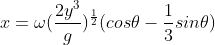
miss its target by a distance
to the horizontal, and aimed at a target whose distance is y
(small compared to Earth's radius R). Show that if no allowance is
made for the effects of the Coriolis force, the projectile will
miss its target by a distance
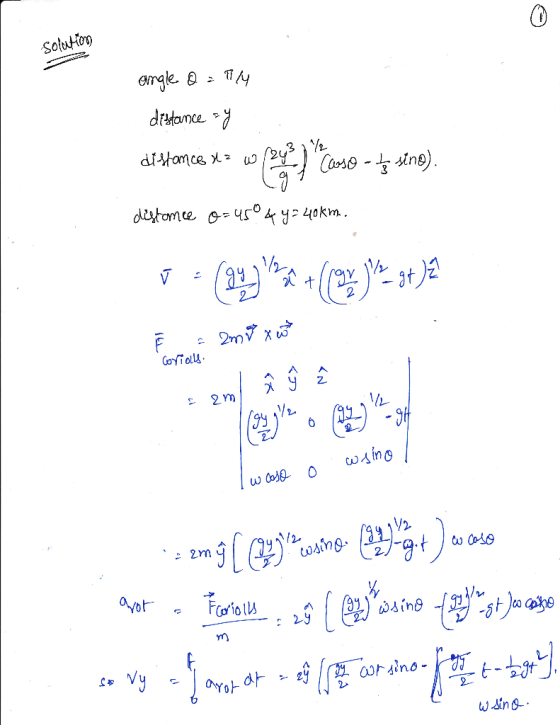
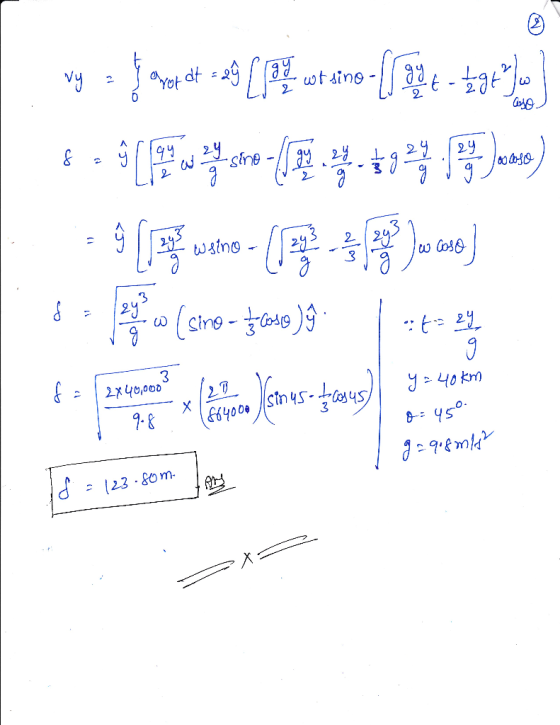
Evaluate this distance if  and y=40km. Why is it that the deviation is to the east near the
north pole, but to the west both on the equator and near the south
pole? (Neglect atmospheric resistance)
and y=40km. Why is it that the deviation is to the east near the
north pole, but to the west both on the equator and near the south
pole? (Neglect atmospheric resistance)
Homework Answers
Add Answer to:
A projectile is launched due north from a point in colatitude
at an angle
to the...
4.4.2 Two Rotations Before Projectile Launch A projectile will be launched from 68° north latitud...
 4.4.2 Two Rotations Before Projectile Launch A projectile will be launched from 68° north latitude. Before launch, the longitudinal axis (b) of the projectile is initially aligned with local south (e). by and b are likewise aligned with local east (e) and local vertical (ez), respectively. The projectile is then rotated twice: first, through an azimuth angle of y 45° toward the east next, through an elevation angle of θ 60° up. If the missile's velocity is EvB - 1000...
9.28« Use the result (9,73) of Problem 9.26 to do the following: A naval gun shoots...
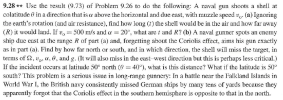 9.28« Use the result (9,73) of Problem 9.26 to do the following: A naval gun shoots a shell at colatitude θ in a direction that is α above the horizontal and due east, with muzzle speed u . (a) Ignoring the earth's rotation (and air resistance), find how long (t) the shell would be in the air and how far away (R) it would land. If v 500 m/s anda 20°, what are t and R? (b) A naval gunner...
A projectile is launched from the north pole with an initial vertical velocity v_0. What value...
 A projectile is launched from the north pole with an initial vertical velocity v_0. What value of v_0 will result in a maximum altitude of 0.61R? Neglect aerodynamic drag and use g = 9.825 m/s^2 as the surface-level acceleration due to gravity and R = 6371 km as the radius of the earth.
A projectile is launched with an initial speed of 58.0 m/s at an angle of 32.0°...
A projectile is launched with an initial speed of 58.0 m/s at an angle of 32.0° above the horizontal. The projectile lands on a hillside 3.80 s later. Neglect air friction. (Assume that the +x-axis is to the right and the +y-axis is up along the page.) (a) What is the projectile's velocity at the highest point of its trajectory? (b) What is the straight-line distance from where the projectile was launched to where it hits its target?
A projectile is launched with an initial speed of 51.0 m/s at an angle of 31.0°...
A projectile is launched with an initial speed of 51.0 m/s at an angle of 31.0° above the horizontal. The projectile lands on a hillside 3.65 s later. Neglect air friction. (Assume that the +x-axis is to the right and the +y-axis is up along the page.) (a) What is the projectile's velocity at the highest point of its trajectory? magnitude direction (b) What is the straight-line distance from where the projectile was launched to where it hits its target?
A projectile is launched with an initial speed of 41.0 m/s at an angle of 33.0°...
A projectile is launched with an initial speed of 41.0 m/s at an angle of 33.0° above the horizontal. The projectile lands on a hillside 3.75 s later. Neglect air friction. (Assume that the +x-axis is to the right and the +y-axis is up along the page.) (a) What is the projectile's velocity at the highest point of its trajectory? magnitude m/s direction ° counterclockwise from the +x-axis (b) What is the straight-line distance from where the projectile was launched...
A projectile is launched with an initial speed of 48.0 m/s at an angle of 31.0°...
A projectile is launched with an initial speed of 48.0 m/s at an angle of 31.0° above the horizontal. The projectile lands on a hillside 3.70 s later. Neglect air friction. (Assume that the +x-axis is to the right and the +y-axis is up along the page.) (a) What is the projectile's velocity at the highest point of its trajectory? magnitude _____ m/s direction _______ degrees (counterclockwise from the +x axis) (b) What is the straight-line distance from where the...
A projectile is launched with an initial speed of 55.0 m/s at an angle of 34.0°...
A projectile is launched with an initial speed of 55.0 m/s at an angle of 34.0° above the horizontal. The projectile lands on a hillside 3.90 s later. Neglect air friction. (Assume that the +x-axis is to the right and the +y-axis is up along the page.) (a) What is the projectile's velocity at the highest point of its trajectory? magnitude m/s direction ° counterclockwise from the +x-axis (b) What is the straight-line distance from where the projectile was launched...
A projectile is launched with an initial speed of 59.0 m/s at an angle of 34.0°...
A projectile is launched with an initial speed of 59.0 m/s at an angle of 34.0° above the horizontal. The projectile lands on a hillside 3.60 s later. Neglect air friction. (Assume that the +x-axis is to the right and the +y-axis is up along the page.) (a) What is the projectile's velocity at the highest point of its trajectory? magnitude m/s direction ° counterclockwise from the +x-axis (b) What is the straight-line distance from where the projectile was launched...
. AT&T. 2:59 PM @ 57% ☺ ☺ ☺ Q a 364 Chapter 9 Mechanics in...
 . AT&T. 2:59 PM @ 57% ☺ ☺ ☺ Q a 364 Chapter 9 Mechanics in Noninertial Frames SECTION Free Fall and the Coriolis Force 9.25. A high speed train is traveling at a cost 150 m access the South Pole and the bea about 300 p d s iho l ed from the limite e way de 9.26 la Section 8 wewed a head of time to find the on that is dropped forest.com sofinst onder in the car's...
 4.4.2 Two Rotations Before Projectile Launch A projectile will be launched from 68° north latitude. Before launch, the longitudinal axis (b) of the projectile is initially aligned with local south (e). by and b are likewise aligned with local east (e) and local vertical (ez), respectively. The projectile is then rotated twice: first, through an azimuth angle of y 45° toward the east next, through an elevation angle of θ 60° up. If the missile's velocity is EvB - 1000...
 9.28« Use the result (9,73) of Problem 9.26 to do the following: A naval gun shoots a shell at colatitude θ in a direction that is α above the horizontal and due east, with muzzle speed u . (a) Ignoring the earth's rotation (and air resistance), find how long (t) the shell would be in the air and how far away (R) it would land. If v 500 m/s anda 20°, what are t and R? (b) A naval gunner...
 A projectile is launched from the north pole with an initial vertical velocity v_0. What value of v_0 will result in a maximum altitude of 0.61R? Neglect aerodynamic drag and use g = 9.825 m/s^2 as the surface-level acceleration due to gravity and R = 6371 km as the radius of the earth.
 . AT&T. 2:59 PM @ 57% ☺ ☺ ☺ Q a 364 Chapter 9 Mechanics in Noninertial Frames SECTION Free Fall and the Coriolis Force 9.25. A high speed train is traveling at a cost 150 m access the South Pole and the bea about 300 p d s iho l ed from the limite e way de 9.26 la Section 8 wewed a head of time to find the on that is dropped forest.com sofinst onder in the car's...
Most questions answered within 3 hours.
-
Where is the error in this code sequence?
String s1 = "Hello";
String s2 = "ello";...
asked 11 months ago -
Financial data for Joel de Paris, Inc., for last year
follow:
Joel de Paris, Inc.
Balance...
asked 11 months ago -
Consider this reaction:
Al2(SO4)3 (aq)+ BaCl3
(aq) Al2Cl6 (aq)- +
3BaSO4(s) . What is the...
asked 11 months ago -
Suppose that Savneet is considering increasing her
recent random sample from 20 car rentals to 40...
asked 11 months ago -
Trucks arrive at an unloading terminal at an average rate of 120
per hour.
Trucks arrive...
asked 11 months ago -
Why are methanol and ethanol completely soluble in water while
octanol is not very little soluble....
asked 11 months ago -
A facilities manager at a university reads in a research report
that the mean amount of...
asked 11 months ago -
When the CuSO4 is rehydrated by adding water to the anhydrous
compound, is this an endothermic...
asked 11 months ago -
A ray of sunlight is passing from diamond into crown glass; the
angle of incidence is...
asked 11 months ago -
A block of mass 0.249 kg is placed on top of a light, vertical
spring of...
asked 11 months ago -
how do the kidneys compensate in the presences of acidosis
a) trigger hyperventilate
b) reserve acid...
asked 11 months ago -
Question 501 pts
The rental rate of capital to the firm increases. Which of the
following...
asked 11 months ago