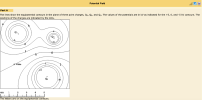
The lines show the equipotential contours in the plane of threepoint charges, Q1, Q2, andQ3. The values of the potentials are inkV as indicated for the +5, 0, and -5 kVcontours. The positions of the charges are indicated by thedots.

a-Calculate the work performed by an external agent to move a charge of -0.59x10^-12 C from `i' to `b' ?
b-Calculate the magnitude of the electric field at `g'. ?
c- Calculate the magnitude of the force on a charge of 9.6*10^-19 C at `k'.?
d-Calculate the size of Q3. The magnitudes of the three charges are in the exact ratios of 1 to 2 to 3.
Homework Answers
A. the potentials at points i and b are +3kV and -3kV
respectively. to move the charge from i to b,
work done = charge x potential difference = -0.59×10^-12C x -6x10^3
V = 3.54 x 10^-9J = 4.02 nJ.
B. the perpendicular distance between the equipotentials either
side of g (-1kV and +1kV) is 9mm.
(to measure distance XY, place the straight edge of a sheet of
paper against X and Y, mark the positions of X and Y on the edge of
the paper, and measure this distance using the scale given in the
figure.)
electric field strength at g = PD/distance = 2x10^3V/9x10^-3mm =
0.22x10^6 V/m.
C. the perpendicular distance between the equipotentials either
side of k (-1kV and +1kV) is 12.5mm.
electric field strength at k = PD/distance = 2x10^3V/12.5x10^-3mm =
0.16x10^6 V/m.
force on charge at k = charge x electric field strength =
9.6×10^-19 C x 0.16x10^6 V/m = 1.536x10^-13 N.
D. (THE DIFFICULT PART.) to find the charge Q3 we can use the
SUPERPOSITION PRINCIPLE : the electrostatic potential at any point
in the diagram is the sum of the potentials from all 3 charges. the
potential at distance r from a charge Q is Q/4πεr, where ε is the
permittivity of free space. we pick any convenient point X on an
equipotential and measure the distances r1, r2,r3 of Q1, Q2, Q3
from X. then
(1/ 4πε)(Q1/r1 + Q2/r2 + Q3/r3) = P
where P = potential at X.
(comment: if required, we could use this equation to find all 3
charges Q1, Q2, Q3 by selecting 3 different points X, Y, Z then
solving 3 simultaneous equations. alternatively, we could measure
distances from several points and average the resulting values of
Q3 to improve accuracy.)
judging by the distance from each charge to the nearest
equipotential (+5 or -5 kV), Q3 has the largest magnitude (because
Q/r is the same for each charge, so large distance r to the
equipotential means Q must also be large) and is +ve. Q1 is comes
in between and is -ve, and Q2 is smallest, also -ve.
so Q3 : Q1 :Q2 = +3 : -2 : -1. if Q2 = -q then Q1 = -2q and Q3 =
+3q. substituting above,
q(-2/r1 -1/r2 + 3/r3) = 4πεP.
for accuracy, choose X as far from each charge as possible. X
cannot be on the P= 0 V equipotential, because the equation would
then give us q=0 for all values of r. i choose X as the point where
the +1kV equipotential meets the left lower edge.
distances measured to X from Q1, Q2, Q3 are 62, 70, 35.5 mm
respectively.
P= +1kV, ε = 8.85x10^-12 F/m, 4πεP = 1.1x10^-7 C/m.
(-2/r1 -1/r2 + 3/r3) = (-2/0.062 -1/0.070 + 3/0.0355) = 37.96
m^-1.
q = 1.1x10^-7 / 37.96 = 2.92 x 10^-9 C.
ANSWER: Q3 = 3x (+2.92nC) = +8.8 nC
Add Answer to:
The lines show the equipotential contours in the plane of
threepoint charges, Q1, Q2,
andQ3. The...
The lines show the equipotential contours in the plane of three point charges, Q1, Q2, and...
 The lines show the equipotential
contours in the plane of three point charges, Q1, Q2, and Q3. The values of the potentials are in
kV as indicated for the +5, 0, and -5
kV contours. The positions of the charges are
indicated by the dots.
Calculate the external work required to move a negative charge,
q= -8e (where e is, as usual, the charge of a proton) from `a' to
`b' at constant speed.
(Note: The equipotential lines shown are...
The lines show the equipotential
contours in the plane of three point charges, Q1, Q2, and Q3. The values of the potentials are in
kV as indicated for the +5, 0, and -5
kV contours. The positions of the charges are
indicated by the dots.
Calculate the external work required to move a negative charge,
q= -8e (where e is, as usual, the charge of a proton) from `a' to
`b' at constant speed.
(Note: The equipotential lines shown are...
Potential Field Part A The lines show the equipotential contours in the plane of three point...
 Potential Field Part A The lines show the equipotential contours in the plane of three point charges, Q1, Q2, and Q3. The values of the potentials are in kV as indicated for the +5, 0, and -5 kV contours. The positions of the charges are indicated by the dots 121 olta cm The letters are on the equipotential contours True: The electric field at i is stronger than at j False: The force on a proton at g points to...
Potential Field Part A The lines show the equipotential contours in the plane of three point...
 Potential Field Part A The lines show the equipotential contours in the plane of three point charges, Q1, Q2, and Q3. The values of the potentials are in kV as indicated for the +5, 0, and -5 kV contours. The positions of the charges are indicated by the dots. Q1 Q2 olts 5 Q3 cm 1 2 3 5 The letters are on the equipotential contours. True The electric field at i is stronger than at j. FalseThe force on...
Equipotential Lines The lines in the figure below show the equipotential contours in the plane of...
 Equipotential Lines The lines in the figure below show the equipotential contours in the plane of three point charges, Q1, Q2, and Q3. Note that these are point charges (one is not bigger in size than the others; they're points). That means that the potential goes to infinity as you approach them. We've cut off the contours at plus and minus 7kV. The white space is where the potential is greater or less than that. The values of the equipotential...
Calculate the size of the force on a charge of 9.60 x 10^-19 C at g?...
 Calculate the size of the force on a charge of 9.60 x 10^-19 C
at g?
Calculate the size of Q3 . The magnitudes of three charges are
in the exact ratios of 1 to 2 to 3?
For review purposes I need this problem worked out and explained
.
Potential Field Part A The lines show the equipotential contours in the plane of three point charges, Q1, Q2, and Q3. The values of the potentials are in kv as...
Calculate the size of the force on a charge of 9.60 x 10^-19 C
at g?
Calculate the size of Q3 . The magnitudes of three charges are
in the exact ratios of 1 to 2 to 3?
For review purposes I need this problem worked out and explained
.
Potential Field Part A The lines show the equipotential contours in the plane of three point charges, Q1, Q2, and Q3. The values of the potentials are in kv as...
The curves show the equipotential contours in the plane o three point charges 1 2 and...
 The curves show the equipotential contours in the plane o three point charges 1 2 and 3 Thevalues o the potentia sare n ㎸ as indicatedfor the charges are indicated by the dots. Q1 he letters are on the equipotential contours. B Charge Q3 has the largest magnitude of all. D The potential energy of an electron at j is positive. D Qz is a positive charge. B The electric potential at i is lower than at j. B The...
Pictured on the right are three point charges Q1 = 15.4 μC, Q2 = -33.6 μC,...
 Pictured on the right are three point charges Q1 = 15.4 μC, Q2 =
-33.6 μC, and Q3 = 57.3 μC arranged according to the figure on the
right. A fourth point charge is located at point A with a charge of
QA = 15.5 μC. Calculate the magnitude of the net force on the
charge at point A.
15.4 HC 15.5 Q1 50.1 cm -33.6 I 157.3 Q2 Q3 K-50.1cm
Pictured on the right are three point charges Q1 = 15.4 μC, Q2 =
-33.6 μC, and Q3 = 57.3 μC arranged according to the figure on the
right. A fourth point charge is located at point A with a charge of
QA = 15.5 μC. Calculate the magnitude of the net force on the
charge at point A.
15.4 HC 15.5 Q1 50.1 cm -33.6 I 157.3 Q2 Q3 K-50.1cm
Three charges, Q1, Q2, and Q3 are located in a straight line. The position of Q2...
Three charges, Q1, Q2, and Q3 are located in a straight line. The position of Q2 is 0.290 m to the right of Q1. Q3 is located 0.158 m to the right of Q2. (a)Q1= 2.24·10-6 C, Q2= -2.84·10-6 C, and Q3= 3.33·10-6 C. Calculate the total force on Q2. Give with the plus sign for a force directed to the right. (b)Now the charges Q1= 2.24·10-6 C and Q2= -2.84·10-6 C are fixed at their positions, distance 0.290 m...
 The lines show the equipotential
contours in the plane of three point charges, Q1, Q2, and Q3. The values of the potentials are in
kV as indicated for the +5, 0, and -5
kV contours. The positions of the charges are
indicated by the dots.
Calculate the external work required to move a negative charge,
q= -8e (where e is, as usual, the charge of a proton) from `a' to
`b' at constant speed.
(Note: The equipotential lines shown are...
The lines show the equipotential
contours in the plane of three point charges, Q1, Q2, and Q3. The values of the potentials are in
kV as indicated for the +5, 0, and -5
kV contours. The positions of the charges are
indicated by the dots.
Calculate the external work required to move a negative charge,
q= -8e (where e is, as usual, the charge of a proton) from `a' to
`b' at constant speed.
(Note: The equipotential lines shown are...
 Potential Field Part A The lines show the equipotential contours in the plane of three point charges, Q1, Q2, and Q3. The values of the potentials are in kV as indicated for the +5, 0, and -5 kV contours. The positions of the charges are indicated by the dots 121 olta cm The letters are on the equipotential contours True: The electric field at i is stronger than at j False: The force on a proton at g points to...
 Potential Field Part A The lines show the equipotential contours in the plane of three point charges, Q1, Q2, and Q3. The values of the potentials are in kV as indicated for the +5, 0, and -5 kV contours. The positions of the charges are indicated by the dots. Q1 Q2 olts 5 Q3 cm 1 2 3 5 The letters are on the equipotential contours. True The electric field at i is stronger than at j. FalseThe force on...
 Equipotential Lines The lines in the figure below show the equipotential contours in the plane of three point charges, Q1, Q2, and Q3. Note that these are point charges (one is not bigger in size than the others; they're points). That means that the potential goes to infinity as you approach them. We've cut off the contours at plus and minus 7kV. The white space is where the potential is greater or less than that. The values of the equipotential...
 Calculate the size of the force on a charge of 9.60 x 10^-19 C
at g?
Calculate the size of Q3 . The magnitudes of three charges are
in the exact ratios of 1 to 2 to 3?
For review purposes I need this problem worked out and explained
.
Potential Field Part A The lines show the equipotential contours in the plane of three point charges, Q1, Q2, and Q3. The values of the potentials are in kv as...
Calculate the size of the force on a charge of 9.60 x 10^-19 C
at g?
Calculate the size of Q3 . The magnitudes of three charges are
in the exact ratios of 1 to 2 to 3?
For review purposes I need this problem worked out and explained
.
Potential Field Part A The lines show the equipotential contours in the plane of three point charges, Q1, Q2, and Q3. The values of the potentials are in kv as...
 The curves show the equipotential contours in the plane o three point charges 1 2 and 3 Thevalues o the potentia sare n ㎸ as indicatedfor the charges are indicated by the dots. Q1 he letters are on the equipotential contours. B Charge Q3 has the largest magnitude of all. D The potential energy of an electron at j is positive. D Qz is a positive charge. B The electric potential at i is lower than at j. B The...
 Pictured on the right are three point charges Q1 = 15.4 μC, Q2 =
-33.6 μC, and Q3 = 57.3 μC arranged according to the figure on the
right. A fourth point charge is located at point A with a charge of
QA = 15.5 μC. Calculate the magnitude of the net force on the
charge at point A.
15.4 HC 15.5 Q1 50.1 cm -33.6 I 157.3 Q2 Q3 K-50.1cm
Pictured on the right are three point charges Q1 = 15.4 μC, Q2 =
-33.6 μC, and Q3 = 57.3 μC arranged according to the figure on the
right. A fourth point charge is located at point A with a charge of
QA = 15.5 μC. Calculate the magnitude of the net force on the
charge at point A.
15.4 HC 15.5 Q1 50.1 cm -33.6 I 157.3 Q2 Q3 K-50.1cm
Most questions answered within 3 hours.
-
Where is the error in this code sequence?
String s1 = "Hello";
String s2 = "ello";...
asked 10 months ago -
Financial data for Joel de Paris, Inc., for last year
follow:
Joel de Paris, Inc.
Balance...
asked 10 months ago -
Consider this reaction:
Al2(SO4)3 (aq)+ BaCl3
(aq) Al2Cl6 (aq)- +
3BaSO4(s) . What is the...
asked 10 months ago -
Suppose that Savneet is considering increasing her
recent random sample from 20 car rentals to 40...
asked 10 months ago -
Trucks arrive at an unloading terminal at an average rate of 120
per hour.
Trucks arrive...
asked 10 months ago -
Why are methanol and ethanol completely soluble in water while
octanol is not very little soluble....
asked 10 months ago -
A facilities manager at a university reads in a research report
that the mean amount of...
asked 10 months ago -
When the CuSO4 is rehydrated by adding water to the anhydrous
compound, is this an endothermic...
asked 10 months ago -
A ray of sunlight is passing from diamond into crown glass; the
angle of incidence is...
asked 10 months ago -
A block of mass 0.249 kg is placed on top of a light, vertical
spring of...
asked 10 months ago -
how do the kidneys compensate in the presences of acidosis
a) trigger hyperventilate
b) reserve acid...
asked 10 months ago -
Question 501 pts
The rental rate of capital to the firm increases. Which of the
following...
asked 10 months ago