
Homework Answers
Add Answer to:
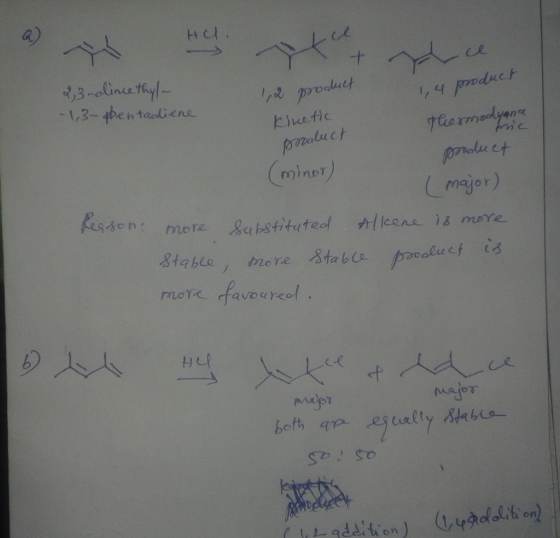
Give the major products obtained from the reaction of one equivalent of HCl with the following:...
Draw the major products obtained from heating each of the following ethers with one equivalent of HI Part A Draw the major products obtained from heating each of the following ethers with one eq...
 Draw the major products obtained from heating each of the following ethers with one equivalent of HI Part A
Draw the major products obtained from heating each of the following ethers with one equivalent of HI Part A
Draw the major products obtained from heating each of the following ethers with one equivalent of HI Part A
3. Predict and label the major and minor products from the following E2 reaction. Justify your...
 3. Predict and label the major and minor products from the following E2 reaction. Justify your answer with figures which demonstrate the transition state leading to the products obtained (4 points) 4. When the two constitutional isomers, 3,3-dimethyl-1-butene and 2,3-dimethyl-2-butene, are reacted with HCl the same major product is formed. Explain the observation and identify the product. (4 points) Scanned with CamScanner
What products are obtained from the reaction of the following compounds with one equivalent of Br2....
 What products are obtained from the reaction of the following compounds with one equivalent of Br2. using FeBrz as a catalyst? Part A choch Part B What products are obtained from the reaction of the following compounds with one equivalent of Br. using FeBr3 as a catalyst? What products are obtained from the reaction of the following compounds with one equivalent of Br2. using FeBr3 as a catalyst? o ano What products are obtained from the reaction of the following...
For each of the following reactions, give the major products (kinetic and thermodynamic). (Hint: to determine...
 For each of the following reactions, give the major products (kinetic and thermodynamic). (Hint: to determine the major products, consider #2 above) 4. HC HCI a. kinetic thermodynamic kinetic thermodynamic HCI HCI d. C. kinetic thermodynamic kinetic the rm odynamic
Alder Re? 9. Draw the two major products for the following reaction. a. Identify each as...
 Alder Re? 9. Draw the two major products for the following reaction. a. Identify each as either a 1,2 or 1,4 addition product. b. Write either "thermodynamic" or "kinetic" underneath each one. c. Draw the two resonance structures for the intermediate from which both form H-Br ton nroducts for the following reaction. Draw the the major product or products for the following reaction. Drow the resonance structures for the intermediate from which both form Bra/ hv NBS/ peroxides 11. Give...
22. What is the major organic product obtained from the following reaction? ho A) 2 B)4...
 22. What is the major organic product obtained from the following reaction? ho A) 2 B)4 C)3 D) 1 23. What is the correct name for the molecule below: A) 2,6-dimethyl-3-oxonon-2-ene B) B) 2,6-dimethylnona-8-oxone C) C) 4,8-dimethylnon-7-en-2-one D) 4,8-dimethyl-2-oxonon-7-ene 24. Which of the following describes a synthesis of an aldehyde? A) hydrogenation of an acid chloride using Pd/BaSO4/S as a poisoned catalyst B) reaction of a primary alcohol with Na2Cr207 C) reaction of a ketone with ozone D) treatment of...
Question 5 (2 points) What are the major organic products obtained from the following reaction? Br...
 Question 5 (2 points) What are the major organic products obtained from the following reaction? Br N-bromosuccinimide hy Br O1 and 2 3 and 4 1 and 3 2 and 4
Draw the kinetic and the thermodynamic addition products formed when one equivalent of HBr reacts with...
 Draw the kinetic and the thermodynamic addition products formed
when one equivalent of HBr reacts with the following compound. Draw
a single product for each. Ignore stereochemical or chiral
isomers.
Draw the kinetic and the thermodynamic addition products formed when one equivalent of HBr reacts with the following compound. Draw a single product for each. Ignore stereochemical or chiral isomers. kinetic product: HBr one equivalent thermodynamic product
Draw the kinetic and the thermodynamic addition products formed
when one equivalent of HBr reacts with the following compound. Draw
a single product for each. Ignore stereochemical or chiral
isomers.
Draw the kinetic and the thermodynamic addition products formed when one equivalent of HBr reacts with the following compound. Draw a single product for each. Ignore stereochemical or chiral isomers. kinetic product: HBr one equivalent thermodynamic product
Consider the following reaction: Reagents sCy major Jinor 95:5 If the products produced are the 2 diastereomers show...
 Consider the following reaction: Reagents sCy major Jinor 95:5 If the products produced are the 2 diastereomers shown in the given ratio, which of the following statements best describes the reaction? Question 4 options: Based on the data given, it cannot be determined if this reaction is under kinetic or thermodynamic control. The reaction is under thermodynamic control as the products are more stable than the starting material. The reaction is under thermodynamic control as the major product is the...
Draw the two major products obtained in the reaction shown. + CH2Cl2 Brz (one equivalent) • You do not have to conside...
 Draw the two major products obtained in the reaction shown. + CH2Cl2 Brz (one equivalent) • You do not have to consider stereochemistry. • You do not have to explicitly draw H atoms. • Draw one structure per sketcher. Add additional sketchers using the drop-down menu in the bottom right corner. • Separate multiple products using the + sign from the drop-down menu. Draw the major 1,2- and 1,4-addition products obtained in the reaction shown. Assume that both are derived...
 Draw the major products obtained from heating each of the following ethers with one equivalent of HI Part A
Draw the major products obtained from heating each of the following ethers with one equivalent of HI Part A
Draw the major products obtained from heating each of the following ethers with one equivalent of HI Part A
 3. Predict and label the major and minor products from the following E2 reaction. Justify your answer with figures which demonstrate the transition state leading to the products obtained (4 points) 4. When the two constitutional isomers, 3,3-dimethyl-1-butene and 2,3-dimethyl-2-butene, are reacted with HCl the same major product is formed. Explain the observation and identify the product. (4 points) Scanned with CamScanner
 What products are obtained from the reaction of the following compounds with one equivalent of Br2. using FeBrz as a catalyst? Part A choch Part B What products are obtained from the reaction of the following compounds with one equivalent of Br. using FeBr3 as a catalyst? What products are obtained from the reaction of the following compounds with one equivalent of Br2. using FeBr3 as a catalyst? o ano What products are obtained from the reaction of the following...
 For each of the following reactions, give the major products (kinetic and thermodynamic). (Hint: to determine the major products, consider #2 above) 4. HC HCI a. kinetic thermodynamic kinetic thermodynamic HCI HCI d. C. kinetic thermodynamic kinetic the rm odynamic
 Alder Re? 9. Draw the two major products for the following reaction. a. Identify each as either a 1,2 or 1,4 addition product. b. Write either "thermodynamic" or "kinetic" underneath each one. c. Draw the two resonance structures for the intermediate from which both form H-Br ton nroducts for the following reaction. Draw the the major product or products for the following reaction. Drow the resonance structures for the intermediate from which both form Bra/ hv NBS/ peroxides 11. Give...
 22. What is the major organic product obtained from the following reaction? ho A) 2 B)4 C)3 D) 1 23. What is the correct name for the molecule below: A) 2,6-dimethyl-3-oxonon-2-ene B) B) 2,6-dimethylnona-8-oxone C) C) 4,8-dimethylnon-7-en-2-one D) 4,8-dimethyl-2-oxonon-7-ene 24. Which of the following describes a synthesis of an aldehyde? A) hydrogenation of an acid chloride using Pd/BaSO4/S as a poisoned catalyst B) reaction of a primary alcohol with Na2Cr207 C) reaction of a ketone with ozone D) treatment of...
 Question 5 (2 points) What are the major organic products obtained from the following reaction? Br N-bromosuccinimide hy Br O1 and 2 3 and 4 1 and 3 2 and 4
 Draw the kinetic and the thermodynamic addition products formed
when one equivalent of HBr reacts with the following compound. Draw
a single product for each. Ignore stereochemical or chiral
isomers.
Draw the kinetic and the thermodynamic addition products formed when one equivalent of HBr reacts with the following compound. Draw a single product for each. Ignore stereochemical or chiral isomers. kinetic product: HBr one equivalent thermodynamic product
Draw the kinetic and the thermodynamic addition products formed
when one equivalent of HBr reacts with the following compound. Draw
a single product for each. Ignore stereochemical or chiral
isomers.
Draw the kinetic and the thermodynamic addition products formed when one equivalent of HBr reacts with the following compound. Draw a single product for each. Ignore stereochemical or chiral isomers. kinetic product: HBr one equivalent thermodynamic product
 Consider the following reaction: Reagents sCy major Jinor 95:5 If the products produced are the 2 diastereomers shown in the given ratio, which of the following statements best describes the reaction? Question 4 options: Based on the data given, it cannot be determined if this reaction is under kinetic or thermodynamic control. The reaction is under thermodynamic control as the products are more stable than the starting material. The reaction is under thermodynamic control as the major product is the...
 Draw the two major products obtained in the reaction shown. + CH2Cl2 Brz (one equivalent) • You do not have to consider stereochemistry. • You do not have to explicitly draw H atoms. • Draw one structure per sketcher. Add additional sketchers using the drop-down menu in the bottom right corner. • Separate multiple products using the + sign from the drop-down menu. Draw the major 1,2- and 1,4-addition products obtained in the reaction shown. Assume that both are derived...
Most questions answered within 3 hours.
-
Where is the error in this code sequence?
String s1 = "Hello";
String s2 = "ello";...
asked 10 months ago -
Financial data for Joel de Paris, Inc., for last year
follow:
Joel de Paris, Inc.
Balance...
asked 10 months ago -
Consider this reaction:
Al2(SO4)3 (aq)+ BaCl3
(aq) Al2Cl6 (aq)- +
3BaSO4(s) . What is the...
asked 10 months ago -
Suppose that Savneet is considering increasing her
recent random sample from 20 car rentals to 40...
asked 10 months ago -
Trucks arrive at an unloading terminal at an average rate of 120
per hour.
Trucks arrive...
asked 10 months ago -
Why are methanol and ethanol completely soluble in water while
octanol is not very little soluble....
asked 10 months ago -
A facilities manager at a university reads in a research report
that the mean amount of...
asked 10 months ago -
When the CuSO4 is rehydrated by adding water to the anhydrous
compound, is this an endothermic...
asked 10 months ago -
A ray of sunlight is passing from diamond into crown glass; the
angle of incidence is...
asked 10 months ago -
A block of mass 0.249 kg is placed on top of a light, vertical
spring of...
asked 10 months ago -
how do the kidneys compensate in the presences of acidosis
a) trigger hyperventilate
b) reserve acid...
asked 10 months ago -
Question 501 pts
The rental rate of capital to the firm increases. Which of the
following...
asked 10 months ago