Assembly code Selection Sort
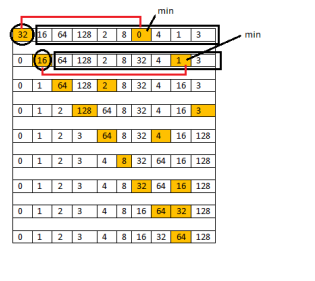

a) Calculating the average value of array elements and assigning it to the variable avg,
b) Write the code that implements the Selective Sorting algorithm in assembly language (emu 8086) with the option a, in the blank space below, explain the code.
n = 10 (number of elements in array a)
a [10] = {32, 16, 64, 128, 2, 8, 0, 4, 1, 3}
Homework Answers
Request Answer!
We need at least 10 more requests to produce the answer.
0 / 10 have requested this problem solution
The more requests, the faster the answer.
Write code by Assembly language Microprocessor - 8086 Example An sbit signed int array of size...
 Write code by Assembly language
Microprocessor - 8086
Example An sbit signed int array of size 1024 elements is starting at slooh, Write apiece of code to sort the array asending order ?
Write code by Assembly language
Microprocessor - 8086
Example An sbit signed int array of size 1024 elements is starting at slooh, Write apiece of code to sort the array asending order ?
Programming Problem: SUMMING ARRAY ELEMENTS - Use Assembly Language x86 (MASM) Write an assembly code...
Programming Problem: SUMMING ARRAY ELEMENTS - Use Assembly Language x86 (MASM) Write an assembly code calculates the sum of all array elements. Save the sum in the EAX register. ------------------------------------------------------------------------------- This is my code so far: INCLUDE Irvine32.inc N=10 .data array SDWORD N DUP(0,1,2,3,4,5,6,7,8,9) j DWORD ? k DWORD ? .code main PROC ; not complete exit main ENDP END main
[C++ language] Write down the steps how insertion sort for sorting the following elements in an...
[C++ language] Write down the steps how insertion sort for sorting the following elements in an array: 22, 1, 7, -9, 121, 75, 89, 29, 500, 43 I need Steps as an algorithm plus the code and screenshotes
Write a program in MIPS assembly language that implements the DESCENDING bubble sort algorithm to sort a variable-sized array of signed 32-bit integers
Write a program in MIPS assembly language that implements the DESCENDING bubble sort algorithm to sort a variable-sized array of signed 32-bit integers (words)that are read from the console. Be reminded that in a descending sort, the integers are sorted from the largest to the smallest. A “special value” 99999 will beused to signify the end of the input sequence. This value is not to be considered part of the input data set. However, any value greater than 99999 that...
sample bubble sort code: ;---------------------------------------------------------- BubbleSort PROC USES eax ecx esi, pArray:PTR DWORD, ; pointer to...
 sample bubble sort code:
;----------------------------------------------------------
BubbleSort PROC USES eax ecx esi,
pArray:PTR DWORD, ; pointer to array
Count:DWORD ; array size
;
; Sort an array of 32-bit signed integers in ascending
; order, using the bubble sort algorithm.
; Receives: pointer to array, array size
; Returns: nothing
;-----------------------------------------------------------
mov ecx,Count
dec ecx ; decrement count by 1
L1: push ecx ; save outer loop count
mov esi,pArray ; point to first value
L2: mov eax,[esi] ; get array...
sample bubble sort code:
;----------------------------------------------------------
BubbleSort PROC USES eax ecx esi,
pArray:PTR DWORD, ; pointer to array
Count:DWORD ; array size
;
; Sort an array of 32-bit signed integers in ascending
; order, using the bubble sort algorithm.
; Receives: pointer to array, array size
; Returns: nothing
;-----------------------------------------------------------
mov ecx,Count
dec ecx ; decrement count by 1
L1: push ecx ; save outer loop count
mov esi,pArray ; point to first value
L2: mov eax,[esi] ; get array...
sample bubble sort code: ;---------------------------------------------------------- BubbleSort PROC USES eax ecx esi, pArray:PTR DWORD, ; pointer to...
 sample bubble sort code:
;----------------------------------------------------------
BubbleSort PROC USES eax ecx esi,
pArray:PTR DWORD, ; pointer to array
Count:DWORD ; array size
;
; Sort an array of 32-bit signed integers in ascending
; order, using the bubble sort algorithm.
; Receives: pointer to array, array size
; Returns: nothing
;-----------------------------------------------------------
mov ecx,Count
dec ecx ; decrement count by 1
L1: push ecx ; save outer loop count
mov esi,pArray ; point to first value
L2: mov eax,[esi] ; get array...
sample bubble sort code:
;----------------------------------------------------------
BubbleSort PROC USES eax ecx esi,
pArray:PTR DWORD, ; pointer to array
Count:DWORD ; array size
;
; Sort an array of 32-bit signed integers in ascending
; order, using the bubble sort algorithm.
; Receives: pointer to array, array size
; Returns: nothing
;-----------------------------------------------------------
mov ecx,Count
dec ecx ; decrement count by 1
L1: push ecx ; save outer loop count
mov esi,pArray ; point to first value
L2: mov eax,[esi] ; get array...
MIPS insertion sort program......could really use some assistance
Write a program in MIPS assembly language that implements the DESCENDING insertion sort algorithm to sort a variable-sized array of signed 32-bit integers (words)that are read from the console. Be reminded that in a descending sort, the integers are sorted from the largest to the smallest. A “special value” 99999 will beused to signify the end of the input sequence. This value is not to be considered part of the input data set. However, any value greater than 99999 that...
MIPS insertion sort program......could really use some assistance
Write a program in MIPS assembly language that implements the DESCENDING insertion sort algorithm to sort a variable-sized array of signed 32-bit integers (words)that are read from the console. Be reminded that in a descending sort, the integers are sorted from the largest to the smallest. A “special value” 99999 will beused to signify the end of the input sequence. This value is not to be considered part of the input data set. However, any value greater than 99999 that...
Sorting Sort the following array using the quick sort algorithm: (4 Marks) a. 12 26 8...
 Sorting Sort the following array using the quick sort algorithm: (4 Marks) a. 12 26 8 9 7 0 4 Pivot selection is defined to be the first element of each sub-list. Show the array before and after each quicksort round (when the array is partitioned after placing the pivot at its correct position). Also, clearly highlight the pivot in each partition b. Consider an unsorted array of integers of size n. Write a Java program to arrange the array...
E2.15 In assembly code, write a program to count the number of elements in an array...
E2.15 In assembly code, write a program to count the number of elements in an array that are smaller than 16. The array is stored at memory locations starting from $1010. The array has 30 8-bit unsigned elements. Store the count in the memory location $C001.
 Write code by Assembly language
Microprocessor - 8086
Example An sbit signed int array of size 1024 elements is starting at slooh, Write apiece of code to sort the array asending order ?
Write code by Assembly language
Microprocessor - 8086
Example An sbit signed int array of size 1024 elements is starting at slooh, Write apiece of code to sort the array asending order ?
 sample bubble sort code:
;----------------------------------------------------------
BubbleSort PROC USES eax ecx esi,
pArray:PTR DWORD, ; pointer to array
Count:DWORD ; array size
;
; Sort an array of 32-bit signed integers in ascending
; order, using the bubble sort algorithm.
; Receives: pointer to array, array size
; Returns: nothing
;-----------------------------------------------------------
mov ecx,Count
dec ecx ; decrement count by 1
L1: push ecx ; save outer loop count
mov esi,pArray ; point to first value
L2: mov eax,[esi] ; get array...
sample bubble sort code:
;----------------------------------------------------------
BubbleSort PROC USES eax ecx esi,
pArray:PTR DWORD, ; pointer to array
Count:DWORD ; array size
;
; Sort an array of 32-bit signed integers in ascending
; order, using the bubble sort algorithm.
; Receives: pointer to array, array size
; Returns: nothing
;-----------------------------------------------------------
mov ecx,Count
dec ecx ; decrement count by 1
L1: push ecx ; save outer loop count
mov esi,pArray ; point to first value
L2: mov eax,[esi] ; get array...
 sample bubble sort code:
;----------------------------------------------------------
BubbleSort PROC USES eax ecx esi,
pArray:PTR DWORD, ; pointer to array
Count:DWORD ; array size
;
; Sort an array of 32-bit signed integers in ascending
; order, using the bubble sort algorithm.
; Receives: pointer to array, array size
; Returns: nothing
;-----------------------------------------------------------
mov ecx,Count
dec ecx ; decrement count by 1
L1: push ecx ; save outer loop count
mov esi,pArray ; point to first value
L2: mov eax,[esi] ; get array...
sample bubble sort code:
;----------------------------------------------------------
BubbleSort PROC USES eax ecx esi,
pArray:PTR DWORD, ; pointer to array
Count:DWORD ; array size
;
; Sort an array of 32-bit signed integers in ascending
; order, using the bubble sort algorithm.
; Receives: pointer to array, array size
; Returns: nothing
;-----------------------------------------------------------
mov ecx,Count
dec ecx ; decrement count by 1
L1: push ecx ; save outer loop count
mov esi,pArray ; point to first value
L2: mov eax,[esi] ; get array...
 Sorting Sort the following array using the quick sort algorithm: (4 Marks) a. 12 26 8 9 7 0 4 Pivot selection is defined to be the first element of each sub-list. Show the array before and after each quicksort round (when the array is partitioned after placing the pivot at its correct position). Also, clearly highlight the pivot in each partition b. Consider an unsorted array of integers of size n. Write a Java program to arrange the array...
Most questions answered within 3 hours.
-
Where is the error in this code sequence?
String s1 = "Hello";
String s2 = "ello";...
asked 11 months ago -
Financial data for Joel de Paris, Inc., for last year
follow:
Joel de Paris, Inc.
Balance...
asked 11 months ago -
Consider this reaction:
Al2(SO4)3 (aq)+ BaCl3
(aq) Al2Cl6 (aq)- +
3BaSO4(s) . What is the...
asked 11 months ago -
Suppose that Savneet is considering increasing her
recent random sample from 20 car rentals to 40...
asked 11 months ago -
Trucks arrive at an unloading terminal at an average rate of 120
per hour.
Trucks arrive...
asked 11 months ago -
Why are methanol and ethanol completely soluble in water while
octanol is not very little soluble....
asked 11 months ago -
A facilities manager at a university reads in a research report
that the mean amount of...
asked 11 months ago -
When the CuSO4 is rehydrated by adding water to the anhydrous
compound, is this an endothermic...
asked 11 months ago -
A ray of sunlight is passing from diamond into crown glass; the
angle of incidence is...
asked 11 months ago -
A block of mass 0.249 kg is placed on top of a light, vertical
spring of...
asked 11 months ago -
how do the kidneys compensate in the presences of acidosis
a) trigger hyperventilate
b) reserve acid...
asked 11 months ago -
Question 501 pts
The rental rate of capital to the firm increases. Which of the
following...
asked 11 months ago