Ochem electron pushing transformation help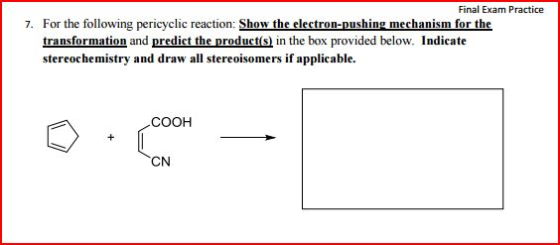
Homework Answers

Add Answer to:
Ochem electron pushing transformation help
For the following pericyclic reaction: Show the electron-pushing mechanism for the...
5. Draw an arrow-pushing mechanism for the following reaction, and predict the stereochemistry of the product(s)....
 5. Draw an arrow-pushing mechanism for the following reaction, and predict the stereochemistry of the product(s). If more than one stereoisomer is formed, state which stereoisomers will be formed in equal quantities and which will be formed in unequal quantities. cat. H2SO4 HO Draw an arrow-pushing mechanism for the following reaction, and predict the stereochemistry of the product(s). If more than one stereoisomer is formed, state which stereoisomers will be formed in equal quantities and which will be formed in...
1) Provide a detailed electron pushing mechanism for the below transformation. Show ALL relevant resonance structures...
 1) Provide a detailed electron pushing mechanism for the below transformation. Show ALL relevant resonance structures to help explain why the para product is the major organic product. (Note: your electron pushing mechanism should include formation of the electrophile) (4 points) Cl AICl3
a) complete the curved arrow electron-pushing mechanism and predict the major organic product of the reaction...
 a) complete the curved arrow electron-pushing mechanism and
predict the major organic product of the reaction when
1-chloropentane is treated with hydroxide in ethanol as shown
below.
a) Complete the curved arrow electron-pushing mechanism and predict the major organic product of the reaction when 1-chloropentane is treated with hydroxide in ethanol as shown below. Use curved arrows to show the Draw the structure of the organic product formed in the reaction. Draw lone pairs. conversion to the product. CH3CH2OH -CI...
a) complete the curved arrow electron-pushing mechanism and
predict the major organic product of the reaction when
1-chloropentane is treated with hydroxide in ethanol as shown
below.
a) Complete the curved arrow electron-pushing mechanism and predict the major organic product of the reaction when 1-chloropentane is treated with hydroxide in ethanol as shown below. Use curved arrows to show the Draw the structure of the organic product formed in the reaction. Draw lone pairs. conversion to the product. CH3CH2OH -CI...
Draw the SN1 mechanism of the reaction between (R)-3-methylhexane and ethanol. Show lone pairs, electron pushing...
 Draw the SN1 mechanism of the reaction between (R)-3-methylhexane
and ethanol. Show lone pairs, electron pushing arrows, 3-D view to
reflect appropriate stereochemistry, reactants,intermediates, and
products. name the product. draw and completely label a reaction
energy diagram corresponding to the mechanism you have drawn.
B. Draw the Snl mechanism of the reaction between (R)-3-bromo-3-methylhexane and ethanol. Show lone pairs, electron pushing arrows, 3-D view to reflect appropriate stereochemistry, reactants, intermediates, and products. You do not have to show transition states....
Draw the SN1 mechanism of the reaction between (R)-3-methylhexane
and ethanol. Show lone pairs, electron pushing arrows, 3-D view to
reflect appropriate stereochemistry, reactants,intermediates, and
products. name the product. draw and completely label a reaction
energy diagram corresponding to the mechanism you have drawn.
B. Draw the Snl mechanism of the reaction between (R)-3-bromo-3-methylhexane and ethanol. Show lone pairs, electron pushing arrows, 3-D view to reflect appropriate stereochemistry, reactants, intermediates, and products. You do not have to show transition states....
4. (15 Points) Pericyclic Reactions: The transformation below can be described as a pericyclic reaction followed by a polar-acidic mechanism, where the acid is not shown because it is picked up from...
 4. (15 Points) Pericyclic Reactions: The transformation below can be described as a pericyclic reaction followed by a polar-acidic mechanism, where the acid is not shown because it is picked up from the environment. (a) Start by redrawing the starting material below, and show how the pericyclic reaction occurs with curved arrows. (b) Specify the type of pericyclic reaction it represents and the name reaction. (c) If you've done the pericyclic reaction correctly, your product will be an enol. From...
Complete the electron pushing mechanism for the formation of the major product in the following reaction...
 Complete the electron pushing mechanism for the formation of the major product in the following reaction by adding any missing charges, atoms, bonds, non-bonding electrons, and curved arrows. Predict all the products of the reaction.
Complete the electron pushing mechanism for the formation of the major product in the following reaction by adding any missing charges, atoms, bonds, non-bonding electrons, and curved arrows. Predict all the products of the reaction.
Complete the electron pushing mechanism for the formation of the major product in the following reaction by adding any missing charges, atoms, bonds, non-bonding electrons, and curved arrows. Predict all the products of the reaction.
b Write a mechanism for the reaction using curved arrows to show electron reorganization. Consult the arrow-pushing ins...
 b Write a mechanism for the reaction using curved arrows to show electron reorganization. Consult the arrow-pushing instructions for the convention on regiospecific electrophilic attack on a double bond. Arrow-pushing Instructions inox tv no H- B Draw the organic product of the following reaction. CH3 meta-Chloroperoxy- benzoic acid • You do not have to consider stereochemistry. • Indicate regiochemistry when relevant. • The aromatic ring, when present, is unreactive in all cases. • Do not draw organic or inorganic by-products....
For the reaction below: Draw the complete electron pushing arrow mechanism to show the formation of...
 For the reaction below: Draw the complete electron pushing arrow mechanism to show the formation of the final product shown. Explain every step of your mechanism. Explain why this is a product favored reaction. ii. H30* H20 OH A
Draw a full mechanism for the following transformation and predict the product. Show all the elementary...
 Draw a full mechanism for the following transformation and
predict the product. Show all the elementary step(s) being sure to
include all arrows, important electron pairs and any formal charges
if needed.
SHORT ANSWER # 27: Draw a full mechanism for the following transformation and predict the product. Show all the elementary step(s) being sure to include all arrows, important electron pairs and any formal charges if needed. (8 points) H H+ HO hemiacetal product
Draw a full mechanism for the following transformation and
predict the product. Show all the elementary step(s) being sure to
include all arrows, important electron pairs and any formal charges
if needed.
SHORT ANSWER # 27: Draw a full mechanism for the following transformation and predict the product. Show all the elementary step(s) being sure to include all arrows, important electron pairs and any formal charges if needed. (8 points) H H+ HO hemiacetal product
Draw the SN2 mechanism of the reaction between (S)-2-bromobutane and iodid ion. Show lone pairs, electron...
 Draw the SN2 mechanism of the reaction between (S)-2-bromobutane
and iodid ion. Show lone pairs, electron pushing arrows, 3-D view
to reflect appropriate stereochemistry, reactants, transition
states, and products. name the product. draw and completely label a
reaction energy diagram corresponding to the mechanism you have
drawn.
f. Draw the Sn2 mechanism of the reaction between (s)-2-bromobutane and iodide ion. Show lone pairs, electron pushing arrows, 3-D view to reflect appropriate stereochemistry, reactants, transition states, and products. Name the product....
Draw the SN2 mechanism of the reaction between (S)-2-bromobutane
and iodid ion. Show lone pairs, electron pushing arrows, 3-D view
to reflect appropriate stereochemistry, reactants, transition
states, and products. name the product. draw and completely label a
reaction energy diagram corresponding to the mechanism you have
drawn.
f. Draw the Sn2 mechanism of the reaction between (s)-2-bromobutane and iodide ion. Show lone pairs, electron pushing arrows, 3-D view to reflect appropriate stereochemistry, reactants, transition states, and products. Name the product....
 5. Draw an arrow-pushing mechanism for the following reaction, and predict the stereochemistry of the product(s). If more than one stereoisomer is formed, state which stereoisomers will be formed in equal quantities and which will be formed in unequal quantities. cat. H2SO4 HO Draw an arrow-pushing mechanism for the following reaction, and predict the stereochemistry of the product(s). If more than one stereoisomer is formed, state which stereoisomers will be formed in equal quantities and which will be formed in...
 1) Provide a detailed electron pushing mechanism for the below transformation. Show ALL relevant resonance structures to help explain why the para product is the major organic product. (Note: your electron pushing mechanism should include formation of the electrophile) (4 points) Cl AICl3
 a) complete the curved arrow electron-pushing mechanism and
predict the major organic product of the reaction when
1-chloropentane is treated with hydroxide in ethanol as shown
below.
a) Complete the curved arrow electron-pushing mechanism and predict the major organic product of the reaction when 1-chloropentane is treated with hydroxide in ethanol as shown below. Use curved arrows to show the Draw the structure of the organic product formed in the reaction. Draw lone pairs. conversion to the product. CH3CH2OH -CI...
a) complete the curved arrow electron-pushing mechanism and
predict the major organic product of the reaction when
1-chloropentane is treated with hydroxide in ethanol as shown
below.
a) Complete the curved arrow electron-pushing mechanism and predict the major organic product of the reaction when 1-chloropentane is treated with hydroxide in ethanol as shown below. Use curved arrows to show the Draw the structure of the organic product formed in the reaction. Draw lone pairs. conversion to the product. CH3CH2OH -CI...
 Draw the SN1 mechanism of the reaction between (R)-3-methylhexane
and ethanol. Show lone pairs, electron pushing arrows, 3-D view to
reflect appropriate stereochemistry, reactants,intermediates, and
products. name the product. draw and completely label a reaction
energy diagram corresponding to the mechanism you have drawn.
B. Draw the Snl mechanism of the reaction between (R)-3-bromo-3-methylhexane and ethanol. Show lone pairs, electron pushing arrows, 3-D view to reflect appropriate stereochemistry, reactants, intermediates, and products. You do not have to show transition states....
Draw the SN1 mechanism of the reaction between (R)-3-methylhexane
and ethanol. Show lone pairs, electron pushing arrows, 3-D view to
reflect appropriate stereochemistry, reactants,intermediates, and
products. name the product. draw and completely label a reaction
energy diagram corresponding to the mechanism you have drawn.
B. Draw the Snl mechanism of the reaction between (R)-3-bromo-3-methylhexane and ethanol. Show lone pairs, electron pushing arrows, 3-D view to reflect appropriate stereochemistry, reactants, intermediates, and products. You do not have to show transition states....
 4. (15 Points) Pericyclic Reactions: The transformation below can be described as a pericyclic reaction followed by a polar-acidic mechanism, where the acid is not shown because it is picked up from the environment. (a) Start by redrawing the starting material below, and show how the pericyclic reaction occurs with curved arrows. (b) Specify the type of pericyclic reaction it represents and the name reaction. (c) If you've done the pericyclic reaction correctly, your product will be an enol. From...
 Complete the electron pushing mechanism for the formation of the major product in the following reaction by adding any missing charges, atoms, bonds, non-bonding electrons, and curved arrows. Predict all the products of the reaction.
Complete the electron pushing mechanism for the formation of the major product in the following reaction by adding any missing charges, atoms, bonds, non-bonding electrons, and curved arrows. Predict all the products of the reaction.
Complete the electron pushing mechanism for the formation of the major product in the following reaction by adding any missing charges, atoms, bonds, non-bonding electrons, and curved arrows. Predict all the products of the reaction.
 b Write a mechanism for the reaction using curved arrows to show electron reorganization. Consult the arrow-pushing instructions for the convention on regiospecific electrophilic attack on a double bond. Arrow-pushing Instructions inox tv no H- B Draw the organic product of the following reaction. CH3 meta-Chloroperoxy- benzoic acid • You do not have to consider stereochemistry. • Indicate regiochemistry when relevant. • The aromatic ring, when present, is unreactive in all cases. • Do not draw organic or inorganic by-products....
 For the reaction below: Draw the complete electron pushing arrow mechanism to show the formation of the final product shown. Explain every step of your mechanism. Explain why this is a product favored reaction. ii. H30* H20 OH A
 Draw a full mechanism for the following transformation and
predict the product. Show all the elementary step(s) being sure to
include all arrows, important electron pairs and any formal charges
if needed.
SHORT ANSWER # 27: Draw a full mechanism for the following transformation and predict the product. Show all the elementary step(s) being sure to include all arrows, important electron pairs and any formal charges if needed. (8 points) H H+ HO hemiacetal product
Draw a full mechanism for the following transformation and
predict the product. Show all the elementary step(s) being sure to
include all arrows, important electron pairs and any formal charges
if needed.
SHORT ANSWER # 27: Draw a full mechanism for the following transformation and predict the product. Show all the elementary step(s) being sure to include all arrows, important electron pairs and any formal charges if needed. (8 points) H H+ HO hemiacetal product
 Draw the SN2 mechanism of the reaction between (S)-2-bromobutane
and iodid ion. Show lone pairs, electron pushing arrows, 3-D view
to reflect appropriate stereochemistry, reactants, transition
states, and products. name the product. draw and completely label a
reaction energy diagram corresponding to the mechanism you have
drawn.
f. Draw the Sn2 mechanism of the reaction between (s)-2-bromobutane and iodide ion. Show lone pairs, electron pushing arrows, 3-D view to reflect appropriate stereochemistry, reactants, transition states, and products. Name the product....
Draw the SN2 mechanism of the reaction between (S)-2-bromobutane
and iodid ion. Show lone pairs, electron pushing arrows, 3-D view
to reflect appropriate stereochemistry, reactants, transition
states, and products. name the product. draw and completely label a
reaction energy diagram corresponding to the mechanism you have
drawn.
f. Draw the Sn2 mechanism of the reaction between (s)-2-bromobutane and iodide ion. Show lone pairs, electron pushing arrows, 3-D view to reflect appropriate stereochemistry, reactants, transition states, and products. Name the product....
Most questions answered within 3 hours.
-
Where is the error in this code sequence?
String s1 = "Hello";
String s2 = "ello";...
asked 10 months ago -
Financial data for Joel de Paris, Inc., for last year
follow:
Joel de Paris, Inc.
Balance...
asked 10 months ago -
Consider this reaction:
Al2(SO4)3 (aq)+ BaCl3
(aq) Al2Cl6 (aq)- +
3BaSO4(s) . What is the...
asked 10 months ago -
Suppose that Savneet is considering increasing her
recent random sample from 20 car rentals to 40...
asked 10 months ago -
Trucks arrive at an unloading terminal at an average rate of 120
per hour.
Trucks arrive...
asked 10 months ago -
Why are methanol and ethanol completely soluble in water while
octanol is not very little soluble....
asked 10 months ago -
A facilities manager at a university reads in a research report
that the mean amount of...
asked 10 months ago -
When the CuSO4 is rehydrated by adding water to the anhydrous
compound, is this an endothermic...
asked 10 months ago -
A ray of sunlight is passing from diamond into crown glass; the
angle of incidence is...
asked 10 months ago -
A block of mass 0.249 kg is placed on top of a light, vertical
spring of...
asked 10 months ago -
how do the kidneys compensate in the presences of acidosis
a) trigger hyperventilate
b) reserve acid...
asked 10 months ago -
Question 501 pts
The rental rate of capital to the firm increases. Which of the
following...
asked 10 months ago