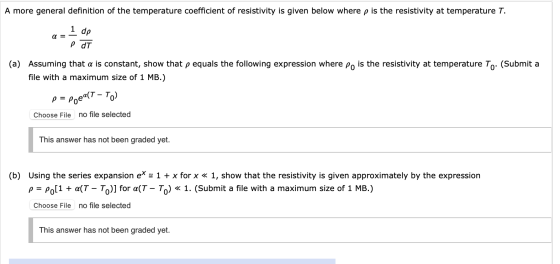
A more general definition of the temperature coefficient of resistivity is given below where ? is the resistivity at temperature T.
Homework Answers
Request Answer!
We need at least 10 more requests to produce the answer.
0 / 10 have requested this problem solution
The more requests, the faster the answer.
Add Answer to:
A more general definition of the temperature coefficient of resistivity is given below where ? is the resistivity at temperature T.
The temperature coefficient of resistance α in equation R(T)=R0[1+α(T−T0)] equals the temperature coefficient of resistivity α...
The temperature coefficient of resistance α in equation R(T)=R0[1+α(T−T0)] equals the temperature coefficient of resistivity α in equation ρ(T)=ρ0[1+α(T−T0)] only if the coefficient of thermal expansion is small. A cylindrical column of mercury is in a vertical glass tube. At 20 ∘C, the length of the mercury column is 12.0 cm. The diameter of the mercury column is 1.6 mm and doesn't change with temperature because glass has a small coefficient of thermal expansion. The coefficient of volume expansion of...
Resistance in metals increases with increasing temperature according to the equation, ρ(T) = ρo(1 + α(T - To)) where α is the temperature coefficient of resistivity and ρo is the resistivity at temperature To. For a particular wire α = 1.5 × 10⁻³ 1/°C and
 Resistance in metals increases with increasing temperature according to the equation, ρ(T) = ρo(1 + α(T - To)) where α is the temperature coefficient of resistivity and ρo is the resistivity at temperature To. For a particular wire α = 1.5 × 10⁻³ 1/°C and the resistivity is ρo = 8.5 × 10⁻⁷ Ω⋅m at To = 125 °C.
The temperature coefficient of resistivity for the metal gold is 0.0034 (C°)-1, and for tungsten it...
The temperature coefficient of resistivity for the metal gold is 0.0034 (C°)-1, and for tungsten it is 0.0045 (C°)-1. The resistance of a gold wire increases by 7.2 percent due to an increase in temperature. For the same increase in temperature, what is the percentage increase in the resistance in a tungsten wire?
Material A has a temperature coefficient of resistivity 4 times that of material B. If a...
Material A has a temperature coefficient of resistivity 4 times that of material B. If a cylindrical rod of material B had the same resistance as a cylindrical rod of material A (that is twice as long) how are the radii of the two rods related? The resistivity of material B is 8 times that of material A.
Which is not a requirement for RTD material? High temperature coefficient and High resistivity to ensure...
 Which is not a requirement for RTD material? High temperature coefficient and High resistivity to ensure small wire length Sufficient mechanical strength Instability of electrical characteristics Du Linearity of relation between resistance and temperature
The temperature coefficient of resistivity of a material is 0.0036 (C°)-1. By how much ΔT does...
The temperature coefficient of resistivity of a material is 0.0036 (C°)-1. By how much ΔT does the temperature of a wire made from this material have to change, in order that the resistance of the wire doubles?
Tungsten has a temperature coefficient of resistivity of 0.0045 (C°)-1. A tungsten wire is connected to...
Tungsten has a temperature coefficient of resistivity of 0.0045 (C°)-1. A tungsten wire is connected to a source of constant voltage via a switch. At the instant the switch is closed, the temperature of the wire is 28 °C, and the initial power delivered to the wire is P0. At what wire temperature will the power that is delivered to the wire be decreased to 1/2 P0?
The temperature coefficient of resistivity of a material is 0.0049 (C°)-1. By how much ΔT does...
The temperature coefficient of resistivity of a material is 0.0049 (C°)-1. By how much ΔT does the temperature of a wire made from this material have to change, in order that the resistance of the wire doubles?
4. Draw InD vs. I/T curve where D is the diffusion coefficient and T is temperature....
 4. Draw InD vs. I/T curve where D is the diffusion coefficient and T is temperature. Show the slope and intercept. What do the slope and the intercept represent. (2p)
Q2: Find the general solution to T' = AT where A is given by 1-3 -2]...
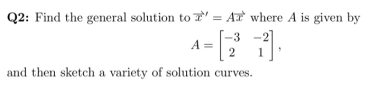 Q2: Find the general solution to T' = AT where A is given by 1-3 -2] A = 2 1]' and then sketch a variety of solution curves.
 Which is not a requirement for RTD material? High temperature coefficient and High resistivity to ensure small wire length Sufficient mechanical strength Instability of electrical characteristics Du Linearity of relation between resistance and temperature
 4. Draw InD vs. I/T curve where D is the diffusion coefficient and T is temperature. Show the slope and intercept. What do the slope and the intercept represent. (2p)
 Q2: Find the general solution to T' = AT where A is given by 1-3 -2] A = 2 1]' and then sketch a variety of solution curves.
Most questions answered within 3 hours.
-
Where is the error in this code sequence?
String s1 = "Hello";
String s2 = "ello";...
asked 10 months ago -
Financial data for Joel de Paris, Inc., for last year
follow:
Joel de Paris, Inc.
Balance...
asked 10 months ago -
Consider this reaction:
Al2(SO4)3 (aq)+ BaCl3
(aq) Al2Cl6 (aq)- +
3BaSO4(s) . What is the...
asked 10 months ago -
Suppose that Savneet is considering increasing her
recent random sample from 20 car rentals to 40...
asked 10 months ago -
Trucks arrive at an unloading terminal at an average rate of 120
per hour.
Trucks arrive...
asked 10 months ago -
Why are methanol and ethanol completely soluble in water while
octanol is not very little soluble....
asked 10 months ago -
A facilities manager at a university reads in a research report
that the mean amount of...
asked 10 months ago -
When the CuSO4 is rehydrated by adding water to the anhydrous
compound, is this an endothermic...
asked 10 months ago -
A ray of sunlight is passing from diamond into crown glass; the
angle of incidence is...
asked 10 months ago -
A block of mass 0.249 kg is placed on top of a light, vertical
spring of...
asked 10 months ago -
how do the kidneys compensate in the presences of acidosis
a) trigger hyperventilate
b) reserve acid...
asked 10 months ago -
Question 501 pts
The rental rate of capital to the firm increases. Which of the
following...
asked 10 months ago