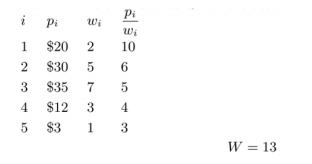
1) Use the Breadth-First-Search with Branch-and-Bound Pruning algorithm for the 0–1 Knapsack problem to maximize the profit for the following problem instance. Show the actions step by step.
2) Use the Best-First Search with Branch-and-Bound Pruning algorithm for the 0–1 Knapsack problem to maximize the profit for the following problem instance. Show the actions step by step.
Homework Answers
Request Answer!
We need at least 10 more requests to produce the answer.
0 / 10 have requested this problem solution
The more requests, the faster the answer.
Add Answer to:
1) Use the Breadth-First-Search with Branch-and-Bound Pruning
algorithm for the 0–1 Knapsack problem to maximize the...
Use the Best-First Search with Branch-and-Bound Pruning algorithm for the 0–1 Knapsack problem to maximize the...
 Use the Best-First Search with Branch-and-Bound Pruning
algorithm for the 0–1 Knapsack problem to maximize the profit for
the following problem instance. Show the actions step by step.
i P 1 $20 2 10 2 $30 5 6 3 $35 75 4 $12 3 4 5 $3 13
Use the Best-First Search with Branch-and-Bound Pruning
algorithm for the 0–1 Knapsack problem to maximize the profit for
the following problem instance. Show the actions step by step.
i P 1 $20 2 10 2 $30 5 6 3 $35 75 4 $12 3 4 5 $3 13
Section 6.1 1. Use Algorithm 6.1 (The Breadth-First Search with Branch-and-Bound Pruning algorithm for the 0-1...
 Section 6.1 1. Use Algorithm 6.1 (The Breadth-First Search with Branch-and-Bound Pruning algorithm for the 0-1 Knapsack problem) to maximize the profit for the following problem instance. Show the actions step by step i P t0 1 $20 2 10 2 830 56 3 835 75 4 812 3 4 5 83 1 3 W= 13
(2) (15 points) Use the Best-First Search with Branch-and-Bound Pruning algorithm for the 0-1 Knapsack problem...
 (2) (15 points) Use the Best-First Search with Branch-and-Bound Pruning algorithm for the 0-1 Knapsack problem to maximize the profit for the following problem instance. Show the actions step by step. Pi wi 1 $20 2 10 2 $30 5 6 3 S35 7 5 4 $12 3 4 5 $3 3 wi W 13
Solve 01 Knapsack problem using 1) Backtracking 2) Breath first search with branch and bound 3)...
 Solve 01 Knapsack problem using 1) Backtracking 2) Breath first
search with branch and bound 3) Best fit search with branch
bound.
Find out maxprofit and solution vector X=(x1,x2,x3,x4,x5).
You need to show how you solve it using pruned state space
tree.
plw $20* $30» $35.» $12* $3. pi/wi- 10» 60 5» 4° 30 2» 5* 2» 30 4° 30 W=12(Knapsack capacity)-
Solve 01 Knapsack problem using 1) Backtracking 2) Breath first
search with branch and bound 3) Best fit search with branch
bound.
Find out maxprofit and solution vector X=(x1,x2,x3,x4,x5).
You need to show how you solve it using pruned state space
tree.
plw $20* $30» $35.» $12* $3. pi/wi- 10» 60 5» 4° 30 2» 5* 2» 30 4° 30 W=12(Knapsack capacity)-
Local Search Knapsack 0-1
Design a local search algorithm for the 0-1 knapsack problem. Assume there are n items x1 ... xn each with weight wi and value vi. The knapsack can have at most one of each item and the total weight cannot exceed W. You want to maximize the total value in the knapsack.Question 1: (7 points) Show the psuedocode/explanation for your algorithm.Question 2. (3 points) Is it guaranteed to find an optimal solution? Justify your answer.
Minimum Spanning Trees Networks & Graphs 1. Create a spanning tree using the breadth-first search algorithm....
 Minimum Spanning Trees Networks & Graphs 1. Create a spanning tree using the breadth-first search algorithm. Start at A (i..0) and label cach vertex with the correct number after A and show your path. How many edges were used to create a spanning tree? 2. Create a spanning tree using the breadth-first search algorithm. Start at G (ie. O) and label each vertex with the correct number after A and show your path How many edges were used to create...
8. EXTRA CREDIT (15 points] Solve the ILP problem below using the branch-and- bound method with...
 8. EXTRA CREDIT (15 points] Solve the ILP problem below using the branch-and- bound method with LP relaxation, as illustrated on Slides 27-31 of the "ILP: Part II” lecture notes. Show your resulting search tree. You can use MATLAB to solve LP- relaxed subproblems as needed, or you can solve them graphically by hand. maximize subject to 17X1 10x1 + + + 12x2 7x2 X 1 X2 VI VAL 40 5 0 integers. X1, X2 X1, X2 10/3. Branch Hint:...
Consider the following directed graph for each of the problems: 1. Perform a breadth-first search on...
 Consider the following directed graph for each of the
problems:
1. Perform a breadth-first search on the graph assuming that the
vertices and adjacency lists
are listed in alphabetical order. Show the breadth-first search
tree that is generated.
2. Perform a depth-first search on the graph assuming that the
vertices and adjacency lists
are listed in alphabetical order. Classify each edge as tree, back
or cross edge. Label each
vertex with its start and finish time.
3. Remove all the...
Consider the following directed graph for each of the
problems:
1. Perform a breadth-first search on the graph assuming that the
vertices and adjacency lists
are listed in alphabetical order. Show the breadth-first search
tree that is generated.
2. Perform a depth-first search on the graph assuming that the
vertices and adjacency lists
are listed in alphabetical order. Classify each edge as tree, back
or cross edge. Label each
vertex with its start and finish time.
3. Remove all the...
Will rate. Must show all work (30 points. Use the MIP branch-and-bound algorithm to solve the...
 Will rate. Must show all work
(30 points. Use the MIP branch-and-bound algorithm to solve the following problem interactively. Use the graphical method to solver for each LP relaxation problem. Minimize Z = -x - y subject to 5x + 2y = 60 3x + 4y = 45 and X1 2 0,x2 > 0 integers. Show the graph for each LP relaxation problem.
Will rate. Must show all work
(30 points. Use the MIP branch-and-bound algorithm to solve the following problem interactively. Use the graphical method to solver for each LP relaxation problem. Minimize Z = -x - y subject to 5x + 2y = 60 3x + 4y = 45 and X1 2 0,x2 > 0 integers. Show the graph for each LP relaxation problem.
1. Apply the dynamic programming algorithm discussed in class to solve the knapsack problem. (10 points)...
 1. Apply the dynamic programming algorithm discussed in class to solve the knapsack problem. (10 points) a. Show the completed table. b. Which items are included in the final configuration of the knapsack? c. What is the maximum value that can fit in the knapsack using a configuration of these items? item 1 2. 3 4 weight 3 2 value $25 $20 $15 1 capacity W = 6. 4 5 $40 $50 5
 Use the Best-First Search with Branch-and-Bound Pruning
algorithm for the 0–1 Knapsack problem to maximize the profit for
the following problem instance. Show the actions step by step.
i P 1 $20 2 10 2 $30 5 6 3 $35 75 4 $12 3 4 5 $3 13
Use the Best-First Search with Branch-and-Bound Pruning
algorithm for the 0–1 Knapsack problem to maximize the profit for
the following problem instance. Show the actions step by step.
i P 1 $20 2 10 2 $30 5 6 3 $35 75 4 $12 3 4 5 $3 13
 Section 6.1 1. Use Algorithm 6.1 (The Breadth-First Search with Branch-and-Bound Pruning algorithm for the 0-1 Knapsack problem) to maximize the profit for the following problem instance. Show the actions step by step i P t0 1 $20 2 10 2 830 56 3 835 75 4 812 3 4 5 83 1 3 W= 13
 (2) (15 points) Use the Best-First Search with Branch-and-Bound Pruning algorithm for the 0-1 Knapsack problem to maximize the profit for the following problem instance. Show the actions step by step. Pi wi 1 $20 2 10 2 $30 5 6 3 S35 7 5 4 $12 3 4 5 $3 3 wi W 13
 Solve 01 Knapsack problem using 1) Backtracking 2) Breath first
search with branch and bound 3) Best fit search with branch
bound.
Find out maxprofit and solution vector X=(x1,x2,x3,x4,x5).
You need to show how you solve it using pruned state space
tree.
plw $20* $30» $35.» $12* $3. pi/wi- 10» 60 5» 4° 30 2» 5* 2» 30 4° 30 W=12(Knapsack capacity)-
Solve 01 Knapsack problem using 1) Backtracking 2) Breath first
search with branch and bound 3) Best fit search with branch
bound.
Find out maxprofit and solution vector X=(x1,x2,x3,x4,x5).
You need to show how you solve it using pruned state space
tree.
plw $20* $30» $35.» $12* $3. pi/wi- 10» 60 5» 4° 30 2» 5* 2» 30 4° 30 W=12(Knapsack capacity)-
 Minimum Spanning Trees Networks & Graphs 1. Create a spanning tree using the breadth-first search algorithm. Start at A (i..0) and label cach vertex with the correct number after A and show your path. How many edges were used to create a spanning tree? 2. Create a spanning tree using the breadth-first search algorithm. Start at G (ie. O) and label each vertex with the correct number after A and show your path How many edges were used to create...
 8. EXTRA CREDIT (15 points] Solve the ILP problem below using the branch-and- bound method with LP relaxation, as illustrated on Slides 27-31 of the "ILP: Part II” lecture notes. Show your resulting search tree. You can use MATLAB to solve LP- relaxed subproblems as needed, or you can solve them graphically by hand. maximize subject to 17X1 10x1 + + + 12x2 7x2 X 1 X2 VI VAL 40 5 0 integers. X1, X2 X1, X2 10/3. Branch Hint:...
 Consider the following directed graph for each of the
problems:
1. Perform a breadth-first search on the graph assuming that the
vertices and adjacency lists
are listed in alphabetical order. Show the breadth-first search
tree that is generated.
2. Perform a depth-first search on the graph assuming that the
vertices and adjacency lists
are listed in alphabetical order. Classify each edge as tree, back
or cross edge. Label each
vertex with its start and finish time.
3. Remove all the...
Consider the following directed graph for each of the
problems:
1. Perform a breadth-first search on the graph assuming that the
vertices and adjacency lists
are listed in alphabetical order. Show the breadth-first search
tree that is generated.
2. Perform a depth-first search on the graph assuming that the
vertices and adjacency lists
are listed in alphabetical order. Classify each edge as tree, back
or cross edge. Label each
vertex with its start and finish time.
3. Remove all the...
 Will rate. Must show all work
(30 points. Use the MIP branch-and-bound algorithm to solve the following problem interactively. Use the graphical method to solver for each LP relaxation problem. Minimize Z = -x - y subject to 5x + 2y = 60 3x + 4y = 45 and X1 2 0,x2 > 0 integers. Show the graph for each LP relaxation problem.
Will rate. Must show all work
(30 points. Use the MIP branch-and-bound algorithm to solve the following problem interactively. Use the graphical method to solver for each LP relaxation problem. Minimize Z = -x - y subject to 5x + 2y = 60 3x + 4y = 45 and X1 2 0,x2 > 0 integers. Show the graph for each LP relaxation problem.
 1. Apply the dynamic programming algorithm discussed in class to solve the knapsack problem. (10 points) a. Show the completed table. b. Which items are included in the final configuration of the knapsack? c. What is the maximum value that can fit in the knapsack using a configuration of these items? item 1 2. 3 4 weight 3 2 value $25 $20 $15 1 capacity W = 6. 4 5 $40 $50 5
Most questions answered within 3 hours.
-
Where is the error in this code sequence?
String s1 = "Hello";
String s2 = "ello";...
asked 10 months ago -
Financial data for Joel de Paris, Inc., for last year
follow:
Joel de Paris, Inc.
Balance...
asked 10 months ago -
Consider this reaction:
Al2(SO4)3 (aq)+ BaCl3
(aq) Al2Cl6 (aq)- +
3BaSO4(s) . What is the...
asked 10 months ago -
Suppose that Savneet is considering increasing her
recent random sample from 20 car rentals to 40...
asked 10 months ago -
Trucks arrive at an unloading terminal at an average rate of 120
per hour.
Trucks arrive...
asked 10 months ago -
Why are methanol and ethanol completely soluble in water while
octanol is not very little soluble....
asked 10 months ago -
A facilities manager at a university reads in a research report
that the mean amount of...
asked 10 months ago -
When the CuSO4 is rehydrated by adding water to the anhydrous
compound, is this an endothermic...
asked 10 months ago -
A ray of sunlight is passing from diamond into crown glass; the
angle of incidence is...
asked 10 months ago -
A block of mass 0.249 kg is placed on top of a light, vertical
spring of...
asked 10 months ago -
how do the kidneys compensate in the presences of acidosis
a) trigger hyperventilate
b) reserve acid...
asked 10 months ago -
Question 501 pts
The rental rate of capital to the firm increases. Which of the
following...
asked 10 months ago