Economics of international trade
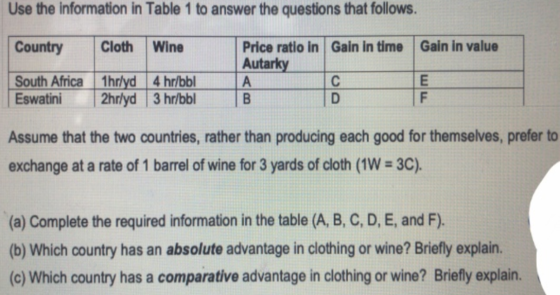
Use the information in Table 1 to answer the questions that follows.
$$ \begin{array}{|l|l|l|l|l|l|} \hline \text { Country } & \text { Cloth } & \text { Wine } & \begin{array}{l} \text { Price ratio in } \\ \text { Autarky } \end{array} & \text { Gain in time } & \text { Gain in value } \\ \hline \text { South Africa } & \text { 1hrlyd } & 4 \mathrm{hr} / \mathrm{bbl} & \mathrm{A} & \mathrm{C} & \mathrm{E} \\ \hline \text { Eswatini } & \text { 2hrlyd } & 3 \mathrm{hr} / \mathrm{bbl} & \mathrm{B} & \mathrm{D} & \mathrm{F} \\ \hline \end{array} $$
Assume that the two countries, rather than producing each good for themselves, prefer to exchange at a rate of 1 barrel of wine for 3 yards of cloth \((1 \mathrm{~W}=3 \mathrm{C}) .\)
(a) Complete the required information in the table \((\mathrm{A}, \mathrm{B}, \mathrm{C}, \mathrm{D}, \mathrm{E},\) and \(\mathrm{F})\).
(b) Which country has an absolute advantage in clothing or wine? Briefly explain.
(c) Which country has a comparative advantage in clothing or wine? Briefly explain.
Homework Answers
(a)Compute the required information in the table (A, B, C, D, E, and F)
Answer
In autarky, relative price ratios are equal to the opportunity cost of production. If a positive amount of both goods are demanded in the market, the cost of purchasing a good must equal the cost to produce the good. Letting South Africa and Eswatini be the same prices ratios as their opportunity cost of production and let us compute for the opportunity cost of each country:
Wine
Computing for both countries opportunity cost for the wine we will also determine the what countries has the comparative advantage of producing wine:
When Eswatini produces 1 barrel of wine, it will cost labor per barrel of an hour of ⅔.
Eswatini has 3 hours in making 1 barrel of wine and 2 hours in making 1 yard of clothing. We can divide both sides by 2 hours to get the cost per barrel. (note* see the given table).
hour or 0.67
Which will equal the opportunity cost of labor of ⅔ hours in making every 1 barrel of wine.
When South Africa produces 1 barrel of wine, it will give an opportunity cost per barrel of an hour of ¼
hour or 0.25
South Africa has 4 hours in making 1 barrel of wine and 1 hour in making 1 yard of clothing. We can divide both sides by 4 hours to get the cost per barrel. (note* see the given table).
We can get this by dividing both sides by 4 hours (note* see the given table).
Which will equal the opportunity cost of labor of ¼ hours in making every 1 barrel of wine.
Therefore, we can now determine what countries have the comparative advantage of producing wine; we will look at who has the lowest opportunity cost of labor when making 1 barrel of wine.
South Africa has the lowest opportunity cost of labor of ¼ hours (0.25) compared to ⅔ hours (0.67) of Eswatini.
It means that South Africa is faster and more efficient when making every 1 barrel of wine than Eswatini.
(c) Thus, South Africa has the Comparative Advantage of producing wine.
Clothing
Computing for both countries opportunity cost for clothing, we will also determine the what countries have the comparative advantage of producing clothing:
When Eswatini produces 1 yard of clothing, it will cost labor per cloth of 1 hour and ½.
Eswatini has 2 hours in making 1 yard of clothing and 3 hours in making 1 barrel of wine. We can divide both sides by 2 hours to get the cost per barrel. (note* see the given table).
or 1 and ½ hours.
Which will equal the opportunity cost of labor of 1 and ½ hours in making every 1 yard of clothing.
When South Africa produces 1 barrel of wine, it will give an opportunity cost per barrel of an hour of 4.
South Africa has 1 hour in making 1 yard of clothing and 4 hours of making 1 barrel of wine. (note* see the given table).
Which will equal the opportunity cost of labor of 4 hours in making every 1 yard of clothing.
Therefore, we can now determine what countries have the comparative advantage of producing clothing; we will look at who has the lowest opportunity cost of labor when creating 1 yard of clothing.
Eswatini has the lowest opportunity cost of labor of 1 hour and ½ (1 hour and 30 minutes) compared to 4 hours of South Africa.
It means that Eswatini is faster and efficient when making every 1 yard of clothing than South Africa.
(c) Thus, Eswatini has the Comparative Advantage of producing wine.
Price ration in Autarky
(A) South Africa Price per barrel of wine = ¼
South Africa Price per yard of clothing = 4
(B) Eswatini Price per barrel of wine = 2/3
Eswatini Price per yard of clothing = 1 and ½
Gain in time
(C) If South Africa trades for 3 yards of clothing in exchange for 1 barrel of wine, South Africa will gain in time of 1 hour.
Let us see; if South Africa produces 3 yards of clothing (because South Africa is more efficient and faster when making cloth, it will only take 1 hour per yard), it will take 3 hours of making it (3 yards multiply by 1 hour). We will subtract the hours when it makes a 1 barrel of wine, which is 4 hours. 4 hours in making 1 barrel of wine minus 3 hours to make 3 yards of clothing equal to 1 hour.
Thus, South Africa will save 1 hour if South Africa is willing to trade.
Thus, South Africa will gain a value of 1 barrel of wine for each trade.
*Note, each country is willing to trade, but it should be regarding which its production has a Comparative Advantage.
(D) If Eswatini will trade for 1 barrel of wine in exchange for 3 yards of clothing, Eswatini will gain in time of 3 hours.
If Eswatini produces 1 barrel of wine (because Eswatini is more efficient and faster when making wine, it will only take 3 hours per barrel), it will take 3 hours of making it (1 barrel multiply by 3 hours). We will subtract the hours when it makes 3 yards of clothing, which is 6 hours (3 yards multiply by 2 hours). 6 hours in making 3 yards of clothing minus 3 hours in making 1 barrel of wine, which will then equal 3 hours.
Thus, Eswatini will save 3 hours if Eswatini is willing to trade.
Thus, Eswatini will gain a value of 3 yards of clothing each trade.
*Note, each country is willing to trade, but it should be regarding which its production has a Comparative Advantage.
Therefore we have the answer for:
C. South Africa gain in time is 1 hour.
D. Eswatini gain in time is 3 hours.
South Africa gained a value of 1 barrel of wine.
Eswatini gained a value of 3 yards of clothing.
(b). For this problem, from the extent of my resources, there will be an absolute advantage only when a producer can produce a good or service in a more significant quantity but still at the same cost or the same quantity at a lower price than the other producers.
On the given problem, we don't have any situation or additional information that will lead to each country's absolute advantage.
For example, if there's additional information on South Africa and Eswatini, there is 1 worker for each country. Still, Eswatini has excel more; it produces more at the same cost, or when South Africa has the same quantity produced, but it lowers the cost of its production of cloth by finding more local and inexpensive materials then, it will give an absolute advantage for South Africa.
Thus, there will be no country that has an absolute advantage.
Gases are different from solids and liquids
 Gases are different from solids and liquids. In a sample of gas, the molecules are far apart. The gas molecules also move around and collide with each other as well as with the walls of the container. These collisions generate pressure. The pressure of a gas can be measured in different units. One convenient unit of measure is called the atmosphere (atm) because it is based on atmospheric pressure. At sea level, the average pressure is 1 atm. As you...
A sample of N203 contains 1 moles of nitrogen....
 A sample of \(\mathrm{N}_{2} \mathrm{O}_{3}\) contains 1 moles of nitrogen. Use the following atomic masses: \(\mathrm{N}=14, \mathrm{O}=16\).$$ \begin{array}{|l|l|l|} \hline \text { The number of moles of } \mathrm{N}_{2} \mathrm{O}_{3} \text { present }= & \mathrm{mol} \mathrm{N}_{2} \mathrm{O}_{3} \\ \hline \text { The mass of the sample }= & \mathrm{g} \mathrm{N}_{2} \mathrm{O}_{3} \\ \hline \text { The number of moles of oxygen in the sample }= & & \mathrm{mol} \mathrm{O} \\ \hline \text { The mass of oxygen in the sample...
Solve table and Req
 1. Calculate the current, voltage potential, and power for each resistor, and fill out Table \(1 .\) Assume \(V_{i n}=24 V\)$$ \begin{array}{|c|c|c|c|c|} \hline \text { Resistor } & \text { Resistance }(\Omega) & \text { Voltage (V) } & \text { Current (mA) } & \text { Power (W) } \\ \hline R_{1} & 1 \mathrm{k} & & & \\ \hline R_{2} & 10 & & & \\ \hline R_{3} & 2 \mathrm{k} & & & \\ \hline R_{4} &...
These questions are about international trade. I want to know the answers. 5 Heckscher-Ohlin Model. Suppose...
 These questions are about international trade.
I want to know the answers.
5 Heckscher-Ohlin Model. Suppose the production of cloth is labour intensive and the production of food is land intensive and suppose the United States (US) is labour abundant and Canada is land abundant. (a) Show how the US production possibility frontier (PPF) differs from the Canadian PPF. Briefly explain. (Use the general version of the PPF's) (b) Which country will have the lower price of cloth Pc relative...
These questions are about international trade.
I want to know the answers.
5 Heckscher-Ohlin Model. Suppose the production of cloth is labour intensive and the production of food is land intensive and suppose the United States (US) is labour abundant and Canada is land abundant. (a) Show how the US production possibility frontier (PPF) differs from the Canadian PPF. Briefly explain. (Use the general version of the PPF's) (b) Which country will have the lower price of cloth Pc relative...
E and F please 1. (16 points) Answer the following questions based on the information in...
 E and F please
1. (16 points) Answer the following questions based on the information in the table below. U.S.U.K. Wheat (bushels/hr) 9 3 Cloth (yards/hr) 6 6 A. (2 points) Which country has an absolute advantage in wheat? Which country has an absolute advantage in cloth? Can mutually beneficial trade take place between U.S. and U.K. according to the law of absolute advantage? B. (2 points) What is the opportunity cost of wheat in each country? c. (2 points)...
E and F please
1. (16 points) Answer the following questions based on the information in the table below. U.S.U.K. Wheat (bushels/hr) 9 3 Cloth (yards/hr) 6 6 A. (2 points) Which country has an absolute advantage in wheat? Which country has an absolute advantage in cloth? Can mutually beneficial trade take place between U.S. and U.K. according to the law of absolute advantage? B. (2 points) What is the opportunity cost of wheat in each country? c. (2 points)...
David Ricardo, the British political economist, used the example of two commodities —wine and cloth —produced...
David Ricardo, the British political economist, used the example of two commodities —wine and cloth —produced by England and Portugal to explain trade. The following table shows the number of labor hours it would take England and Portugal to produce one unit each of wine and cloth: Portugal England Wine 120 80 Cloth 100 90 Portugal can produce both wine and cloth using fewer labor hours than England. A group of Mercantilists, who believe that nations build their wealth by...
23. Place the following in order of increasing IE1 N F As B) As < N < F D) As < F< N A) N <As < F...
 23. Place the following in order of increasing IE1.\(\begin{array}{lll}\mathrm{N} & \mathrm{F} & \text { As }\end{array}\)A) \(\mathrm{N}<\mathrm{As}<\mathrm{F}\)B) \(A s<N<F\)C) \(\mathrm{F}<\mathrm{N}<\mathrm{As}\)D) As \(<F<N\)E) \(\mathrm{F}<\mathrm{AS}<\mathrm{N}\)24. Place the following in order of decreasing metallic character.\(\mathrm{P} \quad\) As \(\quad \mathrm{K}\)A) \(\mathrm{P}>\mathrm{As}>\mathrm{K}\)B) \(\mathrm{As}>\mathrm{P}>\mathrm{K}\)C) \(\mathrm{K}>\mathrm{P}>\mathrm{As}\)D) \(\mathrm{As}>\mathrm{K}>\mathrm{P}\)E) \(K>A s>P\)25. Choose the paramagnetic species from below.A) Ti4+B) \(\mathrm{O}\)C) \(\mathrm{Ar}\)26. Give the set of four quantum numbers that could represent the electron gained to form the Br- ion from the \(\mathrm{Br}\) atom.A) \(n=4, l=2, m l=1, m s=-\frac{1}{2}\)B) \(n=4,...
Only answer if you are a real economist, and sure about your answers . Because I’m...
 Only answer if you are a real economist, and sure about your
answers . Because I’m sick of people posting random and waste my
questions credit !
Explain why that’s the point of question here . Explain and
give more details when you choice
1) The trade-to-GDP ratio for a nation that had S600 million in exports, $400 million in imports, and GDP of $2,000 million would be A) 0.1 B) 0.2 C) 0.5 D) -0.1 2) A relative measure...
Only answer if you are a real economist, and sure about your
answers . Because I’m sick of people posting random and waste my
questions credit !
Explain why that’s the point of question here . Explain and
give more details when you choice
1) The trade-to-GDP ratio for a nation that had S600 million in exports, $400 million in imports, and GDP of $2,000 million would be A) 0.1 B) 0.2 C) 0.5 D) -0.1 2) A relative measure...
Can a country have comparative advantage even though it has an absolute disadvantage? Make up a numerical...
Can a country have comparative advantage even though it has an absolute disadvantage? Make up a numerical example to show this. Someone tells you, “I do not understand how Bangladesh with its low productivity can compete in the world markets at all and even trade with the U.S. Surely the U.S. is better at producing everything relative to Bangladesh!” Ross Perot, a former presidential candidate, said in 1993 that the introduction of free trade between the U.S. and Mexico, would lead to...
Consider a 2-good 2-country Ricardian model of trade where labour productivity differences are due to different...
 Consider a 2-good 2-country Ricardian model of trade where
labour productivity differences are due to different levels of
“institutions”. The 2 goods are airplanes and frozen chicken and
the 2 countries Japan and Mozambique. The unit labour requirements
are given in the table below. a. Give one reason why “institutions”
may affect labour productivity differently for the 2 goods. b.
Which country has a comparative advantage in frozen chicken?
Explain which steps you take to find this answer. c. Assume...
Consider a 2-good 2-country Ricardian model of trade where
labour productivity differences are due to different levels of
“institutions”. The 2 goods are airplanes and frozen chicken and
the 2 countries Japan and Mozambique. The unit labour requirements
are given in the table below. a. Give one reason why “institutions”
may affect labour productivity differently for the 2 goods. b.
Which country has a comparative advantage in frozen chicken?
Explain which steps you take to find this answer. c. Assume...
 Gases are different from solids and liquids. In a sample of gas, the molecules are far apart. The gas molecules also move around and collide with each other as well as with the walls of the container. These collisions generate pressure. The pressure of a gas can be measured in different units. One convenient unit of measure is called the atmosphere (atm) because it is based on atmospheric pressure. At sea level, the average pressure is 1 atm. As you...
 A sample of \(\mathrm{N}_{2} \mathrm{O}_{3}\) contains 1 moles of nitrogen. Use the following atomic masses: \(\mathrm{N}=14, \mathrm{O}=16\).$$ \begin{array}{|l|l|l|} \hline \text { The number of moles of } \mathrm{N}_{2} \mathrm{O}_{3} \text { present }= & \mathrm{mol} \mathrm{N}_{2} \mathrm{O}_{3} \\ \hline \text { The mass of the sample }= & \mathrm{g} \mathrm{N}_{2} \mathrm{O}_{3} \\ \hline \text { The number of moles of oxygen in the sample }= & & \mathrm{mol} \mathrm{O} \\ \hline \text { The mass of oxygen in the sample...
 These questions are about international trade.
I want to know the answers.
5 Heckscher-Ohlin Model. Suppose the production of cloth is labour intensive and the production of food is land intensive and suppose the United States (US) is labour abundant and Canada is land abundant. (a) Show how the US production possibility frontier (PPF) differs from the Canadian PPF. Briefly explain. (Use the general version of the PPF's) (b) Which country will have the lower price of cloth Pc relative...
These questions are about international trade.
I want to know the answers.
5 Heckscher-Ohlin Model. Suppose the production of cloth is labour intensive and the production of food is land intensive and suppose the United States (US) is labour abundant and Canada is land abundant. (a) Show how the US production possibility frontier (PPF) differs from the Canadian PPF. Briefly explain. (Use the general version of the PPF's) (b) Which country will have the lower price of cloth Pc relative...
 E and F please
1. (16 points) Answer the following questions based on the information in the table below. U.S.U.K. Wheat (bushels/hr) 9 3 Cloth (yards/hr) 6 6 A. (2 points) Which country has an absolute advantage in wheat? Which country has an absolute advantage in cloth? Can mutually beneficial trade take place between U.S. and U.K. according to the law of absolute advantage? B. (2 points) What is the opportunity cost of wheat in each country? c. (2 points)...
E and F please
1. (16 points) Answer the following questions based on the information in the table below. U.S.U.K. Wheat (bushels/hr) 9 3 Cloth (yards/hr) 6 6 A. (2 points) Which country has an absolute advantage in wheat? Which country has an absolute advantage in cloth? Can mutually beneficial trade take place between U.S. and U.K. according to the law of absolute advantage? B. (2 points) What is the opportunity cost of wheat in each country? c. (2 points)...
 23. Place the following in order of increasing IE1.\(\begin{array}{lll}\mathrm{N} & \mathrm{F} & \text { As }\end{array}\)A) \(\mathrm{N}<\mathrm{As}<\mathrm{F}\)B) \(A s<N<F\)C) \(\mathrm{F}<\mathrm{N}<\mathrm{As}\)D) As \(<F<N\)E) \(\mathrm{F}<\mathrm{AS}<\mathrm{N}\)24. Place the following in order of decreasing metallic character.\(\mathrm{P} \quad\) As \(\quad \mathrm{K}\)A) \(\mathrm{P}>\mathrm{As}>\mathrm{K}\)B) \(\mathrm{As}>\mathrm{P}>\mathrm{K}\)C) \(\mathrm{K}>\mathrm{P}>\mathrm{As}\)D) \(\mathrm{As}>\mathrm{K}>\mathrm{P}\)E) \(K>A s>P\)25. Choose the paramagnetic species from below.A) Ti4+B) \(\mathrm{O}\)C) \(\mathrm{Ar}\)26. Give the set of four quantum numbers that could represent the electron gained to form the Br- ion from the \(\mathrm{Br}\) atom.A) \(n=4, l=2, m l=1, m s=-\frac{1}{2}\)B) \(n=4,...
 Only answer if you are a real economist, and sure about your
answers . Because I’m sick of people posting random and waste my
questions credit !
Explain why that’s the point of question here . Explain and
give more details when you choice
1) The trade-to-GDP ratio for a nation that had S600 million in exports, $400 million in imports, and GDP of $2,000 million would be A) 0.1 B) 0.2 C) 0.5 D) -0.1 2) A relative measure...
Only answer if you are a real economist, and sure about your
answers . Because I’m sick of people posting random and waste my
questions credit !
Explain why that’s the point of question here . Explain and
give more details when you choice
1) The trade-to-GDP ratio for a nation that had S600 million in exports, $400 million in imports, and GDP of $2,000 million would be A) 0.1 B) 0.2 C) 0.5 D) -0.1 2) A relative measure...
 Consider a 2-good 2-country Ricardian model of trade where
labour productivity differences are due to different levels of
“institutions”. The 2 goods are airplanes and frozen chicken and
the 2 countries Japan and Mozambique. The unit labour requirements
are given in the table below. a. Give one reason why “institutions”
may affect labour productivity differently for the 2 goods. b.
Which country has a comparative advantage in frozen chicken?
Explain which steps you take to find this answer. c. Assume...
Consider a 2-good 2-country Ricardian model of trade where
labour productivity differences are due to different levels of
“institutions”. The 2 goods are airplanes and frozen chicken and
the 2 countries Japan and Mozambique. The unit labour requirements
are given in the table below. a. Give one reason why “institutions”
may affect labour productivity differently for the 2 goods. b.
Which country has a comparative advantage in frozen chicken?
Explain which steps you take to find this answer. c. Assume...
Most questions answered within 3 hours.
-
Where is the error in this code sequence?
String s1 = "Hello";
String s2 = "ello";...
asked 11 months ago -
Financial data for Joel de Paris, Inc., for last year
follow:
Joel de Paris, Inc.
Balance...
asked 11 months ago -
Consider this reaction:
Al2(SO4)3 (aq)+ BaCl3
(aq) Al2Cl6 (aq)- +
3BaSO4(s) . What is the...
asked 11 months ago -
Suppose that Savneet is considering increasing her
recent random sample from 20 car rentals to 40...
asked 11 months ago -
Trucks arrive at an unloading terminal at an average rate of 120
per hour.
Trucks arrive...
asked 11 months ago -
Why are methanol and ethanol completely soluble in water while
octanol is not very little soluble....
asked 11 months ago -
A facilities manager at a university reads in a research report
that the mean amount of...
asked 11 months ago -
When the CuSO4 is rehydrated by adding water to the anhydrous
compound, is this an endothermic...
asked 11 months ago -
A ray of sunlight is passing from diamond into crown glass; the
angle of incidence is...
asked 11 months ago -
A block of mass 0.249 kg is placed on top of a light, vertical
spring of...
asked 11 months ago -
how do the kidneys compensate in the presences of acidosis
a) trigger hyperventilate
b) reserve acid...
asked 11 months ago -
Question 501 pts
The rental rate of capital to the firm increases. Which of the
following...
asked 11 months ago