1) Neutron stars are extremely dense objects that are formed from the remnants of supernova explosions....
1) Neutron stars are extremely dense objects that are formed from the remnants of supernova explosions. Many rotate very rapidly. Suppose the mass of a certain spherical neutron star is twice the mass of the Sun and its radius is 14.0 km. Determine the greatest possible angular speed the neutron star can have so that the matter at its surface on the equator is just held in orbit by the gravitational force. (The mass of the Sun is 1.99 1030 kg.)
______________________rad/s
Homework Answers
 ,
Newton's law of universal graviation
,
Newton's law of universal graviation
 ,
Newton's second law
,
Newton's second law


 ,
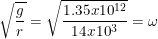
the normal (or centripetal) acceleration will be equatl to the
force of gravity, so
,
the normal (or centripetal) acceleration will be equatl to the
force of gravity, so

Add Answer to:
1) Neutron stars are extremely dense objects that are formed
from the remnants of supernova explosions....
Neutron stars are extremely dense objects formed from the remnants of supernova explosions. Many rotate very...
Neutron stars are extremely dense objects formed from the remnants of supernova explosions. Many rotate very rapidly. Suppose the mass of a certain spherical neutron star is twice the mass of the Sun and its radius is 11.0 km. Determine the greatest possible angular speed it can have so that the matter at the surface of the star on its equator is just held in orbit by the gravitational force. rad/s
2) Densities We discussed White Dwarfs and Neutron stars, very dense objects compared to stars like...
 2) Densities We discussed White Dwarfs and Neutron stars, very dense objects compared to stars like our sun. On the other hand, we also discussed Red Giants which are much less dense than our sun. To realize just how dense, please compute the average densities (in kg/m) for a) the sun (Rsun=7 x 10 km, Msun= 2 x 1030 kg) b) when the sun becomes a red giant (R= 1AU, M=Msun). By what factor is a Red Giant less dense...
Certain neutron stars (extremely dense stars) are believed to be rotating at about 1.1 rev/s. If...
Certain neutron stars (extremely dense stars) are believed to be rotating at about 1.1 rev/s. If such a star has a radius of 29 km, what must be its minimum mass so that material on its surface remains in place during the rapid rotation?
A neutron star is the remnant left after certain supernovae (explosions of giant stars). Typically, neutron...
A neutron star is the remnant left after certain supernovae (explosions of giant stars). Typically, neutron stars are about 18.0 km in diameter and have around the same mass as our sun. What is a typical neutron star density in g/cm3?
A neutron star is the remnant left after certain supernovae (explosions of giant stars). Typically, neutron...
A neutron star is the remnant left after certain supernovae (explosions of giant stars). Typically, neutron stars are about 16 km in diameter and have around the same mass as our sun. What is a typical neutron star density in g/cm3? Express your answer using two significant figures.
Neutron stars, such as the one at the center of the Crab Nebula, have about the...
Neutron stars, such as the one at the center of the Crab Nebula, have about the same mass as our sun but a much smaller diameter. If you weigh 690 N on the earth, what would be your weight on the surface of a neutron star that has the same mass as our sun and a diameter of 23.0 km ? Take the mass of the sun to be ms = 1.99×1030 kg , the gravitational constant to be G...
Neutron stars, such as the one at the center of the Crab Nebula, have about the...
Neutron stars, such as the one at the center of the Crab Nebula, have about the same mass as our sun but a much smaller diameter. If you weigh 690 N on the earth, what would be your weight on the surface of a neutron star that has the same mass as our sun and a diameter of 24.0 km ? Take the mass of the sun to be ms = 1.99×1030 kg , the gravitational constant to be G...
A neutron star is an extremely dense, rapidly spinning object that results from the collapse of...
A neutron star is an extremely dense, rapidly spinning object that results from the collapse of a star at the end of its life. A neutron star of 1.8 times the Sun's mass has an approximately uniform density of 1
Neutron stars, such as the one at the center of the Crab Nebula, have about the...
Neutron stars, such as the one at the center of the Crab Nebula, have about the same mass as our sun but a much smaller diameter. Part A If you weigh 665 N on the earth, what would be your weight on the surface of a neutron star that has the same mass as our sun and a diameter of 16.0 km ? Take the mass of the sun to be ms = 1.99×1030 kg , the gravitational constant to...
Chapter 13, Problem 021 Your answer is partially correct. Try again. Certain neutron stars (extremely dense...
 Chapter 13, Problem 021 Your answer is partially correct. Try again. Certain neutron stars (extremely dense stars) are believed to be rotating at about 1.1 rev/s. If such a star has a radius of 27 km, what must be its minimum mass so that material on its surface remains in place during the rapid rotation? Number 119300000000000000 Units Tkg the tolerance is +/-2% Click if you would like to show Work for this question: Open Show Work
 2) Densities We discussed White Dwarfs and Neutron stars, very dense objects compared to stars like our sun. On the other hand, we also discussed Red Giants which are much less dense than our sun. To realize just how dense, please compute the average densities (in kg/m) for a) the sun (Rsun=7 x 10 km, Msun= 2 x 1030 kg) b) when the sun becomes a red giant (R= 1AU, M=Msun). By what factor is a Red Giant less dense...
 Chapter 13, Problem 021 Your answer is partially correct. Try again. Certain neutron stars (extremely dense stars) are believed to be rotating at about 1.1 rev/s. If such a star has a radius of 27 km, what must be its minimum mass so that material on its surface remains in place during the rapid rotation? Number 119300000000000000 Units Tkg the tolerance is +/-2% Click if you would like to show Work for this question: Open Show Work
Most questions answered within 3 hours.
-
Where is the error in this code sequence?
String s1 = "Hello";
String s2 = "ello";...
asked 10 months ago -
Financial data for Joel de Paris, Inc., for last year
follow:
Joel de Paris, Inc.
Balance...
asked 10 months ago -
Consider this reaction:
Al2(SO4)3 (aq)+ BaCl3
(aq) Al2Cl6 (aq)- +
3BaSO4(s) . What is the...
asked 10 months ago -
Suppose that Savneet is considering increasing her
recent random sample from 20 car rentals to 40...
asked 10 months ago -
Trucks arrive at an unloading terminal at an average rate of 120
per hour.
Trucks arrive...
asked 10 months ago -
Why are methanol and ethanol completely soluble in water while
octanol is not very little soluble....
asked 10 months ago -
A facilities manager at a university reads in a research report
that the mean amount of...
asked 10 months ago -
When the CuSO4 is rehydrated by adding water to the anhydrous
compound, is this an endothermic...
asked 10 months ago -
A ray of sunlight is passing from diamond into crown glass; the
angle of incidence is...
asked 10 months ago -
A block of mass 0.249 kg is placed on top of a light, vertical
spring of...
asked 10 months ago -
how do the kidneys compensate in the presences of acidosis
a) trigger hyperventilate
b) reserve acid...
asked 10 months ago -
Question 501 pts
The rental rate of capital to the firm increases. Which of the
following...
asked 10 months ago