
Homework Answers

Add Answer to:
C = 1,000+.5Yd T = 200 G = 400 1 = 500 Refer to information given...
provide an explanation with a steps of the answer for each question please 1,600 Planned aggregate expenditure, AE...
 provide an explanation with a steps of the answer for each
question please
1,600 Planned aggregate expenditure, AE (billions of dollars) OS 1,600 Aggregate output, Y billions of dollars) Figure 24.5 1) Refer to Figure 24.5. If the economy is in equilibrium and the government decreases spending by $200 billion, equilibrium aggregate output decreases to S billion. A) 1,400 B) 1,200 C) 1,000 D) 800 2) Refer to Figure 24.5. If the economy is in equilibrium and the government increases...
provide an explanation with a steps of the answer for each
question please
1,600 Planned aggregate expenditure, AE (billions of dollars) OS 1,600 Aggregate output, Y billions of dollars) Figure 24.5 1) Refer to Figure 24.5. If the economy is in equilibrium and the government decreases spending by $200 billion, equilibrium aggregate output decreases to S billion. A) 1,400 B) 1,200 C) 1,000 D) 800 2) Refer to Figure 24.5. If the economy is in equilibrium and the government increases...
1) Which of the following is not a category of fiscal policy? a) government policies regarding...
1) Which of the following is not a category of fiscal policy? a) government policies regarding transfer payments and welfare benefits b) government policies regarding the purchase of goods and services c) government policies regarding taxation d) government policies regarding money supply in the economy 2) If output is less than planned aggregate expenditure, there will be a) no change in inventories. b) a planned increase in inventories. c) an unplanned increase in inventories. d) an unplanned decrease in inventories....
1) You are hired by the Council of Economic Advisors (CEA) as an economic consultant. The...
1) You are hired by the Council of Economic Advisors (CEA) as an economic consultant. The chairperson of the CEA tells you that she believes the current unemployment rate is too high. The unemployment rate can be reduced if aggregate output increases. She wants to know what policy to pursue to increase aggregate output by $300 billion. The best estimate she has for the MPC is 0.8. Which of the following policies should you recommend? a) Reduce taxes by $75...
Suppose the GDP is given by the following: C 500 0.75(Yd) Lp 375 G=200 T 400...
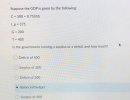 Suppose the GDP is given by the following: C 500 0.75(Yd) Lp 375 G=200 T 400 Is the government running a surplus or a deficit and how much? Deficit of 400 Surplus of 200 Deficit of 200 Balanced budget Surplus of 400
Please give a detailed solution, thank you! 5. Given C 5000.75 (Y T) I = 2,000 -50r G 1,000 T 1,000 - 10Y - 2000r Ms 50,...
 Please give a detailed
solution, thank you!
5. Given C 5000.75 (Y T) I = 2,000 -50r G 1,000 T 1,000 - 10Y - 2000r Ms 50,000 P a. Derive the IS curve and the LM curve, and find the equilibrium interest rate and output b. Government spending increases by 500. If the central bank does not react at all to this change, what is the new equilibrium output and interest rate? If instead the central bank wants to keep...
Please give a detailed
solution, thank you!
5. Given C 5000.75 (Y T) I = 2,000 -50r G 1,000 T 1,000 - 10Y - 2000r Ms 50,000 P a. Derive the IS curve and the LM curve, and find the equilibrium interest rate and output b. Government spending increases by 500. If the central bank does not react at all to this change, what is the new equilibrium output and interest rate? If instead the central bank wants to keep...
QUESTION 18 $500 T 400 300 C+ 200 100 $100 200 300 400500 Real GDP Refer...
 QUESTION 18 $500 T 400 300 C+ 200 100 $100 200 300 400500 Real GDP Refer to the diagram for a private closed economy. At the equilibrium level of GDP, the APC and APS are 5/6 and 1/6, respectively. are 4/5 and 1/5, respectively. are equal to the MPC and MPS, respectively. cannot be determined from the information given.
I. You are given the following information about a hypothetical economy C 800+ 0.75Y 1 500...
 I. You are given the following information about a hypothetical economy C 800+ 0.75Y 1 500 G- 900 Where C- Consumption 1 Investment G Government spending () Compute the equilibrium level of national output and consumption. (ii) What is the size of government expenditure multiplier (ii) Interpret the government expenditure multiplier in 1 (b) (ii) above (3mks) (3mk) (3mks)
2. Assume the following Keynesian model: C = 400 + .75Yd I = 200 G =...
2. Assume the following Keynesian model: C = 400 + .75Yd I = 200 G = 100 X = 150 M = 50 + .15 Yd T = 100 a. Find the aggregate expenditure function b. Find the equilibrium level of GDP. c. Using a “Keynesian cross” (or 45-degree line) diagram, show graphically the equilibrium in part a). d. What is the spending multiplier in this model? Tax multiplier? e. Show that leakages are equal to injections at equilibrium. f....
Refer to thve informatiion provided in the tble below to anweq s 7 ugh 13 Income...
 Refer to thve informatiion provided in the tble below to anweq s 7 ugh 13 Income Taxes Dispole Income CY B00 1,300 2,00 3,300 4300 1,000 2,000 3,000 4,000 5,000 Conmumgtio 200 vetment Gvement 200 200 200 200 200 7. The marginal propensity to consume is Spending (G) 400 1,00 340 340 340 340 340 1,360 2M0 3MA 4360 500 400 6,000 400 400 5,800 400 340 400 a) 0.6. b) 0.75. 085 d) none of the sbove e) c)...
Refer to the information provided in Figure 8.1 below to answer the questions that follow. Figure...
Refer to the information provided in Figure 8.1 below to answer the questions that follow. Figure 8.1 1) Refer to Figure 8.1. The equation for this household's saving function is a) S = -1,000 + 0.8Y. b) S = -300 + 0.25Y. c) S = -200 + 0.8Y. d) S = -500 + 0.5Y. Refer to the information provided in Figure 8.1 below to answer the questions that follow. Figure 8.1 2) Refer to Figure 8.1. This household consumes $2,000...
 provide an explanation with a steps of the answer for each
question please
1,600 Planned aggregate expenditure, AE (billions of dollars) OS 1,600 Aggregate output, Y billions of dollars) Figure 24.5 1) Refer to Figure 24.5. If the economy is in equilibrium and the government decreases spending by $200 billion, equilibrium aggregate output decreases to S billion. A) 1,400 B) 1,200 C) 1,000 D) 800 2) Refer to Figure 24.5. If the economy is in equilibrium and the government increases...
provide an explanation with a steps of the answer for each
question please
1,600 Planned aggregate expenditure, AE (billions of dollars) OS 1,600 Aggregate output, Y billions of dollars) Figure 24.5 1) Refer to Figure 24.5. If the economy is in equilibrium and the government decreases spending by $200 billion, equilibrium aggregate output decreases to S billion. A) 1,400 B) 1,200 C) 1,000 D) 800 2) Refer to Figure 24.5. If the economy is in equilibrium and the government increases...
 Suppose the GDP is given by the following: C 500 0.75(Yd) Lp 375 G=200 T 400 Is the government running a surplus or a deficit and how much? Deficit of 400 Surplus of 200 Deficit of 200 Balanced budget Surplus of 400
 Please give a detailed
solution, thank you!
5. Given C 5000.75 (Y T) I = 2,000 -50r G 1,000 T 1,000 - 10Y - 2000r Ms 50,000 P a. Derive the IS curve and the LM curve, and find the equilibrium interest rate and output b. Government spending increases by 500. If the central bank does not react at all to this change, what is the new equilibrium output and interest rate? If instead the central bank wants to keep...
Please give a detailed
solution, thank you!
5. Given C 5000.75 (Y T) I = 2,000 -50r G 1,000 T 1,000 - 10Y - 2000r Ms 50,000 P a. Derive the IS curve and the LM curve, and find the equilibrium interest rate and output b. Government spending increases by 500. If the central bank does not react at all to this change, what is the new equilibrium output and interest rate? If instead the central bank wants to keep...
 QUESTION 18 $500 T 400 300 C+ 200 100 $100 200 300 400500 Real GDP Refer to the diagram for a private closed economy. At the equilibrium level of GDP, the APC and APS are 5/6 and 1/6, respectively. are 4/5 and 1/5, respectively. are equal to the MPC and MPS, respectively. cannot be determined from the information given.
 I. You are given the following information about a hypothetical economy C 800+ 0.75Y 1 500 G- 900 Where C- Consumption 1 Investment G Government spending () Compute the equilibrium level of national output and consumption. (ii) What is the size of government expenditure multiplier (ii) Interpret the government expenditure multiplier in 1 (b) (ii) above (3mks) (3mk) (3mks)
 Refer to thve informatiion provided in the tble below to anweq s 7 ugh 13 Income Taxes Dispole Income CY B00 1,300 2,00 3,300 4300 1,000 2,000 3,000 4,000 5,000 Conmumgtio 200 vetment Gvement 200 200 200 200 200 7. The marginal propensity to consume is Spending (G) 400 1,00 340 340 340 340 340 1,360 2M0 3MA 4360 500 400 6,000 400 400 5,800 400 340 400 a) 0.6. b) 0.75. 085 d) none of the sbove e) c)...
Most questions answered within 3 hours.
-
Where is the error in this code sequence?
String s1 = "Hello";
String s2 = "ello";...
asked 11 months ago -
Financial data for Joel de Paris, Inc., for last year
follow:
Joel de Paris, Inc.
Balance...
asked 11 months ago -
Consider this reaction:
Al2(SO4)3 (aq)+ BaCl3
(aq) Al2Cl6 (aq)- +
3BaSO4(s) . What is the...
asked 11 months ago -
Suppose that Savneet is considering increasing her
recent random sample from 20 car rentals to 40...
asked 11 months ago -
Trucks arrive at an unloading terminal at an average rate of 120
per hour.
Trucks arrive...
asked 11 months ago -
Why are methanol and ethanol completely soluble in water while
octanol is not very little soluble....
asked 11 months ago -
A facilities manager at a university reads in a research report
that the mean amount of...
asked 11 months ago -
When the CuSO4 is rehydrated by adding water to the anhydrous
compound, is this an endothermic...
asked 11 months ago -
A ray of sunlight is passing from diamond into crown glass; the
angle of incidence is...
asked 11 months ago -
A block of mass 0.249 kg is placed on top of a light, vertical
spring of...
asked 11 months ago -
how do the kidneys compensate in the presences of acidosis
a) trigger hyperventilate
b) reserve acid...
asked 11 months ago -
Question 501 pts
The rental rate of capital to the firm increases. Which of the
following...
asked 11 months ago