
Homework Answers
Add Answer to:
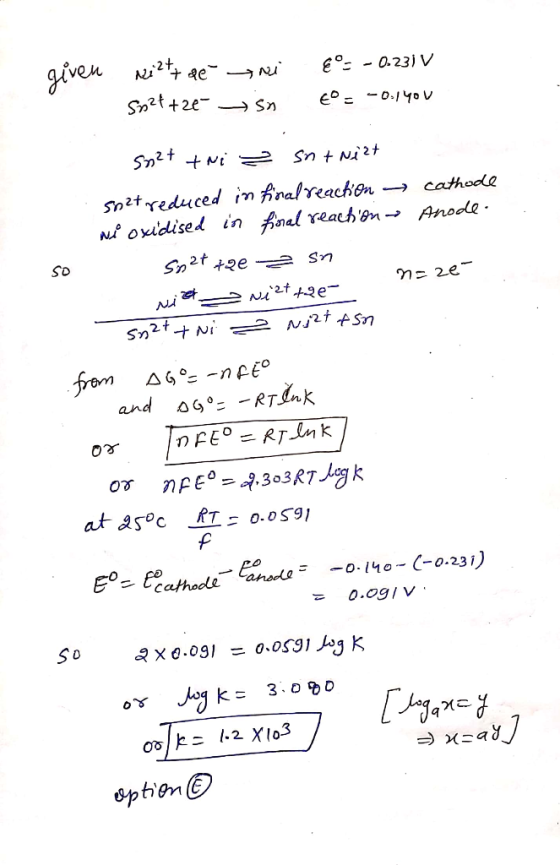
5. The reduction potentials for Ni2+ and Sn2+ are as follows: Ni2+ + 2e → Ni,...
Selective Reduction The standard reduction potential for the half-reaction: Sn4+ + 2e - Sn2+ is +0.15...
 Selective Reduction The standard reduction potential for the half-reaction: Sn4+ + 2e - Sn2+ is +0.15 V. Consider data from the table of standard reduction potentials for common half-reactions, in your text. For a galvanic cell under standard conditions, which of the following anodic half reactions would produce, at the cathode a spontaneous reduction of Sn4+ to Sn2+ but not Sn2+ to Sn. no yes yes yes yes yes Fe — Fe2+ + 2e- Sn2+ Sn4+ + 2e- Sn Sn2+...
Selective Oxidation The standard reduction potential for the half-reaction Sn4+ + 2e - Sn2+ is +0.15...
 Selective Oxidation The standard reduction potential for the half-reaction Sn4+ + 2e - Sn2+ is +0.15 V. Consider data from the table of standard reduction potentials for common half-reactions, in your text. For a galvanic cell under standard conditions, which of the following cathodic half reactions would produce, at the anode, a spontaneous oxidation of Sn to Sn2+ but not Sn2+ to Sn4+. 2H+ + 2e - H2 Fe3+ + 3e + Fe Sn2+ + 2e Fe2+ + 2e →...
Given the following standard reduction potentials choose the cell which will work as a voltaic cell....
 Given the following standard reduction potentials choose the cell which will work as a voltaic cell. All cells below are written according to the usual cell diagram convention. Cu2+(aq) + 2e → Cu(s) E° = 0.34 V 2H+(aq) + 2e → H2(g) E° = 0.00 V Sn2+ (aq) + 2e → Sn(s) E° = -0.14 V Ni2+(aq) + 2e → Ni(s) E° = -0.26 V Cd2+(aq) + 2e → → Cd(s) E° = -0.40 V Sn(s) | Sn2+(aq) || Ni2+(aq)...
Question 2. [10 Marks] Given the following half-cell reduction potentials: Ni2+ (aq) + 2e-F Ni(s), Ered...
 Question 2. [10 Marks] Given the following half-cell reduction potentials: Ni2+ (aq) + 2e-F Ni(s), Ered = -0.23 V Pt2+ (aq) + 2e-E Pt(s), Ered = +1.2 V Pd2+(aq) + 2e- EPd(s), Ered = 0.99 V a) Sketch the cell for which the overall cell potential is the greatest. [3 Marks) b) Identify the cathode and anode, and then show the direction of electron flow for the cell in the circuit (a). [3 Marks] c) Will Pt(s) reduce Pd2+(aq)? Explain...
Cell Potential and Equilibrium Standard reduction potentials The equilibrium constant, K, for a redox reaction is...
 Cell Potential and Equilibrium Standard reduction potentials The equilibrium constant, K, for a redox reaction is related to the standard cell potential, Ecel, by the equation Reduction half-reaction (V) Ag+ (aq) + e-→Ag(s) Cu2+ (aq) + 2e-→Cu(s) 0.34 Sn (a) 4e-Sn(s 0.15 2H' (aq) + 2e-→H2 (g) Ni2+ (aq) + 2e-→Ni(s)-0.26 Fe2+ (aq) + 2e-→Fe(s)-0.45 Zn2+ (aq) + 2e-→Zn(s)-0.76 Al3+ (aq) +3e-→Al(s) -1.66 Mg2+ (aq) + 2e-→Mg(s) -2.37 0.80 n FEcell where n is the number of moles of electrons...
Use the tabulated electrode potentials to calculate K for the oxidation of nickel by H+: Ni(s)+2H+(aq)→Ni2+(aq)+H2(g)...
Use the tabulated electrode potentials to calculate K for the oxidation of nickel by H+: Ni(s)+2H+(aq)→Ni2+(aq)+H2(g) Express your answer using two significant figures. Standard reduction half-cell potentials at 25∘C Half-reaction E∘ (V) Half-reaction E∘ (V) Au3+(aq)+3e−→Au(s) 1.50 Fe2+(aq)+2e−→Fe(s) −0.45 Ag+(aq)+e−→Ag(s) 0.80 Cr3+(aq)+e−→Cr2+(aq) −0.50 Fe3+(aq)+3e−→Fe2+(aq) 0.77 Cr3+(aq)+3e−→Cr(s) −0.73 Cu+(aq)+e−→Cu(s) 0.52 Zn2+(aq)+2e−→Zn(s) −0.76 Cu2+(aq)+2e−→Cu(s) 0.34 Mn2+(aq)+2e−→Mn(s) −1.18 2H+(aq)+2e−→H2(g) 0.00 Al3+(aq)+3e−→Al(s) −1.66 Fe3+(aq)+3e−→Fe(s) −0.036 Mg2+(aq)+2e−→Mg(s) −2.37 Pb2+(aq)+2e−→Pb(s) −0.13 Na+(aq)+e−→Na(s) −2.71 Sn2+(aq)+2e−→Sn(s) −0.14 Ca2+(aq)+2e−→Ca(s) −2.76 Ni2+(aq)+2e−→Ni(s) −0.23 Ba2+(aq)+2e−→Ba(s) −2.90 Co2+(aq)+2e−→Co(s) −0.28 K+(aq)+e−→K(s) −2.92 Cd2+(aq)+2e−→Cd(s)...
Use the data in the table below to calculate the equilibrium constant at 25°C for the reaction: Cl2(g) + Sn(aq) + Sn2+...
 Use the data in the table below to calculate the equilibrium constant at 25°C for the reaction: Cl2(g) + Sn(aq) + Sn2+ (aq) + 2C1- (aq) Standard Reduction Potentials at 25°C Sn(aq) + 2e + Sn2+ (aq) E° = -0.14 V Cl2 (g) + 2e + 2C1- (aq) E° = 1.36 V Express your answer to two significant figures. O ALQ O a ?
Calculate the equilibrium constant for each of the reactions at 25∘C. Standard Electrode Potentials at 25...
Calculate the equilibrium constant for each of the reactions at 25∘C. Standard Electrode Potentials at 25 ∘C Reduction Half-Reaction E∘(V) Fe3+(aq)+3e− →Fe(s) -0.036 Sn2+(aq)+2e− →Sn(s) -0.14 Ni2+(aq)+2e− →Ni(s) -0.23 O2(g)+2H2O(l)+4e− →4OH−(aq) 0.40 Br2(l)+2e− →2Br− 1.09 I2(s)+2e− →2I− 0.54 A) 2Fe3+(aq)+3Sn(s)→2Fe(s)+3Sn2+(aq) (answers are not 4.1x10^5, 3.3x10^3, 2.7x10^10, or 2.6x10^10) B) O2(g)+2H2O(l)+2Ni(s)→4OH−(aq)+2Ni2+(aq) C) Br2(l)+2I−(aq)→2Br−(aq)+I2(s) (answer is not 1.7x10^18)
Use standard reduction potentials to calculate the equilibrium constant for the reaction: Ni2+(aq) + 2(aq)—Ni(s) +...
 Use standard reduction potentials to calculate the equilibrium constant for the reaction: Ni2+(aq) + 2(aq)—Ni(s) + 12(5) Hint: Carry at least 5 significant figures during intermediate calculations to avoid round off error when taking the antilogarithm. Equilibrium constant: AGº for this reaction would be than zero.
Refer to the following standard reduction half-cell potentials at 25∘C : VO2+(aq)+Ni2+(aq)2H+(aq)++2e−e−→ →Ni(s)VO2+(aq) +H2O(l)E∘=−0.23V E∘=0.99V ...
Refer to the following standard reduction half-cell potentials at 25∘C : VO2+(aq)+Ni2+(aq)2H+(aq)++2e−e−→ →Ni(s)VO2+(aq) +H2O(l)E∘=−0.23V E∘=0.99V Part A Part complete An electrochemical cell is based on these two half-reactions: Oxidation:Reduction:Ni(s)VO2+(aq,0.017M)+2H+(aq,1.3M)+e−→→Ni2+(aq,2.5M)+2e−VO2+(aq,2.5M)+H2O(l) Calculate the cell potential under these nonstandard concentrations.
 Selective Reduction The standard reduction potential for the half-reaction: Sn4+ + 2e - Sn2+ is +0.15 V. Consider data from the table of standard reduction potentials for common half-reactions, in your text. For a galvanic cell under standard conditions, which of the following anodic half reactions would produce, at the cathode a spontaneous reduction of Sn4+ to Sn2+ but not Sn2+ to Sn. no yes yes yes yes yes Fe — Fe2+ + 2e- Sn2+ Sn4+ + 2e- Sn Sn2+...
 Selective Oxidation The standard reduction potential for the half-reaction Sn4+ + 2e - Sn2+ is +0.15 V. Consider data from the table of standard reduction potentials for common half-reactions, in your text. For a galvanic cell under standard conditions, which of the following cathodic half reactions would produce, at the anode, a spontaneous oxidation of Sn to Sn2+ but not Sn2+ to Sn4+. 2H+ + 2e - H2 Fe3+ + 3e + Fe Sn2+ + 2e Fe2+ + 2e →...
 Given the following standard reduction potentials choose the cell which will work as a voltaic cell. All cells below are written according to the usual cell diagram convention. Cu2+(aq) + 2e → Cu(s) E° = 0.34 V 2H+(aq) + 2e → H2(g) E° = 0.00 V Sn2+ (aq) + 2e → Sn(s) E° = -0.14 V Ni2+(aq) + 2e → Ni(s) E° = -0.26 V Cd2+(aq) + 2e → → Cd(s) E° = -0.40 V Sn(s) | Sn2+(aq) || Ni2+(aq)...
 Question 2. [10 Marks] Given the following half-cell reduction potentials: Ni2+ (aq) + 2e-F Ni(s), Ered = -0.23 V Pt2+ (aq) + 2e-E Pt(s), Ered = +1.2 V Pd2+(aq) + 2e- EPd(s), Ered = 0.99 V a) Sketch the cell for which the overall cell potential is the greatest. [3 Marks) b) Identify the cathode and anode, and then show the direction of electron flow for the cell in the circuit (a). [3 Marks] c) Will Pt(s) reduce Pd2+(aq)? Explain...
 Cell Potential and Equilibrium Standard reduction potentials The equilibrium constant, K, for a redox reaction is related to the standard cell potential, Ecel, by the equation Reduction half-reaction (V) Ag+ (aq) + e-→Ag(s) Cu2+ (aq) + 2e-→Cu(s) 0.34 Sn (a) 4e-Sn(s 0.15 2H' (aq) + 2e-→H2 (g) Ni2+ (aq) + 2e-→Ni(s)-0.26 Fe2+ (aq) + 2e-→Fe(s)-0.45 Zn2+ (aq) + 2e-→Zn(s)-0.76 Al3+ (aq) +3e-→Al(s) -1.66 Mg2+ (aq) + 2e-→Mg(s) -2.37 0.80 n FEcell where n is the number of moles of electrons...
 Use the data in the table below to calculate the equilibrium constant at 25°C for the reaction: Cl2(g) + Sn(aq) + Sn2+ (aq) + 2C1- (aq) Standard Reduction Potentials at 25°C Sn(aq) + 2e + Sn2+ (aq) E° = -0.14 V Cl2 (g) + 2e + 2C1- (aq) E° = 1.36 V Express your answer to two significant figures. O ALQ O a ?
 Use standard reduction potentials to calculate the equilibrium constant for the reaction: Ni2+(aq) + 2(aq)—Ni(s) + 12(5) Hint: Carry at least 5 significant figures during intermediate calculations to avoid round off error when taking the antilogarithm. Equilibrium constant: AGº for this reaction would be than zero.
Most questions answered within 3 hours.
-
Where is the error in this code sequence?
String s1 = "Hello";
String s2 = "ello";...
asked 10 months ago -
Financial data for Joel de Paris, Inc., for last year
follow:
Joel de Paris, Inc.
Balance...
asked 10 months ago -
Consider this reaction:
Al2(SO4)3 (aq)+ BaCl3
(aq) Al2Cl6 (aq)- +
3BaSO4(s) . What is the...
asked 10 months ago -
Suppose that Savneet is considering increasing her
recent random sample from 20 car rentals to 40...
asked 10 months ago -
Trucks arrive at an unloading terminal at an average rate of 120
per hour.
Trucks arrive...
asked 10 months ago -
Why are methanol and ethanol completely soluble in water while
octanol is not very little soluble....
asked 10 months ago -
A facilities manager at a university reads in a research report
that the mean amount of...
asked 10 months ago -
When the CuSO4 is rehydrated by adding water to the anhydrous
compound, is this an endothermic...
asked 10 months ago -
A ray of sunlight is passing from diamond into crown glass; the
angle of incidence is...
asked 10 months ago -
A block of mass 0.249 kg is placed on top of a light, vertical
spring of...
asked 10 months ago -
how do the kidneys compensate in the presences of acidosis
a) trigger hyperventilate
b) reserve acid...
asked 10 months ago -
Question 501 pts
The rental rate of capital to the firm increases. Which of the
following...
asked 10 months ago