
Homework Answers
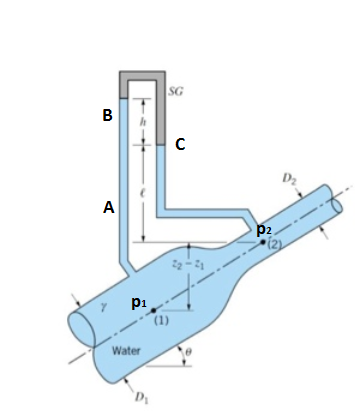
water flows through a pipe reducer as shown in figure above.
To determine the manometer reading, h which is given by following steps :
Step 1 : U tube manometer reading -
the static pressure at (1) & (2) which are measured by the inverted U-tube manometer.
From starting point (1) to point (2) means that :
A  B C
B C
p1 -  (z2 - z1) - (l -
h) +
(oilh +
l) =
p2
{ eq.1 }
(z2 - z1) - (l -
h) +
(oilh +
l) =
p2
{ eq.1 }
where, oil = oil
of specific gravity = SG
p1 & p2 = pressure at point 1 & 2
p1 - p2 =
(z2 - z1) + (1 - SG)
h
{ eq.2 }
Step 2 : from Bernoulli's equation, To determine (p1 - p2) -
p1 + (1/2)  v12 +
z1 = p2 (1/2)
v22 +
z2
v12 +
z1 = p2 (1/2)
v22 +
z2
or p1 - p2 =
(z2 - z1) + (1/2) [
v22 -
v12]
{ eq. 3 }
Step 3 : comparing above eq. 2 & 3 -
(z2 - z1) + (1 - SG) h =
(z2 - z1) + (1/2) [
v22 -
v12]
(1 - SG) h = (1/2)
[
v22 -
v12]
(1 - SG) h = (1/2)
v22 [ 1 - v12 /
v22]
(1 - SG) h = (1/2)
v22 [1 - (v1 /
v2)2]
{ eq.4 }
Step 4 : from continuity equation, To determine (v22 - v12) -
Q1 = Q2
A1 v1 = A2 v2 { eq. 5 }
where, A = area of the pipe =  (D/2)2
v = volume inside a pipe
inserting the value of 'A' in eq.5,
(D1/2)2 v1 =
(D2/2)2
v2
v1 / v2 = D22 / D12
v1 / v2 = A2 / A1 = (D2 / D1)2
Add Answer to:
Bernoulli equation
7. Bernoulli?s Equation. Water flows through a pipe reducer as is shown the figure....
Water flows through a pipe reducer as shown in the figure. If the manometer reading h - 2 m. Find...
 Water flows through a pipe reducer as shown in the figure. If the manometer reading h - 2 m. Find the flow rate in Liters per second. Assume DI-15 cm, D2-10 cm. SG:-0.80 a. What is the effect of the angle θ b. Is this a practical arrangement, if yes why, if not how would you improve it? c. Ca n mercury be used as a manometer fluid in this arrangement? Why, or why not? SG D2 Water Di
Water...
Water flows through a pipe reducer as shown in the figure. If the manometer reading h - 2 m. Find the flow rate in Liters per second. Assume DI-15 cm, D2-10 cm. SG:-0.80 a. What is the effect of the angle θ b. Is this a practical arrangement, if yes why, if not how would you improve it? c. Ca n mercury be used as a manometer fluid in this arrangement? Why, or why not? SG D2 Water Di
Water...
a. What is the numerical value of velocity V1? b. What is the numerical value of...
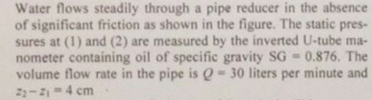 a. What is the numerical value of velocity V1?
b. What is the numerical value of velocity V2?
c. what is the value of manometer reading h?
d. What formula can be used to determine h?
Water flows steadily through a pipe reducer in the absence of significant friction as shown in the figure. The static pres- sures at (1) and (2) are measured by the inverted U-tube ma- nometer containing oil of specific gravity SG = 0.876. The volume...
a. What is the numerical value of velocity V1?
b. What is the numerical value of velocity V2?
c. what is the value of manometer reading h?
d. What formula can be used to determine h?
Water flows steadily through a pipe reducer in the absence of significant friction as shown in the figure. The static pres- sures at (1) and (2) are measured by the inverted U-tube ma- nometer containing oil of specific gravity SG = 0.876. The volume...
Water flows steadily from a large tank as shown in the figure. The height of water...
 Water flows steadily from a large tank as shown in the figure. The height of water in the tank is H = 4 m represents the height from the centerline of the horizontal pipe to the surface of the water in the tank. The water flows out of the tank through a pipe with diameter of 4 cm. The stream of water flows through a bend (= 30 degrees, L = 2.88 m) and exits as a free jet through...
Water flows in the horizontal pipe shown in the figure. At point A the area is...
 Water flows in the horizontal pipe shown in the figure.
At point A the area is 26.0 cm2 and the
speed of the water is 2.20 m/s. At B the area is 15.0
cm2. The fluid in the manometer is mercury, which has a
density of 13,600 kg/m3. We can treat water as an ideal
fluid having a density of 1000 kg/m3. What is the
manometer reading h?
Question 10 (1 point) Water flows in the horizontal pipe shown in...
Water flows in the horizontal pipe shown in the figure.
At point A the area is 26.0 cm2 and the
speed of the water is 2.20 m/s. At B the area is 15.0
cm2. The fluid in the manometer is mercury, which has a
density of 13,600 kg/m3. We can treat water as an ideal
fluid having a density of 1000 kg/m3. What is the
manometer reading h?
Question 10 (1 point) Water flows in the horizontal pipe shown in...
4-For the manometer shown in the Fig. below contains oil and water.For the column heights indicat...
 4-For the manometer shown in the Fig. below contains oil and water.For the column heights indicated what is the pressur differential between pipes A and B. CDI water water 650) 20 10 Glycerin S.G-1.26 oil o-o.as S.G 0.85 Dimensions in cm S-The inverted U-tube manometer contains oil S.G.-0.9and water. The pressure differential between A and B, pA-PB is-5kPa Determine the differential reading,h Oil 0.2 m 0.3 m Water 9-Air flows through a pipe at a rate of 200L/s.The pipe consists...
Question 3: A simple U-tube manometer is shown in Figure 2. One end of the U-tube...
 Question 3: A simple U-tube manometer is shown in Figure 2. One end of the U-tube is connected to the pipe A so that the pressure at A (PA) is to be measured. The other end is left to be open to the atmosphere. The U-tube contains a liquid (mercury with specific gravity slig-13.54) called the gage fluid, which does not mix with the fluid (water). If the reading of inside pipe A
(c) Fuel oil, with a density of 870 kg m-, is pumped through a horizontal pipe,...
 (c) Fuel oil, with a density of 870 kg m-, is pumped through a horizontal pipe, as shown in Figure Q2.2. The pipe is 100 mm in diameter and contains an orifice plate with a throat diameter of 40 mm. The pressure drop across the orifice is measured on a U-tube manometer, containing mercury with a specific gravity 13.6. The difference in levels of the columns is measured as 45 mm. The coefficient of discharge for the orifice plate Ca...
EMERGENCY WILL RATE ANSWER Discharge from a mud drilling rig (Specific Gravity of mud =16.0) flows...
 EMERGENCY WILL RATE ANSWER
Discharge from a mud drilling rig (Specific Gravity of mud =16.0) flows through a pipe setup as shown in the Figure Q2 below. An inverted manometer is connected to differential pitot tube and used to measure the flow rate through the narrow pipe. Specific gravity of mercury in the manometer is 13.6. The pipe diameters are Im and 2m as shown in the figure. (1) Calculate the flow through section A. (13 Marks) (ii) What is...
EMERGENCY WILL RATE ANSWER
Discharge from a mud drilling rig (Specific Gravity of mud =16.0) flows through a pipe setup as shown in the Figure Q2 below. An inverted manometer is connected to differential pitot tube and used to measure the flow rate through the narrow pipe. Specific gravity of mercury in the manometer is 13.6. The pipe diameters are Im and 2m as shown in the figure. (1) Calculate the flow through section A. (13 Marks) (ii) What is...
bernoulli equation 4. Water flows through a circular pipe with a constant radium of 8cm. The...
 bernoulli equation
4. Water flows through a circular pipe with a constant radium of 8cm. The speed and pressure at point A is 2m/s and 250,000 Pa respectively a.) What is the speed of the fluid at point B? b.) What is the pressure at point B which is 5 m higher than point A?
bernoulli equation
4. Water flows through a circular pipe with a constant radium of 8cm. The speed and pressure at point A is 2m/s and 250,000 Pa respectively a.) What is the speed of the fluid at point B? b.) What is the pressure at point B which is 5 m higher than point A?
Water flows through the pipe contraction shown in Figure 1. For the given difference in piezometer...
 Water flows through the pipe contraction shown in Figure 1. For the given difference in piezometer levels, determine the flow rate in L/s. Assume that: H=0.80 m, DI = 8 cm, oil D2 = 5 cm & S.G. of oil = 0.7 -- --3 Figure 1
 Water flows through a pipe reducer as shown in the figure. If the manometer reading h - 2 m. Find the flow rate in Liters per second. Assume DI-15 cm, D2-10 cm. SG:-0.80 a. What is the effect of the angle θ b. Is this a practical arrangement, if yes why, if not how would you improve it? c. Ca n mercury be used as a manometer fluid in this arrangement? Why, or why not? SG D2 Water Di
Water...
Water flows through a pipe reducer as shown in the figure. If the manometer reading h - 2 m. Find the flow rate in Liters per second. Assume DI-15 cm, D2-10 cm. SG:-0.80 a. What is the effect of the angle θ b. Is this a practical arrangement, if yes why, if not how would you improve it? c. Ca n mercury be used as a manometer fluid in this arrangement? Why, or why not? SG D2 Water Di
Water...
 a. What is the numerical value of velocity V1?
b. What is the numerical value of velocity V2?
c. what is the value of manometer reading h?
d. What formula can be used to determine h?
Water flows steadily through a pipe reducer in the absence of significant friction as shown in the figure. The static pres- sures at (1) and (2) are measured by the inverted U-tube ma- nometer containing oil of specific gravity SG = 0.876. The volume...
a. What is the numerical value of velocity V1?
b. What is the numerical value of velocity V2?
c. what is the value of manometer reading h?
d. What formula can be used to determine h?
Water flows steadily through a pipe reducer in the absence of significant friction as shown in the figure. The static pres- sures at (1) and (2) are measured by the inverted U-tube ma- nometer containing oil of specific gravity SG = 0.876. The volume...
 Water flows steadily from a large tank as shown in the figure. The height of water in the tank is H = 4 m represents the height from the centerline of the horizontal pipe to the surface of the water in the tank. The water flows out of the tank through a pipe with diameter of 4 cm. The stream of water flows through a bend (= 30 degrees, L = 2.88 m) and exits as a free jet through...
 Water flows in the horizontal pipe shown in the figure.
At point A the area is 26.0 cm2 and the
speed of the water is 2.20 m/s. At B the area is 15.0
cm2. The fluid in the manometer is mercury, which has a
density of 13,600 kg/m3. We can treat water as an ideal
fluid having a density of 1000 kg/m3. What is the
manometer reading h?
Question 10 (1 point) Water flows in the horizontal pipe shown in...
Water flows in the horizontal pipe shown in the figure.
At point A the area is 26.0 cm2 and the
speed of the water is 2.20 m/s. At B the area is 15.0
cm2. The fluid in the manometer is mercury, which has a
density of 13,600 kg/m3. We can treat water as an ideal
fluid having a density of 1000 kg/m3. What is the
manometer reading h?
Question 10 (1 point) Water flows in the horizontal pipe shown in...
 4-For the manometer shown in the Fig. below contains oil and water.For the column heights indicated what is the pressur differential between pipes A and B. CDI water water 650) 20 10 Glycerin S.G-1.26 oil o-o.as S.G 0.85 Dimensions in cm S-The inverted U-tube manometer contains oil S.G.-0.9and water. The pressure differential between A and B, pA-PB is-5kPa Determine the differential reading,h Oil 0.2 m 0.3 m Water 9-Air flows through a pipe at a rate of 200L/s.The pipe consists...
 Question 3: A simple U-tube manometer is shown in Figure 2. One end of the U-tube is connected to the pipe A so that the pressure at A (PA) is to be measured. The other end is left to be open to the atmosphere. The U-tube contains a liquid (mercury with specific gravity slig-13.54) called the gage fluid, which does not mix with the fluid (water). If the reading of inside pipe A
 (c) Fuel oil, with a density of 870 kg m-, is pumped through a horizontal pipe, as shown in Figure Q2.2. The pipe is 100 mm in diameter and contains an orifice plate with a throat diameter of 40 mm. The pressure drop across the orifice is measured on a U-tube manometer, containing mercury with a specific gravity 13.6. The difference in levels of the columns is measured as 45 mm. The coefficient of discharge for the orifice plate Ca...
 EMERGENCY WILL RATE ANSWER
Discharge from a mud drilling rig (Specific Gravity of mud =16.0) flows through a pipe setup as shown in the Figure Q2 below. An inverted manometer is connected to differential pitot tube and used to measure the flow rate through the narrow pipe. Specific gravity of mercury in the manometer is 13.6. The pipe diameters are Im and 2m as shown in the figure. (1) Calculate the flow through section A. (13 Marks) (ii) What is...
EMERGENCY WILL RATE ANSWER
Discharge from a mud drilling rig (Specific Gravity of mud =16.0) flows through a pipe setup as shown in the Figure Q2 below. An inverted manometer is connected to differential pitot tube and used to measure the flow rate through the narrow pipe. Specific gravity of mercury in the manometer is 13.6. The pipe diameters are Im and 2m as shown in the figure. (1) Calculate the flow through section A. (13 Marks) (ii) What is...
 bernoulli equation
4. Water flows through a circular pipe with a constant radium of 8cm. The speed and pressure at point A is 2m/s and 250,000 Pa respectively a.) What is the speed of the fluid at point B? b.) What is the pressure at point B which is 5 m higher than point A?
bernoulli equation
4. Water flows through a circular pipe with a constant radium of 8cm. The speed and pressure at point A is 2m/s and 250,000 Pa respectively a.) What is the speed of the fluid at point B? b.) What is the pressure at point B which is 5 m higher than point A?
 Water flows through the pipe contraction shown in Figure 1. For the given difference in piezometer levels, determine the flow rate in L/s. Assume that: H=0.80 m, DI = 8 cm, oil D2 = 5 cm & S.G. of oil = 0.7 -- --3 Figure 1
Most questions answered within 3 hours.
-
Where is the error in this code sequence?
String s1 = "Hello";
String s2 = "ello";...
asked 10 months ago -
Financial data for Joel de Paris, Inc., for last year
follow:
Joel de Paris, Inc.
Balance...
asked 10 months ago -
Consider this reaction:
Al2(SO4)3 (aq)+ BaCl3
(aq) Al2Cl6 (aq)- +
3BaSO4(s) . What is the...
asked 10 months ago -
Suppose that Savneet is considering increasing her
recent random sample from 20 car rentals to 40...
asked 10 months ago -
Trucks arrive at an unloading terminal at an average rate of 120
per hour.
Trucks arrive...
asked 10 months ago -
Why are methanol and ethanol completely soluble in water while
octanol is not very little soluble....
asked 10 months ago -
A facilities manager at a university reads in a research report
that the mean amount of...
asked 10 months ago -
When the CuSO4 is rehydrated by adding water to the anhydrous
compound, is this an endothermic...
asked 10 months ago -
A ray of sunlight is passing from diamond into crown glass; the
angle of incidence is...
asked 10 months ago -
A block of mass 0.249 kg is placed on top of a light, vertical
spring of...
asked 10 months ago -
how do the kidneys compensate in the presences of acidosis
a) trigger hyperventilate
b) reserve acid...
asked 10 months ago -
Question 501 pts
The rental rate of capital to the firm increases. Which of the
following...
asked 10 months ago