
Homework Answers

Add Answer to:
10. Let R > 0, Describe the arc「with parametrisation z(t)-Reit for-π/2-t-π/2 Use th is parametrisation to...
2. Let f(z) be the principal branch of i.е., f(z) exp@ Log(z)}. Co mpute (e)dz where...
 2. Let f(z) be the principal branch of i.е., f(z) exp@ Log(z)}. Co mpute (e)dz where C is the semicircle {et : 0 < θ < π
(15%) Evaluate the line integral -r-y + ) dz+ (z+2cy+3)dy, where C consists of the arc Ci of the ...
 please calculate directly, my
answer is (3/2)pi+32/3 is that correct?
(15%) Evaluate the line integral -r-y + ) dz+ (z+2cy+3)dy, where C consists of the arc Ci of the quarter circle +y 1,x 2 0,y 0, from (0,-1) to (1,0) followed by the arc C2 of the quarter ellipse 4z2y2 - 4, 2 0, y 20, from (1,0) to (0, 2)
(15%) Evaluate the line integral -r-y + ) dz+ (z+2cy+3)dy, where C consists of the arc Ci of the...
please calculate directly, my
answer is (3/2)pi+32/3 is that correct?
(15%) Evaluate the line integral -r-y + ) dz+ (z+2cy+3)dy, where C consists of the arc Ci of the quarter circle +y 1,x 2 0,y 0, from (0,-1) to (1,0) followed by the arc C2 of the quarter ellipse 4z2y2 - 4, 2 0, y 20, from (1,0) to (0, 2)
(15%) Evaluate the line integral -r-y + ) dz+ (z+2cy+3)dy, where C consists of the arc Ci of the...
Problem 4, Find, for 0-x-π, the arc-length of the segment of the curve R(t) = (2...
 Problem 4, Find, for 0-x-π, the arc-length of the segment of the curve R(t) = (2 cos t-cos 2t, 2 sin t-sin 2t) corresponding to 0< t < r
Problem 5: Let f(z) = zi = eiLog?, [2] > 0, -T < Arg z <a...
 Problem 5: Let f(z) = zi = eiLog?, [2] > 0, -T < Arg z <a denote the principal branch of the function z', and let C be any contour from –2 to 1 that, except for its endpoints, lies above the real axis. (a) Find an antiderivative of the function f(z); (b) Compute the integralf(z)dz; SOLUTION:
If zo E C is a constant complex number, and r> 0 is constant, consider the...
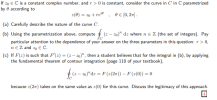 If zo E C is a constant complex number, and r> 0 is constant, consider the curve in C in C parametrized by 0 according to z(0) = 20 +reio 0 € (0,27] (a) Carefully describe the nature of the curve C. (b) Using the parametrization above, compute particular attention to the dependence of your answer on the three parameters in this question: r >0, ne Z and zo E C. (c) If F(z) is such that F"(z) = (2-zo)",...
30] Find th e solution of the following boundary value problem. 1<r<2, u(r, θ = 0) = 0, u(r, θ = π) =0, 1,0-0, u(...
 30] Find th e solution of the following boundary value problem. 1<r<2, u(r, θ = 0) = 0, u(r, θ = π) =0, 1,0-0, u(r-2,0)-sin(20), 0 < θ < π. u(r Please also draw the sketch associated with this problem. You may assume that An -n2, Hn(s)sin(ns), n 1,2,3,. are the eigenpairs for the eigenvalue problem H(0) 0, H(T)0.
30] Find th e solution of the following boundary value problem. 1
30] Find th e solution of the following boundary value problem. 1<r<2, u(r, θ = 0) = 0, u(r, θ = π) =0, 1,0-0, u(r-2,0)-sin(20), 0 < θ < π. u(r Please also draw the sketch associated with this problem. You may assume that An -n2, Hn(s)sin(ns), n 1,2,3,. are the eigenpairs for the eigenvalue problem H(0) 0, H(T)0.
30] Find th e solution of the following boundary value problem. 1
(3) For the following velocity fields F on R3, find the flow along the given curve. r(t) = (t, t2, 1) F=(-4xy, 83, 2) with 0 2 t 1l F=(z-z, 0,2) r(t)-(cost, 0, sin t) with 0 t π F = (-y,2, 2) with r(...
 (3) For the following velocity fields F on R3, find the flow along the given curve. r(t) = (t, t2, 1) F=(-4xy, 83, 2) with 0 2 t 1l F=(z-z, 0,2) r(t)-(cost, 0, sin t) with 0 t π F = (-y,2, 2) with r(t) = (-2 cost, 2 sin t, 2t) 0 < t < 2π
(3) For the following velocity fields F on R3, find the flow along the given curve. r(t) = (t, t2, 1) F=(-4xy, 83,...
(3) For the following velocity fields F on R3, find the flow along the given curve. r(t) = (t, t2, 1) F=(-4xy, 83, 2) with 0 2 t 1l F=(z-z, 0,2) r(t)-(cost, 0, sin t) with 0 t π F = (-y,2, 2) with r(t) = (-2 cost, 2 sin t, 2t) 0 < t < 2π
(3) For the following velocity fields F on R3, find the flow along the given curve. r(t) = (t, t2, 1) F=(-4xy, 83,...
step by step please, thank you (2) Use Stokes' Theorem to evaluate the integral F.dr, where...
 step by step please, thank
you
(2) Use Stokes' Theorem to evaluate the integral F.dr, where F(x, y, z) =< -Y, I, z > and where S is the upper hemispherical surface defined by z = v1- 2 - y2. The boundary of S is the curve C defined by Cos (t) y= sin (t) 0t 27 Z=0
step by step please, thank
you
(2) Use Stokes' Theorem to evaluate the integral F.dr, where F(x, y, z) =< -Y, I, z > and where S is the upper hemispherical surface defined by z = v1- 2 - y2. The boundary of S is the curve C defined by Cos (t) y= sin (t) 0t 27 Z=0
10. Let and consider approximating its average value on the interval (0,2) given by the integral 4-2 dx. 0 (a) Use Calculus to show that the the exact answer is π/2. (Hint: You may want to substitute...
 10. Let and consider approximating its average value on the interval (0,2) given by the integral 4-2 dx. 0 (a) Use Calculus to show that the the exact answer is π/2. (Hint: You may want to substitute 2 sin , and later use the trignometric identify cos(20)-1-2 cos2 θ). (b) Assume r is uniformly distributed in (0,2). What is the expected value, E f ()] How is the formula for expected value related to the expression given by expression in...
Hi need help for these Questions: a. Given f = yi + xzk and g = xyz2, determine (∇ x f ) . ∇g at the point (1,0,3) b. Point A lies on the curve r(t) = 2 cos t i + 2 sin t j + t k for the range 0 ≤ t...
 Hi need help for these Questions:
a. Given f = yi + xzk and g =
xyz2, determine (∇ x f ) .
∇g at the point (1,0,3)
b. Point A lies on the curve r(t) = 2 cos t i +
2 sin t j + t k for the range 0 ≤
t ≤ 2π . At point A, the tangent vector is T = -
21/2i +
21/2j + k. Determine
the co-ordinates of point A and...
Hi need help for these Questions:
a. Given f = yi + xzk and g =
xyz2, determine (∇ x f ) .
∇g at the point (1,0,3)
b. Point A lies on the curve r(t) = 2 cos t i +
2 sin t j + t k for the range 0 ≤
t ≤ 2π . At point A, the tangent vector is T = -
21/2i +
21/2j + k. Determine
the co-ordinates of point A and...
 2. Let f(z) be the principal branch of i.е., f(z) exp@ Log(z)}. Co mpute (e)dz where C is the semicircle {et : 0 < θ < π
 please calculate directly, my
answer is (3/2)pi+32/3 is that correct?
(15%) Evaluate the line integral -r-y + ) dz+ (z+2cy+3)dy, where C consists of the arc Ci of the quarter circle +y 1,x 2 0,y 0, from (0,-1) to (1,0) followed by the arc C2 of the quarter ellipse 4z2y2 - 4, 2 0, y 20, from (1,0) to (0, 2)
(15%) Evaluate the line integral -r-y + ) dz+ (z+2cy+3)dy, where C consists of the arc Ci of the...
please calculate directly, my
answer is (3/2)pi+32/3 is that correct?
(15%) Evaluate the line integral -r-y + ) dz+ (z+2cy+3)dy, where C consists of the arc Ci of the quarter circle +y 1,x 2 0,y 0, from (0,-1) to (1,0) followed by the arc C2 of the quarter ellipse 4z2y2 - 4, 2 0, y 20, from (1,0) to (0, 2)
(15%) Evaluate the line integral -r-y + ) dz+ (z+2cy+3)dy, where C consists of the arc Ci of the...
 Problem 4, Find, for 0-x-π, the arc-length of the segment of the curve R(t) = (2 cos t-cos 2t, 2 sin t-sin 2t) corresponding to 0< t < r
 Problem 5: Let f(z) = zi = eiLog?, [2] > 0, -T < Arg z <a denote the principal branch of the function z', and let C be any contour from –2 to 1 that, except for its endpoints, lies above the real axis. (a) Find an antiderivative of the function f(z); (b) Compute the integralf(z)dz; SOLUTION:
 If zo E C is a constant complex number, and r> 0 is constant, consider the curve in C in C parametrized by 0 according to z(0) = 20 +reio 0 € (0,27] (a) Carefully describe the nature of the curve C. (b) Using the parametrization above, compute particular attention to the dependence of your answer on the three parameters in this question: r >0, ne Z and zo E C. (c) If F(z) is such that F"(z) = (2-zo)",...
 30] Find th e solution of the following boundary value problem. 1<r<2, u(r, θ = 0) = 0, u(r, θ = π) =0, 1,0-0, u(r-2,0)-sin(20), 0 < θ < π. u(r Please also draw the sketch associated with this problem. You may assume that An -n2, Hn(s)sin(ns), n 1,2,3,. are the eigenpairs for the eigenvalue problem H(0) 0, H(T)0.
30] Find th e solution of the following boundary value problem. 1
30] Find th e solution of the following boundary value problem. 1<r<2, u(r, θ = 0) = 0, u(r, θ = π) =0, 1,0-0, u(r-2,0)-sin(20), 0 < θ < π. u(r Please also draw the sketch associated with this problem. You may assume that An -n2, Hn(s)sin(ns), n 1,2,3,. are the eigenpairs for the eigenvalue problem H(0) 0, H(T)0.
30] Find th e solution of the following boundary value problem. 1
 (3) For the following velocity fields F on R3, find the flow along the given curve. r(t) = (t, t2, 1) F=(-4xy, 83, 2) with 0 2 t 1l F=(z-z, 0,2) r(t)-(cost, 0, sin t) with 0 t π F = (-y,2, 2) with r(t) = (-2 cost, 2 sin t, 2t) 0 < t < 2π
(3) For the following velocity fields F on R3, find the flow along the given curve. r(t) = (t, t2, 1) F=(-4xy, 83,...
(3) For the following velocity fields F on R3, find the flow along the given curve. r(t) = (t, t2, 1) F=(-4xy, 83, 2) with 0 2 t 1l F=(z-z, 0,2) r(t)-(cost, 0, sin t) with 0 t π F = (-y,2, 2) with r(t) = (-2 cost, 2 sin t, 2t) 0 < t < 2π
(3) For the following velocity fields F on R3, find the flow along the given curve. r(t) = (t, t2, 1) F=(-4xy, 83,...
 step by step please, thank
you
(2) Use Stokes' Theorem to evaluate the integral F.dr, where F(x, y, z) =< -Y, I, z > and where S is the upper hemispherical surface defined by z = v1- 2 - y2. The boundary of S is the curve C defined by Cos (t) y= sin (t) 0t 27 Z=0
step by step please, thank
you
(2) Use Stokes' Theorem to evaluate the integral F.dr, where F(x, y, z) =< -Y, I, z > and where S is the upper hemispherical surface defined by z = v1- 2 - y2. The boundary of S is the curve C defined by Cos (t) y= sin (t) 0t 27 Z=0
 10. Let and consider approximating its average value on the interval (0,2) given by the integral 4-2 dx. 0 (a) Use Calculus to show that the the exact answer is π/2. (Hint: You may want to substitute 2 sin , and later use the trignometric identify cos(20)-1-2 cos2 θ). (b) Assume r is uniformly distributed in (0,2). What is the expected value, E f ()] How is the formula for expected value related to the expression given by expression in...
 Hi need help for these Questions:
a. Given f = yi + xzk and g =
xyz2, determine (∇ x f ) .
∇g at the point (1,0,3)
b. Point A lies on the curve r(t) = 2 cos t i +
2 sin t j + t k for the range 0 ≤
t ≤ 2π . At point A, the tangent vector is T = -
21/2i +
21/2j + k. Determine
the co-ordinates of point A and...
Hi need help for these Questions:
a. Given f = yi + xzk and g =
xyz2, determine (∇ x f ) .
∇g at the point (1,0,3)
b. Point A lies on the curve r(t) = 2 cos t i +
2 sin t j + t k for the range 0 ≤
t ≤ 2π . At point A, the tangent vector is T = -
21/2i +
21/2j + k. Determine
the co-ordinates of point A and...
Most questions answered within 3 hours.
-
Where is the error in this code sequence?
String s1 = "Hello";
String s2 = "ello";...
asked 10 months ago -
Financial data for Joel de Paris, Inc., for last year
follow:
Joel de Paris, Inc.
Balance...
asked 10 months ago -
Consider this reaction:
Al2(SO4)3 (aq)+ BaCl3
(aq) Al2Cl6 (aq)- +
3BaSO4(s) . What is the...
asked 10 months ago -
Suppose that Savneet is considering increasing her
recent random sample from 20 car rentals to 40...
asked 10 months ago -
Trucks arrive at an unloading terminal at an average rate of 120
per hour.
Trucks arrive...
asked 10 months ago -
Why are methanol and ethanol completely soluble in water while
octanol is not very little soluble....
asked 10 months ago -
A facilities manager at a university reads in a research report
that the mean amount of...
asked 10 months ago -
When the CuSO4 is rehydrated by adding water to the anhydrous
compound, is this an endothermic...
asked 10 months ago -
A ray of sunlight is passing from diamond into crown glass; the
angle of incidence is...
asked 10 months ago -
A block of mass 0.249 kg is placed on top of a light, vertical
spring of...
asked 10 months ago -
how do the kidneys compensate in the presences of acidosis
a) trigger hyperventilate
b) reserve acid...
asked 10 months ago -
Question 501 pts
The rental rate of capital to the firm increases. Which of the
following...
asked 10 months ago