Please show all the steps and answer each part. Thank you so much.
9.2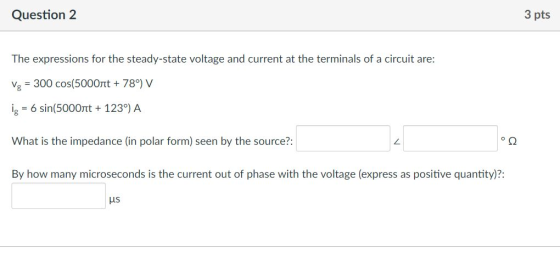
Homework Answers
Request Answer!
We need at least 10 more requests to produce the answer.
0 / 10 have requested this problem solution
The more requests, the faster the answer.
Add Answer to:
Please show all the steps and answer each part. Thank you so
much.
9.2
Question 2...
IV The expressions for the steady-state voltage and current at the terminals of the circuit shown...
 IV The expressions for the steady-state voltage and current at the terminals of the circuit shown below are Vg-300 cos(5000t+78"N , i,-6 sin(5000t+ 1 23°) A Circuit (a) What is the impedance seen by the source? (b) By how many microseconds is the current out of phase with the voltage?
The expressions for the steady-state voltage and current at the terminals of the circuit seen in...
 The expressions for the steady-state voltage and current at the terminals of the circuit seen in the figure are Ug-320 cos(5000nt + 71°)V g-4 sin(5000t 121°) A (Figure 1) Part A What is the impedance seen by the source? Enter your answer using polar notation. Express argument in degrees Submit Request Answer Part B By how many microseconds is the current out of phase with the voltage? Express your answer with the appropriate units. 7 Circuit
7. The expressions for the steady-state voltage and current at the terminals of the circuit seen...
 7. The expressions for the steady-state voltage and current at the terminals of the circuit seen in Fig. P9.14 are Ug = 300 cos (5000 + 78*) V, 's = 6 sin (5000?1+ 123°) A a) What is the impedance seen by the source? b) By how many microseconds is the current out of phase with the voltage? Figure P9.14 2, Circuit
Problem 9.14 2 of 13 Review I Constants The expressions for the steady-state voltage and current...
 Problem 9.14 2 of 13 Review I Constants The expressions for the steady-state voltage and current at the terminals of the circuit seen in the figure are g 350 cos(5000xt85°) V, ig=8 sin(5000rt 108°) A (Figure 1) Part A What is the impedance seen by the source? Express your answer in ohms to three significant figures using polar notation. Express argument in degrees. VA D T vec Z=43.75 27 Ω Previous Answers Request Answer Submit Incorrect; Try Again; 3 attempts...
I need help completing the answer the formula's is given for each part. Thank you. The...
 I need help completing the answer the formula's is given for
each part. Thank you.
The provided series RLC circuit is in a sinusoidal steady state at a frequency of 60 Hz. V = 100 V, R = 20 L = 15 mH.C = 150 F (t) Cl2 a) Calculate the magnitude (12) and phase angle () of the load. XL2WL عليا function of z = f(R, XL, XC) M = f(R, XL,XC) b) Calculate the source currentl. JE VLO...
I need help completing the answer the formula's is given for
each part. Thank you.
The provided series RLC circuit is in a sinusoidal steady state at a frequency of 60 Hz. V = 100 V, R = 20 L = 15 mH.C = 150 F (t) Cl2 a) Calculate the magnitude (12) and phase angle () of the load. XL2WL عليا function of z = f(R, XL, XC) M = f(R, XL,XC) b) Calculate the source currentl. JE VLO...
Please show all calculations and steps. Thank you ! stance of the inductor and calcu- I...
 Please show all calculations and steps. Thank you
! stance of the inductor and calcu- I In ull current; (b) the active , (C) the power factor. A non-inductive load takes a current of 15 A at 123 ductor is then connected in series in order that the same current shall be supplied from 240 V, 5 mains. Ignore the resistance of the inductor and late: (a) the inductance of the inductor te inductance of the inductor; (b) the imped-...
Please show all calculations and steps. Thank you
! stance of the inductor and calcu- I In ull current; (b) the active , (C) the power factor. A non-inductive load takes a current of 15 A at 123 ductor is then connected in series in order that the same current shall be supplied from 240 V, 5 mains. Ignore the resistance of the inductor and late: (a) the inductance of the inductor te inductance of the inductor; (b) the imped-...
Please answer the following questions and show work. Thank you. 1. true or false. the heavier...
Please answer the following questions and show work. Thank you. 1. true or false. the heavier the current flow for a given voltage, the larger the value for admittance. 2. what is the reactance of a 25 millihenry coil at 600 hertz? a) 94,000 ohms b) 0.011 ohms c) 785 ohms d)94 ohms 3. In a series R-C circuit, at low frequencies, the total reactance of the capacitor will be high ad the total impedance will be capacitive in nature,...
Please show all the steps. Thank you! Find the steady-state 3nrent + 3 cos。+73.8) A ANSWER...
 Please show all the steps. Thank you!
Find the steady-state 3nrent + 3 cos。+73.8) A ANSWER 2 cos(2t 36.99) 3 cos(t 73.8) A 4Ω 3다 3cost A 10cos2t V
Please show all the steps. Thank you!
Find the steady-state 3nrent + 3 cos。+73.8) A ANSWER 2 cos(2t 36.99) 3 cos(t 73.8) A 4Ω 3다 3cost A 10cos2t V
PLEASE SO PART C, THANK YOU WILL RATE. A single-phase transformer with a 5:1 turns ratio...
 PLEASE SO PART C, THANK YOU WILL RATE.
A single-phase transformer with a 5:1 turns ratio is connected to a 600 V voltage source on the primary side, and a 5 Ω resistor on the secondary. A current of 22 amps of current is measured to flow through the 5 Ω resistor on the secondary side. The real power flowing into the transformer primary is measured at 2500 W. You can neglect Lm and Rc (the magnetizing inductance and core...
PLEASE SO PART C, THANK YOU WILL RATE.
A single-phase transformer with a 5:1 turns ratio is connected to a 600 V voltage source on the primary side, and a 5 Ω resistor on the secondary. A current of 22 amps of current is measured to flow through the 5 Ω resistor on the secondary side. The real power flowing into the transformer primary is measured at 2500 W. You can neglect Lm and Rc (the magnetizing inductance and core...
Can you please solve these problems, and show all work? Please number each part of your answer to identify what problem...
 Can you please solve these problems, and show all work?
Please number each part of your answer to identify what problem
section is being solved.
Please circle your answers.
Please include the MATLAB portion, if you can, please.
Thank you.
Problem 1: Consider the causal CT systems with transfer functions s +1 + 16) Ha(s)-(s+ 10)(s+1) й,(s) H3(s)S+ D) H4(s) S1) (s2 +s16) 1. Write magnitude and phase expressions for their Bode plots and sketch their asymptotes. Verify using MATLAB....
Can you please solve these problems, and show all work?
Please number each part of your answer to identify what problem
section is being solved.
Please circle your answers.
Please include the MATLAB portion, if you can, please.
Thank you.
Problem 1: Consider the causal CT systems with transfer functions s +1 + 16) Ha(s)-(s+ 10)(s+1) й,(s) H3(s)S+ D) H4(s) S1) (s2 +s16) 1. Write magnitude and phase expressions for their Bode plots and sketch their asymptotes. Verify using MATLAB....
 IV The expressions for the steady-state voltage and current at the terminals of the circuit shown below are Vg-300 cos(5000t+78"N , i,-6 sin(5000t+ 1 23°) A Circuit (a) What is the impedance seen by the source? (b) By how many microseconds is the current out of phase with the voltage?
 The expressions for the steady-state voltage and current at the terminals of the circuit seen in the figure are Ug-320 cos(5000nt + 71°)V g-4 sin(5000t 121°) A (Figure 1) Part A What is the impedance seen by the source? Enter your answer using polar notation. Express argument in degrees Submit Request Answer Part B By how many microseconds is the current out of phase with the voltage? Express your answer with the appropriate units. 7 Circuit
 7. The expressions for the steady-state voltage and current at the terminals of the circuit seen in Fig. P9.14 are Ug = 300 cos (5000 + 78*) V, 's = 6 sin (5000?1+ 123°) A a) What is the impedance seen by the source? b) By how many microseconds is the current out of phase with the voltage? Figure P9.14 2, Circuit
 Problem 9.14 2 of 13 Review I Constants The expressions for the steady-state voltage and current at the terminals of the circuit seen in the figure are g 350 cos(5000xt85°) V, ig=8 sin(5000rt 108°) A (Figure 1) Part A What is the impedance seen by the source? Express your answer in ohms to three significant figures using polar notation. Express argument in degrees. VA D T vec Z=43.75 27 Ω Previous Answers Request Answer Submit Incorrect; Try Again; 3 attempts...
 I need help completing the answer the formula's is given for
each part. Thank you.
The provided series RLC circuit is in a sinusoidal steady state at a frequency of 60 Hz. V = 100 V, R = 20 L = 15 mH.C = 150 F (t) Cl2 a) Calculate the magnitude (12) and phase angle () of the load. XL2WL عليا function of z = f(R, XL, XC) M = f(R, XL,XC) b) Calculate the source currentl. JE VLO...
I need help completing the answer the formula's is given for
each part. Thank you.
The provided series RLC circuit is in a sinusoidal steady state at a frequency of 60 Hz. V = 100 V, R = 20 L = 15 mH.C = 150 F (t) Cl2 a) Calculate the magnitude (12) and phase angle () of the load. XL2WL عليا function of z = f(R, XL, XC) M = f(R, XL,XC) b) Calculate the source currentl. JE VLO...
 Please show all calculations and steps. Thank you
! stance of the inductor and calcu- I In ull current; (b) the active , (C) the power factor. A non-inductive load takes a current of 15 A at 123 ductor is then connected in series in order that the same current shall be supplied from 240 V, 5 mains. Ignore the resistance of the inductor and late: (a) the inductance of the inductor te inductance of the inductor; (b) the imped-...
Please show all calculations and steps. Thank you
! stance of the inductor and calcu- I In ull current; (b) the active , (C) the power factor. A non-inductive load takes a current of 15 A at 123 ductor is then connected in series in order that the same current shall be supplied from 240 V, 5 mains. Ignore the resistance of the inductor and late: (a) the inductance of the inductor te inductance of the inductor; (b) the imped-...
 Please show all the steps. Thank you!
Find the steady-state 3nrent + 3 cos。+73.8) A ANSWER 2 cos(2t 36.99) 3 cos(t 73.8) A 4Ω 3다 3cost A 10cos2t V
Please show all the steps. Thank you!
Find the steady-state 3nrent + 3 cos。+73.8) A ANSWER 2 cos(2t 36.99) 3 cos(t 73.8) A 4Ω 3다 3cost A 10cos2t V
 PLEASE SO PART C, THANK YOU WILL RATE.
A single-phase transformer with a 5:1 turns ratio is connected to a 600 V voltage source on the primary side, and a 5 Ω resistor on the secondary. A current of 22 amps of current is measured to flow through the 5 Ω resistor on the secondary side. The real power flowing into the transformer primary is measured at 2500 W. You can neglect Lm and Rc (the magnetizing inductance and core...
PLEASE SO PART C, THANK YOU WILL RATE.
A single-phase transformer with a 5:1 turns ratio is connected to a 600 V voltage source on the primary side, and a 5 Ω resistor on the secondary. A current of 22 amps of current is measured to flow through the 5 Ω resistor on the secondary side. The real power flowing into the transformer primary is measured at 2500 W. You can neglect Lm and Rc (the magnetizing inductance and core...
 Can you please solve these problems, and show all work?
Please number each part of your answer to identify what problem
section is being solved.
Please circle your answers.
Please include the MATLAB portion, if you can, please.
Thank you.
Problem 1: Consider the causal CT systems with transfer functions s +1 + 16) Ha(s)-(s+ 10)(s+1) й,(s) H3(s)S+ D) H4(s) S1) (s2 +s16) 1. Write magnitude and phase expressions for their Bode plots and sketch their asymptotes. Verify using MATLAB....
Can you please solve these problems, and show all work?
Please number each part of your answer to identify what problem
section is being solved.
Please circle your answers.
Please include the MATLAB portion, if you can, please.
Thank you.
Problem 1: Consider the causal CT systems with transfer functions s +1 + 16) Ha(s)-(s+ 10)(s+1) й,(s) H3(s)S+ D) H4(s) S1) (s2 +s16) 1. Write magnitude and phase expressions for their Bode plots and sketch their asymptotes. Verify using MATLAB....
Most questions answered within 3 hours.
-
Where is the error in this code sequence?
String s1 = "Hello";
String s2 = "ello";...
asked 10 months ago -
Financial data for Joel de Paris, Inc., for last year
follow:
Joel de Paris, Inc.
Balance...
asked 10 months ago -
Consider this reaction:
Al2(SO4)3 (aq)+ BaCl3
(aq) Al2Cl6 (aq)- +
3BaSO4(s) . What is the...
asked 10 months ago -
Suppose that Savneet is considering increasing her
recent random sample from 20 car rentals to 40...
asked 10 months ago -
Trucks arrive at an unloading terminal at an average rate of 120
per hour.
Trucks arrive...
asked 10 months ago -
Why are methanol and ethanol completely soluble in water while
octanol is not very little soluble....
asked 10 months ago -
A facilities manager at a university reads in a research report
that the mean amount of...
asked 10 months ago -
When the CuSO4 is rehydrated by adding water to the anhydrous
compound, is this an endothermic...
asked 10 months ago -
A ray of sunlight is passing from diamond into crown glass; the
angle of incidence is...
asked 10 months ago -
A block of mass 0.249 kg is placed on top of a light, vertical
spring of...
asked 10 months ago -
how do the kidneys compensate in the presences of acidosis
a) trigger hyperventilate
b) reserve acid...
asked 10 months ago -
Question 501 pts
The rental rate of capital to the firm increases. Which of the
following...
asked 10 months ago