
Homework Answers
Add Answer to:
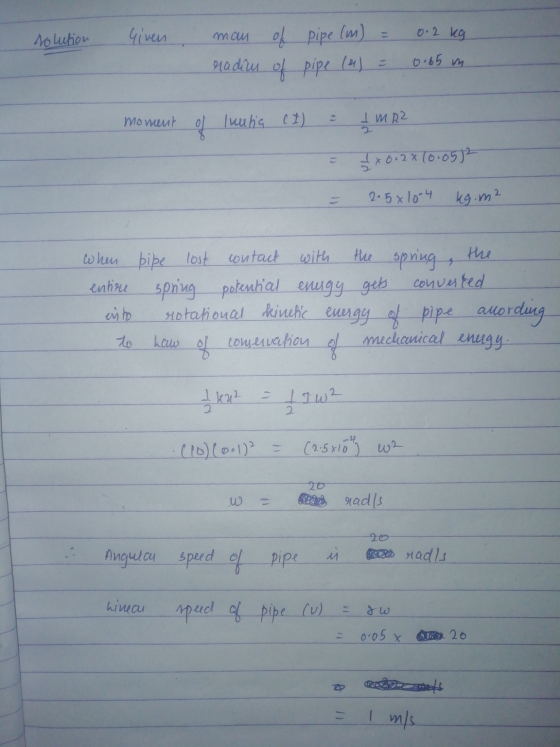
3. A piece of thin-walled pipe and a spring are lying on their sides on a...
the list of equations to list are attached! thanks! 6. A playground merry-go-round, i.e., a horizontal...
 the list of equations to list are attached! thanks!
6. A playground merry-go-round, i.e., a horizontal disc of radius 3 m that can rotate about a vertical axis through its center, is rotating at an angular speed 1/s (measured, as usual, in terms of radians). The moment of inertia of the merry-go-round with respect to that axis is 3000 kg m? A student of mass 80 kg is standing at the center of the merry-go-round. The student now walks outward...
the list of equations to list are attached! thanks!
6. A playground merry-go-round, i.e., a horizontal disc of radius 3 m that can rotate about a vertical axis through its center, is rotating at an angular speed 1/s (measured, as usual, in terms of radians). The moment of inertia of the merry-go-round with respect to that axis is 3000 kg m? A student of mass 80 kg is standing at the center of the merry-go-round. The student now walks outward...
A ball of mass m is pushed out by a compressed spring of spring constant k....
 A ball of mass m is pushed out by a compressed spring of spring
constant k. Both the ball and the spring are on a table (see the
diagram below). The other end of the spring is fixed to the table,
and the spring is initially compressed by x. The ball moves toward
a wedge at the edge of the table and then launches off the wedge
and falls on the ground. The heights of the table and the wedge...
A ball of mass m is pushed out by a compressed spring of spring
constant k. Both the ball and the spring are on a table (see the
diagram below). The other end of the spring is fixed to the table,
and the spring is initially compressed by x. The ball moves toward
a wedge at the edge of the table and then launches off the wedge
and falls on the ground. The heights of the table and the wedge...
A) A pipe L_o in length is open on both sides and a speaker is placed...
A) A pipe L_o in length is open on both sides and a speaker is placed on the left. The speed of sound in air is V_s. Find and set up the necessary equations to calculate the period of the first and third harmonics. (B) An organ pipe maker is trying to make an open pipe that has a fundamental frequency of f_1. Find and set up the equations necessary to calculate the length of the pipe. (C) If the...
2. Consider the following physical situation: A spring that obeys Hooke's Law and has a known/given spring constant k has been compressed to half of its equilibrium length. It's anchored at o...
 2. Consider the following physical situation: A spring that obeys Hooke's Law and has a known/given spring constant k has been compressed to half of its equilibrium length. It's anchored at one end while the other end pushes (but is not attached to) a block of mass m in the horizontal direction. The block is initially held in place. Once released, the block accelerates to the right and achieves a final speed of ve at the point when it leaves...
Problem 3 [35 marks] An inspection of a failed thin walled pressure vessel (cylinder with closed...
 Problem 3 [35 marks] An inspection of a failed thin walled pressure vessel (cylinder with closed ends) shows through- the-thickness cracks in the axial (or longitudinal) direction. The length of the cracks varies from 10 mm to 25 mm. The pressure vessel has radius R = 1.5 m, wall thickness t = 30 mm, and was manufactured from aluminium with fracture toughness properties Kịc = 50 MPa m12. a) Determine the pressure at which the vessel is expected to have...
Constants Periodic Table A spring (80 N/m) has an equilibrium length of 1.00 m. The spring...
 Constants Periodic Table A spring (80 N/m) has an equilibrium length of 1.00 m. The spring is compressed to a length of 0.50 m and a mass of 2.1 kg is placed at its free end on a frictionless slope which makes an angle of 41° with respect to the horizontal. The spring is then released. 0.50 m 0 = 41° Part A If the mass is not attached to the spring, how far up the slope from the compressed...
Exorciso 6.42 A block of ice of mass 3.90 kg is placed against a horizontal spring...
 Exorciso 6.42 A block of ice of mass 3.90 kg is placed against a horizontal spring that has force constant k = 170 N/m and is compressed a distance 2.80x10⁻² m. The spring is released and accelerates the block along a horizontal surface. You can ignore friction and the mass of the spring. Part A Constants Calculate the work done on the block by the spring during the motion of the block from its initial position to where the spring...
A block of mass m sits at rest against a spring, which has spring constant k...
A block of mass m sits at rest against a spring, which has spring constant k and is compressed an amount of deltax from its equilibrium length. The spring is released, and the block slides along the smooth ground before reaching a ramp that makes an angle theta with respect to the ground. a) What is the maximum distance along the length of the ramp that the block will slide? GIve your answer in terms of the variables given. b)...
We usually ignore the kineticenergy of the moving coils of a spring, but let's try...
 We usually ignore the kinetic energy of the moving coils of a spring, but let's try to get a reasonable approximation to this. Consider a spring of mass M, equilibrium length L0, and spring constant k. The work done to stretch or compress the spring by a distance L is , where X = L - L0.Part AConsider a spring, as described above, that has one end fixed and the other end moving with speed v. Assume that the speed of points along...
A spring has spring constant k. One end is fixed, and the other end is attached...
 A spring has spring constant k. One end is fixed, and the other end is attached to a mass m, which is free to move horizontally along a table. The mass slides over the table with a coefficient of friction The spring is compressed a distance d from its equilibrium point and released. When the spring is released, it will push the mass to the right, until it reaches some other distance dy past the equilibrium point dt a) How...
 the list of equations to list are attached! thanks!
6. A playground merry-go-round, i.e., a horizontal disc of radius 3 m that can rotate about a vertical axis through its center, is rotating at an angular speed 1/s (measured, as usual, in terms of radians). The moment of inertia of the merry-go-round with respect to that axis is 3000 kg m? A student of mass 80 kg is standing at the center of the merry-go-round. The student now walks outward...
the list of equations to list are attached! thanks!
6. A playground merry-go-round, i.e., a horizontal disc of radius 3 m that can rotate about a vertical axis through its center, is rotating at an angular speed 1/s (measured, as usual, in terms of radians). The moment of inertia of the merry-go-round with respect to that axis is 3000 kg m? A student of mass 80 kg is standing at the center of the merry-go-round. The student now walks outward...
 A ball of mass m is pushed out by a compressed spring of spring
constant k. Both the ball and the spring are on a table (see the
diagram below). The other end of the spring is fixed to the table,
and the spring is initially compressed by x. The ball moves toward
a wedge at the edge of the table and then launches off the wedge
and falls on the ground. The heights of the table and the wedge...
A ball of mass m is pushed out by a compressed spring of spring
constant k. Both the ball and the spring are on a table (see the
diagram below). The other end of the spring is fixed to the table,
and the spring is initially compressed by x. The ball moves toward
a wedge at the edge of the table and then launches off the wedge
and falls on the ground. The heights of the table and the wedge...
 2. Consider the following physical situation: A spring that obeys Hooke's Law and has a known/given spring constant k has been compressed to half of its equilibrium length. It's anchored at one end while the other end pushes (but is not attached to) a block of mass m in the horizontal direction. The block is initially held in place. Once released, the block accelerates to the right and achieves a final speed of ve at the point when it leaves...
 Problem 3 [35 marks] An inspection of a failed thin walled pressure vessel (cylinder with closed ends) shows through- the-thickness cracks in the axial (or longitudinal) direction. The length of the cracks varies from 10 mm to 25 mm. The pressure vessel has radius R = 1.5 m, wall thickness t = 30 mm, and was manufactured from aluminium with fracture toughness properties Kịc = 50 MPa m12. a) Determine the pressure at which the vessel is expected to have...
 Constants Periodic Table A spring (80 N/m) has an equilibrium length of 1.00 m. The spring is compressed to a length of 0.50 m and a mass of 2.1 kg is placed at its free end on a frictionless slope which makes an angle of 41° with respect to the horizontal. The spring is then released. 0.50 m 0 = 41° Part A If the mass is not attached to the spring, how far up the slope from the compressed...
 Exorciso 6.42 A block of ice of mass 3.90 kg is placed against a horizontal spring that has force constant k = 170 N/m and is compressed a distance 2.80x10⁻² m. The spring is released and accelerates the block along a horizontal surface. You can ignore friction and the mass of the spring. Part A Constants Calculate the work done on the block by the spring during the motion of the block from its initial position to where the spring...
 We usually ignore the kinetic energy of the moving coils of a spring, but let's try to get a reasonable approximation to this. Consider a spring of mass M, equilibrium length L0, and spring constant k. The work done to stretch or compress the spring by a distance L is , where X = L - L0.Part AConsider a spring, as described above, that has one end fixed and the other end moving with speed v. Assume that the speed of points along...
 A spring has spring constant k. One end is fixed, and the other end is attached to a mass m, which is free to move horizontally along a table. The mass slides over the table with a coefficient of friction The spring is compressed a distance d from its equilibrium point and released. When the spring is released, it will push the mass to the right, until it reaches some other distance dy past the equilibrium point dt a) How...
Most questions answered within 3 hours.
-
Where is the error in this code sequence?
String s1 = "Hello";
String s2 = "ello";...
asked 11 months ago -
Financial data for Joel de Paris, Inc., for last year
follow:
Joel de Paris, Inc.
Balance...
asked 11 months ago -
Consider this reaction:
Al2(SO4)3 (aq)+ BaCl3
(aq) Al2Cl6 (aq)- +
3BaSO4(s) . What is the...
asked 11 months ago -
Suppose that Savneet is considering increasing her
recent random sample from 20 car rentals to 40...
asked 11 months ago -
Trucks arrive at an unloading terminal at an average rate of 120
per hour.
Trucks arrive...
asked 11 months ago -
Why are methanol and ethanol completely soluble in water while
octanol is not very little soluble....
asked 11 months ago -
A facilities manager at a university reads in a research report
that the mean amount of...
asked 11 months ago -
When the CuSO4 is rehydrated by adding water to the anhydrous
compound, is this an endothermic...
asked 11 months ago -
A ray of sunlight is passing from diamond into crown glass; the
angle of incidence is...
asked 11 months ago -
A block of mass 0.249 kg is placed on top of a light, vertical
spring of...
asked 11 months ago -
how do the kidneys compensate in the presences of acidosis
a) trigger hyperventilate
b) reserve acid...
asked 11 months ago -
Question 501 pts
The rental rate of capital to the firm increases. Which of the
following...
asked 11 months ago