
Homework Answers
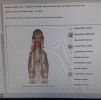
RIGHT SIDE OF IMAGE FROM ABOVE DOWNWORDS:
1.POSTERIOR BELLY OF
DIGASTRIC MUSCLE
2.THYROHYOID MUSCLE
3.SUPERIOR BELLY OF
OMOHYOID MUSCLE
3.INFERIOR BELLY OF
OMOHYOID MUSCLE
4.TRAPEZIUS MUSCLE
LEFT SIDE OF IMAGE FROM ABOVE DOWNWORDS:
1.MYLOHYOID MUSCLE
2.ANTERIOR BELLY OF
DIGASTRIC MUSCLE
3.HYOID BONE
4.STERNOHYOID
MUSCLE
5.STERNOCLEIDOMASTOID MUSCLE
Add Answer to:
6) Identify each of the muscles on this cadaver image (NetAnatomy, Gross anatomy, Head and Neck,...
Anatomy Drill Level 1: Cadaver Practicals, Muscles of the neck and back, Posterior view Your answer...
 Anatomy Drill Level 1: Cadaver Practicals, Muscles of the neck and back, Posterior view Your answer is partially correct. Try again. Click and hold each pin to drag it to the term that identfies its location. Iliocostalis cervicis Iliocostalis lumborum Iliocostalis thoracis Longissimus capitis O Longissimus cervicis O Spinalis thoracis O Semispinalis capitis Spinalis capitis Longissimus thoracis of Splenius capitis Splenius cervicis Muscles of the neck and back. Posterior view
MUSCULAR SYSTEM Skeletal muscles allow our bodies to bend, walk, sit, chew and talk. Humans have...
 MUSCULAR SYSTEM Skeletal muscles allow our bodies to bend, walk, sit, chew and talk. Humans have more than 600 muscles in their bodies. Muscles are named in various ways: by the action they perform (extensor, flexor): by their size (maximus, minimus), or length (brevis, longus); by their shape (deltoid, trapezius); for their origin(s) or insertion(s) (sternocleidomastoid), or by the number of origins or insertions (triceps, biceps). In addition, they can be named for their location (abdominis, brachii) or the bones...
questions 2-4 1-4 Week 10 Topics: Muscle actions and naming conventions, major muscles of the human...
 questions 2-4
1-4 Week 10 Topics: Muscle actions and naming conventions, major muscles of the human body including origin, insertion, action, and innervation Reading: Chapter 10: The Muscular System Learning Objectives: 1. Define the following terms, prime mover, synergist, antagonist, origin, insertion, aponeurosis, sphincter 2. Describe the functions of prime movers, antagonists, and Synergists 3. List the criteria used in naming muscles. Provide examples of cach, 4. Name and identify key muscles of the human body, giving the origin, insertion,...
questions 2-4
1-4 Week 10 Topics: Muscle actions and naming conventions, major muscles of the human body including origin, insertion, action, and innervation Reading: Chapter 10: The Muscular System Learning Objectives: 1. Define the following terms, prime mover, synergist, antagonist, origin, insertion, aponeurosis, sphincter 2. Describe the functions of prime movers, antagonists, and Synergists 3. List the criteria used in naming muscles. Provide examples of cach, 4. Name and identify key muscles of the human body, giving the origin, insertion,...
1. Remember: When you lift your arm above your head, the scapula protracts, elevates, and upwardly...
1. Remember: When you lift your arm above your head, the scapula protracts, elevates, and upwardly rotates. When you bring your arm down to your side, the scapula retracts, depresses, and downwardly rotates. 2. What is the difference between the actions of the pectoralis minor and the serratus anterior? Which muscle likely contracts more when you lift your arm above your head? 3. List all the actions of the trapezius muscle on the neck. List all the actions of the...
The Language of Anatomy Name LabTime/Date Surface Anatomy 1. Match each of the numbered descriptions with...
 The Language of Anatomy Name LabTime/Date Surface Anatomy 1. Match each of the numbered descriptions with the related term in the key, and record the key letter or term in front of the description Key: a. buccal c. cephalic e. patellar b. calcaneal d. digital f. Scapular 1. cheek 4 anterior aspect of knee 2. fingers 5. heel of foot 3. shoulder blade region 6. head 2. Indicate the following body areas on the accompanying diagram by placing the correct...
Please write a nursing assessment using medical terms to describe each assessment. HEENT (head, ears, eyes,...
Please write a nursing assessment using medical terms to describe each assessment. HEENT (head, ears, eyes, nose and throat) Inspect head, eyes, ears, nose for size, shape, symmetry. Palpate head, hair, face and sinuses for any deformities, tenderness, masses. Upon palpitation of L.C.’s head she had no tenderness or masses. Her hair was Assess eyes with penlight for pupil size, reactivity & accommodation. 6 cardinal fields of gaze. Symmetrical? Assess hearing: vocal and soft sounds Assess oral cavity: dentures? Difficulty...
U Question 26 6 pts Match the cranial nerve with its function. wtoreve - Wand Olomotor...
 U Question 26 6 pts Match the cranial nerve with its function. wtoreve - Wand Olomotor more tro Trigem ve Charge A merve VW Hypoglosure CNI Olfactory ON II Optic Smell CN i Oculomotor Choose Choose Autonomic function of cut, cardiac inhibition, sensation from larynx and pharynx, motor to muscles of vocal cords, swallowing Controls the superior oblique muscle of eye Motor to shoulders and neck muscles Motor to lateral rectus muscle in eye Equilibrium and hearing Sensation to the...
Pre-Lab #4 (This will help you prepare for the Skeletal Anatomy Test at end of Week...
Pre-Lab #4 (This will help you prepare for the Skeletal Anatomy Test at end of Week 5). Diagram (or obtain an unlabeled digital image of) and label the bones below. You can obtain unlabeled images online. For each bone complete the following tasks for Pre-Lab #4 Identify the bone and whether it is right or left (if that applies). Identify any markings or structures listed below on the bone (ex: fossa, cavity, process, etc). Identify any specific joints/articulations this bone...
General Review! Muste Recym 11. Identify each lettered muscle in the illustration of the human anterior...
 General Review! Muste Recym 11. Identify each lettered muscle in the illustration of the human anterior superficial musculature by matching its letter with one of the following muscle names 1. adductor longus 2. biceps brachii 3. brachioradialis 4. deltoid 34. tibialis anterior 35. transversus abdominis 36. trapezius 37. triceps brachi 38. vastus lateralis 39. vastus medialis 5. extensor digitorum longus 6. external oblique 7. fibularis longus 8. flexor carpi radialis 40. zygomaticus 9. flexor carpi ulnaris 10. frontal belly of...
Elbow Flexion: biceps brachii, brachialis, and brachioradialis muscles Hip Flexion: iliopsoas, sartorius muscles Extension: biceps femoris,...
 Elbow Flexion: biceps brachii, brachialis, and brachioradialis muscles Hip Flexion: iliopsoas, sartorius muscles Extension: biceps femoris, semitendinosus, semimembranosus, and gluteus maxim Abduction: tensor fasciae latae, sartorius, and gluteus medius muscles Adduction: gracilis and adductor muscles I Knee Flexion: biceps femoris, semitendinosus, semimembranosus, and gastrocnemius muscles .Extension: rectus femoris, vastus medialis, vastus intermedius, and vastus lateralis Ankle Dorsiflexion: tibialis anterior muscle Plantarflexion: gastrocnemius and soleus muscles Inversion: tibialis anterior and tibialis posterior muscles Eversion: fibularis brevis and fibularis longus muscles ke...
 Anatomy Drill Level 1: Cadaver Practicals, Muscles of the neck and back, Posterior view Your answer is partially correct. Try again. Click and hold each pin to drag it to the term that identfies its location. Iliocostalis cervicis Iliocostalis lumborum Iliocostalis thoracis Longissimus capitis O Longissimus cervicis O Spinalis thoracis O Semispinalis capitis Spinalis capitis Longissimus thoracis of Splenius capitis Splenius cervicis Muscles of the neck and back. Posterior view
 MUSCULAR SYSTEM Skeletal muscles allow our bodies to bend, walk, sit, chew and talk. Humans have more than 600 muscles in their bodies. Muscles are named in various ways: by the action they perform (extensor, flexor): by their size (maximus, minimus), or length (brevis, longus); by their shape (deltoid, trapezius); for their origin(s) or insertion(s) (sternocleidomastoid), or by the number of origins or insertions (triceps, biceps). In addition, they can be named for their location (abdominis, brachii) or the bones...
 questions 2-4
1-4 Week 10 Topics: Muscle actions and naming conventions, major muscles of the human body including origin, insertion, action, and innervation Reading: Chapter 10: The Muscular System Learning Objectives: 1. Define the following terms, prime mover, synergist, antagonist, origin, insertion, aponeurosis, sphincter 2. Describe the functions of prime movers, antagonists, and Synergists 3. List the criteria used in naming muscles. Provide examples of cach, 4. Name and identify key muscles of the human body, giving the origin, insertion,...
questions 2-4
1-4 Week 10 Topics: Muscle actions and naming conventions, major muscles of the human body including origin, insertion, action, and innervation Reading: Chapter 10: The Muscular System Learning Objectives: 1. Define the following terms, prime mover, synergist, antagonist, origin, insertion, aponeurosis, sphincter 2. Describe the functions of prime movers, antagonists, and Synergists 3. List the criteria used in naming muscles. Provide examples of cach, 4. Name and identify key muscles of the human body, giving the origin, insertion,...
 The Language of Anatomy Name LabTime/Date Surface Anatomy 1. Match each of the numbered descriptions with the related term in the key, and record the key letter or term in front of the description Key: a. buccal c. cephalic e. patellar b. calcaneal d. digital f. Scapular 1. cheek 4 anterior aspect of knee 2. fingers 5. heel of foot 3. shoulder blade region 6. head 2. Indicate the following body areas on the accompanying diagram by placing the correct...
 U Question 26 6 pts Match the cranial nerve with its function. wtoreve - Wand Olomotor more tro Trigem ve Charge A merve VW Hypoglosure CNI Olfactory ON II Optic Smell CN i Oculomotor Choose Choose Autonomic function of cut, cardiac inhibition, sensation from larynx and pharynx, motor to muscles of vocal cords, swallowing Controls the superior oblique muscle of eye Motor to shoulders and neck muscles Motor to lateral rectus muscle in eye Equilibrium and hearing Sensation to the...
 General Review! Muste Recym 11. Identify each lettered muscle in the illustration of the human anterior superficial musculature by matching its letter with one of the following muscle names 1. adductor longus 2. biceps brachii 3. brachioradialis 4. deltoid 34. tibialis anterior 35. transversus abdominis 36. trapezius 37. triceps brachi 38. vastus lateralis 39. vastus medialis 5. extensor digitorum longus 6. external oblique 7. fibularis longus 8. flexor carpi radialis 40. zygomaticus 9. flexor carpi ulnaris 10. frontal belly of...
 Elbow Flexion: biceps brachii, brachialis, and brachioradialis muscles Hip Flexion: iliopsoas, sartorius muscles Extension: biceps femoris, semitendinosus, semimembranosus, and gluteus maxim Abduction: tensor fasciae latae, sartorius, and gluteus medius muscles Adduction: gracilis and adductor muscles I Knee Flexion: biceps femoris, semitendinosus, semimembranosus, and gastrocnemius muscles .Extension: rectus femoris, vastus medialis, vastus intermedius, and vastus lateralis Ankle Dorsiflexion: tibialis anterior muscle Plantarflexion: gastrocnemius and soleus muscles Inversion: tibialis anterior and tibialis posterior muscles Eversion: fibularis brevis and fibularis longus muscles ke...
Most questions answered within 3 hours.
-
Where is the error in this code sequence?
String s1 = "Hello";
String s2 = "ello";...
asked 11 months ago -
Financial data for Joel de Paris, Inc., for last year
follow:
Joel de Paris, Inc.
Balance...
asked 11 months ago -
Consider this reaction:
Al2(SO4)3 (aq)+ BaCl3
(aq) Al2Cl6 (aq)- +
3BaSO4(s) . What is the...
asked 11 months ago -
Suppose that Savneet is considering increasing her
recent random sample from 20 car rentals to 40...
asked 11 months ago -
Trucks arrive at an unloading terminal at an average rate of 120
per hour.
Trucks arrive...
asked 11 months ago -
Why are methanol and ethanol completely soluble in water while
octanol is not very little soluble....
asked 11 months ago -
A facilities manager at a university reads in a research report
that the mean amount of...
asked 11 months ago -
When the CuSO4 is rehydrated by adding water to the anhydrous
compound, is this an endothermic...
asked 11 months ago -
A ray of sunlight is passing from diamond into crown glass; the
angle of incidence is...
asked 11 months ago -
A block of mass 0.249 kg is placed on top of a light, vertical
spring of...
asked 11 months ago -
how do the kidneys compensate in the presences of acidosis
a) trigger hyperventilate
b) reserve acid...
asked 11 months ago -
Question 501 pts
The rental rate of capital to the firm increases. Which of the
following...
asked 11 months ago