
Homework Answers
Add Answer to:
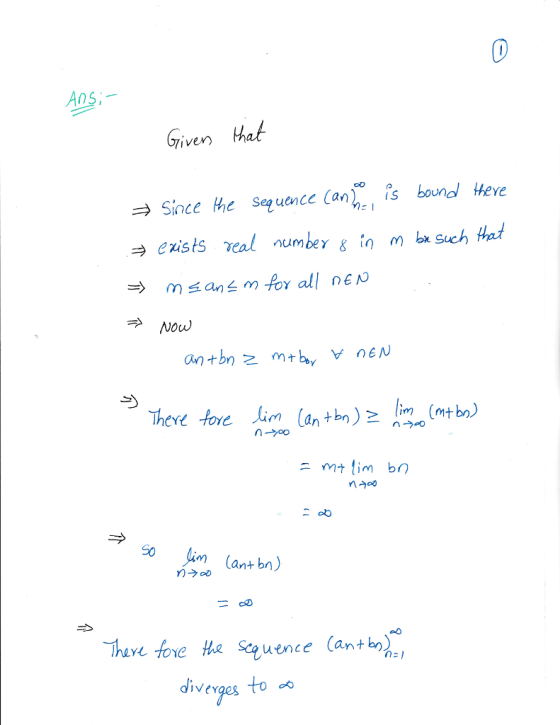
2. Let (%)-1 be a bounded sequence and let (h) .1 be a sequence that diverges...
Let (an)nen be a bounded sequence in R. For all n e N define bn =...
 Let (an)nen be a bounded sequence in R. For all n e N define bn = sup{am, On+1, On+2,...}. (You do not have to show that the supremum exists.) (a) Prove that the sequence (bn)nen is a monotone sequence. (b) Prove that the sequence (bn)nen is convergent. (c) Prove or disprove: lim an = lim bre. 100 000
3. Let (an)n1 be a sequence. o Prove that if (an)ni is monotone increasing and not...
 3. Let (an)n1 be a sequence. o Prove that if (an)ni is monotone increasing and not bounded above, thenlimn00 an0o. o Show that removing the monotonicity hypothesis makes this statement false. (Give an example of a sequence that is not bounded above, and does not diverge to oo.)
Exercise 2.3.9. (a) Let (an) be a bounded (not necessarily convergent) sequence, and assume lim bn...
 Exercise 2.3.9. (a) Let (an) be a bounded (not necessarily convergent) sequence, and assume lim bn = 0. Show that lim(anon) = 0. Why are we not allowed to use the Algebraic Limit Theorem to prove this?
Let (xn) be a bounded sequence of real numbers, and put u = lim supn→∞ xn . Let E be the set consisting of the limits of all convergent subsequences of (xn). Show that u ∈ E and that u = sup(E). Form...
 Let (xn) be a bounded sequence
of real numbers, and put u = lim supn→∞ xn . Let E be the set
consisting of the limits of all convergent subsequences of (xn).
Show that u ∈ E and that u = sup(E).
Formulate and prove a similar result for lim infn→∞ xn .
Thank you!
7. Let (Fm) be a bounded sequence of real numbers, and put u-lim supn→oorn . Let E be the set consisting of the limits of...
Let (xn) be a bounded sequence
of real numbers, and put u = lim supn→∞ xn . Let E be the set
consisting of the limits of all convergent subsequences of (xn).
Show that u ∈ E and that u = sup(E).
Formulate and prove a similar result for lim infn→∞ xn .
Thank you!
7. Let (Fm) be a bounded sequence of real numbers, and put u-lim supn→oorn . Let E be the set consisting of the limits of...
4. (20 pts) Let {xn} be a Cauchy sequence. Show that a) (5 pts) {xn} is...
 4. (20 pts) Let {xn} be a Cauchy sequence. Show that a) (5 pts) {xn} is bounded. Hint: See Lecture 4 notes b) (5 pts) {Jxn} is a Cauchy sequence. Hint: Use the following inequality ||x| - |y|| < |x - y|, for all x, y E R. _ subsequence of {xn} and xn c) (5 pts) If {xnk} is a See Lecture 4 notes. as k - oo, then xn OO as n»oo. Hint: > d) (5 pts) If...
please prove Let - andd On -n+1 Show that a is an increasing sequence, that bn is a decreas- Let - andd On -n+1 Show that a is an increasing sequence, that bn is a decreas-
 please prove
Let - andd On -n+1 Show that a is an increasing sequence, that bn is a decreas-
Let - andd On -n+1 Show that a is an increasing sequence, that bn is a decreas-
please prove
Let - andd On -n+1 Show that a is an increasing sequence, that bn is a decreas-
Let - andd On -n+1 Show that a is an increasing sequence, that bn is a decreas-
18. If ai, az, as,... is a bounded sequence of real numbers, define lim sup an...
 18. If ai, az, as,... is a bounded sequence of real numbers, define lim sup an (also denoted lim an) to be --+ n+ l.u.b. {z ER: an > & for an infinite number of integers n} and define lim inf an (also denoted lim an) to be g.l.b. {ER: An <for an infinite number of integers n}. Prove that lim inf an Slim sup an, with the equality holding if and only if the sequence converges. 19. Let ai,...
(5) Let {fn} be a sequence in C((0, 1]) which converges uniformly (to C([0, 1]). Prove that {fn} is uniformly bounded a...
 (5) Let {fn} be a sequence in C((0, 1]) which converges uniformly (to C([0, 1]). Prove that {fn} is uniformly bounded and equicontinuous function f E a
(5) Let {fn} be a sequence in C((0, 1]) which converges uniformly (to C([0, 1]). Prove that {fn} is uniformly bounded and equicontinuous function f E a
(5) Let {fn} be a sequence in C((0, 1]) which converges uniformly (to C([0, 1]). Prove that {fn} is uniformly bounded and equicontinuous function f E a
1)this sequence is bounded or unbounded? 2)this sequence is monotonic or nonmonotonic 6 Given the sequence...
 1)this sequence is bounded or unbounded?
2)this sequence is monotonic or nonmonotonic
6 Given the sequence an - 3ñ: This sequence is Select an answer v This sequence is Select an answer v Does this sequence converge or diverge? Select an answer v If the sequence does converge, to what value? If it diverges, enter DNE Question Help: D Video D Video Submit Question
1)this sequence is bounded or unbounded?
2)this sequence is monotonic or nonmonotonic
6 Given the sequence an - 3ñ: This sequence is Select an answer v This sequence is Select an answer v Does this sequence converge or diverge? Select an answer v If the sequence does converge, to what value? If it diverges, enter DNE Question Help: D Video D Video Submit Question
Determine if the sequence converges or diverges. If converge, find the limit. iii. an (1-2) ni!
 Determine if the sequence converges or diverges. If converge, find
the limit.
iii. an (1-2) ni!
Determine if the sequence converges or diverges. If converge, find
the limit.
iii. an (1-2) ni!
 Let (an)nen be a bounded sequence in R. For all n e N define bn = sup{am, On+1, On+2,...}. (You do not have to show that the supremum exists.) (a) Prove that the sequence (bn)nen is a monotone sequence. (b) Prove that the sequence (bn)nen is convergent. (c) Prove or disprove: lim an = lim bre. 100 000
 3. Let (an)n1 be a sequence. o Prove that if (an)ni is monotone increasing and not bounded above, thenlimn00 an0o. o Show that removing the monotonicity hypothesis makes this statement false. (Give an example of a sequence that is not bounded above, and does not diverge to oo.)
 Exercise 2.3.9. (a) Let (an) be a bounded (not necessarily convergent) sequence, and assume lim bn = 0. Show that lim(anon) = 0. Why are we not allowed to use the Algebraic Limit Theorem to prove this?
 Let (xn) be a bounded sequence
of real numbers, and put u = lim supn→∞ xn . Let E be the set
consisting of the limits of all convergent subsequences of (xn).
Show that u ∈ E and that u = sup(E).
Formulate and prove a similar result for lim infn→∞ xn .
Thank you!
7. Let (Fm) be a bounded sequence of real numbers, and put u-lim supn→oorn . Let E be the set consisting of the limits of...
Let (xn) be a bounded sequence
of real numbers, and put u = lim supn→∞ xn . Let E be the set
consisting of the limits of all convergent subsequences of (xn).
Show that u ∈ E and that u = sup(E).
Formulate and prove a similar result for lim infn→∞ xn .
Thank you!
7. Let (Fm) be a bounded sequence of real numbers, and put u-lim supn→oorn . Let E be the set consisting of the limits of...
 4. (20 pts) Let {xn} be a Cauchy sequence. Show that a) (5 pts) {xn} is bounded. Hint: See Lecture 4 notes b) (5 pts) {Jxn} is a Cauchy sequence. Hint: Use the following inequality ||x| - |y|| < |x - y|, for all x, y E R. _ subsequence of {xn} and xn c) (5 pts) If {xnk} is a See Lecture 4 notes. as k - oo, then xn OO as n»oo. Hint: > d) (5 pts) If...
 please prove
Let - andd On -n+1 Show that a is an increasing sequence, that bn is a decreas-
Let - andd On -n+1 Show that a is an increasing sequence, that bn is a decreas-
please prove
Let - andd On -n+1 Show that a is an increasing sequence, that bn is a decreas-
Let - andd On -n+1 Show that a is an increasing sequence, that bn is a decreas-
 18. If ai, az, as,... is a bounded sequence of real numbers, define lim sup an (also denoted lim an) to be --+ n+ l.u.b. {z ER: an > & for an infinite number of integers n} and define lim inf an (also denoted lim an) to be g.l.b. {ER: An <for an infinite number of integers n}. Prove that lim inf an Slim sup an, with the equality holding if and only if the sequence converges. 19. Let ai,...
 (5) Let {fn} be a sequence in C((0, 1]) which converges uniformly (to C([0, 1]). Prove that {fn} is uniformly bounded and equicontinuous function f E a
(5) Let {fn} be a sequence in C((0, 1]) which converges uniformly (to C([0, 1]). Prove that {fn} is uniformly bounded and equicontinuous function f E a
(5) Let {fn} be a sequence in C((0, 1]) which converges uniformly (to C([0, 1]). Prove that {fn} is uniformly bounded and equicontinuous function f E a
 1)this sequence is bounded or unbounded?
2)this sequence is monotonic or nonmonotonic
6 Given the sequence an - 3ñ: This sequence is Select an answer v This sequence is Select an answer v Does this sequence converge or diverge? Select an answer v If the sequence does converge, to what value? If it diverges, enter DNE Question Help: D Video D Video Submit Question
1)this sequence is bounded or unbounded?
2)this sequence is monotonic or nonmonotonic
6 Given the sequence an - 3ñ: This sequence is Select an answer v This sequence is Select an answer v Does this sequence converge or diverge? Select an answer v If the sequence does converge, to what value? If it diverges, enter DNE Question Help: D Video D Video Submit Question
 Determine if the sequence converges or diverges. If converge, find
the limit.
iii. an (1-2) ni!
Determine if the sequence converges or diverges. If converge, find
the limit.
iii. an (1-2) ni!
Most questions answered within 3 hours.
-
Where is the error in this code sequence?
String s1 = "Hello";
String s2 = "ello";...
asked 10 months ago -
Financial data for Joel de Paris, Inc., for last year
follow:
Joel de Paris, Inc.
Balance...
asked 10 months ago -
Consider this reaction:
Al2(SO4)3 (aq)+ BaCl3
(aq) Al2Cl6 (aq)- +
3BaSO4(s) . What is the...
asked 10 months ago -
Suppose that Savneet is considering increasing her
recent random sample from 20 car rentals to 40...
asked 10 months ago -
Trucks arrive at an unloading terminal at an average rate of 120
per hour.
Trucks arrive...
asked 10 months ago -
Why are methanol and ethanol completely soluble in water while
octanol is not very little soluble....
asked 10 months ago -
A facilities manager at a university reads in a research report
that the mean amount of...
asked 10 months ago -
When the CuSO4 is rehydrated by adding water to the anhydrous
compound, is this an endothermic...
asked 10 months ago -
A ray of sunlight is passing from diamond into crown glass; the
angle of incidence is...
asked 10 months ago -
A block of mass 0.249 kg is placed on top of a light, vertical
spring of...
asked 10 months ago -
how do the kidneys compensate in the presences of acidosis
a) trigger hyperventilate
b) reserve acid...
asked 10 months ago -
Question 501 pts
The rental rate of capital to the firm increases. Which of the
following...
asked 10 months ago