
Homework Answers
Add Answer to:
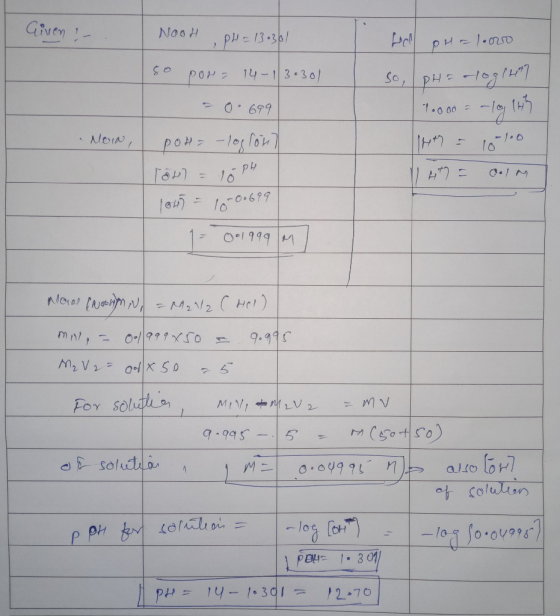
12. Given the following: NaOH(aq), pH = 13.301 HCl(aq), pH = 1.000 A mixture is made...
27. Calculate the pH of a mixture made by adding 50.0 mL of 0.20 M HCI(aq)...
 27. Calculate the pH of a mixture made by adding 50.0 mL of 0.20 M HCI(aq) to 150.0 mL of water at 25.0°C A) 0.70 B) 1.00 C) 1.18 D) 1.30 E) 13.0 Ans: D 28. A mixture is made by adding 50.0 mL of 0.20 M NaOH(aq) to 50.0 mL of water. At 25.0°C, what is its pH? A) 1.00 B) 4.55 C) 7.00 D) 13.0 E) 13.3
1) NaOH(aq) + HCl(aq) - NaCl(aq) + H2O(1) To determine the concentration of a NaOH(aq) solution,...
 1) NaOH(aq) + HCl(aq) - NaCl(aq) + H2O(1) To determine the concentration of a NaOH(aq) solution, a student titrated a 50. mL sample with 0.10 M HCl(aq). The reaction is represented by the equation above. The titration is monitored using a pH meter, and the experimental results are plotted in the graph below. 13. 0S 7.04 Answer Key on School Loop @ P 1.07. 0 25.0 50.0 Volume HCI added (mL) One student titrated the NaOH(aq) with 1.0 M HCl(aq)...
Calculate the pH of the resulting solution if 25.0 mL of 0.250 M HCl(aq) is added to 35.0 mL of 0.250 M NaOH(aq).
 Calculate the pH of the resulting solution if 25.0 mL of 0.250 M HCl(aq) is added to 35.0 mL of 0.250 M NaOH(aq).pH=Calculate the pH of the resulting solution if 25.0 mL of 0.250 M HCl(aq) is added to 15.0 mL of 0.350 M NaOH(aq).pH=No referals as the only answer unless you're the first one.
When 200 mL NaOH(aq) is added to 500 mL of 1.0 M HCL(aq), the pH of...
When 200 mL NaOH(aq) is added to 500 mL of 1.0 M HCL(aq), the pH of the resulting mixture is what?
Consider the following reaction. NaOH(aq) + HCl(aq) → NaCl(aq) + H2O(l) If 25.0 mL of a...
Consider the following reaction. NaOH(aq) + HCl(aq) → NaCl(aq) + H2O(l) If 25.0 mL of a 0.100 M solution of NaOH reacted with excess HCl, how many moles of NaCl could form? a. 0.00250 mol b. 0.100 mol c. 25.0 mol d. 2.50 mol 1 points QUESTION 9 Consider the following reaction. How many grams of sucrose would produce 2546 kcal? a. 649.4 g b. 1342 g c. 180.4 g d. 1.897 g
1) Calculate the pH of a solution produced by mixing 100.0 mL of 0.10 M HCl(aq)...
1) Calculate the pH of a solution produced by mixing 100.0 mL of 0.10 M HCl(aq) and 100.0 mL of 0.20 M NaOH(aq). 2) Calculate the pH of an aqueous solution made by mixing 100.0 mL of 0.40 M NH4Cl and 50.0 mL of 0.40 M NaOH. The pKa of NH4+ is 9.24.
Calculate the pH of the resulting solution if 15.0 mL of 0.150 M HCl(aq) is added...
Calculate the pH of the resulting solution if 15.0 mL of 0.150 M HCl(aq) is added to (a) 20.0 mL of 0.150 M NaOH(aq). (b) 25.0 mL of 0.200 M NaOH(aq).
HCl and NaOH react according to the following equation: HCl (aq) + NaOH → Na+(aq) +...
HCl and NaOH react according to the following equation: HCl (aq) + NaOH → Na+(aq) + Cl-(aq) + H2O(l) In a coffee cup calorimeter, 50mL of 2.00 M HCl was combined with 50mL of 2.05 M NaOH. The temperature of the solution rises from 22 degree C to 36 degrees C. What is the enthalpy change for the reaction (delta H rxn)? What is the molar enthalpy for the reaction? Given: The heat capacity of the calorimeter (Cc) is 14.0...
Page 36 When 50.0 mL of 1.00 M HCI(aq) and 50.0 mL of 1.00 M NaOH(aq),...
 Page 36 When 50.0 mL of 1.00 M HCI(aq) and 50.0 mL of 1.00 M NaOH(aq), both at 22.0 °C, are added to a coffee cup calorimeter, the temperature of the mixture reaches a maximum of 28.9 C. What is the approximate amount of heat produced by this reaction? Specific heat of water is 4.184 J/g C HCl(aq) + NaOH(aq) → Nacl(aq) + H2O() The heat given off by the reaction is equal to that taken in by the solution....
A 10.0 mL sample of 0.75 M CH3CH2COOH(aq) is titrated with 0.30 M NaOH(aq) (adding NaOH...
 A 10.0 mL sample of 0.75 M CH3CH2COOH(aq) is titrated with 0.30 M NaOH(aq) (adding NaOH to CH3CH2COOH). Determine which region on the titration curve the mixture produced is in, and the pH of the mixture at each volume of added base. K of CH3CH2COOH is 1.3 x 10⁻⁵. base Henderson-Hasselbalch equation: pH = pK+ log NaOH CH3CH2COOH Parta): 1) After adding 18.0 mL of the NaOH solution, the mixture is (Select) equivalence point on the titration curve. 2) The...
 27. Calculate the pH of a mixture made by adding 50.0 mL of 0.20 M HCI(aq) to 150.0 mL of water at 25.0°C A) 0.70 B) 1.00 C) 1.18 D) 1.30 E) 13.0 Ans: D 28. A mixture is made by adding 50.0 mL of 0.20 M NaOH(aq) to 50.0 mL of water. At 25.0°C, what is its pH? A) 1.00 B) 4.55 C) 7.00 D) 13.0 E) 13.3
 1) NaOH(aq) + HCl(aq) - NaCl(aq) + H2O(1) To determine the concentration of a NaOH(aq) solution, a student titrated a 50. mL sample with 0.10 M HCl(aq). The reaction is represented by the equation above. The titration is monitored using a pH meter, and the experimental results are plotted in the graph below. 13. 0S 7.04 Answer Key on School Loop @ P 1.07. 0 25.0 50.0 Volume HCI added (mL) One student titrated the NaOH(aq) with 1.0 M HCl(aq)...
 Page 36 When 50.0 mL of 1.00 M HCI(aq) and 50.0 mL of 1.00 M NaOH(aq), both at 22.0 °C, are added to a coffee cup calorimeter, the temperature of the mixture reaches a maximum of 28.9 C. What is the approximate amount of heat produced by this reaction? Specific heat of water is 4.184 J/g C HCl(aq) + NaOH(aq) → Nacl(aq) + H2O() The heat given off by the reaction is equal to that taken in by the solution....
 A 10.0 mL sample of 0.75 M CH3CH2COOH(aq) is titrated with 0.30 M NaOH(aq) (adding NaOH to CH3CH2COOH). Determine which region on the titration curve the mixture produced is in, and the pH of the mixture at each volume of added base. K of CH3CH2COOH is 1.3 x 10⁻⁵. base Henderson-Hasselbalch equation: pH = pK+ log NaOH CH3CH2COOH Parta): 1) After adding 18.0 mL of the NaOH solution, the mixture is (Select) equivalence point on the titration curve. 2) The...
Most questions answered within 3 hours.
-
Where is the error in this code sequence?
String s1 = "Hello";
String s2 = "ello";...
asked 11 months ago -
Financial data for Joel de Paris, Inc., for last year
follow:
Joel de Paris, Inc.
Balance...
asked 11 months ago -
Consider this reaction:
Al2(SO4)3 (aq)+ BaCl3
(aq) Al2Cl6 (aq)- +
3BaSO4(s) . What is the...
asked 11 months ago -
Suppose that Savneet is considering increasing her
recent random sample from 20 car rentals to 40...
asked 11 months ago -
Trucks arrive at an unloading terminal at an average rate of 120
per hour.
Trucks arrive...
asked 11 months ago -
Why are methanol and ethanol completely soluble in water while
octanol is not very little soluble....
asked 11 months ago -
A facilities manager at a university reads in a research report
that the mean amount of...
asked 11 months ago -
When the CuSO4 is rehydrated by adding water to the anhydrous
compound, is this an endothermic...
asked 11 months ago -
A ray of sunlight is passing from diamond into crown glass; the
angle of incidence is...
asked 11 months ago -
A block of mass 0.249 kg is placed on top of a light, vertical
spring of...
asked 11 months ago -
how do the kidneys compensate in the presences of acidosis
a) trigger hyperventilate
b) reserve acid...
asked 11 months ago -
Question 501 pts
The rental rate of capital to the firm increases. Which of the
following...
asked 11 months ago