The fluid transmission of a 30000-lb truck allows the engine to deliver constant power to the...
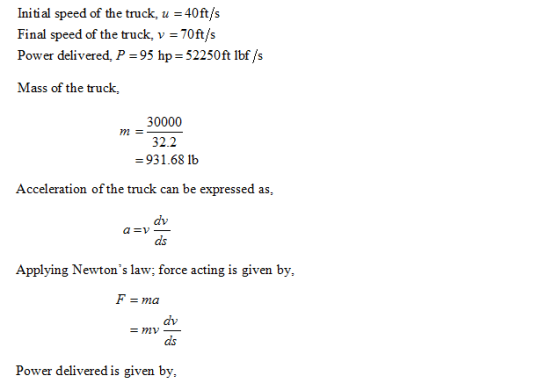
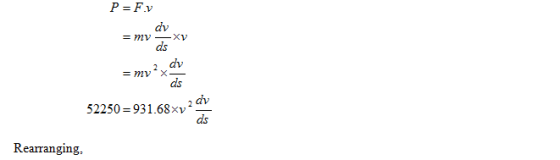
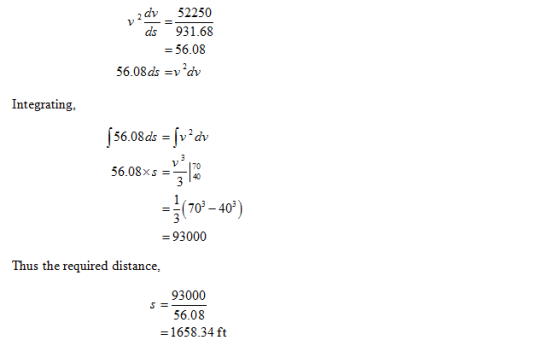
The fluid transmission of a 30000-lb truck allows the engine to deliver constant power to the rear wheels.
Determine the distance required for the truck traveling on a level road to increase its speed from 40 ft/s to 70 ft/s if 95 hp is delivered to the rear wheels. Neglect drag and rolling resistance.
Express your answer with the appropriate units.
Homework Answers
Add Answer to:
The fluid transmission of a 30000-lb truck allows the engine to
deliver constant power to the...
Problem 14.60 A loaded truck weighs 16(103) lb and accelerates uniformly on a level road from...
 Problem 14.60 A loaded truck weighs 16(103) lb and accelerates uniformly on a level road from 15 ft/s to 30 ft/s during 4 s Part A If the frictional resistance to motion is 325 lb, determine the maximum power t Express your answer with the appropriate units. hat must be delivered to the wheels P Value Units Submit Request Answer Provide Feedback
12. A truck carrying a load of 9 kN has a mass of 450 kg. The...
 12. A truck carrying a load of 9 kN has a mass of 450 kg. The driving wheels are 1.066 m in diameter. The total coefficient of air and road resistance is 0.22. The gear ratio and efficiencies are e = 8:1, 1-92% for the transmission and e = 5:1, n=95% for the differential, respectively. T e-8:1, 7-92% I Engine e-5:1, n=95% Differential Transmission Address the following: a) compute the total tracking force (N) b) compute the wheel rotational speed...
Consider the pickup truck with the following specs: Vehicle dimensions and weight: Curb Weight Manual (lb.)-...
 Consider the pickup truck with the following specs: Vehicle dimensions and weight: Curb Weight Manual (lb.)- 8290 Front/Rear Axle Weights (lb.)- 4890/3400 Center of Mass Height (in)- 49 Wheelbase (in.) 172.40 Track Front (in.) 88.50 Track Rear (in.) -84.50 6 Speed Manual Transmission: st 5.79 2nd 3.30 3rd 2.10 4th .30 5th 1.00 Tires 225/70R20 Maximum Payload (lb.) 6120 Standard Towing (lb.) - 6000 Maximum Towing (Ib.) - 24,500 Max. trailer tongue load (lb.) 2500 6th 0.72 Final drive 4.88...
The engine in an imaginary sports car can provide constant power to the wheels over a...
The engine in an imaginary sports car can provide constant power to the wheels over a range of speeds from 0 to 70 miles per hour (mph). At full power, the car can accelerate from zero to 28.0 mph in time 1.20 s. At full power, how long would it take for the car to accelerate from 0 to 56.0 mph ? Neglect friction and air resistance.
n Review | Const The engine in an imaginary sports car can provide constant power to...
 n Review | Const The engine in an imaginary sports car can provide constant power to the wheels over a range of speeds from 0 to 70 miles per hour (mph). At full power, the car can accelerate from zero to 29.0 mph in time 1.50 s. Part A At full power, how long would it take for the car to accelerate from 0 to 58.0 mph ? Neglect friction and air resistance. Express your answer in seconds. View Available...
A car travels at a constant velocity of 90 km/h along an expressway under-ambient temperature and...
 A car travels at a constant velocity of 90 km/h along an
expressway under-ambient temperature and pressure conditions. The
width of the car is 1.5 m while its height is 1.2 m. The wheelbase
(length between the front and rear wheels) is 2.5 m. The drag
coefficient is 0.22.
[Use
air, ambient density of the air = 1.12 kg/m3 and,
fuel, density of the fuel = 930 kg/m3. You may neglect
any energy contained in the exhaust gases and any...
A car travels at a constant velocity of 90 km/h along an
expressway under-ambient temperature and pressure conditions. The
width of the car is 1.5 m while its height is 1.2 m. The wheelbase
(length between the front and rear wheels) is 2.5 m. The drag
coefficient is 0.22.
[Use
air, ambient density of the air = 1.12 kg/m3 and,
fuel, density of the fuel = 930 kg/m3. You may neglect
any energy contained in the exhaust gases and any...
Problem 1 (50): A 3100 lb car has a 5-speed manual transmission with in = 3.22,...
 Problem 1 (50): A 3100 lb car has a 5-speed manual transmission with in = 3.22, 1,2 = 2.15, 1,4 = 1.05, 1,5 = 0.68. The final drive ratio 3.08. The air drag coefficient is 0.29 and the front projected area is 22 square feet. The rolling resistance coefficient is 0.02 and the tire radius is 11 inches. The mass factor is 1.0. The drive train efficiency is 0.93. The engine wide-open-throttle output is shown in the figure. a) Determine...
Problem 1 (50): A 3100 lb car has a 5-speed manual transmission with i;= 3.22, 12...
 Problem 1 (50): A 3100 lb car has a 5-speed manual transmission with i;= 3.22, 12 = 2.15, 14 = 1.05, 1,5 = 0.68. The final drive ratio 3.08. The air drag coefficient is 0.29 and the front projected area is 22 square feet. The rolling resistance coefficient is 0.02 and the tire radius is 11 inches. The mass factor is 1.0. The drive train efficiency is 0.93. The engine wide-open-throttle output is shown in the figure, a) Determine the...
 Problem 14.60 A loaded truck weighs 16(103) lb and accelerates uniformly on a level road from 15 ft/s to 30 ft/s during 4 s Part A If the frictional resistance to motion is 325 lb, determine the maximum power t Express your answer with the appropriate units. hat must be delivered to the wheels P Value Units Submit Request Answer Provide Feedback
 12. A truck carrying a load of 9 kN has a mass of 450 kg. The driving wheels are 1.066 m in diameter. The total coefficient of air and road resistance is 0.22. The gear ratio and efficiencies are e = 8:1, 1-92% for the transmission and e = 5:1, n=95% for the differential, respectively. T e-8:1, 7-92% I Engine e-5:1, n=95% Differential Transmission Address the following: a) compute the total tracking force (N) b) compute the wheel rotational speed...
 Consider the pickup truck with the following specs: Vehicle dimensions and weight: Curb Weight Manual (lb.)- 8290 Front/Rear Axle Weights (lb.)- 4890/3400 Center of Mass Height (in)- 49 Wheelbase (in.) 172.40 Track Front (in.) 88.50 Track Rear (in.) -84.50 6 Speed Manual Transmission: st 5.79 2nd 3.30 3rd 2.10 4th .30 5th 1.00 Tires 225/70R20 Maximum Payload (lb.) 6120 Standard Towing (lb.) - 6000 Maximum Towing (Ib.) - 24,500 Max. trailer tongue load (lb.) 2500 6th 0.72 Final drive 4.88...
 n Review | Const The engine in an imaginary sports car can provide constant power to the wheels over a range of speeds from 0 to 70 miles per hour (mph). At full power, the car can accelerate from zero to 29.0 mph in time 1.50 s. Part A At full power, how long would it take for the car to accelerate from 0 to 58.0 mph ? Neglect friction and air resistance. Express your answer in seconds. View Available...
 A car travels at a constant velocity of 90 km/h along an
expressway under-ambient temperature and pressure conditions. The
width of the car is 1.5 m while its height is 1.2 m. The wheelbase
(length between the front and rear wheels) is 2.5 m. The drag
coefficient is 0.22.
[Use
air, ambient density of the air = 1.12 kg/m3 and,
fuel, density of the fuel = 930 kg/m3. You may neglect
any energy contained in the exhaust gases and any...
A car travels at a constant velocity of 90 km/h along an
expressway under-ambient temperature and pressure conditions. The
width of the car is 1.5 m while its height is 1.2 m. The wheelbase
(length between the front and rear wheels) is 2.5 m. The drag
coefficient is 0.22.
[Use
air, ambient density of the air = 1.12 kg/m3 and,
fuel, density of the fuel = 930 kg/m3. You may neglect
any energy contained in the exhaust gases and any...
 Problem 1 (50): A 3100 lb car has a 5-speed manual transmission with in = 3.22, 1,2 = 2.15, 1,4 = 1.05, 1,5 = 0.68. The final drive ratio 3.08. The air drag coefficient is 0.29 and the front projected area is 22 square feet. The rolling resistance coefficient is 0.02 and the tire radius is 11 inches. The mass factor is 1.0. The drive train efficiency is 0.93. The engine wide-open-throttle output is shown in the figure. a) Determine...
 Problem 1 (50): A 3100 lb car has a 5-speed manual transmission with i;= 3.22, 12 = 2.15, 14 = 1.05, 1,5 = 0.68. The final drive ratio 3.08. The air drag coefficient is 0.29 and the front projected area is 22 square feet. The rolling resistance coefficient is 0.02 and the tire radius is 11 inches. The mass factor is 1.0. The drive train efficiency is 0.93. The engine wide-open-throttle output is shown in the figure, a) Determine the...
Most questions answered within 3 hours.
-
Where is the error in this code sequence?
String s1 = "Hello";
String s2 = "ello";...
asked 11 months ago -
Financial data for Joel de Paris, Inc., for last year
follow:
Joel de Paris, Inc.
Balance...
asked 11 months ago -
Consider this reaction:
Al2(SO4)3 (aq)+ BaCl3
(aq) Al2Cl6 (aq)- +
3BaSO4(s) . What is the...
asked 11 months ago -
Suppose that Savneet is considering increasing her
recent random sample from 20 car rentals to 40...
asked 11 months ago -
Trucks arrive at an unloading terminal at an average rate of 120
per hour.
Trucks arrive...
asked 11 months ago -
Why are methanol and ethanol completely soluble in water while
octanol is not very little soluble....
asked 11 months ago -
A facilities manager at a university reads in a research report
that the mean amount of...
asked 11 months ago -
When the CuSO4 is rehydrated by adding water to the anhydrous
compound, is this an endothermic...
asked 11 months ago -
A ray of sunlight is passing from diamond into crown glass; the
angle of incidence is...
asked 11 months ago -
A block of mass 0.249 kg is placed on top of a light, vertical
spring of...
asked 11 months ago -
how do the kidneys compensate in the presences of acidosis
a) trigger hyperventilate
b) reserve acid...
asked 11 months ago -
Question 501 pts
The rental rate of capital to the firm increases. Which of the
following...
asked 11 months ago