
Homework Answers
Request Answer!
We need at least 10 more requests to produce the answer.
0 / 10 have requested this problem solution
The more requests, the faster the answer.
Add Answer to:
1. All of the objects below are rotating with an angular velocity of 2 rpm. They...
A rigid object rotating about a fixed axis has an angular momentum L=7.0 kg m2 /s...
 A
rigid object rotating about a fixed axis has an angular momentum
L=7.0 kg m2 /s and a kinetic energy K=21.3 J. What is the
rotational inertia I of the object?
A rigid object rotating about a fixed axis has an angular momentum L=7.0 kg m2/s and a kinetic energy K=21.3 J. What is the rotational inertial of the object? Select one: I=1.27 kg m 2 1=1.61 kg m 2 1=0.92 kg m^2 I=1.15 kg m 2 I=1.50 kg m...
A
rigid object rotating about a fixed axis has an angular momentum
L=7.0 kg m2 /s and a kinetic energy K=21.3 J. What is the
rotational inertia I of the object?
A rigid object rotating about a fixed axis has an angular momentum L=7.0 kg m2/s and a kinetic energy K=21.3 J. What is the rotational inertial of the object? Select one: I=1.27 kg m 2 1=1.61 kg m 2 1=0.92 kg m^2 I=1.15 kg m 2 I=1.50 kg m...
Calculate the angular momentum for a rotating disk, sphere, and rod. (a) A uniform disk of...
 Calculate the angular momentum for a rotating disk, sphere, and rod. (a) A uniform disk of mass 16 kg, thickness 0.5 m, and radius 0.9 m is located at the origin, oriented with its axis along the y axis. It rotates clockwise around its axis when viewed from above (that is, you stand at a point on the +y axis and look toward the origin at the disk). The disk makes one complete rotation every 0.7 s. What is the...
I don't understand how to find 6b and all of 7. 6. A hollow sphere with...
 I don't understand how to find 6b and all of 7.
6. A hollow sphere with mass = 0.65 kg and radius = 0.13 m is initially at rest on a 20° incline and rolls down the incline without slipping. The initial height of the disk (H) a. At the top of the incline, just before the disk begins to roll, what is the total mechanical energy of the disk? Emech=PEtop=6.37) b. Determine the velocity of the disk at H=...
I don't understand how to find 6b and all of 7.
6. A hollow sphere with mass = 0.65 kg and radius = 0.13 m is initially at rest on a 20° incline and rolls down the incline without slipping. The initial height of the disk (H) a. At the top of the incline, just before the disk begins to roll, what is the total mechanical energy of the disk? Emech=PEtop=6.37) b. Determine the velocity of the disk at H=...
1. What is the angular momentum of a 0.240-kg ball rotating on the end of a...
1. What is the angular momentum of a 0.240-kg ball rotating on the end of a thin string in a circle of radius 1.35 m at an angular speed of 15.0 rad/s ? 2. A diver can reduce her moment of inertia by a factor of about 4.0 when changing from the straight position to the tuck position. If she makes 2.0 rotations in 1.5 s when in the tuck position, what is her angular speed (rev/s) when in the...
To understand how to use conservation of angular momentum to solve problems involving collisions of rotating bodies. (...
To understand how to use conservation of angular momentum to solve problems involving collisions of rotating bodies. (Figure 1) Consider a turntable to be a circular disk of moment of inertia It rotating at a constant angular velocity ωi around an axis through the center and perpendicular to the plane of the disk (the disk's "primary axis of symmetry"). The axis of the disk is vertical and the disk is supported by frictionless bearings. The motor of the turntable is...
5*) Find the angular velocity of the Earth due to its daily rotation and express it...
 5*) Find the angular velocity of the Earth due to its daily
rotation and express it in radians per second. Then use it, and a
model of the Earth as a solid sphere of mass M=
5.97 × 1024 kg and radius R
= 6.37 × 10⁶ m, to estimate the angular momentum of the Earth due
to its rotation around its axis. (The result should be of the order
of 1033 kg m2/s. This is called the Earth’s “intrinsic”...
5*) Find the angular velocity of the Earth due to its daily
rotation and express it in radians per second. Then use it, and a
model of the Earth as a solid sphere of mass M=
5.97 × 1024 kg and radius R
= 6.37 × 10⁶ m, to estimate the angular momentum of the Earth due
to its rotation around its axis. (The result should be of the order
of 1033 kg m2/s. This is called the Earth’s “intrinsic”...
B. A disk of radius 20 cm, is rotating from rest at an angular velocity of...
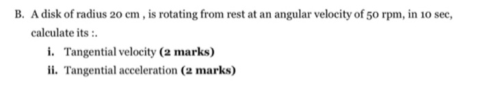 B. A disk of radius 20 cm, is rotating from rest at an angular velocity of 50 rpm, in 10 sec, calculate its : i. Tangential velocity (2 marks) ii. Tangential acceleration (2 marks)
A moon of mass m orbits around a non-rotating planet of mass M with orbital angular velocity . The moon also rotates about its own axis with angular velocity .
 1. A moon of mass \(m\) orbits around a non-rotating planet of mass \(M\) with orbital angular velocity \(\Omega\). The moon also rotates about its own axis with angular velocity \(\omega\). The axis of rotation of the moon is perpendicular to the plane of the orbit. Let \(I\) be the moment of inertia of the moon about its own axis. You can assume \(m<<M\)so that the center ofmass of the system is at the center of the planet.(a) What is...
Multiple Choice (select the best answer) (2 pts each 1. Consider a uniform hoop of radius...
 Multiple Choice (select the best answer) (2 pts each 1. Consider a uniform hoop of radius R and mass M rolling without slipping. Which is larger, its translational kinetic energy or its rotational kinetic energy? A) Translational kinetic energy is larger B) Rotational kinetic energy is larger. C) Both are equal. D) You need to know the speed of the hoop to tell. 2. A disk and a hoop of the same mass and radius are released at the same...
1.A flywheel rotating at 12 rev/s is brought to rest in 5 s. The magnitude of...
1.A flywheel rotating at 12 rev/s is brought to rest in 5 s. The magnitude of the average angular acceleration in rad/s2 of the wheel during this process is: 2.The coefficient of static friction between a certain cylinder and a horizontal floor is 0.50. If the rotational inertia of the cylinder about its symmetry axis is given by I = (1/2)MR2, then the magnitude of the maximum acceleration in m/s2 the cylinder can have without sliding is: 3.A playground merry-go-round...
 A
rigid object rotating about a fixed axis has an angular momentum
L=7.0 kg m2 /s and a kinetic energy K=21.3 J. What is the
rotational inertia I of the object?
A rigid object rotating about a fixed axis has an angular momentum L=7.0 kg m2/s and a kinetic energy K=21.3 J. What is the rotational inertial of the object? Select one: I=1.27 kg m 2 1=1.61 kg m 2 1=0.92 kg m^2 I=1.15 kg m 2 I=1.50 kg m...
A
rigid object rotating about a fixed axis has an angular momentum
L=7.0 kg m2 /s and a kinetic energy K=21.3 J. What is the
rotational inertia I of the object?
A rigid object rotating about a fixed axis has an angular momentum L=7.0 kg m2/s and a kinetic energy K=21.3 J. What is the rotational inertial of the object? Select one: I=1.27 kg m 2 1=1.61 kg m 2 1=0.92 kg m^2 I=1.15 kg m 2 I=1.50 kg m...
 Calculate the angular momentum for a rotating disk, sphere, and rod. (a) A uniform disk of mass 16 kg, thickness 0.5 m, and radius 0.9 m is located at the origin, oriented with its axis along the y axis. It rotates clockwise around its axis when viewed from above (that is, you stand at a point on the +y axis and look toward the origin at the disk). The disk makes one complete rotation every 0.7 s. What is the...
 I don't understand how to find 6b and all of 7.
6. A hollow sphere with mass = 0.65 kg and radius = 0.13 m is initially at rest on a 20° incline and rolls down the incline without slipping. The initial height of the disk (H) a. At the top of the incline, just before the disk begins to roll, what is the total mechanical energy of the disk? Emech=PEtop=6.37) b. Determine the velocity of the disk at H=...
I don't understand how to find 6b and all of 7.
6. A hollow sphere with mass = 0.65 kg and radius = 0.13 m is initially at rest on a 20° incline and rolls down the incline without slipping. The initial height of the disk (H) a. At the top of the incline, just before the disk begins to roll, what is the total mechanical energy of the disk? Emech=PEtop=6.37) b. Determine the velocity of the disk at H=...
 5*) Find the angular velocity of the Earth due to its daily
rotation and express it in radians per second. Then use it, and a
model of the Earth as a solid sphere of mass M=
5.97 × 1024 kg and radius R
= 6.37 × 10⁶ m, to estimate the angular momentum of the Earth due
to its rotation around its axis. (The result should be of the order
of 1033 kg m2/s. This is called the Earth’s “intrinsic”...
5*) Find the angular velocity of the Earth due to its daily
rotation and express it in radians per second. Then use it, and a
model of the Earth as a solid sphere of mass M=
5.97 × 1024 kg and radius R
= 6.37 × 10⁶ m, to estimate the angular momentum of the Earth due
to its rotation around its axis. (The result should be of the order
of 1033 kg m2/s. This is called the Earth’s “intrinsic”...
 B. A disk of radius 20 cm, is rotating from rest at an angular velocity of 50 rpm, in 10 sec, calculate its : i. Tangential velocity (2 marks) ii. Tangential acceleration (2 marks)
 Multiple Choice (select the best answer) (2 pts each 1. Consider a uniform hoop of radius R and mass M rolling without slipping. Which is larger, its translational kinetic energy or its rotational kinetic energy? A) Translational kinetic energy is larger B) Rotational kinetic energy is larger. C) Both are equal. D) You need to know the speed of the hoop to tell. 2. A disk and a hoop of the same mass and radius are released at the same...
Most questions answered within 3 hours.
-
Where is the error in this code sequence?
String s1 = "Hello";
String s2 = "ello";...
asked 10 months ago -
Financial data for Joel de Paris, Inc., for last year
follow:
Joel de Paris, Inc.
Balance...
asked 10 months ago -
Consider this reaction:
Al2(SO4)3 (aq)+ BaCl3
(aq) Al2Cl6 (aq)- +
3BaSO4(s) . What is the...
asked 10 months ago -
Suppose that Savneet is considering increasing her
recent random sample from 20 car rentals to 40...
asked 10 months ago -
Trucks arrive at an unloading terminal at an average rate of 120
per hour.
Trucks arrive...
asked 10 months ago -
Why are methanol and ethanol completely soluble in water while
octanol is not very little soluble....
asked 10 months ago -
A facilities manager at a university reads in a research report
that the mean amount of...
asked 10 months ago -
When the CuSO4 is rehydrated by adding water to the anhydrous
compound, is this an endothermic...
asked 10 months ago -
A ray of sunlight is passing from diamond into crown glass; the
angle of incidence is...
asked 10 months ago -
A block of mass 0.249 kg is placed on top of a light, vertical
spring of...
asked 10 months ago -
how do the kidneys compensate in the presences of acidosis
a) trigger hyperventilate
b) reserve acid...
asked 10 months ago -
Question 501 pts
The rental rate of capital to the firm increases. Which of the
following...
asked 10 months ago