
Homework Answers
Add Answer to:
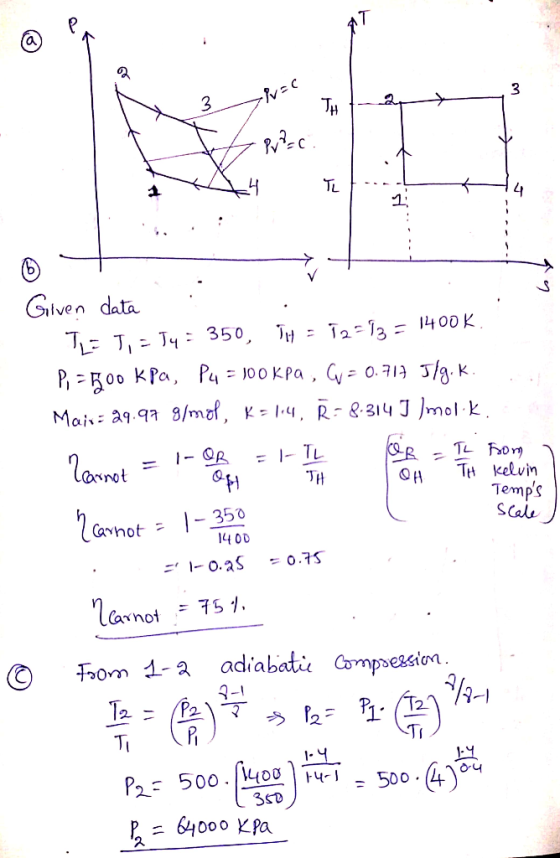
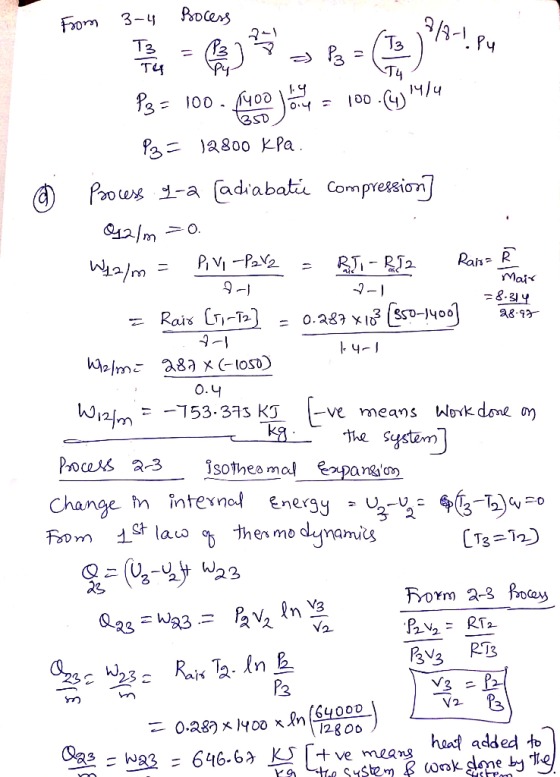
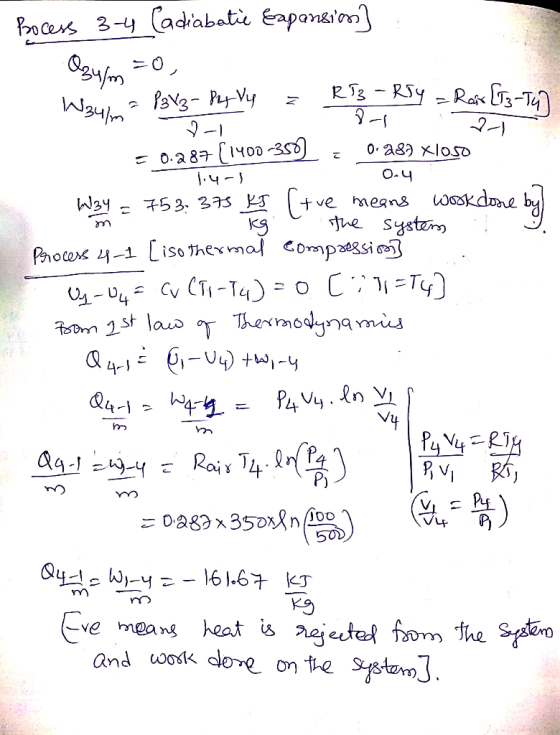
Air in a piston-cylinder assembly executes a Carnot power cycle (4 internally reversible processes, shown in...
2. An ideal gas within a piston-cylinder assembly executes a Carnot power cycle. The isothermal compression...
 2. An ideal gas within a piston-cylinder assembly executes a Carnot power cycle. The isothermal compression occurs at 300 K from 80 kPa to 110 kPa. If the thermal efficiency is 70% determine (30 points): P a. the temperature of the isothermal expansion, in K, and b. the network developed, in kJ per kmol of gas. Jooote Nmax = 1 - - - TW TA 70%=1-300x TA = 300 kdy cokela TH TH= loook - +10 A = With I...
Problem 2:2* (Carnot Cycle Application) Two kilograms of air within a piston-cylinder assembly execute a Carnot...
 Problem 2:2* (Carnot Cycle Application) Two kilograms of air within a piston-cylinder assembly execute a Carnot power cycle with maximum and minimum temperatures of 750 K and 300 K, respectively. The heat transfer to the air during the isothermal expansion is 60 kJ. At the end of the isothermal expansion, the pressure is 600 kPa. Assuming the ideal gas model for the air, determine (a) The thermal efficiency. (b) The Pressure and volume at the beginning of the isothermal expansion,...
Question 5 (10 points) Air within a piston-cylinder assembly executes a Carnot heat pump cycle. For...
 Question 5 (10 points) Air within a piston-cylinder assembly executes a Carnot heat pump cycle. For the cycle, Th = 325 C and Tc = {TC) C. The thermal energy produced by the engine has a magnitude of 200 kJ per kg of air. The pressure at the start of the isothermal expansion is 325 kPa. Determine the magnitude of the net work input, in kJ per kg of air. Your Answer: Answer
4. The pressure-volume diagram below shows a special reversible cycle called the Carnot cycle A mole...
 4. The pressure-volume diagram below shows a special reversible cycle called the Carnot cycle A mole of an ideal gas starts off in state 1 in contact with a large thermal reservoir at temperature Th. The gas then undergoes an isothermal expansion from Vi to V2. Upon reaching state 2, the gas container is removed from contact with the thermal reservoir and covered with thermal insulation. Next the gas is allowed to expand adiabatically from V2to Vs. Because the expansion...
4. An ideal Carnot power generation cycle using air is represented by the diagram below. The prop...
 4. An ideal Carnot power generation cycle using air is represented by the diagram below. The properties of the state points are given in the table below. Take the properties of air to be cp 0040.717. and RBhthe ns: and G, have been 1.004 chosen as the average values between the high temperature and low temperature processes, in order for you to not have to worry about the temperature dependence of cp and c, for this problem.) Recall that y...
A piston-cylinder assembly contains air modeled as an ideal gas. The air undergoes a power cycle...
A piston-cylinder assembly contains air modeled as an ideal gas. The air undergoes a power cycle consisting of four processes in series: • Process 1-2: Constant-temperature expansion at 600 K from p1 = 0.5 MPa to p2 = 0.4 MPa. • Process 2-3: Polytropic expansion with n = 1.3 to p3 = 0.3 MPa. • Process 3-4: Constant-pressure compression to ν4 = ν1. • Process 4-1: Constant-volume heating. a) Sketch the cycle on a p-ν diagram. b) Calculate the work...
A piston-cylinder assembly undergoes a cycle consisting of the following three processes:
A piston-cylinder assembly undergoes a cycle consisting of the following three processes: • Process 1-2: Compression with constant internal energy • Process 2-3: Constant-volume cooling to p3 = 100 kPa, V3 = 0.1 m3 • Process 3-1: Constant-pressure expansion with W31 = 12 kJ Sketch the cycle on a p-V diagram, labeling each of the states and indicating the process directions with arrows. If the work for the entire cycle is Wcycle = -20 kJ and changes in kinetic and potential energy are negligible,...
A gas within a piston-cylinder assembly undergoes a thermodynamic cycle consisting of three processes: Process 1-2:...
A gas within a piston-cylinder assembly undergoes a thermodynamic cycle consisting of three processes: Process 1-2: Constant volume V1 = 2 m3, p1 = 1 bar, to p2 = 3 bar, U2 – U1 = 400 kJ. Process 2-3: Constant pressure compression to V3 = 1 m3. Process 3-1: Adiabatic expansion, with W31 = 150 kJ. There are no significant changes in kinetic or potential energy. Determine the net work for the cycle, in kJ, and the heat transfers for...
PROBLEM-4 (50%) One kg of air is in a piston-cylinder assembly. Air is modeled as an...
 PROBLEM-4 (50%) One kg of air is in a piston-cylinder assembly. Air is modeled as an ideal gas with a constant specific heat ratio, k = 1.4. The air undergoes a power cycle consisting of four processes in series: Process 1-2: Constant-temperature expansion at 600 K from P1 = 0.5 MPa to P2 = 0.4 MPa Process 2–3: Polytropic expansion with n=k to P3 = 0.3 MPa Process 3–4: Constant-pressure compression to V4 = V1 Process 4–1: Constant-volume heating. (a)...
Problem 9.011 SI Consider a modification of the air-standard Otto cycle in which the isentropic compression...
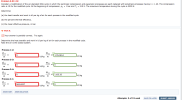 Problem 9.011 SI Consider a modification of the air-standard Otto cycle in which the isentropic compression and expansion processes are each replaced with polytropic processes having n = 1.25. The compression ratio is 10 for the modified cycle. At the beginning of compression, P1 = 1 bar and T1 = 310 K. The maximum temperature during the cycle is 2200 K. Determine: (a) the heat transfer and work in kj per kg of air for each process in the modified...
 2. An ideal gas within a piston-cylinder assembly executes a Carnot power cycle. The isothermal compression occurs at 300 K from 80 kPa to 110 kPa. If the thermal efficiency is 70% determine (30 points): P a. the temperature of the isothermal expansion, in K, and b. the network developed, in kJ per kmol of gas. Jooote Nmax = 1 - - - TW TA 70%=1-300x TA = 300 kdy cokela TH TH= loook - +10 A = With I...
 Problem 2:2* (Carnot Cycle Application) Two kilograms of air within a piston-cylinder assembly execute a Carnot power cycle with maximum and minimum temperatures of 750 K and 300 K, respectively. The heat transfer to the air during the isothermal expansion is 60 kJ. At the end of the isothermal expansion, the pressure is 600 kPa. Assuming the ideal gas model for the air, determine (a) The thermal efficiency. (b) The Pressure and volume at the beginning of the isothermal expansion,...
 Question 5 (10 points) Air within a piston-cylinder assembly executes a Carnot heat pump cycle. For the cycle, Th = 325 C and Tc = {TC) C. The thermal energy produced by the engine has a magnitude of 200 kJ per kg of air. The pressure at the start of the isothermal expansion is 325 kPa. Determine the magnitude of the net work input, in kJ per kg of air. Your Answer: Answer
 4. The pressure-volume diagram below shows a special reversible cycle called the Carnot cycle A mole of an ideal gas starts off in state 1 in contact with a large thermal reservoir at temperature Th. The gas then undergoes an isothermal expansion from Vi to V2. Upon reaching state 2, the gas container is removed from contact with the thermal reservoir and covered with thermal insulation. Next the gas is allowed to expand adiabatically from V2to Vs. Because the expansion...
 4. An ideal Carnot power generation cycle using air is represented by the diagram below. The properties of the state points are given in the table below. Take the properties of air to be cp 0040.717. and RBhthe ns: and G, have been 1.004 chosen as the average values between the high temperature and low temperature processes, in order for you to not have to worry about the temperature dependence of cp and c, for this problem.) Recall that y...
 PROBLEM-4 (50%) One kg of air is in a piston-cylinder assembly. Air is modeled as an ideal gas with a constant specific heat ratio, k = 1.4. The air undergoes a power cycle consisting of four processes in series: Process 1-2: Constant-temperature expansion at 600 K from P1 = 0.5 MPa to P2 = 0.4 MPa Process 2–3: Polytropic expansion with n=k to P3 = 0.3 MPa Process 3–4: Constant-pressure compression to V4 = V1 Process 4–1: Constant-volume heating. (a)...
 Problem 9.011 SI Consider a modification of the air-standard Otto cycle in which the isentropic compression and expansion processes are each replaced with polytropic processes having n = 1.25. The compression ratio is 10 for the modified cycle. At the beginning of compression, P1 = 1 bar and T1 = 310 K. The maximum temperature during the cycle is 2200 K. Determine: (a) the heat transfer and work in kj per kg of air for each process in the modified...
Most questions answered within 3 hours.
-
Where is the error in this code sequence?
String s1 = "Hello";
String s2 = "ello";...
asked 11 months ago -
Financial data for Joel de Paris, Inc., for last year
follow:
Joel de Paris, Inc.
Balance...
asked 11 months ago -
Consider this reaction:
Al2(SO4)3 (aq)+ BaCl3
(aq) Al2Cl6 (aq)- +
3BaSO4(s) . What is the...
asked 11 months ago -
Suppose that Savneet is considering increasing her
recent random sample from 20 car rentals to 40...
asked 11 months ago -
Trucks arrive at an unloading terminal at an average rate of 120
per hour.
Trucks arrive...
asked 11 months ago -
Why are methanol and ethanol completely soluble in water while
octanol is not very little soluble....
asked 11 months ago -
A facilities manager at a university reads in a research report
that the mean amount of...
asked 11 months ago -
When the CuSO4 is rehydrated by adding water to the anhydrous
compound, is this an endothermic...
asked 11 months ago -
A ray of sunlight is passing from diamond into crown glass; the
angle of incidence is...
asked 11 months ago -
A block of mass 0.249 kg is placed on top of a light, vertical
spring of...
asked 11 months ago -
how do the kidneys compensate in the presences of acidosis
a) trigger hyperventilate
b) reserve acid...
asked 11 months ago -
Question 501 pts
The rental rate of capital to the firm increases. Which of the
following...
asked 11 months ago