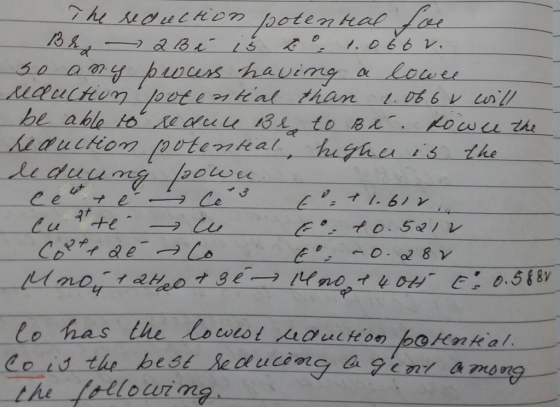
Which of the following metals is able to reduce Br2 2Br- the best? 1. Ce3+ (aq)...
Which of the following metals is able to reduce
Br2 2Br- the best?
1. Ce3+ (aq)
2. Cu (s)
3. Co (s)
4. MnO2 (in a basic solution)
Homework Answers
3. Co(s)
Add Answer to:
Which of the following metals is able to reduce
Br2
2Br- the best?
1. Ce3+ (aq)...
Consider the following reduction/oxidation reaction : Mg(s) + Br2(l) → Mg2+(aq) + 2Br–(aq) What is the...
Consider the following reduction/oxidation reaction : Mg(s) + Br2(l) → Mg2+(aq) + 2Br–(aq) What is the anode? a.) Mg(s) / Mg2+(aq) b.) Br2(l) / 2Br–(aq)
Balance Redox Equations (Basic Solution) with steps. 1. Mn^2+ (aq) + Br2(l) = MnO2 (s) + Br^- (aq) 2. NO2^- (aq) + MnO4^...
Balance Redox Equations (Basic Solution) with steps. 1. Mn^2+ (aq) + Br2(l) = MnO2 (s) + Br^- (aq) 2. NO2^- (aq) + MnO4^- (aq) = NO3^- (aq) + MnO2 (s) 3. N2H4 (g) + ClO3^- (aq) = NO(g) + Cl^- (aq)
Question 5 (1 point) For the cell diagram Pt(s) | Br2(1) | Br"(aq) || C1-(aq)| Cl2(g)...
 Question 5 (1 point) For the cell diagram Pt(s) | Br2(1) | Br"(aq) || C1-(aq)| Cl2(g) | Pt(s) which reaction occurs at the cathode? O 2C1-(aq) --> Cl2(g) + 2e- O 2Br (aq) --> Br2(1) + 2e O Br2(l) +2e --> 2Br (aq) O Cl2(g) + 2Br (aq) --> 2C1-(aq) + Br2(1) O C12(g) + 22 --> 2C1“(aq)
Consider the following half-reactions: Half-reaction E° (V) Brz(1) + 2e 2Br" (aq) 1.080V Pb2+(aq) + 2e...
 Consider the following half-reactions: Half-reaction E° (V) Brz(1) + 2e 2Br" (aq) 1.080V Pb2+(aq) + 2e —— Pb(s) -0.126v Mn2+(aq) + 2e —— Mn(s) -1.180V (1) The strongest oxidizing agent is: enter formula (2) The weakest oxidizing agent is: (3) The weakest reducing agent is: (4) The strongest reducing agent is: (5) Will Br2(1) oxidize Mn(s) to Mn2+(aq)? (6) Which species can be oxidized by Pb2+ 2+(aq)? If none, leave box blank. Submit Answer Retry Entire Group 9 more group...
Saved Question 8 (1 point) Saved For the cell diagram Pt(s) | Br2(1) | Br-(aq) ||...
 Saved Question 8 (1 point) Saved For the cell diagram Pt(s) | Br2(1) | Br-(aq) || Cl-(aq) | Cl2(g) | Pt(s) which reaction occurs at the anode? O Cl2(g) + 2Br (aq) --> 2C1-(aq) + Br2(1) O Br2(l) +2e --> 2Br" (aq) O 2Br"(aq) --> Br2(I) + 2e O Cl2(g) +2e --> 2014(aq) O 2014(aq) --> Cl2(g) + 2e
help with these please Half-reaction E° (V) Br26) + 2e —> 2Br (aq) 1.080V Ca2+(aq) +...
 help with these please
Half-reaction E° (V) Br26) + 2e —> 2Br (aq) 1.080V Ca2+(aq) + 2e —— Cd) 0.403V Zn2+ (aq) + 2e —— Zn(0.763V (1) The strongest oxidizing agent is: enter formula (2) The weakest oxidizing agent is: (3) The weakest reducing agent is: (4) The strongest reducing agent is: (5) Will Br2(1) oxidize Zn(s) to Zn?"(aq)? O (6) Which species can be oxidized by Ca2+(aq)? If none, leave box blank. Consider the following half-reactions: Half-reaction E° (V)...
help with these please
Half-reaction E° (V) Br26) + 2e —> 2Br (aq) 1.080V Ca2+(aq) + 2e —— Cd) 0.403V Zn2+ (aq) + 2e —— Zn(0.763V (1) The strongest oxidizing agent is: enter formula (2) The weakest oxidizing agent is: (3) The weakest reducing agent is: (4) The strongest reducing agent is: (5) Will Br2(1) oxidize Zn(s) to Zn?"(aq)? O (6) Which species can be oxidized by Ca2+(aq)? If none, leave box blank. Consider the following half-reactions: Half-reaction E° (V)...
Consider the following half-reactions: Half-reaction F2(g) + 2e - 2H+ (aq) + 2 Mn2+ (aq) +...
 Consider the following half-reactions: Half-reaction F2(g) + 2e - 2H+ (aq) + 2 Mn2+ (aq) + 2e E° (V) 2F (aq) 2.870V H2(g) 0.000V Mn(s) -1.180V The strongest oxidizing agent is: enter formula / / The weakest oxidizing agent is: / The weakest reducing agent is: The strongest reducing agent is: Will Mn2+ (aq) reduce F2(g) to F"(aq)? Which species can be reduced by H2(g)? If none, leave box blank. Consider the following half-reactions: Half-reaction E° (V) Br2(1) + 2e...
The following reaction occurs in basic solution: Br2 (aq) → Br– (aq) + BrO3– (aq) Which...
The following reaction occurs in basic solution: Br2 (aq) → Br– (aq) + BrO3– (aq) Which of the following statements is/are correct? This equation describes the self-oxidation-reduction (disproportionation) reaction of bromine in water. The oxidation number of Br changes from 0 to –1 and 0 to +1 in the reduction and oxidation half reactions respectively. In the balanced equation the number of moles of OH– is twice the moles of Br2.
1. (2 points) Silver ion, Ag+ (aq), oxidizes formaldehyde, CH2O(aq), to formic acid, HCOOH(aq). Write the...
 1. (2 points) Silver ion, Ag+ (aq), oxidizes formaldehyde, CH2O(aq), to formic acid, HCOOH(aq). Write the balanced equation for this transformation in aqueous acidic solution. In your answer be sure to convert any H+(aq) that may be present to H30+ (aq) and to include states on all species. 2. (1point)At 25 °C the redox process Mn2+ (aq) + Mg(s) = Mn(s) + Mg2+ (aq) has the standard potential of Eºcell = +1.34 V. Calculate the equilibrium constant of this process...
Balance the following Redox Equations in Basic Mediums. Redox Reactions in Basic Solution 1. Al(s) + ...
Balance the following Redox Equations in Basic Mediums. Redox Reactions in Basic Solution 1. Al(s) + MnO4¯ (aq) ¾® MnO2(s) + Al(OH)4¯ (aq) 2. NO2¯ (aq) + Al(s) ¾® NH3(aq) + AlO2¯ (aq) 3. Cr(s) + CrO42-(aq) ¾® Cr(OH)3(s) Note: Cr(OH)3 is found in BOTH half reactions! 4. Cl2(aq) + Br2(l) ¾® OBr¯ (aq) + Cl¯ (aq) 5. S8(aq) + MnO4¯ (aq) ¾® SO42-(aq) + MnO2(s)
 Question 5 (1 point) For the cell diagram Pt(s) | Br2(1) | Br"(aq) || C1-(aq)| Cl2(g) | Pt(s) which reaction occurs at the cathode? O 2C1-(aq) --> Cl2(g) + 2e- O 2Br (aq) --> Br2(1) + 2e O Br2(l) +2e --> 2Br (aq) O Cl2(g) + 2Br (aq) --> 2C1-(aq) + Br2(1) O C12(g) + 22 --> 2C1“(aq)
 Consider the following half-reactions: Half-reaction E° (V) Brz(1) + 2e 2Br" (aq) 1.080V Pb2+(aq) + 2e —— Pb(s) -0.126v Mn2+(aq) + 2e —— Mn(s) -1.180V (1) The strongest oxidizing agent is: enter formula (2) The weakest oxidizing agent is: (3) The weakest reducing agent is: (4) The strongest reducing agent is: (5) Will Br2(1) oxidize Mn(s) to Mn2+(aq)? (6) Which species can be oxidized by Pb2+ 2+(aq)? If none, leave box blank. Submit Answer Retry Entire Group 9 more group...
 Saved Question 8 (1 point) Saved For the cell diagram Pt(s) | Br2(1) | Br-(aq) || Cl-(aq) | Cl2(g) | Pt(s) which reaction occurs at the anode? O Cl2(g) + 2Br (aq) --> 2C1-(aq) + Br2(1) O Br2(l) +2e --> 2Br" (aq) O 2Br"(aq) --> Br2(I) + 2e O Cl2(g) +2e --> 2014(aq) O 2014(aq) --> Cl2(g) + 2e
 help with these please
Half-reaction E° (V) Br26) + 2e —> 2Br (aq) 1.080V Ca2+(aq) + 2e —— Cd) 0.403V Zn2+ (aq) + 2e —— Zn(0.763V (1) The strongest oxidizing agent is: enter formula (2) The weakest oxidizing agent is: (3) The weakest reducing agent is: (4) The strongest reducing agent is: (5) Will Br2(1) oxidize Zn(s) to Zn?"(aq)? O (6) Which species can be oxidized by Ca2+(aq)? If none, leave box blank. Consider the following half-reactions: Half-reaction E° (V)...
help with these please
Half-reaction E° (V) Br26) + 2e —> 2Br (aq) 1.080V Ca2+(aq) + 2e —— Cd) 0.403V Zn2+ (aq) + 2e —— Zn(0.763V (1) The strongest oxidizing agent is: enter formula (2) The weakest oxidizing agent is: (3) The weakest reducing agent is: (4) The strongest reducing agent is: (5) Will Br2(1) oxidize Zn(s) to Zn?"(aq)? O (6) Which species can be oxidized by Ca2+(aq)? If none, leave box blank. Consider the following half-reactions: Half-reaction E° (V)...
 Consider the following half-reactions: Half-reaction F2(g) + 2e - 2H+ (aq) + 2 Mn2+ (aq) + 2e E° (V) 2F (aq) 2.870V H2(g) 0.000V Mn(s) -1.180V The strongest oxidizing agent is: enter formula / / The weakest oxidizing agent is: / The weakest reducing agent is: The strongest reducing agent is: Will Mn2+ (aq) reduce F2(g) to F"(aq)? Which species can be reduced by H2(g)? If none, leave box blank. Consider the following half-reactions: Half-reaction E° (V) Br2(1) + 2e...
 1. (2 points) Silver ion, Ag+ (aq), oxidizes formaldehyde, CH2O(aq), to formic acid, HCOOH(aq). Write the balanced equation for this transformation in aqueous acidic solution. In your answer be sure to convert any H+(aq) that may be present to H30+ (aq) and to include states on all species. 2. (1point)At 25 °C the redox process Mn2+ (aq) + Mg(s) = Mn(s) + Mg2+ (aq) has the standard potential of Eºcell = +1.34 V. Calculate the equilibrium constant of this process...
Most questions answered within 3 hours.
-
Where is the error in this code sequence?
String s1 = "Hello";
String s2 = "ello";...
asked 11 months ago -
Financial data for Joel de Paris, Inc., for last year
follow:
Joel de Paris, Inc.
Balance...
asked 11 months ago -
Consider this reaction:
Al2(SO4)3 (aq)+ BaCl3
(aq) Al2Cl6 (aq)- +
3BaSO4(s) . What is the...
asked 11 months ago -
Suppose that Savneet is considering increasing her
recent random sample from 20 car rentals to 40...
asked 11 months ago -
Trucks arrive at an unloading terminal at an average rate of 120
per hour.
Trucks arrive...
asked 11 months ago -
Why are methanol and ethanol completely soluble in water while
octanol is not very little soluble....
asked 11 months ago -
A facilities manager at a university reads in a research report
that the mean amount of...
asked 11 months ago -
When the CuSO4 is rehydrated by adding water to the anhydrous
compound, is this an endothermic...
asked 11 months ago -
A ray of sunlight is passing from diamond into crown glass; the
angle of incidence is...
asked 11 months ago -
A block of mass 0.249 kg is placed on top of a light, vertical
spring of...
asked 11 months ago -
how do the kidneys compensate in the presences of acidosis
a) trigger hyperventilate
b) reserve acid...
asked 11 months ago -
Question 501 pts
The rental rate of capital to the firm increases. Which of the
following...
asked 11 months ago