
Homework Answers


Add Answer to:
bsp G-.5 ?? RJs K (motor) Kr J-.0000221 kg m R-10.6 n bsp 1 K-.0502 1....
Consider the model of a small DC motor, where the following parameter values are assumed: R-10 L-10mH,J-0.01kgm0.0.05 2. ra a. Write down the transfer function of the system b. Choose a sample ti...
 Consider the model of a small DC motor, where the following parameter values are assumed: R-10 L-10mH,J-0.01kgm0.0.05 2. ra a. Write down the transfer function of the system b. Choose a sample time for the system c. Find the pulse transfer function (use MATLAB 'c2d' command) d. Find the range of K for stability for the closed-loop sampled-data system
Consider the model of a small DC motor, where the following parameter values are assumed: R-10 L-10mH,J-0.01kgm0.0.05 2. ra a. Write...
Consider the model of a small DC motor, where the following parameter values are assumed: R-10 L-10mH,J-0.01kgm0.0.05 2. ra a. Write down the transfer function of the system b. Choose a sample time for the system c. Find the pulse transfer function (use MATLAB 'c2d' command) d. Find the range of K for stability for the closed-loop sampled-data system
Consider the model of a small DC motor, where the following parameter values are assumed: R-10 L-10mH,J-0.01kgm0.0.05 2. ra a. Write...
3. Consider the following mass-spring-damper system. Let m= 1 kg, b = 10 Ns/m, and k...
 3. Consider the following mass-spring-damper system. Let m= 1 kg, b = 10 Ns/m, and k = 20 N/m. b m F k a) Derive the open-loop transfer function X(S) F(s) Plot the step response using matlab. b) Derive the closed-loop transfer function with P-controller with Kp = 300. Plot the step response using matlab. c) Derive the closed-loop transfer function with PD-controller with Ky and Ka = 10. Plot the step response using matlab. d) Derive the closed-loop transfer...
1. Set up each of the following systems in a form suited for plotting the root...
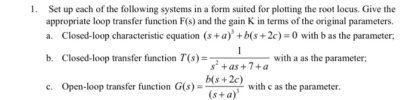 1. Set up each of the following systems in a form suited for plotting the root locus. Give the appropriate loop transfer function F(s) and the gain K in terms of the original parameters. a. Closed-loop characteristic equation (s+a) +b(s+2c)=0 with b as the parameter; b. Closed-loop transfer function T($)= with a as the parameter; s? +as+7+a b(s +2c) c. Open-loop transfer function G(s) = with c as the parameter. (s + a) 1
Problem 8: A simplified model of a glider is where y is the flight path angle in radians, v is the airspeed in m/sec, n -L/mg is the load factor, L is the lift in Newtons, m is the mass in kg, and...
 Problem 8: A simplified model of a glider is where y is the flight path angle in radians, v is the airspeed in m/sec, n -L/mg is the load factor, L is the lift in Newtons, m is the mass in kg, and k 61.6594 and k 4.8747x10³ are constants for the glider. (a) Given that y -0.15 rad, and the airspeed is 50.8691 m/sec, find the necessary load factor to maintain equilibriunm (b) Let the state vector be [7...
Use R programming to solve Q2. A matrix operator H(G; k) on a pxp symmetric matrix G (iy)- with a positive integer parameter k (k < p) yields another p×p symmetric matrix H = (hij 1 with i=k,j...
 Use R programming to solve
Q2. A matrix operator H(G; k) on a pxp symmetric matrix G (iy)- with a positive integer parameter k (k < p) yields another p×p symmetric matrix H = (hij 1 with i=k,j = k; (a) Use one single loop to construct the function H(G; k) in R (b) Generate a random matrix X of dimension 7x5, each element of which is id from N(0,1). Use the function H(G; k constructed in (a) to compute...
Use R programming to solve
Q2. A matrix operator H(G; k) on a pxp symmetric matrix G (iy)- with a positive integer parameter k (k < p) yields another p×p symmetric matrix H = (hij 1 with i=k,j = k; (a) Use one single loop to construct the function H(G; k) in R (b) Generate a random matrix X of dimension 7x5, each element of which is id from N(0,1). Use the function H(G; k constructed in (a) to compute...
Wis) R(s u(s) 14 Gl(s) H(s) Given a system as in the diagram above, where K is an adjustable pa...
 Wis) R(s u(s) 14 Gl(s) H(s) Given a system as in the diagram above, where K is an adjustable parameter pl(s) Dal(sKp+ g) Assuming W-0, find the transfer function Y(s)/R(s) h) Assuming R-0, find the transfer function Y(s)/W(s) i) What is the type of the system (with respect to steady-state error)? j) What is the steady-state error when rt)u(t) (unit-step) and w(t)-0 k) What is the s.s. error when r(t) t u(t) and w(t)-0 ) Assume r(t)-0, what is the...
Using the Following Functions G(s) = 1 and H(s) = 1 1. Enter the G(s) and...
 Using the Following Functions G(s) = 1 and H(s) = 1 1. Enter the G(s) and H(s) functions. (Take advantage of using either symbolic tool or entering vector format with Commands like tf to generate the transfer function.) Your goal is to find the following a) X(5) - O Y ) Cascade system b) XI(6) — 6) → Y(s) Parallel System X2(8) — 20) R(S) O G() Yes H(s) Feedback System (Hint: Use commands like cascade(tf), parallel(tf) and feedback(tt)) 2....
Problem 2 (50 pts): Consider the unity-feedback system: R(2) E(z) Y(2) K G(2) 2 G(2) =...
 Problem 2 (50 pts): Consider the unity-feedback system: R(2) E(z) Y(2) K G(2) 2 G(2) = is the transfer-function of the plant and zero-order hold. (2 – 1)(z – 0.2) a) (5 points) Find the closed-loop transfer-function Hyr(2). b) (5 points) Find the characteristic polynomial. c) (20 points) Determine the range of K for closed-loop stability.
Question 1 a) Define the term transfer function in relation to a linear control system. [5...
 Question 1 a) Define the term transfer function in relation to a
linear control system. [5 marks] Figure Q1 shows a block diagram of
a feedback control system, with a plant with transfer function G(s)
, a controller with transfer function C(s) , and a sensor with
transfer function H(s) . b) Derive from first principles the closed
loop transfer function G (s) cl from the reference signal r(t) , to
the output signal y(t) . [5 marks] c) Give...
Question 1 a) Define the term transfer function in relation to a
linear control system. [5 marks] Figure Q1 shows a block diagram of
a feedback control system, with a plant with transfer function G(s)
, a controller with transfer function C(s) , and a sensor with
transfer function H(s) . b) Derive from first principles the closed
loop transfer function G (s) cl from the reference signal r(t) , to
the output signal y(t) . [5 marks] c) Give...
The Quanser motor to be used in Lab R6-R8 can be modeled in terms of the output angular velocity ...
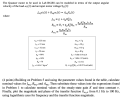 The Quanser motor to be used in Lab R6-R8 can be modeled in terms of the output angular velocity of the load ω1(t) and an input motor voltage yn(t): where r24 6.35 mm r72- 19 mm r120 32 mm Ta = 50 mm Tg = 90% m 69% K, = 70 /m = 4.61E-7 kg-m" m24-5g m72-30 g m120 83 g md 40 g kt-7.68E-3 N-m/A km-7.68E-3 V/(rad/s) Rm 2.62 Bm-0015 N-m/(rad/s) B. + η (4 points) Building on Problem...
 Consider the model of a small DC motor, where the following parameter values are assumed: R-10 L-10mH,J-0.01kgm0.0.05 2. ra a. Write down the transfer function of the system b. Choose a sample time for the system c. Find the pulse transfer function (use MATLAB 'c2d' command) d. Find the range of K for stability for the closed-loop sampled-data system
Consider the model of a small DC motor, where the following parameter values are assumed: R-10 L-10mH,J-0.01kgm0.0.05 2. ra a. Write...
Consider the model of a small DC motor, where the following parameter values are assumed: R-10 L-10mH,J-0.01kgm0.0.05 2. ra a. Write down the transfer function of the system b. Choose a sample time for the system c. Find the pulse transfer function (use MATLAB 'c2d' command) d. Find the range of K for stability for the closed-loop sampled-data system
Consider the model of a small DC motor, where the following parameter values are assumed: R-10 L-10mH,J-0.01kgm0.0.05 2. ra a. Write...
 3. Consider the following mass-spring-damper system. Let m= 1 kg, b = 10 Ns/m, and k = 20 N/m. b m F k a) Derive the open-loop transfer function X(S) F(s) Plot the step response using matlab. b) Derive the closed-loop transfer function with P-controller with Kp = 300. Plot the step response using matlab. c) Derive the closed-loop transfer function with PD-controller with Ky and Ka = 10. Plot the step response using matlab. d) Derive the closed-loop transfer...
 1. Set up each of the following systems in a form suited for plotting the root locus. Give the appropriate loop transfer function F(s) and the gain K in terms of the original parameters. a. Closed-loop characteristic equation (s+a) +b(s+2c)=0 with b as the parameter; b. Closed-loop transfer function T($)= with a as the parameter; s? +as+7+a b(s +2c) c. Open-loop transfer function G(s) = with c as the parameter. (s + a) 1
 Problem 8: A simplified model of a glider is where y is the flight path angle in radians, v is the airspeed in m/sec, n -L/mg is the load factor, L is the lift in Newtons, m is the mass in kg, and k 61.6594 and k 4.8747x10³ are constants for the glider. (a) Given that y -0.15 rad, and the airspeed is 50.8691 m/sec, find the necessary load factor to maintain equilibriunm (b) Let the state vector be [7...
 Use R programming to solve
Q2. A matrix operator H(G; k) on a pxp symmetric matrix G (iy)- with a positive integer parameter k (k < p) yields another p×p symmetric matrix H = (hij 1 with i=k,j = k; (a) Use one single loop to construct the function H(G; k) in R (b) Generate a random matrix X of dimension 7x5, each element of which is id from N(0,1). Use the function H(G; k constructed in (a) to compute...
Use R programming to solve
Q2. A matrix operator H(G; k) on a pxp symmetric matrix G (iy)- with a positive integer parameter k (k < p) yields another p×p symmetric matrix H = (hij 1 with i=k,j = k; (a) Use one single loop to construct the function H(G; k) in R (b) Generate a random matrix X of dimension 7x5, each element of which is id from N(0,1). Use the function H(G; k constructed in (a) to compute...
 Wis) R(s u(s) 14 Gl(s) H(s) Given a system as in the diagram above, where K is an adjustable parameter pl(s) Dal(sKp+ g) Assuming W-0, find the transfer function Y(s)/R(s) h) Assuming R-0, find the transfer function Y(s)/W(s) i) What is the type of the system (with respect to steady-state error)? j) What is the steady-state error when rt)u(t) (unit-step) and w(t)-0 k) What is the s.s. error when r(t) t u(t) and w(t)-0 ) Assume r(t)-0, what is the...
 Using the Following Functions G(s) = 1 and H(s) = 1 1. Enter the G(s) and H(s) functions. (Take advantage of using either symbolic tool or entering vector format with Commands like tf to generate the transfer function.) Your goal is to find the following a) X(5) - O Y ) Cascade system b) XI(6) — 6) → Y(s) Parallel System X2(8) — 20) R(S) O G() Yes H(s) Feedback System (Hint: Use commands like cascade(tf), parallel(tf) and feedback(tt)) 2....
 Problem 2 (50 pts): Consider the unity-feedback system: R(2) E(z) Y(2) K G(2) 2 G(2) = is the transfer-function of the plant and zero-order hold. (2 – 1)(z – 0.2) a) (5 points) Find the closed-loop transfer-function Hyr(2). b) (5 points) Find the characteristic polynomial. c) (20 points) Determine the range of K for closed-loop stability.
 Question 1 a) Define the term transfer function in relation to a
linear control system. [5 marks] Figure Q1 shows a block diagram of
a feedback control system, with a plant with transfer function G(s)
, a controller with transfer function C(s) , and a sensor with
transfer function H(s) . b) Derive from first principles the closed
loop transfer function G (s) cl from the reference signal r(t) , to
the output signal y(t) . [5 marks] c) Give...
Question 1 a) Define the term transfer function in relation to a
linear control system. [5 marks] Figure Q1 shows a block diagram of
a feedback control system, with a plant with transfer function G(s)
, a controller with transfer function C(s) , and a sensor with
transfer function H(s) . b) Derive from first principles the closed
loop transfer function G (s) cl from the reference signal r(t) , to
the output signal y(t) . [5 marks] c) Give...
 The Quanser motor to be used in Lab R6-R8 can be modeled in terms of the output angular velocity of the load ω1(t) and an input motor voltage yn(t): where r24 6.35 mm r72- 19 mm r120 32 mm Ta = 50 mm Tg = 90% m 69% K, = 70 /m = 4.61E-7 kg-m" m24-5g m72-30 g m120 83 g md 40 g kt-7.68E-3 N-m/A km-7.68E-3 V/(rad/s) Rm 2.62 Bm-0015 N-m/(rad/s) B. + η (4 points) Building on Problem...
Most questions answered within 3 hours.
-
Where is the error in this code sequence?
String s1 = "Hello";
String s2 = "ello";...
asked 11 months ago -
Financial data for Joel de Paris, Inc., for last year
follow:
Joel de Paris, Inc.
Balance...
asked 11 months ago -
Consider this reaction:
Al2(SO4)3 (aq)+ BaCl3
(aq) Al2Cl6 (aq)- +
3BaSO4(s) . What is the...
asked 11 months ago -
Suppose that Savneet is considering increasing her
recent random sample from 20 car rentals to 40...
asked 11 months ago -
Trucks arrive at an unloading terminal at an average rate of 120
per hour.
Trucks arrive...
asked 11 months ago -
Why are methanol and ethanol completely soluble in water while
octanol is not very little soluble....
asked 11 months ago -
A facilities manager at a university reads in a research report
that the mean amount of...
asked 11 months ago -
When the CuSO4 is rehydrated by adding water to the anhydrous
compound, is this an endothermic...
asked 11 months ago -
A ray of sunlight is passing from diamond into crown glass; the
angle of incidence is...
asked 11 months ago -
A block of mass 0.249 kg is placed on top of a light, vertical
spring of...
asked 11 months ago -
how do the kidneys compensate in the presences of acidosis
a) trigger hyperventilate
b) reserve acid...
asked 11 months ago -
Question 501 pts
The rental rate of capital to the firm increases. Which of the
following...
asked 11 months ago