
Homework Answers

Add Answer to:
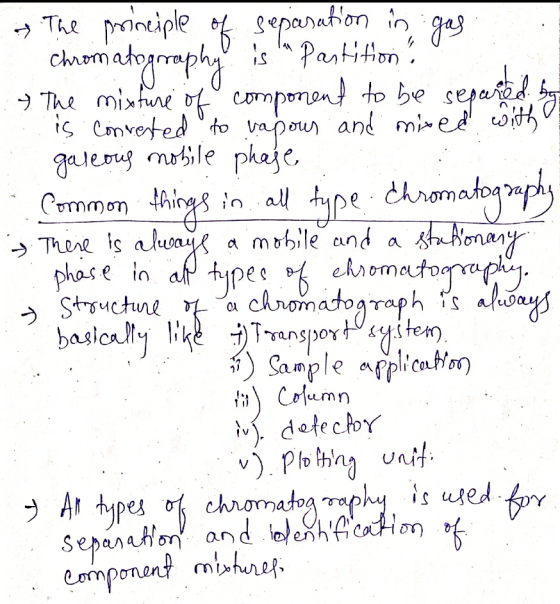
Lab #2: Gas Chromatography Theory behind gas chromatography What do all types of chromatography share in...
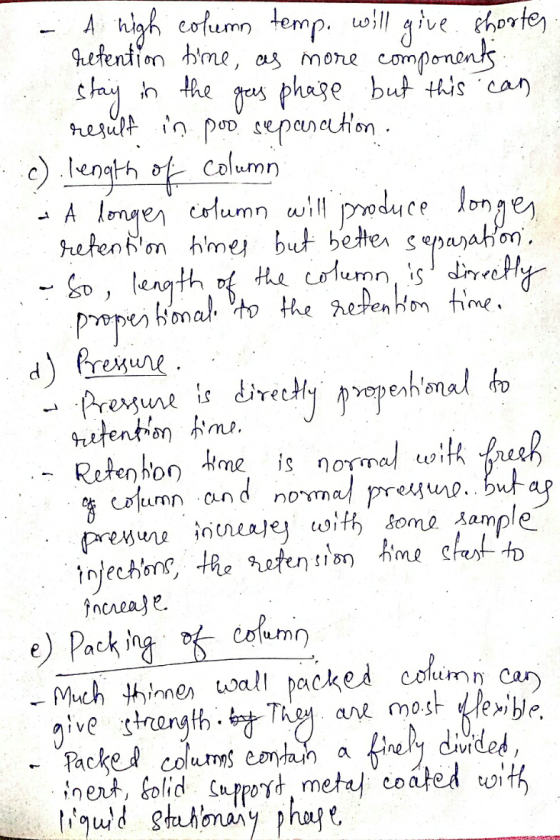
As you increase the gas chromatography column temperature, analytes’ ______________ increases and stationary phase solubility _______________....
As you increase the gas chromatography column temperature, analytes’ ______________ increases and stationary phase solubility _______________. A) boiling point; increases B) vapor pressure; decreases C) vapor pressure; increases D) retention time; increases E) retention time; decreases
1. Calculate the vapor pressure of heptane (b.p. 98.0 ∘C98.0 ∘C) at the gas chromatography column...
1. Calculate the vapor pressure of heptane (b.p. 98.0 ∘C98.0 ∘C) at the gas chromatography column temperature of 94.0 ∘C94.0 ∘C using the form of the Clausius–Clapeyron equation shown ln(P1P2)=−(ΔHvapR)(1T1−1T2)ln(P1P2)=−(ΔHvapR)(1T1−1T2) where RR is the ideal gas constant, ΔHvapΔHvap is the enthalpy of vaporization, T1T1 and T2T2 are two different temperatures, and P1P1 and P2P2 are the vapor pressures at the respective temperatures. The enthalpy of vaporization can be estimated using Trouton's rule, ΔH∘vap=(88 J⋅mol−1⋅K−1)×Tbp.ΔHvap∘=(88 J·mol−1⋅K−1)×Tbp. P= 2. Calculate the vapor...
1. A mixture of four alkenes (1-decene, 1-heptene, 1-nonene, and 1-octene) was analyzed by gas chromatography....
 1. A mixture of four alkenes (1-decene, 1-heptene, 1-nonene, and 1-octene) was analyzed by gas chromatography. Below, on the line, list the four alkenes in order of increasing retention time: 2. At 760.0 mm atmospheric pressure, a binary liquid mixture of components A and B gives the temperature composition diagram shown below. The liquid curve plots boiling point vs. composition of the liquid mixture. The vapor curve plots temperature vs. equilibrium vapor composition. A horizontal line on the diagram, such...
Calculate the vapor pressure of 3-pentanone (b.p. 102.0 °C) at the gas chromatography column temperature of...
 Calculate the vapor pressure of 3-pentanone (b.p. 102.0 °C) at the gas chromatography column temperature of 96.0"C using the form of the Clausius-Clapeyron equation shown below, P1 P. vap where R is the ideal gas constant, ???? is the enthalpy of vaporization, T1 and T2 are two different temperatures, and P1 and P2 are the vapor pressures at the respective temperatures. The enthalpy of vaporization can be estimated using Trouton's rule, ??'vap-(88 J mol-1 K-1), Tp. Number Torr Calculate the...
PART 1: In a gas chromatography experiment using a non-polar stationary phase A) solutes are eluted...
PART 1: In a gas chromatography experiment using a non-polar stationary phase A) solutes are eluted in order of increasing boiling point. B) solutes are eluted in order of increasing vapor pressure. C) solutes are eluted in order of increasing polarity. PART 2: You can improve the separation of components in gas chromatography by A) raising the temperature of the injection port. B)raising the temperature of the column isothermally. C) raising the temperature of the column programmatically.
In gas chromatography, when two compunds have very similar retention times, explain what change could be...
In gas chromatography, when two compunds have very similar retention times, explain what change could be made to 1. pressure 2 heating ramp rate and 3 length of column to achieve a better separation. thankyou!
In my organic chemistry lab we are performing a gas chromatography experiment and I need help...
 In my organic chemistry lab we are performing a gas
chromatography experiment and I need help with our prelab
assignment, thanks!
Question 3 1 pts If compound A elutes (comes off) a GC column earlier than compound B in a temperature gradient GC run. What can be inferred about their respective boiling points? Compound A probably has a lower boiling point than that of compound B. Compound A and B have the same boiling point. Elution time does not correlate...
In my organic chemistry lab we are performing a gas
chromatography experiment and I need help with our prelab
assignment, thanks!
Question 3 1 pts If compound A elutes (comes off) a GC column earlier than compound B in a temperature gradient GC run. What can be inferred about their respective boiling points? Compound A probably has a lower boiling point than that of compound B. Compound A and B have the same boiling point. Elution time does not correlate...
Chromatography Basics Multiple Choice: Answer the following multiple choice questions about Chromatography Basics (SHOW WORKING): 1) In...
Chromatography Basics Multiple Choice: Answer the following multiple choice questions about Chromatography Basics (SHOW WORKING): 1) In a given chromatographic column, A) different solutes behave as if there are a different number of theoretical plates for each. B) the number of theoretical plates is the same for all solutes. C) efficiency is improved by increasing plate height. 2) What useful information can be found from a Van Deemter plot? A) The selectivity factor B) Optimum mobile phase flow rate C) Optimum...
LAB 2A SEPARATION OF LIQUIDS BY SIMPLE DISTILLATION ANALYSIS BY GAS CHROMATOGRAPHY LAB 2A Pre-Lab Questions...
 LAB 2A SEPARATION OF LIQUIDS BY SIMPLE DISTILLATION ANALYSIS BY GAS CHROMATOGRAPHY LAB 2A Pre-Lab Questions NAME DATE LAB SECTION Answer the following questions in the pre-lab section of your notebook. 1. Which compound, acetone or 1-propanol, has the higher boiling point? Why? 2. Do you expect acetone to be soluble in 1-propanol? Why or why not? Model: For this question, you will be graded on completion, rather than correctness of the model. In the post-lab, you will be asked...
9 VII. Gas Chromatography 1. The organic mixture to be separated on the GC is injected...
 9 VII. Gas Chromatography 1. The organic mixture to be separated on the GC is injected into the GC as a (gas, liquid, or solid). 2. The typical volume of mixture injected into a GC is 1-10 (microliters, milliliters, or deciliters). 3. Immediately upon entering the injection port the mixture is_ _(solidified, condensed, or vaporized). (heated, cooled, maintained at room 4. The event described in #3 occurs because the injection port is temperature). 5. An inert gas, referred to as...
 1. A mixture of four alkenes (1-decene, 1-heptene, 1-nonene, and 1-octene) was analyzed by gas chromatography. Below, on the line, list the four alkenes in order of increasing retention time: 2. At 760.0 mm atmospheric pressure, a binary liquid mixture of components A and B gives the temperature composition diagram shown below. The liquid curve plots boiling point vs. composition of the liquid mixture. The vapor curve plots temperature vs. equilibrium vapor composition. A horizontal line on the diagram, such...
 Calculate the vapor pressure of 3-pentanone (b.p. 102.0 °C) at the gas chromatography column temperature of 96.0"C using the form of the Clausius-Clapeyron equation shown below, P1 P. vap where R is the ideal gas constant, ???? is the enthalpy of vaporization, T1 and T2 are two different temperatures, and P1 and P2 are the vapor pressures at the respective temperatures. The enthalpy of vaporization can be estimated using Trouton's rule, ??'vap-(88 J mol-1 K-1), Tp. Number Torr Calculate the...
 In my organic chemistry lab we are performing a gas
chromatography experiment and I need help with our prelab
assignment, thanks!
Question 3 1 pts If compound A elutes (comes off) a GC column earlier than compound B in a temperature gradient GC run. What can be inferred about their respective boiling points? Compound A probably has a lower boiling point than that of compound B. Compound A and B have the same boiling point. Elution time does not correlate...
In my organic chemistry lab we are performing a gas
chromatography experiment and I need help with our prelab
assignment, thanks!
Question 3 1 pts If compound A elutes (comes off) a GC column earlier than compound B in a temperature gradient GC run. What can be inferred about their respective boiling points? Compound A probably has a lower boiling point than that of compound B. Compound A and B have the same boiling point. Elution time does not correlate...
 LAB 2A SEPARATION OF LIQUIDS BY SIMPLE DISTILLATION ANALYSIS BY GAS CHROMATOGRAPHY LAB 2A Pre-Lab Questions NAME DATE LAB SECTION Answer the following questions in the pre-lab section of your notebook. 1. Which compound, acetone or 1-propanol, has the higher boiling point? Why? 2. Do you expect acetone to be soluble in 1-propanol? Why or why not? Model: For this question, you will be graded on completion, rather than correctness of the model. In the post-lab, you will be asked...
 9 VII. Gas Chromatography 1. The organic mixture to be separated on the GC is injected into the GC as a (gas, liquid, or solid). 2. The typical volume of mixture injected into a GC is 1-10 (microliters, milliliters, or deciliters). 3. Immediately upon entering the injection port the mixture is_ _(solidified, condensed, or vaporized). (heated, cooled, maintained at room 4. The event described in #3 occurs because the injection port is temperature). 5. An inert gas, referred to as...
Most questions answered within 3 hours.
-
Where is the error in this code sequence?
String s1 = "Hello";
String s2 = "ello";...
asked 10 months ago -
Financial data for Joel de Paris, Inc., for last year
follow:
Joel de Paris, Inc.
Balance...
asked 10 months ago -
Consider this reaction:
Al2(SO4)3 (aq)+ BaCl3
(aq) Al2Cl6 (aq)- +
3BaSO4(s) . What is the...
asked 10 months ago -
Suppose that Savneet is considering increasing her
recent random sample from 20 car rentals to 40...
asked 10 months ago -
Trucks arrive at an unloading terminal at an average rate of 120
per hour.
Trucks arrive...
asked 10 months ago -
Why are methanol and ethanol completely soluble in water while
octanol is not very little soluble....
asked 10 months ago -
A facilities manager at a university reads in a research report
that the mean amount of...
asked 10 months ago -
When the CuSO4 is rehydrated by adding water to the anhydrous
compound, is this an endothermic...
asked 10 months ago -
A ray of sunlight is passing from diamond into crown glass; the
angle of incidence is...
asked 10 months ago -
A block of mass 0.249 kg is placed on top of a light, vertical
spring of...
asked 10 months ago -
how do the kidneys compensate in the presences of acidosis
a) trigger hyperventilate
b) reserve acid...
asked 10 months ago -
Question 501 pts
The rental rate of capital to the firm increases. Which of the
following...
asked 10 months ago