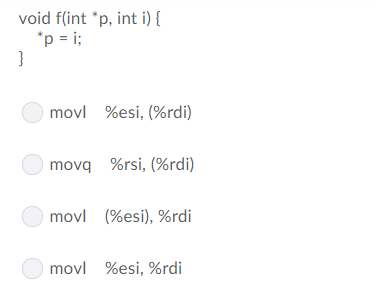
Of the choices of assembly below, which is a possible result of compiling the following C function:
Homework Answers
Ans: movl (%esi), %rdi
For example:
movl 8(%ebp), %eax means
%eax is register EAX; (%eax) is the memory location whose address is contained in the register EAX; 8(%eax) is the memory location whose address is the value of EAX plus 8.
Add Answer to:
Of the choices of assembly below, which is a possible result of
compiling the following C...
Consider the following source code, where b, c, and d are constants declared with #define. You...
Consider the following source code, where b, c, and d are constants declared with #define. You will need to determine the values for b, c, and d. struct lnode { char *str; struct lnode *next; } struct lnode A[b][c][d]; int store_ele(int h, int i, int j, struct lnode dest) { A[h][i][j] = dest; return sizeof(A);} On compiling this program (with -O2), GCC generates the following assembly code for the store_ele function: store_ele: movslq %edi, %rdi movslq %esi, %rsi movslq %edx,...
Problem 2 Consider the following source code, where R, S, and T are constants declared with...
 Problem 2 Consider the following source code, where R, S, and T are constants declared with #define. long int AIRISJIT int store_ele(int h, int i, int j, long int 'dest) Alh][i]01-.dest; return sizeof(A) In compiling this program, GCC generates the following assembly code (with-02) store_ ele: movslq %esi, %rsi movslq %edi, %rdi movq (%rcx), %rax leaq (%rdi,%rdi,4), %rdi leaq (%rsi,%rsi,4), %rcx movslq %edx, %rdx addq %rcx, %rdx movq %rax, A( %rdx,8) movl $1120, %eax ret Create a text file to...
Write the C Code for the Intel assembley below. Note: Don't copy and paste anything from...
Write the C Code for the Intel assembley below. Note: Don't copy and paste anything from github because it won't be the right answer. .file "mystery.c" .comm num,1600,32 .text .globl add .type add, @function add: .LFB2: .cfi_startproc pushq %rbp .cfi_def_cfa_offset 16 .cfi_offset 6, -16 movq %rsp, %rbp .cfi_def_cfa_register 6 movq %rdi, -8(%rbp) movq %rsi, -16(%rbp) movq -16(%rbp), %rax movq -8(%rbp), %rdx addq %rdx, %rax popq %rbp .cfi_def_cfa 7, 8 ret .cfi_endproc .LFE2: .size add, .-add .globl dothething .type dothething, @function...
You know the following assembly code snippet is from a recursive function in C. You also...
You know the following assembly code snippet is from a recursive function in C. You also know that the stack contents at a particular point in time when we are in the recursive function are shown on the next page. Answer the following questions: a) how many Foo stack frames are on the stack? b) what is the return address back to the function that called Foo for the first time? c) what is the return address back into the...
In the following code, A and B are constants defined with #define: 1 typedef struct {...
In the following code, A and B are constants defined with #define: 1 typedef struct { 2 int x[A][B]; /* Unknown constants A and B */ 3 long y; 4 } str1; 5 6 typedef struct { 7 char array[B]; 8 int t; 9 short s[A]; 10 long u; 11 } str2; 12 13 void setVal(str1 *p, str2 *q) { 14 long v1 = q-<t; 15 long v2 = q-<u; 16 p-<y = v1+v2; 17 } gcc generates the following...
Suppose we have C program, int foo(long s, long d) { char arr_a[11]; int...
Suppose we have C program, int foo(long s, long d) { char arr_a[11]; int i; arr_a[10] = 0; arr_s[10] = 0; for (i = 0; i < 5; i++) { if ((s == 1) && (d == 2)) { arr_a[i] = hello[4-i]; arr_s[i] = hello[4-i]; arr_a[i+5] = world[i]; arr_s[i+5] = world[i]; } else { arr_a[i+5] = hello[4-i]; arr_s[i+5] = hello[4-i]; arr_a[i] = world[i]; arr_s[i] =...
a) Write the following C function in Assembly. You must follow the System V 64-bit calling convention and use AT&T S...
 a) Write the following C function in Assembly. You must follow
the System V 64-bit calling convention and use AT&T Syntax
notation. Note: You cannot change the algorithm in any way so your
assembly function must still be recursive. (20 points) long Catalan(long n) { long sum
= 0; if (n == 0) return 1; for (int i = 0; i < n; i++) { sum +=
Catalan(i) * Catalan(n - i - 1); } return sum; } b) The...
a) Write the following C function in Assembly. You must follow
the System V 64-bit calling convention and use AT&T Syntax
notation. Note: You cannot change the algorithm in any way so your
assembly function must still be recursive. (20 points) long Catalan(long n) { long sum
= 0; if (n == 0) return 1; for (int i = 0; i < n; i++) { sum +=
Catalan(i) * Catalan(n - i - 1); } return sum; } b) The...
For the C code 1 int loop while(int a, int b) int result 1; while (a < b) t result (atb); return ...
 For the C code 1 int loop while(int a, int b) int result 1; while (a < b) t result (atb); return result; Gcc generates the following assembly code: %ebp+8, mov1 movl movl %ebp+12 at 8(%ebp) ,%ecx 12(%ebp) ,%ebx $1,%eax a at b 5 jge L11 leal (%ebx, %ecx), Xodx 8 L12: inull %eax , %eax addl $1,%ecx addl $1, edx cmp1 %ecx , %ebx 9 10 12 13 J8 14 ·L11: .L12 In generating this code, occ makes an...
C programming Given an integer variable declared as int result, which of the following choices set...
C programming Given an integer variable declared as int result, which of the following choices set result = 2? Each choice may contain a single statement or a group of statements. Select all choices you believe are correct--this question may have more than one correct answer! A. double temp = 19.0; int div = 10; result = 1 + temp / div; B. double val1 = 3; double val2 = 0.75; result = val1 / 2 + val2 * 2; C....
the answer is movl 8(%ebp), %edx or movl 4(%ebp), %edx? Consider the following C and assembly...
 the answer is movl 8(%ebp),
%edx or movl 4(%ebp), %edx?
Consider the following C and assembly code: int increment(int x){ return x+1; } increment: 1 push? 2 movl 3 movl 4 addl 5 6 popl ret %ebp %esp, %ebp 8(%ebp), %eax $1, %eax %ebp Suppose we want to move the return address into register %edx on line 5. Write 1 line of assembly code to perform this action. (Write your answer with exactly 2 spaces: one after the instruction, and...
the answer is movl 8(%ebp),
%edx or movl 4(%ebp), %edx?
Consider the following C and assembly code: int increment(int x){ return x+1; } increment: 1 push? 2 movl 3 movl 4 addl 5 6 popl ret %ebp %esp, %ebp 8(%ebp), %eax $1, %eax %ebp Suppose we want to move the return address into register %edx on line 5. Write 1 line of assembly code to perform this action. (Write your answer with exactly 2 spaces: one after the instruction, and...
 Problem 2 Consider the following source code, where R, S, and T are constants declared with #define. long int AIRISJIT int store_ele(int h, int i, int j, long int 'dest) Alh][i]01-.dest; return sizeof(A) In compiling this program, GCC generates the following assembly code (with-02) store_ ele: movslq %esi, %rsi movslq %edi, %rdi movq (%rcx), %rax leaq (%rdi,%rdi,4), %rdi leaq (%rsi,%rsi,4), %rcx movslq %edx, %rdx addq %rcx, %rdx movq %rax, A( %rdx,8) movl $1120, %eax ret Create a text file to...
 a) Write the following C function in Assembly. You must follow
the System V 64-bit calling convention and use AT&T Syntax
notation. Note: You cannot change the algorithm in any way so your
assembly function must still be recursive. (20 points) long Catalan(long n) { long sum
= 0; if (n == 0) return 1; for (int i = 0; i < n; i++) { sum +=
Catalan(i) * Catalan(n - i - 1); } return sum; } b) The...
a) Write the following C function in Assembly. You must follow
the System V 64-bit calling convention and use AT&T Syntax
notation. Note: You cannot change the algorithm in any way so your
assembly function must still be recursive. (20 points) long Catalan(long n) { long sum
= 0; if (n == 0) return 1; for (int i = 0; i < n; i++) { sum +=
Catalan(i) * Catalan(n - i - 1); } return sum; } b) The...
 For the C code 1 int loop while(int a, int b) int result 1; while (a < b) t result (atb); return result; Gcc generates the following assembly code: %ebp+8, mov1 movl movl %ebp+12 at 8(%ebp) ,%ecx 12(%ebp) ,%ebx $1,%eax a at b 5 jge L11 leal (%ebx, %ecx), Xodx 8 L12: inull %eax , %eax addl $1,%ecx addl $1, edx cmp1 %ecx , %ebx 9 10 12 13 J8 14 ·L11: .L12 In generating this code, occ makes an...
 the answer is movl 8(%ebp),
%edx or movl 4(%ebp), %edx?
Consider the following C and assembly code: int increment(int x){ return x+1; } increment: 1 push? 2 movl 3 movl 4 addl 5 6 popl ret %ebp %esp, %ebp 8(%ebp), %eax $1, %eax %ebp Suppose we want to move the return address into register %edx on line 5. Write 1 line of assembly code to perform this action. (Write your answer with exactly 2 spaces: one after the instruction, and...
the answer is movl 8(%ebp),
%edx or movl 4(%ebp), %edx?
Consider the following C and assembly code: int increment(int x){ return x+1; } increment: 1 push? 2 movl 3 movl 4 addl 5 6 popl ret %ebp %esp, %ebp 8(%ebp), %eax $1, %eax %ebp Suppose we want to move the return address into register %edx on line 5. Write 1 line of assembly code to perform this action. (Write your answer with exactly 2 spaces: one after the instruction, and...
Most questions answered within 3 hours.
-
Where is the error in this code sequence?
String s1 = "Hello";
String s2 = "ello";...
asked 11 months ago -
Financial data for Joel de Paris, Inc., for last year
follow:
Joel de Paris, Inc.
Balance...
asked 11 months ago -
Consider this reaction:
Al2(SO4)3 (aq)+ BaCl3
(aq) Al2Cl6 (aq)- +
3BaSO4(s) . What is the...
asked 11 months ago -
Suppose that Savneet is considering increasing her
recent random sample from 20 car rentals to 40...
asked 11 months ago -
Trucks arrive at an unloading terminal at an average rate of 120
per hour.
Trucks arrive...
asked 11 months ago -
Why are methanol and ethanol completely soluble in water while
octanol is not very little soluble....
asked 11 months ago -
A facilities manager at a university reads in a research report
that the mean amount of...
asked 11 months ago -
When the CuSO4 is rehydrated by adding water to the anhydrous
compound, is this an endothermic...
asked 11 months ago -
A ray of sunlight is passing from diamond into crown glass; the
angle of incidence is...
asked 11 months ago -
A block of mass 0.249 kg is placed on top of a light, vertical
spring of...
asked 11 months ago -
how do the kidneys compensate in the presences of acidosis
a) trigger hyperventilate
b) reserve acid...
asked 11 months ago -
Question 501 pts
The rental rate of capital to the firm increases. Which of the
following...
asked 11 months ago