
Homework Answers
![3x10 on 다 mec humnd energy 2 1 2. 16.6子大30x6-0.24-2-19m]S](http://img.homeworklib.com/questions/86ec31e0-71c8-11eb-bdb7-0db3ebd13cc5.png?x-oss-process=image/resize,w_560)
In a double-star system, two stars of mass 4.0 x 1030 kg each rotate about the system's center of mass at radius 1.8 x...
 In a double-star system, two stars of mass 4.0 x 1030 kg each rotate about the system's center of mass at radius 1.8 x 10¹¹ m. (a) What is their common angular speed? (b) If a meteoroid passes through the system's center of mass perpendicular to their orbital plane, what minimum speed must it have at the center of mass if it is to escape to "infinity" from the two-star system? (a) Number Units (b) Number Units
3) The next two questions pertain to the following situation. Star S has two planets, X...
 3) The next two questions pertain to the following situation. Star S has two planets, X and Y, that both orbit Sin uniform circular motion. Planet X of mass my = 2.7 x 10²¹ kg orbits star S in uniform circular motion at a distance rx = 2.8 * 1012 m and with speed vx = 9.7 x 10⁴ m/s. The mass of star S is Ms and its radius is Rs = 2 x 10 m, as shown in...
Galaxies contain both stars and dark matter. The mass M of a galaxy that is located...
 Galaxies contain both stars and dark matter. The mass M of a galaxy that is located within a certain star's orbit is given by where v is the velocity of the star, r is the distance from the galaxy's center to the star, and G is Newton's gravitational constant, 6.673 x 10- N m/kg Stars near the edge of a particular galaxy have velocities of 259 km/s. The radius of the galaxy is 53 kpc. How much mass is in...
In this situation both objects start combined together. Object one has a mass of 10.0 kg...
In this situation both objects start combined together. Object one has a mass of 10.0 kg and object two has a mass of 5.0 kg. Combined they are at rest, however they then interact and object one pushes away at 4.0 m/s. What will object two’s velocity be at this point?
6. A star of mass 1.4M SuN (is the Sun's mass, a convenient mass unit in...
 6. A star of mass 1.4M SuN (is the Sun's mass, a convenient mass unit in Astronomy) is a great distance from another star of equal mass and is approaching the second star at v 680km /s. The two stars undergo a close encounter (considered a collision) and much later the first star is moving at a θ-350 to its initial direction. In the frame of reference in which the second star is initially at rest v2, 0, find the...
Chapter 08, Problem 51 Chalkboard Video A star has a mass of 2.10 x 1050 kg...
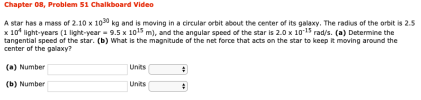 Chapter 08, Problem 51 Chalkboard Video A star has a mass of 2.10 x 1050 kg and is moving in a circular orbit about the center of its galaxy. The radius of the orbit is 2.5 x 10⁴ light-years (1 light-year = 9.5 x 10¹⁵ m), and the angular speed of the star is 2.0 x 10⁻¹⁵ rad/s. (a) Determine the tangential speed of the star. (b) What is the magnitude of the net force that acts on the star...
The mass of a star is 1.770×1031 kg and it performs one rotation in 21.90 days....
The mass of a star is 1.770×1031 kg and it performs one rotation in 21.90 days. Find its new period (in days) if the diameter suddenly shrinks to 0.590 times its present size. Assume a uniform mass distribution before and after. A figure skater is spinning with an initial angular speed of 9.8rad/s. He then pulls his arms in, reducing his moment of inertia to 0.27 times its original value. What is his angular speed after pulling in his arms?...
(d) A particle of mass m is moving at a speed u and hits an identical particle that is siting at ...
 (d) A particle of mass m is moving at a speed u and hits an identical particle that is siting at rest. What are their four-momenta in the center of mass frame (e) In the center of mass frame, the collision of the two particles in part (d) causes the particles to fuse and create a single particle with mass M »m (i.e. the two particle turn into one, the opposite of a decay) that is completely at rest in...
Q 7.31: A football player with a mass of 110 kg runs into a stationary tackling...
 Q 7.31: A football player with a mass of 110 kg runs into a stationary tackling sled that has a mass of 250 kg. Both the player and sled move together and come to rest 25 cm from the impact. If the coefficient of kinetic the ground is 0.5, what was the initial speed of the football player? A 6.6 m/s B 9.8 m/s C 2.2 m/s D 5.1 m/s E 8.0 m/s
please answer both questions. My Notes Ask Your Teacher asketball star covers 2.55 m horizontally in...
 please answer both questions.
My Notes Ask Your Teacher asketball star covers 2.55 m horizontally in a jump to dunk the ball. His motion through space can be modeled precisely as at of a particle at his center of mass. His center of mass is at elevation 1.02 m when he leaves the floor. It reaches a maximum height of 1.80 m above the floor and is at elevation 0.950 m when he touches down again. (a) Determine his time...
please answer both questions.
My Notes Ask Your Teacher asketball star covers 2.55 m horizontally in a jump to dunk the ball. His motion through space can be modeled precisely as at of a particle at his center of mass. His center of mass is at elevation 1.02 m when he leaves the floor. It reaches a maximum height of 1.80 m above the floor and is at elevation 0.950 m when he touches down again. (a) Determine his time...
 In a double-star system, two stars of mass 4.0 x 1030 kg each rotate about the system's center of mass at radius 1.8 x 10¹¹ m. (a) What is their common angular speed? (b) If a meteoroid passes through the system's center of mass perpendicular to their orbital plane, what minimum speed must it have at the center of mass if it is to escape to "infinity" from the two-star system? (a) Number Units (b) Number Units
 3) The next two questions pertain to the following situation. Star S has two planets, X and Y, that both orbit Sin uniform circular motion. Planet X of mass my = 2.7 x 10²¹ kg orbits star S in uniform circular motion at a distance rx = 2.8 * 1012 m and with speed vx = 9.7 x 10⁴ m/s. The mass of star S is Ms and its radius is Rs = 2 x 10 m, as shown in...
 Galaxies contain both stars and dark matter. The mass M of a galaxy that is located within a certain star's orbit is given by where v is the velocity of the star, r is the distance from the galaxy's center to the star, and G is Newton's gravitational constant, 6.673 x 10- N m/kg Stars near the edge of a particular galaxy have velocities of 259 km/s. The radius of the galaxy is 53 kpc. How much mass is in...
 6. A star of mass 1.4M SuN (is the Sun's mass, a convenient mass unit in Astronomy) is a great distance from another star of equal mass and is approaching the second star at v 680km /s. The two stars undergo a close encounter (considered a collision) and much later the first star is moving at a θ-350 to its initial direction. In the frame of reference in which the second star is initially at rest v2, 0, find the...
 Chapter 08, Problem 51 Chalkboard Video A star has a mass of 2.10 x 1050 kg and is moving in a circular orbit about the center of its galaxy. The radius of the orbit is 2.5 x 10⁴ light-years (1 light-year = 9.5 x 10¹⁵ m), and the angular speed of the star is 2.0 x 10⁻¹⁵ rad/s. (a) Determine the tangential speed of the star. (b) What is the magnitude of the net force that acts on the star...
 (d) A particle of mass m is moving at a speed u and hits an identical particle that is siting at rest. What are their four-momenta in the center of mass frame (e) In the center of mass frame, the collision of the two particles in part (d) causes the particles to fuse and create a single particle with mass M »m (i.e. the two particle turn into one, the opposite of a decay) that is completely at rest in...
 Q 7.31: A football player with a mass of 110 kg runs into a stationary tackling sled that has a mass of 250 kg. Both the player and sled move together and come to rest 25 cm from the impact. If the coefficient of kinetic the ground is 0.5, what was the initial speed of the football player? A 6.6 m/s B 9.8 m/s C 2.2 m/s D 5.1 m/s E 8.0 m/s
 please answer both questions.
My Notes Ask Your Teacher asketball star covers 2.55 m horizontally in a jump to dunk the ball. His motion through space can be modeled precisely as at of a particle at his center of mass. His center of mass is at elevation 1.02 m when he leaves the floor. It reaches a maximum height of 1.80 m above the floor and is at elevation 0.950 m when he touches down again. (a) Determine his time...
please answer both questions.
My Notes Ask Your Teacher asketball star covers 2.55 m horizontally in a jump to dunk the ball. His motion through space can be modeled precisely as at of a particle at his center of mass. His center of mass is at elevation 1.02 m when he leaves the floor. It reaches a maximum height of 1.80 m above the floor and is at elevation 0.950 m when he touches down again. (a) Determine his time...
Most questions answered within 3 hours.
-
Where is the error in this code sequence?
String s1 = "Hello";
String s2 = "ello";...
asked 11 months ago -
Financial data for Joel de Paris, Inc., for last year
follow:
Joel de Paris, Inc.
Balance...
asked 11 months ago -
Consider this reaction:
Al2(SO4)3 (aq)+ BaCl3
(aq) Al2Cl6 (aq)- +
3BaSO4(s) . What is the...
asked 11 months ago -
Suppose that Savneet is considering increasing her
recent random sample from 20 car rentals to 40...
asked 11 months ago -
Trucks arrive at an unloading terminal at an average rate of 120
per hour.
Trucks arrive...
asked 11 months ago -
Why are methanol and ethanol completely soluble in water while
octanol is not very little soluble....
asked 11 months ago -
A facilities manager at a university reads in a research report
that the mean amount of...
asked 11 months ago -
When the CuSO4 is rehydrated by adding water to the anhydrous
compound, is this an endothermic...
asked 11 months ago -
A ray of sunlight is passing from diamond into crown glass; the
angle of incidence is...
asked 11 months ago -
A block of mass 0.249 kg is placed on top of a light, vertical
spring of...
asked 11 months ago -
how do the kidneys compensate in the presences of acidosis
a) trigger hyperventilate
b) reserve acid...
asked 11 months ago -
Question 501 pts
The rental rate of capital to the firm increases. Which of the
following...
asked 11 months ago