Provide the 1H and 13C NMR data for thiophenol. Note the chemical shift, multiplicity, and integration...
- Provide the 1H and 13C NMR data for thiophenol. Note the chemical shift, multiplicity, and integration for each (e.g. d 1.0, 3H, triplet). Clearly identify which proton is being reported and which carbon is being reported.
- Provide the 1H and 13C NMR data for the product generated in Question #1. Note the chemical shift, multiplicity, and integration for each (e.g. d 1.0, 3H, triplet). Clearly identify which proton is being reported and which carbon is being reported.
Homework Answers

Add Answer to:
Provide the 1H and 13C NMR data for thiophenol. Note the
chemical shift, multiplicity, and integration...
1. Provide the 1H and 13C NMR data for 4-ethyl-1-cyclohexanecarboxaldehye Report the 1H NMR data in...
1. Provide the 1H and 13C NMR data for 4-ethyl-1-cyclohexanecarboxaldehye Report the 1H NMR data in the sequence: chemical shift, integration, multiplicity (e.g. 1.0, 3H, triplet). Be sure to clearly label which proton and carbon you are reporting. 2. Provide the 1H and 13C NMR data for ethylene glycol. Report the 1H NMR data in the sequence: chemical shift, integration, multiplicity (e.g. d 1.0, 3H, triplet). Be sure to clearly label which proton and carbon you are reporting.
(2 pts) Show the complete mechanism using curved arrow formalism for the reaction of 4-ethyl-1-cyclohexanecarboxaldehyde treated...
(2 pts) Show the complete mechanism using curved arrow formalism for the reaction of 4-ethyl-1-cyclohexanecarboxaldehyde treated with ethylene glycol in acid. Provide the 1H and 13C NMR data for the product formed in Question #1. Report the 1H NMR data in the sequence: chemical shift, integration, multiplicity (e.g. d 1.0, 3H, triplet). Be sure to clearly label which proton and carbon you are reporting.
Interpret the given spectra of Triphenylmethanol. 11-Grignard Reaction 12738 13C NMR Atom Chemical Shift (5) Structure:...
 Interpret the given spectra of Triphenylmethanol.
11-Grignard Reaction 12738 13C NMR Atom Chemical Shift (5) Structure: 1H NMR Atom Chemical Shift (8) Multiplicity Structure: * Specify the multiplicity as a singlet (s), doublet (d), triplet (t), quartet (q), or multiplet (m) Specify the number of hydrogens associated with each peak.
Interpret the given spectra of Triphenylmethanol.
11-Grignard Reaction 12738 13C NMR Atom Chemical Shift (5) Structure: 1H NMR Atom Chemical Shift (8) Multiplicity Structure: * Specify the multiplicity as a singlet (s), doublet (d), triplet (t), quartet (q), or multiplet (m) Specify the number of hydrogens associated with each peak.
Using the 1H NMR and 13C NMR Data avalible at the end of the question, deduce...
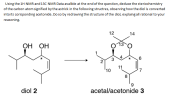 Using the 1H NMR and 13C NMR Data avalible at the end of the question, deduce the steriochemistry of the carbon atom signified by the astrick in the following structres, observing how the diol is converted into its corisponding acetonide. Do so by redrawing the structure of the diol, explaing all rational to your reasoning. 12 14 13 OH ОН 2 11 10 7 diol 2 acetal/acetonide 3 1H NMR Data (300MHZ, CDCI): a(ppm) multiplicity М, 2H М, 1н М,...
Construct a 13C NMR data table for the structure shown. Identify the chemical shifts, and the...
 Construct a 13C NMR data table for the structure shown. Identify
the chemical shifts, and the type of splitting that you\'d expect
were a \"coupled\" carbon-NMR to be acquired.
Construct a 13C NMR data table for the structure shown. Identify the chemical shifts, and the type of splitting that you'd expect were a "coupled" carbon-NMR to be acquired. CH3)2CHCH, CH = CHCH,OCH3 0-50 50-100 100-160 160-220 singlet doublet triplet quartet Chem. Shift Splitting
Construct a 13C NMR data table for the structure shown. Identify
the chemical shifts, and the type of splitting that you\'d expect
were a \"coupled\" carbon-NMR to be acquired.
Construct a 13C NMR data table for the structure shown. Identify the chemical shifts, and the type of splitting that you'd expect were a "coupled" carbon-NMR to be acquired. CH3)2CHCH, CH = CHCH,OCH3 0-50 50-100 100-160 160-220 singlet doublet triplet quartet Chem. Shift Splitting
Given 1H NMR and 13C NMR, what will be the chemical structure of C14H11FO2? (Chemical shift,...
Given 1H NMR and 13C NMR, what will be the chemical structure of C14H11FO2? (Chemical shift, # of peaks, # of protons) 1H NMR: 7-8, multiplet, 8; 4.1, singlet, 2; 2.1, singlet, 1 13C NMR: 202, 131, 127, 126, 123, 120, 118, 115, 114, 109, 108, 63
The chemical shift values of this 13C NMR spectrum have been calibrated to the literature value...
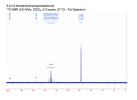 The chemical shift values of this 13C NMR spectrum
have been calibrated to the literature value of CDCl3
(77.16 ppm). The full spectrum is represented, followed by one
zoom. Each signal on this spectrum has been labeled with a letter
(a-k).
13C NMR Triumph.
After the complexity of the 1H NMR data for this
molecule, the 13C NMR spectrum is far more
straightforward. Briefly state two (2) features of the
13C NMR data that clearly support the identity of the...
The chemical shift values of this 13C NMR spectrum
have been calibrated to the literature value of CDCl3
(77.16 ppm). The full spectrum is represented, followed by one
zoom. Each signal on this spectrum has been labeled with a letter
(a-k).
13C NMR Triumph.
After the complexity of the 1H NMR data for this
molecule, the 13C NMR spectrum is far more
straightforward. Briefly state two (2) features of the
13C NMR data that clearly support the identity of the...
for the following 2 compounds, please calculate, and show the calculations for, the degree of unsaturation, assign the IR spectrum peaks, assign the 13C NMR peaks, assign the 1H NMR peaks, and draw th...
 for the following 2 compounds, please calculate, and
show the calculations for, the degree of unsaturation, assign the
IR spectrum peaks, assign the 13C NMR peaks, assign the 1H NMR
peaks, and draw the structure for the unknown compound.
CHIM 245 Spectroscopy Problem Set #2 In this problem set there are two unknown compounds. You are provided with the formula, IR spectrum, "C NMR spectrum, and 'H NMR spectrum for each compound. Each unknown is worth 10 points, with an...
for the following 2 compounds, please calculate, and
show the calculations for, the degree of unsaturation, assign the
IR spectrum peaks, assign the 13C NMR peaks, assign the 1H NMR
peaks, and draw the structure for the unknown compound.
CHIM 245 Spectroscopy Problem Set #2 In this problem set there are two unknown compounds. You are provided with the formula, IR spectrum, "C NMR spectrum, and 'H NMR spectrum for each compound. Each unknown is worth 10 points, with an...
The last substituent on carbon E is CH3 Identify the multiplicity for each 1H NMR signal...
 The
last substituent on carbon E is CH3
Identify the multiplicity for each 1H NMR signal for the following Aldol product. Echs Drag and drop to match → - A heptet → - B doublet of triplet - C singlet → D doublet - E broad singlet → - F doublet of septet - G doublet - H doublet - Singlet - J triplet
The
last substituent on carbon E is CH3
Identify the multiplicity for each 1H NMR signal for the following Aldol product. Echs Drag and drop to match → - A heptet → - B doublet of triplet - C singlet → D doublet - E broad singlet → - F doublet of septet - G doublet - H doublet - Singlet - J triplet
Draw the structures of each and predict the 1H NMR spectrum (approximate chemical shift, integration and...
Draw the structures of each and predict the 1H NMR spectrum (approximate chemical shift, integration and splitting): a) anisole b) 4-nitrotoluene
 Interpret the given spectra of Triphenylmethanol.
11-Grignard Reaction 12738 13C NMR Atom Chemical Shift (5) Structure: 1H NMR Atom Chemical Shift (8) Multiplicity Structure: * Specify the multiplicity as a singlet (s), doublet (d), triplet (t), quartet (q), or multiplet (m) Specify the number of hydrogens associated with each peak.
Interpret the given spectra of Triphenylmethanol.
11-Grignard Reaction 12738 13C NMR Atom Chemical Shift (5) Structure: 1H NMR Atom Chemical Shift (8) Multiplicity Structure: * Specify the multiplicity as a singlet (s), doublet (d), triplet (t), quartet (q), or multiplet (m) Specify the number of hydrogens associated with each peak.
 Using the 1H NMR and 13C NMR Data avalible at the end of the question, deduce the steriochemistry of the carbon atom signified by the astrick in the following structres, observing how the diol is converted into its corisponding acetonide. Do so by redrawing the structure of the diol, explaing all rational to your reasoning. 12 14 13 OH ОН 2 11 10 7 diol 2 acetal/acetonide 3 1H NMR Data (300MHZ, CDCI): a(ppm) multiplicity М, 2H М, 1н М,...
 Construct a 13C NMR data table for the structure shown. Identify
the chemical shifts, and the type of splitting that you\'d expect
were a \"coupled\" carbon-NMR to be acquired.
Construct a 13C NMR data table for the structure shown. Identify the chemical shifts, and the type of splitting that you'd expect were a "coupled" carbon-NMR to be acquired. CH3)2CHCH, CH = CHCH,OCH3 0-50 50-100 100-160 160-220 singlet doublet triplet quartet Chem. Shift Splitting
Construct a 13C NMR data table for the structure shown. Identify
the chemical shifts, and the type of splitting that you\'d expect
were a \"coupled\" carbon-NMR to be acquired.
Construct a 13C NMR data table for the structure shown. Identify the chemical shifts, and the type of splitting that you'd expect were a "coupled" carbon-NMR to be acquired. CH3)2CHCH, CH = CHCH,OCH3 0-50 50-100 100-160 160-220 singlet doublet triplet quartet Chem. Shift Splitting
 The chemical shift values of this 13C NMR spectrum
have been calibrated to the literature value of CDCl3
(77.16 ppm). The full spectrum is represented, followed by one
zoom. Each signal on this spectrum has been labeled with a letter
(a-k).
13C NMR Triumph.
After the complexity of the 1H NMR data for this
molecule, the 13C NMR spectrum is far more
straightforward. Briefly state two (2) features of the
13C NMR data that clearly support the identity of the...
The chemical shift values of this 13C NMR spectrum
have been calibrated to the literature value of CDCl3
(77.16 ppm). The full spectrum is represented, followed by one
zoom. Each signal on this spectrum has been labeled with a letter
(a-k).
13C NMR Triumph.
After the complexity of the 1H NMR data for this
molecule, the 13C NMR spectrum is far more
straightforward. Briefly state two (2) features of the
13C NMR data that clearly support the identity of the...
 for the following 2 compounds, please calculate, and
show the calculations for, the degree of unsaturation, assign the
IR spectrum peaks, assign the 13C NMR peaks, assign the 1H NMR
peaks, and draw the structure for the unknown compound.
CHIM 245 Spectroscopy Problem Set #2 In this problem set there are two unknown compounds. You are provided with the formula, IR spectrum, "C NMR spectrum, and 'H NMR spectrum for each compound. Each unknown is worth 10 points, with an...
for the following 2 compounds, please calculate, and
show the calculations for, the degree of unsaturation, assign the
IR spectrum peaks, assign the 13C NMR peaks, assign the 1H NMR
peaks, and draw the structure for the unknown compound.
CHIM 245 Spectroscopy Problem Set #2 In this problem set there are two unknown compounds. You are provided with the formula, IR spectrum, "C NMR spectrum, and 'H NMR spectrum for each compound. Each unknown is worth 10 points, with an...
 The
last substituent on carbon E is CH3
Identify the multiplicity for each 1H NMR signal for the following Aldol product. Echs Drag and drop to match → - A heptet → - B doublet of triplet - C singlet → D doublet - E broad singlet → - F doublet of septet - G doublet - H doublet - Singlet - J triplet
The
last substituent on carbon E is CH3
Identify the multiplicity for each 1H NMR signal for the following Aldol product. Echs Drag and drop to match → - A heptet → - B doublet of triplet - C singlet → D doublet - E broad singlet → - F doublet of septet - G doublet - H doublet - Singlet - J triplet
Most questions answered within 3 hours.
-
Where is the error in this code sequence?
String s1 = "Hello";
String s2 = "ello";...
asked 11 months ago -
Financial data for Joel de Paris, Inc., for last year
follow:
Joel de Paris, Inc.
Balance...
asked 11 months ago -
Consider this reaction:
Al2(SO4)3 (aq)+ BaCl3
(aq) Al2Cl6 (aq)- +
3BaSO4(s) . What is the...
asked 11 months ago -
Suppose that Savneet is considering increasing her
recent random sample from 20 car rentals to 40...
asked 11 months ago -
Trucks arrive at an unloading terminal at an average rate of 120
per hour.
Trucks arrive...
asked 11 months ago -
Why are methanol and ethanol completely soluble in water while
octanol is not very little soluble....
asked 11 months ago -
A facilities manager at a university reads in a research report
that the mean amount of...
asked 11 months ago -
When the CuSO4 is rehydrated by adding water to the anhydrous
compound, is this an endothermic...
asked 11 months ago -
A ray of sunlight is passing from diamond into crown glass; the
angle of incidence is...
asked 11 months ago -
A block of mass 0.249 kg is placed on top of a light, vertical
spring of...
asked 11 months ago -
how do the kidneys compensate in the presences of acidosis
a) trigger hyperventilate
b) reserve acid...
asked 11 months ago -
Question 501 pts
The rental rate of capital to the firm increases. Which of the
following...
asked 11 months ago