
Homework Answers
Add Answer to:
1.
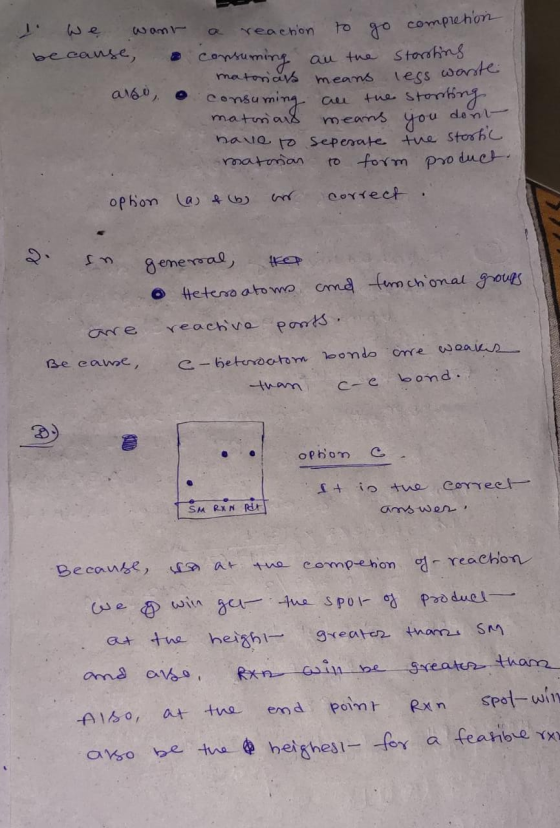
Why do we want a reaction to go to completion?
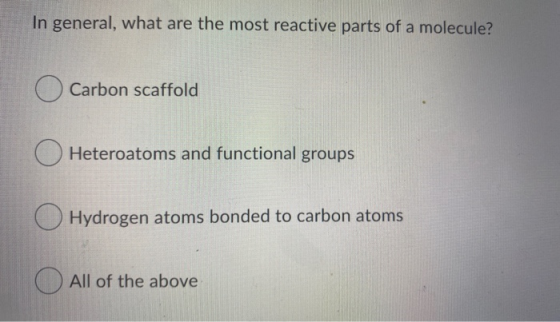
2. In general, what are...
Question 3 20 pts If you were monitoring the reaction of trans-stilbene being convert to stilbene...
 Question 3 20 pts If you were monitoring the reaction of trans-stilbene being convert to stilbene dibromide via TLC, and under UV visualization you saw all three lanes, starting material / co-spot/ reaction, had visible spots, and when treated with KMnO4 and heated spots in all three lanes were yellow, what would you conclude. O The reaction had not gone to completion yet. O The reaction was complete. O You failed to spot the TLC plate with a concentrated enough...
Here is a molecule. Do a retro synthesis (reaction scheme) on the molecule and go all the way back to produce the molecu...
 Here is a molecule. Do a retro synthesis (reaction
scheme) on the molecule and go all the way back to produce the
molecule until you can't go back anymore (think benzene or carbon).
You can use any source and synthesis/reaction to produce the
molecule above. Some notes about the molecule:
I would say start by writing down all the one step
reactions you know that would make the molecule without considering
from where the starting material comes. With some luck...
Here is a molecule. Do a retro synthesis (reaction
scheme) on the molecule and go all the way back to produce the
molecule until you can't go back anymore (think benzene or carbon).
You can use any source and synthesis/reaction to produce the
molecule above. Some notes about the molecule:
I would say start by writing down all the one step
reactions you know that would make the molecule without considering
from where the starting material comes. With some luck...
Here is a molecule. Do a retro synthesis (reaction scheme) on the molecule and go all the way back to produce the molecu...
 Here is a molecule. Do a retro synthesis (reaction
scheme) on the molecule and go all the way back to produce the
molecule until you can't go back anymore (think benzene or carbon).
You can use any source and synthesis/reaction to produce the
molecule above. Some notes about the molecule:
I would say start by writing down all the one step
reactions you know that would make the molecule without considering
from where the starting material comes. With some luck...
Here is a molecule. Do a retro synthesis (reaction
scheme) on the molecule and go all the way back to produce the
molecule until you can't go back anymore (think benzene or carbon).
You can use any source and synthesis/reaction to produce the
molecule above. Some notes about the molecule:
I would say start by writing down all the one step
reactions you know that would make the molecule without considering
from where the starting material comes. With some luck...
7. What two molecules could be used to make the following molecules using crossed aldol reaction....
 7. What two molecules could be used to make the following molecules using crossed aldol reaction. O ook OH 8a. There are 4 alpha-carbons in this molecule. Which alpha carbon(s) is/are the most reactive? What is the product if NaOH and heat are used? 8b. What is the scientist name whom the above reaction is named after? 9. Why does the base (used to proton transfer) need match the initial reactant in the Claisen Condensation? 10. Malonic ester synthesis questions...
Please explain what is going on in this lab for STEP 3. what are some important...
 Please explain what is going on in this lab for STEP 3. what
are some important factors?
Multistep Synthesis Preparation of 4,4-Diphenyl-3-buten-2-one! This experiment illustrates se multistep synthesis, in which the the next. This process is very common iment illustrates several important concepts of organic synthesis. It is a synthesis, in which the product of one reaction becomes the starting material of This process is very common in industry and research, and demands careful to vields and techniques. The experiment...
Please explain what is going on in this lab for STEP 3. what
are some important factors?
Multistep Synthesis Preparation of 4,4-Diphenyl-3-buten-2-one! This experiment illustrates se multistep synthesis, in which the the next. This process is very common iment illustrates several important concepts of organic synthesis. It is a synthesis, in which the product of one reaction becomes the starting material of This process is very common in industry and research, and demands careful to vields and techniques. The experiment...
Answer the following 5 questions: 1. What is(are) the starting material(s) in the reaction below? 2....
 Answer the following 5
questions:
1. What is(are) the
starting material(s) in the reaction below?
2. Determine the
stereochemistry of the following alkenes.
3. What is (are) the
product(s)?
4. Select the correct
drawings of the elimination product(s) formed by treating the
starting material with a base.
5. Indicate how many
unsaturations does this molecule have?
Quiz CH 7 (10 points) CHEM 333 1. What is (are) the starting material(s) in the reaction below? (CH).COH CH, - HCHC=C- =CH-CH- (2...
Answer the following 5
questions:
1. What is(are) the
starting material(s) in the reaction below?
2. Determine the
stereochemistry of the following alkenes.
3. What is (are) the
product(s)?
4. Select the correct
drawings of the elimination product(s) formed by treating the
starting material with a base.
5. Indicate how many
unsaturations does this molecule have?
Quiz CH 7 (10 points) CHEM 333 1. What is (are) the starting material(s) in the reaction below? (CH).COH CH, - HCHC=C- =CH-CH- (2...
Draw the product of the reaction below. CH3 17 13 CH3 1. 03 10 2. Zn,...
 Draw the product of the reaction below. CH3 17 13 CH3 1. 03 10 2. Zn, H3O HO cholesterol . You do not have to consider stereochemistry You do not have to explicitly draw H atoms. Should you want to restart the exercise, the drop-down menu labeled starting pointscan be used to redraw the starting molecule on the sketcher. C P Previous HO
My molecule is 8-ethyldeca-2, 4- diene. Why is the following mechanism incorrect and what does the...
 My molecule is 8-ethyldeca-2, 4- diene. Why is the
following mechanism incorrect and what does the correct scheme look
like?
Incorrect Mechanism (The mechanism is for the formation of the 1,4 product. Please ignore the 1,2 product). mavo + H-Br - R Br Assignment 6: Mechanism Correction > On a page titled Incorrect Mechanism print the incorrect mechanism provided for your molecule on Blackboard. For the mechanism you will focus on the reaction of the portion of the molecule drawn...
My molecule is 8-ethyldeca-2, 4- diene. Why is the
following mechanism incorrect and what does the correct scheme look
like?
Incorrect Mechanism (The mechanism is for the formation of the 1,4 product. Please ignore the 1,2 product). mavo + H-Br - R Br Assignment 6: Mechanism Correction > On a page titled Incorrect Mechanism print the incorrect mechanism provided for your molecule on Blackboard. For the mechanism you will focus on the reaction of the portion of the molecule drawn...
1. Saccharin is an artificial sweetener that was discovered in 1879 when a chemist spilled some...
 1. Saccharin is an artificial sweetener that was discovered in 1879 when a chemist spilled some of his product on his sandwich, and when he ate his sandwich discovered it was particularly sweet. It is synthesized according to the following reaction and the product is isolated after addition of HCI. -NH₂ + NaOH + KMnO4 NH OS=0 a) What safety rule did our chemist violate when discovering saccharin? (1 pt) b) Redraw the structure of the carbon-containing starting material, explicitly...
1. Why do yeasts perform alcohol fermentation? 2. What is the chemical reaction for fermentation? 3....
1. Why do yeasts perform alcohol fermentation? 2. What is the chemical reaction for fermentation? 3. Which are the reactants in this reaction? Which are the products? 4. What is the gas that accumulates in the bag, causing it to inflate? In addition to this gas, what is another product of this process? Can you think of one example when either of these products is useful during cooking/baking? 5. How does inflation of the bag correlate with the amount of...
 Question 3 20 pts If you were monitoring the reaction of trans-stilbene being convert to stilbene dibromide via TLC, and under UV visualization you saw all three lanes, starting material / co-spot/ reaction, had visible spots, and when treated with KMnO4 and heated spots in all three lanes were yellow, what would you conclude. O The reaction had not gone to completion yet. O The reaction was complete. O You failed to spot the TLC plate with a concentrated enough...
 Here is a molecule. Do a retro synthesis (reaction
scheme) on the molecule and go all the way back to produce the
molecule until you can't go back anymore (think benzene or carbon).
You can use any source and synthesis/reaction to produce the
molecule above. Some notes about the molecule:
I would say start by writing down all the one step
reactions you know that would make the molecule without considering
from where the starting material comes. With some luck...
Here is a molecule. Do a retro synthesis (reaction
scheme) on the molecule and go all the way back to produce the
molecule until you can't go back anymore (think benzene or carbon).
You can use any source and synthesis/reaction to produce the
molecule above. Some notes about the molecule:
I would say start by writing down all the one step
reactions you know that would make the molecule without considering
from where the starting material comes. With some luck...
 Here is a molecule. Do a retro synthesis (reaction
scheme) on the molecule and go all the way back to produce the
molecule until you can't go back anymore (think benzene or carbon).
You can use any source and synthesis/reaction to produce the
molecule above. Some notes about the molecule:
I would say start by writing down all the one step
reactions you know that would make the molecule without considering
from where the starting material comes. With some luck...
Here is a molecule. Do a retro synthesis (reaction
scheme) on the molecule and go all the way back to produce the
molecule until you can't go back anymore (think benzene or carbon).
You can use any source and synthesis/reaction to produce the
molecule above. Some notes about the molecule:
I would say start by writing down all the one step
reactions you know that would make the molecule without considering
from where the starting material comes. With some luck...
 7. What two molecules could be used to make the following molecules using crossed aldol reaction. O ook OH 8a. There are 4 alpha-carbons in this molecule. Which alpha carbon(s) is/are the most reactive? What is the product if NaOH and heat are used? 8b. What is the scientist name whom the above reaction is named after? 9. Why does the base (used to proton transfer) need match the initial reactant in the Claisen Condensation? 10. Malonic ester synthesis questions...
 Please explain what is going on in this lab for STEP 3. what
are some important factors?
Multistep Synthesis Preparation of 4,4-Diphenyl-3-buten-2-one! This experiment illustrates se multistep synthesis, in which the the next. This process is very common iment illustrates several important concepts of organic synthesis. It is a synthesis, in which the product of one reaction becomes the starting material of This process is very common in industry and research, and demands careful to vields and techniques. The experiment...
Please explain what is going on in this lab for STEP 3. what
are some important factors?
Multistep Synthesis Preparation of 4,4-Diphenyl-3-buten-2-one! This experiment illustrates se multistep synthesis, in which the the next. This process is very common iment illustrates several important concepts of organic synthesis. It is a synthesis, in which the product of one reaction becomes the starting material of This process is very common in industry and research, and demands careful to vields and techniques. The experiment...
 Answer the following 5
questions:
1. What is(are) the
starting material(s) in the reaction below?
2. Determine the
stereochemistry of the following alkenes.
3. What is (are) the
product(s)?
4. Select the correct
drawings of the elimination product(s) formed by treating the
starting material with a base.
5. Indicate how many
unsaturations does this molecule have?
Quiz CH 7 (10 points) CHEM 333 1. What is (are) the starting material(s) in the reaction below? (CH).COH CH, - HCHC=C- =CH-CH- (2...
Answer the following 5
questions:
1. What is(are) the
starting material(s) in the reaction below?
2. Determine the
stereochemistry of the following alkenes.
3. What is (are) the
product(s)?
4. Select the correct
drawings of the elimination product(s) formed by treating the
starting material with a base.
5. Indicate how many
unsaturations does this molecule have?
Quiz CH 7 (10 points) CHEM 333 1. What is (are) the starting material(s) in the reaction below? (CH).COH CH, - HCHC=C- =CH-CH- (2...
 Draw the product of the reaction below. CH3 17 13 CH3 1. 03 10 2. Zn, H3O HO cholesterol . You do not have to consider stereochemistry You do not have to explicitly draw H atoms. Should you want to restart the exercise, the drop-down menu labeled starting pointscan be used to redraw the starting molecule on the sketcher. C P Previous HO
 My molecule is 8-ethyldeca-2, 4- diene. Why is the
following mechanism incorrect and what does the correct scheme look
like?
Incorrect Mechanism (The mechanism is for the formation of the 1,4 product. Please ignore the 1,2 product). mavo + H-Br - R Br Assignment 6: Mechanism Correction > On a page titled Incorrect Mechanism print the incorrect mechanism provided for your molecule on Blackboard. For the mechanism you will focus on the reaction of the portion of the molecule drawn...
My molecule is 8-ethyldeca-2, 4- diene. Why is the
following mechanism incorrect and what does the correct scheme look
like?
Incorrect Mechanism (The mechanism is for the formation of the 1,4 product. Please ignore the 1,2 product). mavo + H-Br - R Br Assignment 6: Mechanism Correction > On a page titled Incorrect Mechanism print the incorrect mechanism provided for your molecule on Blackboard. For the mechanism you will focus on the reaction of the portion of the molecule drawn...
 1. Saccharin is an artificial sweetener that was discovered in 1879 when a chemist spilled some of his product on his sandwich, and when he ate his sandwich discovered it was particularly sweet. It is synthesized according to the following reaction and the product is isolated after addition of HCI. -NH₂ + NaOH + KMnO4 NH OS=0 a) What safety rule did our chemist violate when discovering saccharin? (1 pt) b) Redraw the structure of the carbon-containing starting material, explicitly...
Most questions answered within 3 hours.
-
Where is the error in this code sequence?
String s1 = "Hello";
String s2 = "ello";...
asked 10 months ago -
Financial data for Joel de Paris, Inc., for last year
follow:
Joel de Paris, Inc.
Balance...
asked 10 months ago -
Consider this reaction:
Al2(SO4)3 (aq)+ BaCl3
(aq) Al2Cl6 (aq)- +
3BaSO4(s) . What is the...
asked 10 months ago -
Suppose that Savneet is considering increasing her
recent random sample from 20 car rentals to 40...
asked 10 months ago -
Trucks arrive at an unloading terminal at an average rate of 120
per hour.
Trucks arrive...
asked 10 months ago -
Why are methanol and ethanol completely soluble in water while
octanol is not very little soluble....
asked 10 months ago -
A facilities manager at a university reads in a research report
that the mean amount of...
asked 10 months ago -
When the CuSO4 is rehydrated by adding water to the anhydrous
compound, is this an endothermic...
asked 10 months ago -
A ray of sunlight is passing from diamond into crown glass; the
angle of incidence is...
asked 10 months ago -
A block of mass 0.249 kg is placed on top of a light, vertical
spring of...
asked 10 months ago -
how do the kidneys compensate in the presences of acidosis
a) trigger hyperventilate
b) reserve acid...
asked 10 months ago -
Question 501 pts
The rental rate of capital to the firm increases. Which of the
following...
asked 10 months ago