
Homework Answers
According to law of mass action,
The rate of forward reaction with rate constant k (assume) can be expressed as, rate = k[CH4][H2S]2
The rate of backward reaction with rate constant k' can be expressed as, rate = k'[CS2][H2]4
At equilibrium, the rate of forward reaction is equal to rate of backward reaction. Then,
k[CH4][H2S]2 = k'[CS2][H2]4
k/k' = [CS2][H2]4 / [CH4][H2S]2
This k/k' is called Kc, ie, equilibrium constant of the reaction.
Then Kc = [CS2][H2]4 / [CH4][H2S]2
Add Answer to:
Select the equilibrium expression, K_c, for the following reaction: CH_4(g) + 2 H_2S(g) CS)2(g) + 4...
Determining the Equilibrium Constant K_p: Methane (CH_4) reacts with hydrogen sulfide to yield H_2 and carbon...
 Determining the Equilibrium Constant K_p: Methane (CH_4) reacts with hydrogen sulfide to yield H_2 and carbon disulfide, a solvent used in manufacturing rayon and cellophane: CH_4(g) + 2H_2S(g) Equilibrium CS_2(g) + 4 H_2(g) What is the value of K_p at 1000 K if the partial pressures in an equilibrium mixture at 1000 K are 0.20 atm of CH_4, 0.25 atm of H_2S, 0.52 atm of CS_2, and 0.10 atm of H_2?
The following reaction was allowed to come to equilibrium at 35 degree C. The initial molar...
 The following reaction was allowed to come to equilibrium at 35 degree C. The initial molar concentration for SO_3 is 0.675 M ([SO_3| = 0.675 M) and the initial molar concentration for CO_2 is 0.444 M (|CO_2] = 0.444 M). After the reaction reached equilibrium the concentration of CO_2 now equals 0.214 M ((CO_2] = 0.214 M). What is the K_c value for the reaction? 0.00987 0.0342 7.31 11.8 16.7 At 35 degree C the equilibrium constant value (K_c) for...
At a given temperature, the equilibrium constant K_c for the reaction 2 NO(g) + 2 H_2(g)...
 At a given temperature, the equilibrium constant K_c for the reaction 2 NO(g) + 2 H_2(g) implies N_2(g) + 2 H_2O(g) What is the equilibrium constant for the following reaction? NO(g) + H_2(g) implies 1/2 N_2(g) + H_2 O(g) Correct. Think About It When we multiply a chemical reaction by a number, the new value of the equilibrium constant is the first equilibrium constant raised to the number.
The following reaction 2H_2S(g) 2H_2(g) + S_2(g), K_c = 1.67 times 10^-7 at 800degreeC is carried...
 The following reaction 2H_2S(g) 2H_2(g) + S_2(g), K_c = 1.67 times 10^-7 at 800degreeC is carried out at the same temperature with the following initial concentrations: [H_2S] = 0.100M, [H_2] = 0.100M, and [S_2] = 0.00 M. Find the equilibrium concentration of S_2. Express the molarity to three significant figures.
The equilibrium constant K_c for the reaction H_2 (g) + Br_2(g) 2 HBr(g) is 2.180 times...
 The equilibrium constant K_c for the reaction H_2 (g) + Br_2(g) 2 HBr(g) is 2.180 times 10^6 at 730 degree C. Starting with 2.20 moles of HBr in a 21.6-L reaction vessel, calculate the concentrations of H_2, Br_2 and HBr at equilibrium. [H_2] = [Br_2] = [HBr] =
7) A student ran the following reaction in thc laboratory at 376 K: CH_4(g) + CCl_4(g)...
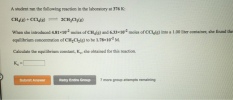 7)
A student ran the following reaction in thc laboratory at 376 K: CH_4(g) + CCl_4(g) ^ 2CH_2Cl_2(g) When she introduced 4.81 times 10^-2 moles of CH_4(g) and 6.33 times10^2 moles of CCl_4(g) into a 1.00 liter container, she found the equilibrium concentration of CH_2Cl_2(g) to be 1.78 times 10^-2 M. Calculate the equilibrium constant. K_c, she obtained for this reaction. K_c =
7)
A student ran the following reaction in thc laboratory at 376 K: CH_4(g) + CCl_4(g) ^ 2CH_2Cl_2(g) When she introduced 4.81 times 10^-2 moles of CH_4(g) and 6.33 times10^2 moles of CCl_4(g) into a 1.00 liter container, she found the equilibrium concentration of CH_2Cl_2(g) to be 1.78 times 10^-2 M. Calculate the equilibrium constant. K_c, she obtained for this reaction. K_c =
The equilibrium constant, K_c, for the following reaction is 55.6 at 698 K: H_2(g) + I_2(g)...
 The equilibrium constant, K_c, for the following reaction is 55.6 at 698 K: H_2(g) + I_2(g) 2HI(g) Calculate the equilibrium concentrations of reactants and product when 0.351 moles of H_2 and 0.351 moles of I_2 are introduced into a 1.00 L vessel at 698 K. [H_2] = M [I_2] = M [HI] = M
For the reaction H_2(g) + S(g) H_2S(g) the initial concentrations are 0.060 M H_2, 0.080 MS,...
 For the reaction H_2(g) + S(g) H_2S(g) the initial concentrations are 0.060 M H_2, 0.080 MS, and no H_2S. At equilibrium, [H_2] = 0.010 M. Calculate the concentrations of S and H_2S at equilibrium. (Be sure to give your answers to three decimal places.) M S M H_2 S Calculate the value of K under the reaction conditions at equilibrium. (Be sure your answer has the appropriate number of significant figures.)
Be sure to answer all parts. The equilibrium constant K_c for the reaction H_2(g) + Br_2(g)...
 Be sure to answer all parts. The equilibrium constant K_c for the reaction H_2(g) + Br_2(g) = 2HBr(g) is 2.180 Times 10^6 at 730DegreeC. Starting with 5.20 moles of HBr in a 12.0-L reaction vessel, calculate the concentrations of H_2, Br_2, and HBr at equilibrium. [H_2] = M [Br_2] = M [HBr] = M
For the equilibrium system CO (g) + 3 H_2 (g) H_2 O (g) + CH_4 (g),...
 For the equilibrium system CO (g) + 3 H_2 (g) H_2 O (g) + CH_4 (g), H = - 206 kJ/mole, state whether the yield of CH_4 will increase, decrease or remain the same for the following changes: Adding some H_2, gas to the system Removing H_2 O from the system Increasing the volume of the system Decreasing the temperature on the system Adding a catalyst to the system
 Determining the Equilibrium Constant K_p: Methane (CH_4) reacts with hydrogen sulfide to yield H_2 and carbon disulfide, a solvent used in manufacturing rayon and cellophane: CH_4(g) + 2H_2S(g) Equilibrium CS_2(g) + 4 H_2(g) What is the value of K_p at 1000 K if the partial pressures in an equilibrium mixture at 1000 K are 0.20 atm of CH_4, 0.25 atm of H_2S, 0.52 atm of CS_2, and 0.10 atm of H_2?
 The following reaction was allowed to come to equilibrium at 35 degree C. The initial molar concentration for SO_3 is 0.675 M ([SO_3| = 0.675 M) and the initial molar concentration for CO_2 is 0.444 M (|CO_2] = 0.444 M). After the reaction reached equilibrium the concentration of CO_2 now equals 0.214 M ((CO_2] = 0.214 M). What is the K_c value for the reaction? 0.00987 0.0342 7.31 11.8 16.7 At 35 degree C the equilibrium constant value (K_c) for...
 At a given temperature, the equilibrium constant K_c for the reaction 2 NO(g) + 2 H_2(g) implies N_2(g) + 2 H_2O(g) What is the equilibrium constant for the following reaction? NO(g) + H_2(g) implies 1/2 N_2(g) + H_2 O(g) Correct. Think About It When we multiply a chemical reaction by a number, the new value of the equilibrium constant is the first equilibrium constant raised to the number.
 The following reaction 2H_2S(g) 2H_2(g) + S_2(g), K_c = 1.67 times 10^-7 at 800degreeC is carried out at the same temperature with the following initial concentrations: [H_2S] = 0.100M, [H_2] = 0.100M, and [S_2] = 0.00 M. Find the equilibrium concentration of S_2. Express the molarity to three significant figures.
 The equilibrium constant K_c for the reaction H_2 (g) + Br_2(g) 2 HBr(g) is 2.180 times 10^6 at 730 degree C. Starting with 2.20 moles of HBr in a 21.6-L reaction vessel, calculate the concentrations of H_2, Br_2 and HBr at equilibrium. [H_2] = [Br_2] = [HBr] =
 7)
A student ran the following reaction in thc laboratory at 376 K: CH_4(g) + CCl_4(g) ^ 2CH_2Cl_2(g) When she introduced 4.81 times 10^-2 moles of CH_4(g) and 6.33 times10^2 moles of CCl_4(g) into a 1.00 liter container, she found the equilibrium concentration of CH_2Cl_2(g) to be 1.78 times 10^-2 M. Calculate the equilibrium constant. K_c, she obtained for this reaction. K_c =
7)
A student ran the following reaction in thc laboratory at 376 K: CH_4(g) + CCl_4(g) ^ 2CH_2Cl_2(g) When she introduced 4.81 times 10^-2 moles of CH_4(g) and 6.33 times10^2 moles of CCl_4(g) into a 1.00 liter container, she found the equilibrium concentration of CH_2Cl_2(g) to be 1.78 times 10^-2 M. Calculate the equilibrium constant. K_c, she obtained for this reaction. K_c =
 The equilibrium constant, K_c, for the following reaction is 55.6 at 698 K: H_2(g) + I_2(g) 2HI(g) Calculate the equilibrium concentrations of reactants and product when 0.351 moles of H_2 and 0.351 moles of I_2 are introduced into a 1.00 L vessel at 698 K. [H_2] = M [I_2] = M [HI] = M
 For the reaction H_2(g) + S(g) H_2S(g) the initial concentrations are 0.060 M H_2, 0.080 MS, and no H_2S. At equilibrium, [H_2] = 0.010 M. Calculate the concentrations of S and H_2S at equilibrium. (Be sure to give your answers to three decimal places.) M S M H_2 S Calculate the value of K under the reaction conditions at equilibrium. (Be sure your answer has the appropriate number of significant figures.)
 Be sure to answer all parts. The equilibrium constant K_c for the reaction H_2(g) + Br_2(g) = 2HBr(g) is 2.180 Times 10^6 at 730DegreeC. Starting with 5.20 moles of HBr in a 12.0-L reaction vessel, calculate the concentrations of H_2, Br_2, and HBr at equilibrium. [H_2] = M [Br_2] = M [HBr] = M
 For the equilibrium system CO (g) + 3 H_2 (g) H_2 O (g) + CH_4 (g), H = - 206 kJ/mole, state whether the yield of CH_4 will increase, decrease or remain the same for the following changes: Adding some H_2, gas to the system Removing H_2 O from the system Increasing the volume of the system Decreasing the temperature on the system Adding a catalyst to the system
Most questions answered within 3 hours.
-
Where is the error in this code sequence?
String s1 = "Hello";
String s2 = "ello";...
asked 11 months ago -
Financial data for Joel de Paris, Inc., for last year
follow:
Joel de Paris, Inc.
Balance...
asked 11 months ago -
Consider this reaction:
Al2(SO4)3 (aq)+ BaCl3
(aq) Al2Cl6 (aq)- +
3BaSO4(s) . What is the...
asked 11 months ago -
Suppose that Savneet is considering increasing her
recent random sample from 20 car rentals to 40...
asked 11 months ago -
Trucks arrive at an unloading terminal at an average rate of 120
per hour.
Trucks arrive...
asked 11 months ago -
Why are methanol and ethanol completely soluble in water while
octanol is not very little soluble....
asked 11 months ago -
A facilities manager at a university reads in a research report
that the mean amount of...
asked 11 months ago -
When the CuSO4 is rehydrated by adding water to the anhydrous
compound, is this an endothermic...
asked 11 months ago -
A ray of sunlight is passing from diamond into crown glass; the
angle of incidence is...
asked 11 months ago -
A block of mass 0.249 kg is placed on top of a light, vertical
spring of...
asked 11 months ago -
how do the kidneys compensate in the presences of acidosis
a) trigger hyperventilate
b) reserve acid...
asked 11 months ago -
Question 501 pts
The rental rate of capital to the firm increases. Which of the
following...
asked 11 months ago