The doublets observed for the alkene protons in the NMR spectra of trans-3-chloropropenoic acid and cis-3-chloropropenoic acid have the same chemical shift, but the J value for one is 14 Hz and the other is 9 Hz. Which is the trans acid and which is the c
The doublets observed for the alkene protons in the NMR spectra of trans-3-chloropropenoic acid and cis-3-chloropropenoic acid have the same chemical shift, but the J value for one is 14 Hz and the other is 9 Hz. Which is the trans acid and which is the cis acid?
Homework Answers
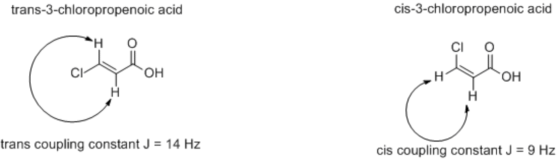
Trans coupling constant which has dihedral angle \(180^{\circ}\) is more than cis coupling constant which has dihedral angle \(0^{\circ}\).
Vicinal Cis alkenyl protons J value is around 10 (range 6-14 hz). and Vicinal trans alkenyl protons J value is around 16 (range11-18 hz).
Hence, the compound which has J value 14 hz is trans 3-chloropropenoic acid, and the compound with J value of 9 hz is cis 3-chloropropenoic acid.
Add Answer to:
The doublets observed for the alkene protons in the NMR spectra of trans-3-chloropropenoic acid and cis-3-chloropropenoic acid have the same chemical shift, but the J value for one is 14 Hz and the other is 9 Hz. Which is the trans acid and which is the c
Predict the 1H NMR chemical shifts and splitting for cis-1-Methoxy-1-buten-3-yne. Estimate the J value between the...
Predict the 1H NMR chemical shifts and splitting for cis-1-Methoxy-1-buten-3-yne. Estimate the J value between the vinylic protons and explain your answer.
v) The resonances at 6.63 and 7.17 have a J of 2 Hz. a. What does...
 v) The resonances at 6.63 and 7.17 have a J of 2 Hz.
a. What does J stand for?
b. What information can you derive from a value of 2?
vi) Based on your spectra above your answer to iv) and v), is
the chemical in the bottle compound A, B or C?
Need help with all of question 3. Thank you :)
QUESTION 3 A chemical bottle has been found in the lab, unfortunately it is incorrectly labelled and...
v) The resonances at 6.63 and 7.17 have a J of 2 Hz.
a. What does J stand for?
b. What information can you derive from a value of 2?
vi) Based on your spectra above your answer to iv) and v), is
the chemical in the bottle compound A, B or C?
Need help with all of question 3. Thank you :)
QUESTION 3 A chemical bottle has been found in the lab, unfortunately it is incorrectly labelled and...
.. Exercise N.5: Spectral Identification Using 'H and 1SC NMR Predict the structure of the organi...
 i need help with these nmr questions
.. Exercise N.5: Spectral Identification Using 'H and 1SC NMR Predict the structure of the organic compounds that give the ill and labeled 5-A through 5-C NMR spectra Problem 5-A δ1.0(3H) δ1,5 (2H) 81.7 (2H) 84.4 (2H) 87.4-8.1 (SH) TMS 'H NMR 85 В.0 75.70 6.5 ea ss so 45 40 36,30,25 20 ia e' as on CDCl TMS 20 10 SoURCE: Reprinted with permission of Aldrich Chemical. 25 20 5 10 CDCH...
i need help with these nmr questions
.. Exercise N.5: Spectral Identification Using 'H and 1SC NMR Predict the structure of the organic compounds that give the ill and labeled 5-A through 5-C NMR spectra Problem 5-A δ1.0(3H) δ1,5 (2H) 81.7 (2H) 84.4 (2H) 87.4-8.1 (SH) TMS 'H NMR 85 В.0 75.70 6.5 ea ss so 45 40 36,30,25 20 ia e' as on CDCl TMS 20 10 SoURCE: Reprinted with permission of Aldrich Chemical. 25 20 5 10 CDCH...
CHOICES: Resonance Form: RF A, RF B, RF C, or, RF A and B The H NMR spectra of amides (1) have some interesting quirks...
 CHOICES: Resonance Form: RF A, RF B, RF C, or, RF A and
B
The H NMR spectra of amides (1) have some interesting quirks. One quirk is that the N-H protons of primary and secondary amides (e.g. 2) are quite broad and appear at relatively high but variable chemical shifts (5-9 ppm). Another "quirk" is that identical N-R groups (e.g R2 groups in 3) can appear at different chemical shifts even though the same groups in a ketone analog...
CHOICES: Resonance Form: RF A, RF B, RF C, or, RF A and
B
The H NMR spectra of amides (1) have some interesting quirks. One quirk is that the N-H protons of primary and secondary amides (e.g. 2) are quite broad and appear at relatively high but variable chemical shifts (5-9 ppm). Another "quirk" is that identical N-R groups (e.g R2 groups in 3) can appear at different chemical shifts even though the same groups in a ketone analog...
PART 3 For each set of data on pages 5-9, calculate and record the degree of...
 PART 3 For each set of data on pages 5-9, calculate and record the degree of unsaturation. Then use your problem solving skills to determine the chemical structure that is consistent with ALL of the data on each page. You are not required to label the spectra (but feel free to do so). This entire assignment is to be completed independently Suggestion for a general method to determine a chemical structure based on the provided molecular formula, IR, H-NMR and...
Only need help with 5,6,7 and mechanism FTIR and NMR Spectra After completing a reaction and...
 Only need help with 5,6,7
and mechanism
FTIR and NMR Spectra After completing a reaction and working up the products, it is still necessary to confirm that the correct product was formed. The most common tools used for this analysis are Fourier Transform Infrared (FTIR) and Nuclear Magnetic Resonance (NMR) spectroscopy. In the virtual laboratory, 'H and C NMR spectra are available. Details on interpreting FTIR and NMR spectra are found in your textbook. Your instructor may or may not...
Only need help with 5,6,7
and mechanism
FTIR and NMR Spectra After completing a reaction and working up the products, it is still necessary to confirm that the correct product was formed. The most common tools used for this analysis are Fourier Transform Infrared (FTIR) and Nuclear Magnetic Resonance (NMR) spectroscopy. In the virtual laboratory, 'H and C NMR spectra are available. Details on interpreting FTIR and NMR spectra are found in your textbook. Your instructor may or may not...
NEED HELP WITH B) C) D) E) F) and G) that apply to the spectra below....
 NEED HELP WITH B) C) D) E) F) and G) that apply to the
spectra below.
OTHER ANSWERS ARE THERE TO SUPPLEMENT
Thank you!
5. Using the GC mentioned in question 4 and the values listed on
the chromatogram for the height and width (at half height) of each
peak, calculate the percent composition for each product (A, B and
C). Be sure to show your work.
Area of peak A = 125 x 8 =
1000mm2
Area of peak...
NEED HELP WITH B) C) D) E) F) and G) that apply to the
spectra below.
OTHER ANSWERS ARE THERE TO SUPPLEMENT
Thank you!
5. Using the GC mentioned in question 4 and the values listed on
the chromatogram for the height and width (at half height) of each
peak, calculate the percent composition for each product (A, B and
C). Be sure to show your work.
Area of peak A = 125 x 8 =
1000mm2
Area of peak...
The IR/spectrum shows the value, 1st photo shows the instructions. Attached are 2 sets of spectra....
 The IR/spectrum shows the value, 1st photo shows the
instructions.
Attached are 2 sets of spectra. Each set is worth 25 points. Not all sets have a Mass Spectrum, but do have information that was obtained from MS and some sets do not have a "C-NMR and don't really need one. Look at each spectrum individually and clearly list and comment on the structural Characteristics you can determine from that spectrum. (Chemical shifts, splitting patterns, coupling constants, fragmentation patterns, absorption...
The IR/spectrum shows the value, 1st photo shows the
instructions.
Attached are 2 sets of spectra. Each set is worth 25 points. Not all sets have a Mass Spectrum, but do have information that was obtained from MS and some sets do not have a "C-NMR and don't really need one. Look at each spectrum individually and clearly list and comment on the structural Characteristics you can determine from that spectrum. (Chemical shifts, splitting patterns, coupling constants, fragmentation patterns, absorption...
(C) Protonation of alkene to form a carbocation followed by addition of bromide ion (D) Addition...
 (C) Protonation of alkene to form a carbocation followed by addition of bromide ion (D) Addition of the proton to one face of the alkene with simultaneous delivery of a bromide ion from a different molecule of H-Br. 11. Which compound is the strongest nmucleophile for reaction of methane methanesulfonate (CHOS0.CH) in methanol at room temperature? (You may assume that everything is soluble in methanol) (A) potassium bromide (B) cesium iodide (C) sodiam chloride (D) lithium flaoride 12. Which proton...
The smallest chemical units of matter are atoms b) molecules c) protons d) neutrons e) electrons...
 The smallest chemical units of matter are atoms b) molecules c) protons d) neutrons e) electrons . Which of the following would have the largest size? a) an atom b) a molecule c) a proton d) a neutron e) an electron 3. Isotopes of an element differ in the number of a) protons in the nucleus b) electrons in the nucleus © neutrons in the nucleus d) electron clouds e) energy levels they contain 4. VO The atomic number represents...
 v) The resonances at 6.63 and 7.17 have a J of 2 Hz.
a. What does J stand for?
b. What information can you derive from a value of 2?
vi) Based on your spectra above your answer to iv) and v), is
the chemical in the bottle compound A, B or C?
Need help with all of question 3. Thank you :)
QUESTION 3 A chemical bottle has been found in the lab, unfortunately it is incorrectly labelled and...
v) The resonances at 6.63 and 7.17 have a J of 2 Hz.
a. What does J stand for?
b. What information can you derive from a value of 2?
vi) Based on your spectra above your answer to iv) and v), is
the chemical in the bottle compound A, B or C?
Need help with all of question 3. Thank you :)
QUESTION 3 A chemical bottle has been found in the lab, unfortunately it is incorrectly labelled and...
 i need help with these nmr questions
.. Exercise N.5: Spectral Identification Using 'H and 1SC NMR Predict the structure of the organic compounds that give the ill and labeled 5-A through 5-C NMR spectra Problem 5-A δ1.0(3H) δ1,5 (2H) 81.7 (2H) 84.4 (2H) 87.4-8.1 (SH) TMS 'H NMR 85 В.0 75.70 6.5 ea ss so 45 40 36,30,25 20 ia e' as on CDCl TMS 20 10 SoURCE: Reprinted with permission of Aldrich Chemical. 25 20 5 10 CDCH...
i need help with these nmr questions
.. Exercise N.5: Spectral Identification Using 'H and 1SC NMR Predict the structure of the organic compounds that give the ill and labeled 5-A through 5-C NMR spectra Problem 5-A δ1.0(3H) δ1,5 (2H) 81.7 (2H) 84.4 (2H) 87.4-8.1 (SH) TMS 'H NMR 85 В.0 75.70 6.5 ea ss so 45 40 36,30,25 20 ia e' as on CDCl TMS 20 10 SoURCE: Reprinted with permission of Aldrich Chemical. 25 20 5 10 CDCH...
 CHOICES: Resonance Form: RF A, RF B, RF C, or, RF A and
B
The H NMR spectra of amides (1) have some interesting quirks. One quirk is that the N-H protons of primary and secondary amides (e.g. 2) are quite broad and appear at relatively high but variable chemical shifts (5-9 ppm). Another "quirk" is that identical N-R groups (e.g R2 groups in 3) can appear at different chemical shifts even though the same groups in a ketone analog...
CHOICES: Resonance Form: RF A, RF B, RF C, or, RF A and
B
The H NMR spectra of amides (1) have some interesting quirks. One quirk is that the N-H protons of primary and secondary amides (e.g. 2) are quite broad and appear at relatively high but variable chemical shifts (5-9 ppm). Another "quirk" is that identical N-R groups (e.g R2 groups in 3) can appear at different chemical shifts even though the same groups in a ketone analog...
 PART 3 For each set of data on pages 5-9, calculate and record the degree of unsaturation. Then use your problem solving skills to determine the chemical structure that is consistent with ALL of the data on each page. You are not required to label the spectra (but feel free to do so). This entire assignment is to be completed independently Suggestion for a general method to determine a chemical structure based on the provided molecular formula, IR, H-NMR and...
 Only need help with 5,6,7
and mechanism
FTIR and NMR Spectra After completing a reaction and working up the products, it is still necessary to confirm that the correct product was formed. The most common tools used for this analysis are Fourier Transform Infrared (FTIR) and Nuclear Magnetic Resonance (NMR) spectroscopy. In the virtual laboratory, 'H and C NMR spectra are available. Details on interpreting FTIR and NMR spectra are found in your textbook. Your instructor may or may not...
Only need help with 5,6,7
and mechanism
FTIR and NMR Spectra After completing a reaction and working up the products, it is still necessary to confirm that the correct product was formed. The most common tools used for this analysis are Fourier Transform Infrared (FTIR) and Nuclear Magnetic Resonance (NMR) spectroscopy. In the virtual laboratory, 'H and C NMR spectra are available. Details on interpreting FTIR and NMR spectra are found in your textbook. Your instructor may or may not...
 NEED HELP WITH B) C) D) E) F) and G) that apply to the
spectra below.
OTHER ANSWERS ARE THERE TO SUPPLEMENT
Thank you!
5. Using the GC mentioned in question 4 and the values listed on
the chromatogram for the height and width (at half height) of each
peak, calculate the percent composition for each product (A, B and
C). Be sure to show your work.
Area of peak A = 125 x 8 =
1000mm2
Area of peak...
NEED HELP WITH B) C) D) E) F) and G) that apply to the
spectra below.
OTHER ANSWERS ARE THERE TO SUPPLEMENT
Thank you!
5. Using the GC mentioned in question 4 and the values listed on
the chromatogram for the height and width (at half height) of each
peak, calculate the percent composition for each product (A, B and
C). Be sure to show your work.
Area of peak A = 125 x 8 =
1000mm2
Area of peak...
 The IR/spectrum shows the value, 1st photo shows the
instructions.
Attached are 2 sets of spectra. Each set is worth 25 points. Not all sets have a Mass Spectrum, but do have information that was obtained from MS and some sets do not have a "C-NMR and don't really need one. Look at each spectrum individually and clearly list and comment on the structural Characteristics you can determine from that spectrum. (Chemical shifts, splitting patterns, coupling constants, fragmentation patterns, absorption...
The IR/spectrum shows the value, 1st photo shows the
instructions.
Attached are 2 sets of spectra. Each set is worth 25 points. Not all sets have a Mass Spectrum, but do have information that was obtained from MS and some sets do not have a "C-NMR and don't really need one. Look at each spectrum individually and clearly list and comment on the structural Characteristics you can determine from that spectrum. (Chemical shifts, splitting patterns, coupling constants, fragmentation patterns, absorption...
 (C) Protonation of alkene to form a carbocation followed by addition of bromide ion (D) Addition of the proton to one face of the alkene with simultaneous delivery of a bromide ion from a different molecule of H-Br. 11. Which compound is the strongest nmucleophile for reaction of methane methanesulfonate (CHOS0.CH) in methanol at room temperature? (You may assume that everything is soluble in methanol) (A) potassium bromide (B) cesium iodide (C) sodiam chloride (D) lithium flaoride 12. Which proton...
 The smallest chemical units of matter are atoms b) molecules c) protons d) neutrons e) electrons . Which of the following would have the largest size? a) an atom b) a molecule c) a proton d) a neutron e) an electron 3. Isotopes of an element differ in the number of a) protons in the nucleus b) electrons in the nucleus © neutrons in the nucleus d) electron clouds e) energy levels they contain 4. VO The atomic number represents...
Most questions answered within 3 hours.
-
Where is the error in this code sequence?
String s1 = "Hello";
String s2 = "ello";...
asked 10 months ago -
Financial data for Joel de Paris, Inc., for last year
follow:
Joel de Paris, Inc.
Balance...
asked 10 months ago -
Consider this reaction:
Al2(SO4)3 (aq)+ BaCl3
(aq) Al2Cl6 (aq)- +
3BaSO4(s) . What is the...
asked 10 months ago -
Suppose that Savneet is considering increasing her
recent random sample from 20 car rentals to 40...
asked 10 months ago -
Trucks arrive at an unloading terminal at an average rate of 120
per hour.
Trucks arrive...
asked 10 months ago -
Why are methanol and ethanol completely soluble in water while
octanol is not very little soluble....
asked 10 months ago -
A facilities manager at a university reads in a research report
that the mean amount of...
asked 10 months ago -
When the CuSO4 is rehydrated by adding water to the anhydrous
compound, is this an endothermic...
asked 10 months ago -
A ray of sunlight is passing from diamond into crown glass; the
angle of incidence is...
asked 10 months ago -
A block of mass 0.249 kg is placed on top of a light, vertical
spring of...
asked 10 months ago -
how do the kidneys compensate in the presences of acidosis
a) trigger hyperventilate
b) reserve acid...
asked 10 months ago -
Question 501 pts
The rental rate of capital to the firm increases. Which of the
following...
asked 10 months ago