Lipolysis: A. is stimulated by insulin. B. is inhibited by glucagon. C. requires the action of...
Lipolysis:
A. is stimulated by insulin.
B. is inhibited by glucagon.
C. requires the action of hormone-sensitive lipase.
D. requires an apolipoprotein.
E. results in an increase in blood concentrations of esterified fatty acids.
Which one of the following compounds is a COMMON intermediate in the beta-oxidation of fatty acids, ketogenesis and cholesterogenesis?
A. mevalonic acid
B. acetoacetic acid
C. acetoacetyl-CoA
D. beta-hydroxy-beta-methylglutaryl-CoA
E. malonyl-CoA
If the fatty acid 9-18:1 undergoes two successive chain elongations, the resulting product is:
A. 13-22:1
B. 13-20:1
C. 9-20:1
D. 5-22:1
E. 15-22:1
Homework Answers
(A) In lipolysis usually lipids are detached from the carrier of lipoproteins by the right activity of lipoprotein Lipase.
The option 3rd is correct one.
(B) The common intermediate in these three Beta oxidation of fatty acid, ketogenesis, cholesterogenesis are beta- hydroxy beta- methylglutaryl- CoA (HMG-CoA).
During the reaction this intermediate is formed in between all these three , which is cleaved to free acetoacetate and acetyl- CoA .
Therefore, the correct option is D
(C) Questions should have more information for proper answering.
Add Answer to:
Lipolysis:
A. is stimulated by insulin.
B. is inhibited by glucagon.
C. requires the action of...
Insert numbers from the answer list below into the sentence's blanks to correct the statement. Enzyme...
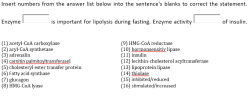 Insert numbers from the answer list below into the sentence's blanks to correct the statement. Enzyme is important for lipolysis during fasting. Enzyme activity of insulin. (1) acetyl-CoA carboxylase (2) acyl-CoA synthetase (3) adrenalin (4) carnitin palmitoyltransferasel (5) cholesteryl ester transfer protein (6) Fatty acid synthase (7) glucagon (8) HMG-CoA lyase (9) HMG-CoA reductase (10) hormonsensitiv lipase (11) insulin (12) lecithin-cholesterol acyltransferase (13) lipoprotein lipase (14) thiolase (15) inhibited/reduced (16) stimulated/increased
Insert numbers from the answer list below into the paragraph's blanks to correct the statement. The...
 Insert numbers from the answer list below into the paragraph's blanks to correct the statement. The flow of fatty acids through the triacylglycerol (TAG) cycle acute of the hormone insulin in particular through the effect of the hormone on the enzymel (1) acetyl-CoA carboxylase (2) acyl-CoA synthetase (3) Adrenaline (4) carnitin palmitoyltransferase (5) cholesteryl ester transfer protein (6) fatty acid synthase (7) Glucagon (8) HMG-CoA lyase (9) HMG-CoA reductase (10) hormonal lipase (11) Insulin (12) lecithin-cholesterol acyltransferase (13) lipoprotein lipase...
Insert numbers from the answer list below into the sentence's blank fields so that the sentence...
 Insert numbers from the answer list below into the sentence's blank fields so that the sentence becomes correct. The enzyme enzyme activity is important for the release of fatty acids of VLDL particles during fasting. The of insulin. (1) acetyl-CoA carboxylase (2) acyl-CoA synthetase (3) adrenalin (4) carnitin palmitoyltransferase (5) cholesteryl ester transfer protein (6) fatty acid synthase (7) Glucagon (8) HMG-CoA lyase (9) HMG-CoA reductase (10) hormonal lipase (11) Insulin (12) lecithin-cholesterol acyltransferase (13) lipoprotein lipase (14) thiolase (15)...
7- Oxidation of fatty acids occure in: A. Mitochondria B. Endoplasmic reticulum C. Lysosome D. Cell...
7- Oxidation of fatty acids occure in: A. Mitochondria B. Endoplasmic reticulum C. Lysosome D. Cell Membrane 8- End product of B-oxidation of fatty acid with even number of carbon atoms is: A- a-keto glutarate B- Propionyl CoA C- Acetoacetyl CoA D- Acetyl CoA 9- How many ATP molecules produces from B-oxidation of palmitylCoA? A.109 B. 129 C. 24 D. 38 ● 10- How many ATP molecules produces from one turn of B-oxidation ? A- 109 B. 129 C. 5 ...
Easy question, 30 min timed assignment, please answer ASAP, thanks. 1. Glycerol from hydrolysis of triacylglycerols...
 Easy question, 30 min timed assignment, please answer ASAP,
thanks.
1. Glycerol from hydrolysis of triacylglycerols enters gluconeogenesis at. a. glyceraldehyde-3-phosphate. b. dihydroxyacetone phosphate. c. 1,3-bisphosphoglycerate. d. 3-phosphoglycerate. e. 2-phosphoglycerate. or tissue prefers to use ketone bodies such as acetoacetate as a source of fuel instead of glucose? a. heart muscle c. brain d. liver e. stomach b. adrenal cortex 3. The key enzyme in glycogen degradation is a. glycogen phosphatase. b. glycogen hydrolase. c. glycogen phosphorylase A d. glycogen...
Easy question, 30 min timed assignment, please answer ASAP,
thanks.
1. Glycerol from hydrolysis of triacylglycerols enters gluconeogenesis at. a. glyceraldehyde-3-phosphate. b. dihydroxyacetone phosphate. c. 1,3-bisphosphoglycerate. d. 3-phosphoglycerate. e. 2-phosphoglycerate. or tissue prefers to use ketone bodies such as acetoacetate as a source of fuel instead of glucose? a. heart muscle c. brain d. liver e. stomach b. adrenal cortex 3. The key enzyme in glycogen degradation is a. glycogen phosphatase. b. glycogen hydrolase. c. glycogen phosphorylase A d. glycogen...
Can someone please check my answers and aid in #12? 1. The amide nitrogen of glutamine:...
Can someone please check my answers and aid in #12? 1. The amide nitrogen of glutamine: A. represents a nontoxic transport form of ammonia. B. is a major source of ammonia for urinary excretion. C. is used in the synthesis of asparagine, purines, and pynimidines. D. can be recovered as ammonia by the action of glutaminase. E. all of the above are correct. 2- Which of the following statements about glutamate is NOT true: a It can be synthesized in...
1. Which of the following is not considered a nutrient a Vitamin B. Water c.Carbohydrate (d)...
 1. Which of the following is not considered a nutrient a Vitamin B. Water c.Carbohydrate (d) Alcohol e Mineral 2. For which of the following causes of death does a person's diet play a part? a. Lung disease (6) Cancer Chronic lower respiratory diseases d. Infections of the blood e AIDS 3. Researchers repeatedly report that people who consume a variety of foods such as fruits, vegetables, legumes, nuts, and whole grains have reduced risks of which of the following...
Please complete for Tuesday, we will go through the questions and mark them in class. pg 156 - 4.23,...
 Please complete for Tuesday, we will go through the questions and mark them in class. pg 156 - 4.23, 4.24, 4.26 pg 170 - 4.29, 4.31, pg 171-4.36 pg 175 - 4.59 pg 176- 4.74, 4.75, 4.80 pg 177-4.81, 4.82 pg 188- 5.1, 5.4, 5.5, 5.6, 5.11 - Using Table 5.1 pg 198-5.22, 5.25 pg 203 - 5.29 pg 206 - 5.37 pg 209 - 5.39 pg 2.14 5.61 pg 235-6.11, 6.14, 6.16 156 CHAPTER 4 Introduction to Organic Compounds...
1. According to the paper, what does lactate dehydrogenase (LDH) do and what does it allow...
 1. According to the paper, what does lactate dehydrogenase
(LDH) do and what does it allow to happen within the myofiber? (5
points)
2. According to the paper, what is the major disadvantage of
relying on glycolysis during high-intensity exercise? (5
points)
3. Using Figure 1 in the paper, briefly describe the different
sources of ATP production at 50% versus 90% AND explain whether you
believe this depiction of ATP production applies to a Type IIX
myofiber in a human....
1. According to the paper, what does lactate dehydrogenase
(LDH) do and what does it allow to happen within the myofiber? (5
points)
2. According to the paper, what is the major disadvantage of
relying on glycolysis during high-intensity exercise? (5
points)
3. Using Figure 1 in the paper, briefly describe the different
sources of ATP production at 50% versus 90% AND explain whether you
believe this depiction of ATP production applies to a Type IIX
myofiber in a human....
 Insert numbers from the answer list below into the sentence's blanks to correct the statement. Enzyme is important for lipolysis during fasting. Enzyme activity of insulin. (1) acetyl-CoA carboxylase (2) acyl-CoA synthetase (3) adrenalin (4) carnitin palmitoyltransferasel (5) cholesteryl ester transfer protein (6) Fatty acid synthase (7) glucagon (8) HMG-CoA lyase (9) HMG-CoA reductase (10) hormonsensitiv lipase (11) insulin (12) lecithin-cholesterol acyltransferase (13) lipoprotein lipase (14) thiolase (15) inhibited/reduced (16) stimulated/increased
 Insert numbers from the answer list below into the paragraph's blanks to correct the statement. The flow of fatty acids through the triacylglycerol (TAG) cycle acute of the hormone insulin in particular through the effect of the hormone on the enzymel (1) acetyl-CoA carboxylase (2) acyl-CoA synthetase (3) Adrenaline (4) carnitin palmitoyltransferase (5) cholesteryl ester transfer protein (6) fatty acid synthase (7) Glucagon (8) HMG-CoA lyase (9) HMG-CoA reductase (10) hormonal lipase (11) Insulin (12) lecithin-cholesterol acyltransferase (13) lipoprotein lipase...
 Insert numbers from the answer list below into the sentence's blank fields so that the sentence becomes correct. The enzyme enzyme activity is important for the release of fatty acids of VLDL particles during fasting. The of insulin. (1) acetyl-CoA carboxylase (2) acyl-CoA synthetase (3) adrenalin (4) carnitin palmitoyltransferase (5) cholesteryl ester transfer protein (6) fatty acid synthase (7) Glucagon (8) HMG-CoA lyase (9) HMG-CoA reductase (10) hormonal lipase (11) Insulin (12) lecithin-cholesterol acyltransferase (13) lipoprotein lipase (14) thiolase (15)...
 Easy question, 30 min timed assignment, please answer ASAP,
thanks.
1. Glycerol from hydrolysis of triacylglycerols enters gluconeogenesis at. a. glyceraldehyde-3-phosphate. b. dihydroxyacetone phosphate. c. 1,3-bisphosphoglycerate. d. 3-phosphoglycerate. e. 2-phosphoglycerate. or tissue prefers to use ketone bodies such as acetoacetate as a source of fuel instead of glucose? a. heart muscle c. brain d. liver e. stomach b. adrenal cortex 3. The key enzyme in glycogen degradation is a. glycogen phosphatase. b. glycogen hydrolase. c. glycogen phosphorylase A d. glycogen...
Easy question, 30 min timed assignment, please answer ASAP,
thanks.
1. Glycerol from hydrolysis of triacylglycerols enters gluconeogenesis at. a. glyceraldehyde-3-phosphate. b. dihydroxyacetone phosphate. c. 1,3-bisphosphoglycerate. d. 3-phosphoglycerate. e. 2-phosphoglycerate. or tissue prefers to use ketone bodies such as acetoacetate as a source of fuel instead of glucose? a. heart muscle c. brain d. liver e. stomach b. adrenal cortex 3. The key enzyme in glycogen degradation is a. glycogen phosphatase. b. glycogen hydrolase. c. glycogen phosphorylase A d. glycogen...
 1. Which of the following is not considered a nutrient a Vitamin B. Water c.Carbohydrate (d) Alcohol e Mineral 2. For which of the following causes of death does a person's diet play a part? a. Lung disease (6) Cancer Chronic lower respiratory diseases d. Infections of the blood e AIDS 3. Researchers repeatedly report that people who consume a variety of foods such as fruits, vegetables, legumes, nuts, and whole grains have reduced risks of which of the following...
 Please complete for Tuesday, we will go through the questions and mark them in class. pg 156 - 4.23, 4.24, 4.26 pg 170 - 4.29, 4.31, pg 171-4.36 pg 175 - 4.59 pg 176- 4.74, 4.75, 4.80 pg 177-4.81, 4.82 pg 188- 5.1, 5.4, 5.5, 5.6, 5.11 - Using Table 5.1 pg 198-5.22, 5.25 pg 203 - 5.29 pg 206 - 5.37 pg 209 - 5.39 pg 2.14 5.61 pg 235-6.11, 6.14, 6.16 156 CHAPTER 4 Introduction to Organic Compounds...
 1. According to the paper, what does lactate dehydrogenase
(LDH) do and what does it allow to happen within the myofiber? (5
points)
2. According to the paper, what is the major disadvantage of
relying on glycolysis during high-intensity exercise? (5
points)
3. Using Figure 1 in the paper, briefly describe the different
sources of ATP production at 50% versus 90% AND explain whether you
believe this depiction of ATP production applies to a Type IIX
myofiber in a human....
1. According to the paper, what does lactate dehydrogenase
(LDH) do and what does it allow to happen within the myofiber? (5
points)
2. According to the paper, what is the major disadvantage of
relying on glycolysis during high-intensity exercise? (5
points)
3. Using Figure 1 in the paper, briefly describe the different
sources of ATP production at 50% versus 90% AND explain whether you
believe this depiction of ATP production applies to a Type IIX
myofiber in a human....
Most questions answered within 3 hours.
-
Where is the error in this code sequence?
String s1 = "Hello";
String s2 = "ello";...
asked 11 months ago -
Financial data for Joel de Paris, Inc., for last year
follow:
Joel de Paris, Inc.
Balance...
asked 11 months ago -
Consider this reaction:
Al2(SO4)3 (aq)+ BaCl3
(aq) Al2Cl6 (aq)- +
3BaSO4(s) . What is the...
asked 11 months ago -
Suppose that Savneet is considering increasing her
recent random sample from 20 car rentals to 40...
asked 11 months ago -
Trucks arrive at an unloading terminal at an average rate of 120
per hour.
Trucks arrive...
asked 11 months ago -
Why are methanol and ethanol completely soluble in water while
octanol is not very little soluble....
asked 11 months ago -
A facilities manager at a university reads in a research report
that the mean amount of...
asked 11 months ago -
When the CuSO4 is rehydrated by adding water to the anhydrous
compound, is this an endothermic...
asked 11 months ago -
A ray of sunlight is passing from diamond into crown glass; the
angle of incidence is...
asked 11 months ago -
A block of mass 0.249 kg is placed on top of a light, vertical
spring of...
asked 11 months ago -
how do the kidneys compensate in the presences of acidosis
a) trigger hyperventilate
b) reserve acid...
asked 11 months ago -
Question 501 pts
The rental rate of capital to the firm increases. Which of the
following...
asked 11 months ago