
Homework Answers
Add Answer to:
Can you please detailed the answer and the calculations as if
it would it be for...
Can someone give step by step calculations with neat hand writing please. 2 other 2. (25...
 Can someone give step by step calculations with neat
hand writing please.
2 other 2. (25 points) Calculate the values of Gibbs free energy change for the reduction of iron ore with hydrogen gas: page Fe2O3(s) + 3 H2(g) = 2 Fe(s) + 3 H2O®)isk for Thermodynamic properties at 25 °C 6° -4° - TAS Fe2O3(s) React HQ React Fes) for H2O Prod AH®, kJ/mol -824.2 0 . 0 -241.8 IS, J/(mol·K) 87.4 130.6 27.3 188.8 Is process spontaneous at...
Can someone give step by step calculations with neat
hand writing please.
2 other 2. (25 points) Calculate the values of Gibbs free energy change for the reduction of iron ore with hydrogen gas: page Fe2O3(s) + 3 H2(g) = 2 Fe(s) + 3 H2O®)isk for Thermodynamic properties at 25 °C 6° -4° - TAS Fe2O3(s) React HQ React Fes) for H2O Prod AH®, kJ/mol -824.2 0 . 0 -241.8 IS, J/(mol·K) 87.4 130.6 27.3 188.8 Is process spontaneous at...
Determine the value of AG for the following reaction: Fe2O3 (s) + 3 H2(g) → 2...
 Determine the value of AG for the following reaction: Fe2O3 (s) + 3 H2(g) → 2 Fe(s) + 3 H2O(g) Fe2O3(s) H2(g) Fe(s) H2O(g) AHf (kJ/mol) -824.2 0 0 -241.8 Sº (J/K mol) 87.4 130.6 27.3 188.8
Exothermic welding is a chemically driven process for producing molten metal. One of the oldest forms of welding, it is...
 Exothermic welding is a chemically driven process for producing molten metal. One of the oldest forms of welding, it is still used for joining train lines. A mixture of iron (III) oxide (Fe203) and aluminium (Al) is employed, which upon activation undergoes the following chemical reaction Fe203(s) 2 Al(s) Al2O3(s) + 2 Fe(s) (a) (3 marks) Using the thermodynamic data provided, calculate the heat released by this process (b) (5 marks) Estimate the final temperature of the mixture, stating any...
Question 5 5 pts Calculate the standard free energy change for the reduction of Fe, o,...
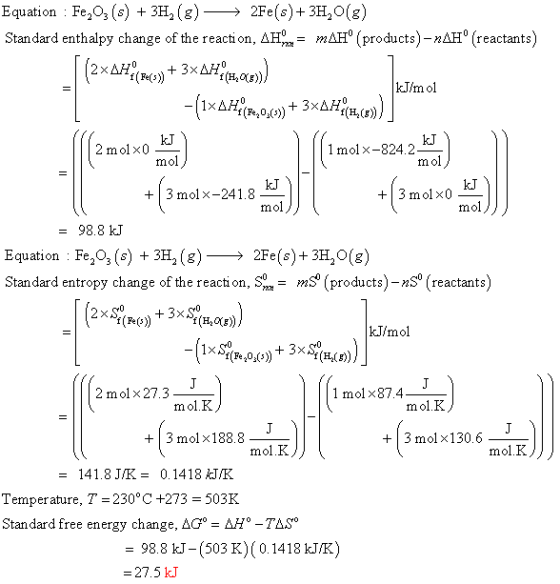
 Question 5 5 pts Calculate the standard free energy change for the reduction of Fe, o, by hydrogen to produce iron metal and water vapor at 230 °C using the data provided. AHF,0, --8242 KJ-mol-1 AHH,0 = -2418 kJ mol S298 Fe30,- 874 ) mol%. S998 H2 - 130.6 mol S98 Fe - 27.3 J-molk! S%99H20 - 188.7 J-mol-K a. 98.8 kJ b. 142JK C.-7.13 x 10ºkJ d. 27.4k
can you answe both 1 and 2 with all work 1. The Ksp for Ba(103)2 is...
 can you answe both 1 and 2 with all work
1. The Ksp for Ba(103)2 is 6.0 x 10⁻¹⁰ at 25°C. What is the solubility of this salt in water in grams per liter. (10 pts) 2. Iron(III) oxide can be reduced by carbon monoxide. Fe,O3(s) + 3CO(g) 2Fe(s) + 3C02(g) Use the following thermodynamic data at 298 K to determine the AGº and the equilibrium constant (Kc) at 350 K. (12 pts) Substance: Fe 0,(s) CO(g) Fe(s) CO(g) AH”...
can you answe both 1 and 2 with all work
1. The Ksp for Ba(103)2 is 6.0 x 10⁻¹⁰ at 25°C. What is the solubility of this salt in water in grams per liter. (10 pts) 2. Iron(III) oxide can be reduced by carbon monoxide. Fe,O3(s) + 3CO(g) 2Fe(s) + 3C02(g) Use the following thermodynamic data at 298 K to determine the AGº and the equilibrium constant (Kc) at 350 K. (12 pts) Substance: Fe 0,(s) CO(g) Fe(s) CO(g) AH”...
Calculate the standard change in Gibbs free energy for the reaction at 25 °C. Standard Gibbs...
 Calculate the standard change in Gibbs free energy for the reaction at 25 °C. Standard Gibbs free energy of formation values can be found in this table. 3H2(g) + Fe,0,($) 2Fe(s) + 3 H,0 () AGran kJ/mol Thermodynamic Properties at 298 K S° Substance Ag(s) Ag+(aq) Ag2O(s) Ag2S(s) AgBr(s) AgCl(s) AgI(S) AgNO3(s) Al(s) Al2O3(s) AlCl3(s) Ar(9) As(s) As2O5(s) AsCl3(1) Au(s) Ba(s) BaCl2(s) BaCO3(s) Bao(s) BaSO4(s) B(s) B203(s) AH kJ/mol 0 105.8 -31.1 -32.6 -100.4 -127.0 -61.8 -124.4 0 -1675.7 -704.2...
please answer 17a,b,c 17. Using values for the standard enthalpies of formation (AHY) and standard molar...
 please answer 17a,b,c
17. Using values for the standard enthalpies of formation (AHY) and standard molar entropy (AS on the Appendix, calculate the following thermodynamic values for the complete combustion of ethanol: (10 points) C2H5OH(g) + 302(g) → 2CO2(g) + 3H2O(g) a) The standard enthalpy change (AHº) b) The standard entropy change (AS) c) Use values from a) and b) above to calculate AG° at 298K Formula SU/(K-mol 160 TABLE 16.1 Standard Molar Entropies for Some Common Substances at 25...
please answer 17a,b,c
17. Using values for the standard enthalpies of formation (AHY) and standard molar entropy (AS on the Appendix, calculate the following thermodynamic values for the complete combustion of ethanol: (10 points) C2H5OH(g) + 302(g) → 2CO2(g) + 3H2O(g) a) The standard enthalpy change (AHº) b) The standard entropy change (AS) c) Use values from a) and b) above to calculate AG° at 298K Formula SU/(K-mol 160 TABLE 16.1 Standard Molar Entropies for Some Common Substances at 25...
please answer these 3 questions 1. 2. 3. Part A Ammonia can also be synthesized by...
 please answer these 3 questions
1. 2.
3.
Part A Ammonia can also be synthesized by the reaction: 3H2(g) + N2(g) +2NH3(g) What is the theoretical yield of ammonia, in kilograms, that we can synthesize from 5.27 kg of H2 and 34.9 kg of N2? VAED ? theoretical yield of NH3 = kg Submit Request Answer Review | Constants I Periodic lable Mining companies use this reaction to obtain iron from iron ore: Fe2O3(s) +3CO(g) + 2Fe(s) + 3CO2(g) Part...
please answer these 3 questions
1. 2.
3.
Part A Ammonia can also be synthesized by the reaction: 3H2(g) + N2(g) +2NH3(g) What is the theoretical yield of ammonia, in kilograms, that we can synthesize from 5.27 kg of H2 and 34.9 kg of N2? VAED ? theoretical yield of NH3 = kg Submit Request Answer Review | Constants I Periodic lable Mining companies use this reaction to obtain iron from iron ore: Fe2O3(s) +3CO(g) + 2Fe(s) + 3CO2(g) Part...
could someone please answer and explain the questions please!! #’s 7,8,9,13,14,17,18,19,20 please and thank you What...
 could someone please answer and explain the questions please!!
#’s 7,8,9,13,14,17,18,19,20
please and thank you
What is the oxidation number for the underlined manganese (A)1 (B)2 (C)4(D)(E)7 When balancing the below half-reaction in 8. Which of the following is true concerning a 1. vanic cc A) Oxidation occurs at the cathode and is (B) Oxidation occurs at the anode and is where anions move towards 2. acidic sol electrons are added to ution, where anions move towards side of.the.cquation. where...
could someone please answer and explain the questions please!!
#’s 7,8,9,13,14,17,18,19,20
please and thank you
What is the oxidation number for the underlined manganese (A)1 (B)2 (C)4(D)(E)7 When balancing the below half-reaction in 8. Which of the following is true concerning a 1. vanic cc A) Oxidation occurs at the cathode and is (B) Oxidation occurs at the anode and is where anions move towards 2. acidic sol electrons are added to ution, where anions move towards side of.the.cquation. where...
Chapter 5 and Chapter 10 Problem solving (please practice the following questions and make sure that you understand...
 Chapter 5 and Chapter 10 Problem solving (please practice the following questions and make sure that you understand the principles behind: you can find Ar from textbook or website I. A 145 g sample of copper metal at 100.0°C is placed into 250.0 g of water at 25.0°C in a calorimeter. When the system reaches thermal equilibrium, the temperature of the water in the calorimeter is 28.8°C. Assume the calorimeter is perfectly insulated. What is the specific heat capacity of...
 Can someone give step by step calculations with neat
hand writing please.
2 other 2. (25 points) Calculate the values of Gibbs free energy change for the reduction of iron ore with hydrogen gas: page Fe2O3(s) + 3 H2(g) = 2 Fe(s) + 3 H2O®)isk for Thermodynamic properties at 25 °C 6° -4° - TAS Fe2O3(s) React HQ React Fes) for H2O Prod AH®, kJ/mol -824.2 0 . 0 -241.8 IS, J/(mol·K) 87.4 130.6 27.3 188.8 Is process spontaneous at...
Can someone give step by step calculations with neat
hand writing please.
2 other 2. (25 points) Calculate the values of Gibbs free energy change for the reduction of iron ore with hydrogen gas: page Fe2O3(s) + 3 H2(g) = 2 Fe(s) + 3 H2O®)isk for Thermodynamic properties at 25 °C 6° -4° - TAS Fe2O3(s) React HQ React Fes) for H2O Prod AH®, kJ/mol -824.2 0 . 0 -241.8 IS, J/(mol·K) 87.4 130.6 27.3 188.8 Is process spontaneous at...
 Determine the value of AG for the following reaction: Fe2O3 (s) + 3 H2(g) → 2 Fe(s) + 3 H2O(g) Fe2O3(s) H2(g) Fe(s) H2O(g) AHf (kJ/mol) -824.2 0 0 -241.8 Sº (J/K mol) 87.4 130.6 27.3 188.8
 Exothermic welding is a chemically driven process for producing molten metal. One of the oldest forms of welding, it is still used for joining train lines. A mixture of iron (III) oxide (Fe203) and aluminium (Al) is employed, which upon activation undergoes the following chemical reaction Fe203(s) 2 Al(s) Al2O3(s) + 2 Fe(s) (a) (3 marks) Using the thermodynamic data provided, calculate the heat released by this process (b) (5 marks) Estimate the final temperature of the mixture, stating any...
 Question 5 5 pts Calculate the standard free energy change for the reduction of Fe, o, by hydrogen to produce iron metal and water vapor at 230 °C using the data provided. AHF,0, --8242 KJ-mol-1 AHH,0 = -2418 kJ mol S298 Fe30,- 874 ) mol%. S998 H2 - 130.6 mol S98 Fe - 27.3 J-molk! S%99H20 - 188.7 J-mol-K a. 98.8 kJ b. 142JK C.-7.13 x 10ºkJ d. 27.4k
 can you answe both 1 and 2 with all work
1. The Ksp for Ba(103)2 is 6.0 x 10⁻¹⁰ at 25°C. What is the solubility of this salt in water in grams per liter. (10 pts) 2. Iron(III) oxide can be reduced by carbon monoxide. Fe,O3(s) + 3CO(g) 2Fe(s) + 3C02(g) Use the following thermodynamic data at 298 K to determine the AGº and the equilibrium constant (Kc) at 350 K. (12 pts) Substance: Fe 0,(s) CO(g) Fe(s) CO(g) AH”...
can you answe both 1 and 2 with all work
1. The Ksp for Ba(103)2 is 6.0 x 10⁻¹⁰ at 25°C. What is the solubility of this salt in water in grams per liter. (10 pts) 2. Iron(III) oxide can be reduced by carbon monoxide. Fe,O3(s) + 3CO(g) 2Fe(s) + 3C02(g) Use the following thermodynamic data at 298 K to determine the AGº and the equilibrium constant (Kc) at 350 K. (12 pts) Substance: Fe 0,(s) CO(g) Fe(s) CO(g) AH”...
 Calculate the standard change in Gibbs free energy for the reaction at 25 °C. Standard Gibbs free energy of formation values can be found in this table. 3H2(g) + Fe,0,($) 2Fe(s) + 3 H,0 () AGran kJ/mol Thermodynamic Properties at 298 K S° Substance Ag(s) Ag+(aq) Ag2O(s) Ag2S(s) AgBr(s) AgCl(s) AgI(S) AgNO3(s) Al(s) Al2O3(s) AlCl3(s) Ar(9) As(s) As2O5(s) AsCl3(1) Au(s) Ba(s) BaCl2(s) BaCO3(s) Bao(s) BaSO4(s) B(s) B203(s) AH kJ/mol 0 105.8 -31.1 -32.6 -100.4 -127.0 -61.8 -124.4 0 -1675.7 -704.2...
 please answer 17a,b,c
17. Using values for the standard enthalpies of formation (AHY) and standard molar entropy (AS on the Appendix, calculate the following thermodynamic values for the complete combustion of ethanol: (10 points) C2H5OH(g) + 302(g) → 2CO2(g) + 3H2O(g) a) The standard enthalpy change (AHº) b) The standard entropy change (AS) c) Use values from a) and b) above to calculate AG° at 298K Formula SU/(K-mol 160 TABLE 16.1 Standard Molar Entropies for Some Common Substances at 25...
please answer 17a,b,c
17. Using values for the standard enthalpies of formation (AHY) and standard molar entropy (AS on the Appendix, calculate the following thermodynamic values for the complete combustion of ethanol: (10 points) C2H5OH(g) + 302(g) → 2CO2(g) + 3H2O(g) a) The standard enthalpy change (AHº) b) The standard entropy change (AS) c) Use values from a) and b) above to calculate AG° at 298K Formula SU/(K-mol 160 TABLE 16.1 Standard Molar Entropies for Some Common Substances at 25...
 please answer these 3 questions
1. 2.
3.
Part A Ammonia can also be synthesized by the reaction: 3H2(g) + N2(g) +2NH3(g) What is the theoretical yield of ammonia, in kilograms, that we can synthesize from 5.27 kg of H2 and 34.9 kg of N2? VAED ? theoretical yield of NH3 = kg Submit Request Answer Review | Constants I Periodic lable Mining companies use this reaction to obtain iron from iron ore: Fe2O3(s) +3CO(g) + 2Fe(s) + 3CO2(g) Part...
please answer these 3 questions
1. 2.
3.
Part A Ammonia can also be synthesized by the reaction: 3H2(g) + N2(g) +2NH3(g) What is the theoretical yield of ammonia, in kilograms, that we can synthesize from 5.27 kg of H2 and 34.9 kg of N2? VAED ? theoretical yield of NH3 = kg Submit Request Answer Review | Constants I Periodic lable Mining companies use this reaction to obtain iron from iron ore: Fe2O3(s) +3CO(g) + 2Fe(s) + 3CO2(g) Part...
 could someone please answer and explain the questions please!!
#’s 7,8,9,13,14,17,18,19,20
please and thank you
What is the oxidation number for the underlined manganese (A)1 (B)2 (C)4(D)(E)7 When balancing the below half-reaction in 8. Which of the following is true concerning a 1. vanic cc A) Oxidation occurs at the cathode and is (B) Oxidation occurs at the anode and is where anions move towards 2. acidic sol electrons are added to ution, where anions move towards side of.the.cquation. where...
could someone please answer and explain the questions please!!
#’s 7,8,9,13,14,17,18,19,20
please and thank you
What is the oxidation number for the underlined manganese (A)1 (B)2 (C)4(D)(E)7 When balancing the below half-reaction in 8. Which of the following is true concerning a 1. vanic cc A) Oxidation occurs at the cathode and is (B) Oxidation occurs at the anode and is where anions move towards 2. acidic sol electrons are added to ution, where anions move towards side of.the.cquation. where...
 Chapter 5 and Chapter 10 Problem solving (please practice the following questions and make sure that you understand the principles behind: you can find Ar from textbook or website I. A 145 g sample of copper metal at 100.0°C is placed into 250.0 g of water at 25.0°C in a calorimeter. When the system reaches thermal equilibrium, the temperature of the water in the calorimeter is 28.8°C. Assume the calorimeter is perfectly insulated. What is the specific heat capacity of...
Most questions answered within 3 hours.
-
Where is the error in this code sequence?
String s1 = "Hello";
String s2 = "ello";...
asked 10 months ago -
Financial data for Joel de Paris, Inc., for last year
follow:
Joel de Paris, Inc.
Balance...
asked 10 months ago -
Consider this reaction:
Al2(SO4)3 (aq)+ BaCl3
(aq) Al2Cl6 (aq)- +
3BaSO4(s) . What is the...
asked 10 months ago -
Suppose that Savneet is considering increasing her
recent random sample from 20 car rentals to 40...
asked 10 months ago -
Trucks arrive at an unloading terminal at an average rate of 120
per hour.
Trucks arrive...
asked 10 months ago -
Why are methanol and ethanol completely soluble in water while
octanol is not very little soluble....
asked 10 months ago -
A facilities manager at a university reads in a research report
that the mean amount of...
asked 10 months ago -
When the CuSO4 is rehydrated by adding water to the anhydrous
compound, is this an endothermic...
asked 10 months ago -
A ray of sunlight is passing from diamond into crown glass; the
angle of incidence is...
asked 10 months ago -
A block of mass 0.249 kg is placed on top of a light, vertical
spring of...
asked 10 months ago -
how do the kidneys compensate in the presences of acidosis
a) trigger hyperventilate
b) reserve acid...
asked 10 months ago -
Question 501 pts
The rental rate of capital to the firm increases. Which of the
following...
asked 10 months ago