
Homework Answers

Add Answer to:
In the circuit shown, the charge on the capacitor as a function of time is given...
A four Capacitor circuit A four-capacitor circuit is chargcd by a battery, as shown in the...
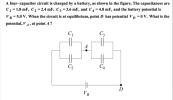 A four Capacitor circuit
A four-capacitor circuit is chargcd by a battery, as shown in the figure. The capacitances are C_1 = 1.8 mF, C_2 = 1.4 mF, C_3 = 3.6 mF, and C_4 = 4.8 mF, and the battery potential is V_B = 5.0 V. When the circuit is at equilibrium, point D has potential V_D = 0 V. What is the potential, V_A , at point A ?
A four Capacitor circuit
A four-capacitor circuit is chargcd by a battery, as shown in the figure. The capacitances are C_1 = 1.8 mF, C_2 = 1.4 mF, C_3 = 3.6 mF, and C_4 = 4.8 mF, and the battery potential is V_B = 5.0 V. When the circuit is at equilibrium, point D has potential V_D = 0 V. What is the potential, V_A , at point A ?
Question 4: RC Circuit: a) Charging capacitor: A simple RC circuit is given in Figure 4a....
 Question 4: RC Circuit: a) Charging capacitor: A simple RC circuit is given in Figure 4a. The capacitor is empty initially and switch was open for a long time. 4E, (V) EMF is used to charge the capacitor as switch is closed at t=0s. By using Kirchhoff's voltage law and Ohm's law that you learned so far, analyze this circuit and find the unknowns given below. 1)At t=0s. draw the equivalent circuit and find v. (Os), i. (Os), i (Os),...
Q2. In the RC Circuit shown in Figure 2, the capacitor is initially uncharged (at time...
 Q2. In the RC Circuit shown in Figure 2, the capacitor is
initially uncharged (at time t=0).
2- In the RC Circuit shown in Figure 2, the capacitor is initially uncharged (at time t=0). (ignore the internal resistance of the battery) Figure 2 C= 5.0nF a) Calculate the current I released by the battery, just after the switch S is closed at t=0, (7 pts) b) Calculate the max. power dissipated in the lightbulb, (9 pts) c) Now lets open...
Q2. In the RC Circuit shown in Figure 2, the capacitor is
initially uncharged (at time t=0).
2- In the RC Circuit shown in Figure 2, the capacitor is initially uncharged (at time t=0). (ignore the internal resistance of the battery) Figure 2 C= 5.0nF a) Calculate the current I released by the battery, just after the switch S is closed at t=0, (7 pts) b) Calculate the max. power dissipated in the lightbulb, (9 pts) c) Now lets open...
The charge on a capacitor in a circuit is found to vary as a function of...
 The charge on a capacitor in a circuit is found to vary as a function of time as 966) = sin(wt + ). What is the current through the capacitor (or, if you are picky, current through the wires connecting the capacitor) as a function of time? Let positive value of current be the How of charge that increases the charge separation on the capacitor in the original direction Gius your answer in terms of omega'. K. phi', and t.
In a series resistance-capacitance DC circuit, the instantaneous charge Q on the capacitor as a... In...
In a series resistance-capacitance DC circuit, the instantaneous charge Q on the capacitor as a... In a series resistance-capacitance DC circuit, the instantaneous charge Q on the capacitor as a function of time (where t=0 is the moment the circuit is energized by closing a switch) is given by the equation Q(t)=CV(1-e-t/(RC), where C, V, and R are constants. Further, the instantaneous charging current Ic is the rate of change of charge on the capacitor, or Ic=dQ/dt a. Find the...
Construct an RC circuit with a time constant of 0.5 s using a selection of 5,...
 Construct an RC circuit with a time constant of 0.5 s using a selection of 5, 50, 500, and 5000 mu F capacitors, and 2, 20, 200, and 2000 ohm resistors. Use as few components as possible. Consider the circuit at right. After the switch is closed for a long time what is the potential difference between points b and a, V_b - V_a? What is the charge on the 6 mu F capacitor and how much energy is stored...
Find the charge q(t) on the capacitor and the current i(t) in the given LRC-series circuit....
 Find the charge q(t) on the capacitor and the current i(t) in the given LRC-series circuit. 5 h, R 2 1 f, E(t) 20 = 0 A 10 , C 200 V, q(0) 0 C, i(0) q(t) C i(t) A Find the maximum charge on the capacitor. (Round your answer to three decimal places.) C C II
Find the charge q(t) on the capacitor and the current i(t) in the given LRC-series circuit. 5 h, R 2 1 f, E(t)...
Find the charge q(t) on the capacitor and the current i(t) in the given LRC-series circuit. 5 h, R 2 1 f, E(t) 20 = 0 A 10 , C 200 V, q(0) 0 C, i(0) q(t) C i(t) A Find the maximum charge on the capacitor. (Round your answer to three decimal places.) C C II
Find the charge q(t) on the capacitor and the current i(t) in the given LRC-series circuit. 5 h, R 2 1 f, E(t)...
Experiment 7 - The Resistor Capacitor Circuit Learning Objectives: Understand the short and long time behavior...
 Experiment 7 - The Resistor Capacitor Circuit Learning Objectives: Understand the short and long time behavior of circuits containing capacitors. Understand the and the mathematical relationshin between the current through the circuit as a function time, resistance, capacitance, and potential difference 1. Understanding the models for the behavior of a capacitor in a circuit A capacitor is a device that stores energy in a circuit as potential energy in an electric field. In the simple circuit drawn on the night,...
Problem 1 An RLC circuit (as shown in page 79 in the textbook) has a resistor...
 Problem 1 An RLC circuit (as shown in page 79 in the textbook) has a resistor of Rohms, an inductor with an inductance of 2 henries, and a capacitor with a capacitance of 0.5 farads. A battery is connected to the circuit giving a voltage V(1) = 2 cos(31) in volts) where 1 is given in seconds. 1) Write the differential equation satisfied by the charge Q(1) (in Coulombs) on the capacitor at time t. Answer: ii) Let $R=1$. Use...
The charge on a capacitor in a circuit is modeled as Q(t) = Qmax cos(ωt +...
The charge on a capacitor in a circuit is modeled as Q(t) = Qmax cos(ωt + φ). What is the current through the circuit as a function of time? (Use the following as necessary: Qmax, ω, φ, and t.)
 A four Capacitor circuit
A four-capacitor circuit is chargcd by a battery, as shown in the figure. The capacitances are C_1 = 1.8 mF, C_2 = 1.4 mF, C_3 = 3.6 mF, and C_4 = 4.8 mF, and the battery potential is V_B = 5.0 V. When the circuit is at equilibrium, point D has potential V_D = 0 V. What is the potential, V_A , at point A ?
A four Capacitor circuit
A four-capacitor circuit is chargcd by a battery, as shown in the figure. The capacitances are C_1 = 1.8 mF, C_2 = 1.4 mF, C_3 = 3.6 mF, and C_4 = 4.8 mF, and the battery potential is V_B = 5.0 V. When the circuit is at equilibrium, point D has potential V_D = 0 V. What is the potential, V_A , at point A ?
 Question 4: RC Circuit: a) Charging capacitor: A simple RC circuit is given in Figure 4a. The capacitor is empty initially and switch was open for a long time. 4E, (V) EMF is used to charge the capacitor as switch is closed at t=0s. By using Kirchhoff's voltage law and Ohm's law that you learned so far, analyze this circuit and find the unknowns given below. 1)At t=0s. draw the equivalent circuit and find v. (Os), i. (Os), i (Os),...
 Q2. In the RC Circuit shown in Figure 2, the capacitor is
initially uncharged (at time t=0).
2- In the RC Circuit shown in Figure 2, the capacitor is initially uncharged (at time t=0). (ignore the internal resistance of the battery) Figure 2 C= 5.0nF a) Calculate the current I released by the battery, just after the switch S is closed at t=0, (7 pts) b) Calculate the max. power dissipated in the lightbulb, (9 pts) c) Now lets open...
Q2. In the RC Circuit shown in Figure 2, the capacitor is
initially uncharged (at time t=0).
2- In the RC Circuit shown in Figure 2, the capacitor is initially uncharged (at time t=0). (ignore the internal resistance of the battery) Figure 2 C= 5.0nF a) Calculate the current I released by the battery, just after the switch S is closed at t=0, (7 pts) b) Calculate the max. power dissipated in the lightbulb, (9 pts) c) Now lets open...
 The charge on a capacitor in a circuit is found to vary as a function of time as 966) = sin(wt + ). What is the current through the capacitor (or, if you are picky, current through the wires connecting the capacitor) as a function of time? Let positive value of current be the How of charge that increases the charge separation on the capacitor in the original direction Gius your answer in terms of omega'. K. phi', and t.
 Construct an RC circuit with a time constant of 0.5 s using a selection of 5, 50, 500, and 5000 mu F capacitors, and 2, 20, 200, and 2000 ohm resistors. Use as few components as possible. Consider the circuit at right. After the switch is closed for a long time what is the potential difference between points b and a, V_b - V_a? What is the charge on the 6 mu F capacitor and how much energy is stored...
 Find the charge q(t) on the capacitor and the current i(t) in the given LRC-series circuit. 5 h, R 2 1 f, E(t) 20 = 0 A 10 , C 200 V, q(0) 0 C, i(0) q(t) C i(t) A Find the maximum charge on the capacitor. (Round your answer to three decimal places.) C C II
Find the charge q(t) on the capacitor and the current i(t) in the given LRC-series circuit. 5 h, R 2 1 f, E(t)...
Find the charge q(t) on the capacitor and the current i(t) in the given LRC-series circuit. 5 h, R 2 1 f, E(t) 20 = 0 A 10 , C 200 V, q(0) 0 C, i(0) q(t) C i(t) A Find the maximum charge on the capacitor. (Round your answer to three decimal places.) C C II
Find the charge q(t) on the capacitor and the current i(t) in the given LRC-series circuit. 5 h, R 2 1 f, E(t)...
 Experiment 7 - The Resistor Capacitor Circuit Learning Objectives: Understand the short and long time behavior of circuits containing capacitors. Understand the and the mathematical relationshin between the current through the circuit as a function time, resistance, capacitance, and potential difference 1. Understanding the models for the behavior of a capacitor in a circuit A capacitor is a device that stores energy in a circuit as potential energy in an electric field. In the simple circuit drawn on the night,...
 Problem 1 An RLC circuit (as shown in page 79 in the textbook) has a resistor of Rohms, an inductor with an inductance of 2 henries, and a capacitor with a capacitance of 0.5 farads. A battery is connected to the circuit giving a voltage V(1) = 2 cos(31) in volts) where 1 is given in seconds. 1) Write the differential equation satisfied by the charge Q(1) (in Coulombs) on the capacitor at time t. Answer: ii) Let $R=1$. Use...
Most questions answered within 3 hours.
-
Where is the error in this code sequence?
String s1 = "Hello";
String s2 = "ello";...
asked 10 months ago -
Financial data for Joel de Paris, Inc., for last year
follow:
Joel de Paris, Inc.
Balance...
asked 10 months ago -
Consider this reaction:
Al2(SO4)3 (aq)+ BaCl3
(aq) Al2Cl6 (aq)- +
3BaSO4(s) . What is the...
asked 10 months ago -
Suppose that Savneet is considering increasing her
recent random sample from 20 car rentals to 40...
asked 10 months ago -
Trucks arrive at an unloading terminal at an average rate of 120
per hour.
Trucks arrive...
asked 10 months ago -
Why are methanol and ethanol completely soluble in water while
octanol is not very little soluble....
asked 10 months ago -
A facilities manager at a university reads in a research report
that the mean amount of...
asked 10 months ago -
When the CuSO4 is rehydrated by adding water to the anhydrous
compound, is this an endothermic...
asked 10 months ago -
A ray of sunlight is passing from diamond into crown glass; the
angle of incidence is...
asked 10 months ago -
A block of mass 0.249 kg is placed on top of a light, vertical
spring of...
asked 10 months ago -
how do the kidneys compensate in the presences of acidosis
a) trigger hyperventilate
b) reserve acid...
asked 10 months ago -
Question 501 pts
The rental rate of capital to the firm increases. Which of the
following...
asked 10 months ago