
Homework Answers
In a Buffer solution
1. There should be a weak acid (like benzoic acid or acetic acid) and its conjugate base (i.e. benzoate ion or acetate ion)
2. Or, there should be a weak base (like NH3) and its conjugate acid (i.e. NH4+).
3. Buffer of weak acid (NH4+) and weak base (CH3COO-) is also possible.
3. All weak acid and base used in buffer solution are stronger than water.
4. A buffer solution can resist the change of pH when a small quantity of acid or base is added.
5. Any kind of strong acid (like HNO3)or base (KOH, NaOH) can not be used in buffer solution.
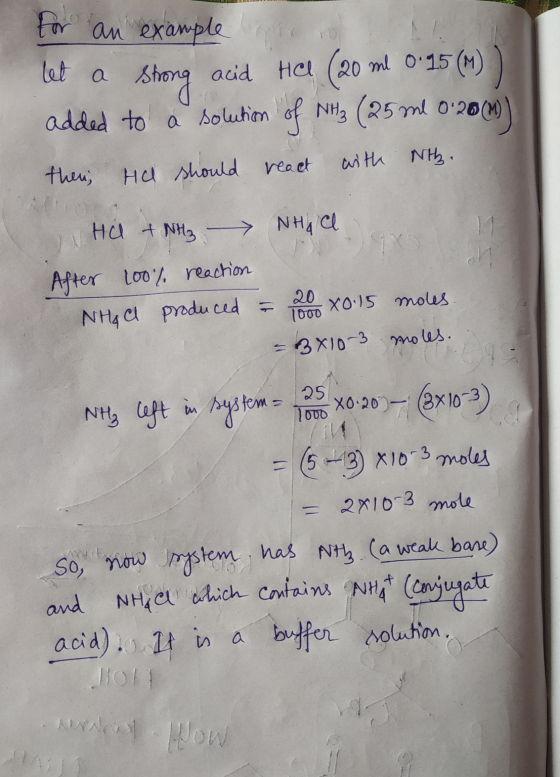
6. In many cases though a strong acid or base added but after some reaction with other moieties in the system it produces some conjugate acid or base of those weak base or acid present in the system. Thus a buffer solution formed. [It is explained in the attached document]
These are some points which can help you to know any given solution is a buffer solution ir not.
Add Answer to:
I know how to do the question, but at the very end, how do you
know...
If a buffer solution is 0.300 M in a weak base (K5 = 2.7 x 10 ) and 0.400 M in its conjugate acid, what is the pH?...
 If a buffer solution is 0.300 M in a weak base (K5 = 2.7 x 10 ) and 0.400 M in its conjugate acid, what is the pH? pH = You need to prepare 100.0 mL of a pH 4.00 buffer solution using 0.100 M benzoic acid (pK-4.20) and 0.200 M sodium benzoate How many milliliters of each solution should be mixed to prepare this buffer? benzoic acid: Amt ml. sodium benzoate: 1 ml
stopн спанде Choose an appropriate weak acid and conjugate base from the list below to make 100 ml of a 0.100M buff...
 stopн спанде Choose an appropriate weak acid and conjugate base from the list below to make 100 ml of a 0.100M buffer solution that has a pH of 7.4. Weak acid Acetic acid Phthalic acid Dihydrogen phosphate (monobasic) Monohrogen phosphate (dibasic) Carbonic acid Citrate Dihydrogen citrate (monobasic) Monohydrogen citrate (dibasic) K. 1.8 x 10 1.3 x 10 6.2 x 10 4.8 x 10 4.6 x 10 8.4 x 10° 1.8 x 10 4.0 x 10- In your notebook, show all...
Question two A buffer solution is able to maintain a constant pH when small amounts of...
 Question two
A buffer solution is able to maintain a constant pH when small amounts of acid or base are added to the buffer. Consider what happens when 1 mL of a 5 M solution is added or 0.005 mol of HCl are added to a 100.0 ml solution acetic acid buffer that contains 0.0100 mol of Acetic acid, HC,H,O,, and 0.0100 mol of sodium acetate, NaC,H,O2. The initial concentration of both the acid and the base are 0.0100 mol/0.1000...
Question two
A buffer solution is able to maintain a constant pH when small amounts of acid or base are added to the buffer. Consider what happens when 1 mL of a 5 M solution is added or 0.005 mol of HCl are added to a 100.0 ml solution acetic acid buffer that contains 0.0100 mol of Acetic acid, HC,H,O,, and 0.0100 mol of sodium acetate, NaC,H,O2. The initial concentration of both the acid and the base are 0.0100 mol/0.1000...
I need help with these problems 07 Question (12 points) e See page 816 1st attempt...
 I need help with these problems
07 Question (12 points) e See page 816 1st attempt See Hint Part 1 (6 points) Calculate the solubility (in M) of cobalt(II) hydroxide, Co(OH)2(s) in H20. Ksp = 3.50x10⁻¹⁶ at a specifictemperature. See Hint Part 2 (6 points) What is the pH of this solution of cobalt(II) hydroxide? pH 04 Question |See page 792 (15 points) A buffer solution includes a weak acid and its conjugate base. 1st attempt See Hint Feedback Include...
I need help with these problems
07 Question (12 points) e See page 816 1st attempt See Hint Part 1 (6 points) Calculate the solubility (in M) of cobalt(II) hydroxide, Co(OH)2(s) in H20. Ksp = 3.50x10⁻¹⁶ at a specifictemperature. See Hint Part 2 (6 points) What is the pH of this solution of cobalt(II) hydroxide? pH 04 Question |See page 792 (15 points) A buffer solution includes a weak acid and its conjugate base. 1st attempt See Hint Feedback Include...
Strong base is dissolved in 635 mL of 0.600 M weak acid (?a=4.31×10⁻⁵) to make a...
Strong base is dissolved in 635 mL of 0.600 M weak acid (?a=4.31×10⁻⁵) to make a buffer with a pH of 4.20. Assume that the volume remains constant when the base is added. HA(aq)+OH−(aq)⟶H2O(l)+A−(aq) Calculate the p?a value of the acid and determine the number of moles of acid initially present. p?a= mol HA= When the reaction is complete, what is the concentration ratio of conjugate base to acid? [A−][HA]= How many moles of strong base were initially added? mol...
Lab 5 Buffers 1. Dissolved ions in salt solutions can act as acids or bases and...
Lab 5 Buffers 1. Dissolved ions in salt solutions can act as acids or bases and react with water to produce hydronium ions or hydroxide ions that contribute to the pH of the salt solution. Since strong acids and strong bases completely ionize in solution, the reverse reaction essentially does not occur, meaning that the resulting conjugate base of a strong acid or conjugate acid of a strong base do NOT act as acids or bases. Ions that are conjugate...
M Review | Constants | Periodic Table - Part A When a solution contains a weak...
 M Review | Constants | Periodic Table - Part A When a solution contains a weak acid and its conjugate base or a weak base and its conjugate acid, it will be a buffer solution. Buffers resist change in pH following the addition of acid or base. A buffer solution prepared from a weak acid (HA) and its conjugate base (A) is represented as What is the pH of a buffer prepared by adding 0.405 mol of the weak acid...
A buffer solution is able to maintain a constant pH when small amounts of acid or...
 A buffer solution is able to maintain a constant pH when small amounts of acid or base are added to the buffer. Consider what happens when 1 mL of a 5 M solution is added or 0.005 mol of HCl are added to a 100.0 mL solution acetic acid buffer that contains 0.0100 mol of Acetic acid, HC,H,O,, and 0.0100 mol of sodium acetate, NaC,H,O,. The initial concentration of both the acid and the base are 0.0100 mol/ 0.1000 L...
please help walk me through how to solve these, the questions change everytime. i am not...
 please help walk me through how to solve these, the questions
change everytime. i am not even sure where to start. thank
you
HON WILL UNULNEM TULENERAL CHEMISTRY LABE Amber Gloria's Qula History Lab & Quiz Exploring Buffers Background Incorrect Question 3 0/1 pts If you mix a weak acid and a weak base together with concentrations of 0.33 and the acid has apk, -8.58, what is the pH of the buffer? Give your answer to two decimals. pH =...
please help walk me through how to solve these, the questions
change everytime. i am not even sure where to start. thank
you
HON WILL UNULNEM TULENERAL CHEMISTRY LABE Amber Gloria's Qula History Lab & Quiz Exploring Buffers Background Incorrect Question 3 0/1 pts If you mix a weak acid and a weak base together with concentrations of 0.33 and the acid has apk, -8.58, what is the pH of the buffer? Give your answer to two decimals. pH =...
i know the answer is B, but I need to see the work how to get...
 i know the answer is B, but I
need to see the work how to get it
What mole ratio of benzoic acid (C6H5COOH, pKa = 4.20) to sodium benzoate would buffer a solution at pH = 4.00? a. 11.2:1 b. 1.6:1 C. 0.63:1 d. 1.05 : 1
i know the answer is B, but I
need to see the work how to get it
What mole ratio of benzoic acid (C6H5COOH, pKa = 4.20) to sodium benzoate would buffer a solution at pH = 4.00? a. 11.2:1 b. 1.6:1 C. 0.63:1 d. 1.05 : 1
 If a buffer solution is 0.300 M in a weak base (K5 = 2.7 x 10 ) and 0.400 M in its conjugate acid, what is the pH? pH = You need to prepare 100.0 mL of a pH 4.00 buffer solution using 0.100 M benzoic acid (pK-4.20) and 0.200 M sodium benzoate How many milliliters of each solution should be mixed to prepare this buffer? benzoic acid: Amt ml. sodium benzoate: 1 ml
 stopн спанде Choose an appropriate weak acid and conjugate base from the list below to make 100 ml of a 0.100M buffer solution that has a pH of 7.4. Weak acid Acetic acid Phthalic acid Dihydrogen phosphate (monobasic) Monohrogen phosphate (dibasic) Carbonic acid Citrate Dihydrogen citrate (monobasic) Monohydrogen citrate (dibasic) K. 1.8 x 10 1.3 x 10 6.2 x 10 4.8 x 10 4.6 x 10 8.4 x 10° 1.8 x 10 4.0 x 10- In your notebook, show all...
 Question two
A buffer solution is able to maintain a constant pH when small amounts of acid or base are added to the buffer. Consider what happens when 1 mL of a 5 M solution is added or 0.005 mol of HCl are added to a 100.0 ml solution acetic acid buffer that contains 0.0100 mol of Acetic acid, HC,H,O,, and 0.0100 mol of sodium acetate, NaC,H,O2. The initial concentration of both the acid and the base are 0.0100 mol/0.1000...
Question two
A buffer solution is able to maintain a constant pH when small amounts of acid or base are added to the buffer. Consider what happens when 1 mL of a 5 M solution is added or 0.005 mol of HCl are added to a 100.0 ml solution acetic acid buffer that contains 0.0100 mol of Acetic acid, HC,H,O,, and 0.0100 mol of sodium acetate, NaC,H,O2. The initial concentration of both the acid and the base are 0.0100 mol/0.1000...
 I need help with these problems
07 Question (12 points) e See page 816 1st attempt See Hint Part 1 (6 points) Calculate the solubility (in M) of cobalt(II) hydroxide, Co(OH)2(s) in H20. Ksp = 3.50x10⁻¹⁶ at a specifictemperature. See Hint Part 2 (6 points) What is the pH of this solution of cobalt(II) hydroxide? pH 04 Question |See page 792 (15 points) A buffer solution includes a weak acid and its conjugate base. 1st attempt See Hint Feedback Include...
I need help with these problems
07 Question (12 points) e See page 816 1st attempt See Hint Part 1 (6 points) Calculate the solubility (in M) of cobalt(II) hydroxide, Co(OH)2(s) in H20. Ksp = 3.50x10⁻¹⁶ at a specifictemperature. See Hint Part 2 (6 points) What is the pH of this solution of cobalt(II) hydroxide? pH 04 Question |See page 792 (15 points) A buffer solution includes a weak acid and its conjugate base. 1st attempt See Hint Feedback Include...
 M Review | Constants | Periodic Table - Part A When a solution contains a weak acid and its conjugate base or a weak base and its conjugate acid, it will be a buffer solution. Buffers resist change in pH following the addition of acid or base. A buffer solution prepared from a weak acid (HA) and its conjugate base (A) is represented as What is the pH of a buffer prepared by adding 0.405 mol of the weak acid...
 A buffer solution is able to maintain a constant pH when small amounts of acid or base are added to the buffer. Consider what happens when 1 mL of a 5 M solution is added or 0.005 mol of HCl are added to a 100.0 mL solution acetic acid buffer that contains 0.0100 mol of Acetic acid, HC,H,O,, and 0.0100 mol of sodium acetate, NaC,H,O,. The initial concentration of both the acid and the base are 0.0100 mol/ 0.1000 L...
 please help walk me through how to solve these, the questions
change everytime. i am not even sure where to start. thank
you
HON WILL UNULNEM TULENERAL CHEMISTRY LABE Amber Gloria's Qula History Lab & Quiz Exploring Buffers Background Incorrect Question 3 0/1 pts If you mix a weak acid and a weak base together with concentrations of 0.33 and the acid has apk, -8.58, what is the pH of the buffer? Give your answer to two decimals. pH =...
please help walk me through how to solve these, the questions
change everytime. i am not even sure where to start. thank
you
HON WILL UNULNEM TULENERAL CHEMISTRY LABE Amber Gloria's Qula History Lab & Quiz Exploring Buffers Background Incorrect Question 3 0/1 pts If you mix a weak acid and a weak base together with concentrations of 0.33 and the acid has apk, -8.58, what is the pH of the buffer? Give your answer to two decimals. pH =...
 i know the answer is B, but I
need to see the work how to get it
What mole ratio of benzoic acid (C6H5COOH, pKa = 4.20) to sodium benzoate would buffer a solution at pH = 4.00? a. 11.2:1 b. 1.6:1 C. 0.63:1 d. 1.05 : 1
i know the answer is B, but I
need to see the work how to get it
What mole ratio of benzoic acid (C6H5COOH, pKa = 4.20) to sodium benzoate would buffer a solution at pH = 4.00? a. 11.2:1 b. 1.6:1 C. 0.63:1 d. 1.05 : 1
Most questions answered within 3 hours.
-
Where is the error in this code sequence?
String s1 = "Hello";
String s2 = "ello";...
asked 10 months ago -
Financial data for Joel de Paris, Inc., for last year
follow:
Joel de Paris, Inc.
Balance...
asked 10 months ago -
Consider this reaction:
Al2(SO4)3 (aq)+ BaCl3
(aq) Al2Cl6 (aq)- +
3BaSO4(s) . What is the...
asked 10 months ago -
Suppose that Savneet is considering increasing her
recent random sample from 20 car rentals to 40...
asked 10 months ago -
Trucks arrive at an unloading terminal at an average rate of 120
per hour.
Trucks arrive...
asked 10 months ago -
Why are methanol and ethanol completely soluble in water while
octanol is not very little soluble....
asked 10 months ago -
A facilities manager at a university reads in a research report
that the mean amount of...
asked 10 months ago -
When the CuSO4 is rehydrated by adding water to the anhydrous
compound, is this an endothermic...
asked 10 months ago -
A ray of sunlight is passing from diamond into crown glass; the
angle of incidence is...
asked 10 months ago -
A block of mass 0.249 kg is placed on top of a light, vertical
spring of...
asked 10 months ago -
how do the kidneys compensate in the presences of acidosis
a) trigger hyperventilate
b) reserve acid...
asked 10 months ago -
Question 501 pts
The rental rate of capital to the firm increases. Which of the
following...
asked 10 months ago