
Homework Answers
A phase is a certain form of matter that includes a specific set
of physical properties.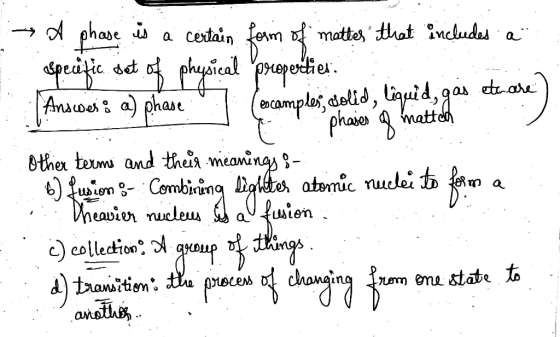
Add Answer to:
- A is a certain form of matter that includes a specific set of physical properties....
#3) Describe the difference between chemical and physical properties and changes of matter? How do these...
#3) Describe the difference between chemical and physical properties and changes of matter? How do these physical and chemical properties relate to intrinsic and extrinsic properties? How are these properties related to the different states of matter? Lastly, how might one classify these different types of matter? Make sure to provide examples of each.
Properties and Changes of Matter propenses both and properties and can undergo physical or chemical changes...
 Properties and Changes of Matter propenses both and properties and can undergo physical or chemical changes Physica properties are those that a substanoe displays without changing ts but not its compositon. are evident only during a chemical change (also called a chemical reaction) in contrast when physical change, it may change appearano, Part A Cassity each of changes as a physical change or a Drag each item to the appropriate bin.
About physical chemistry quanta, matter, and change by atkins / topic46 problem46.4. Could you solve this for me? 46.4 A certain molecule fluoresces at a wavelength of 400 nm with a half-life of 1...
 About physical chemistry quanta, matter, and change by
atkins / topic46 problem46.4.
Could you solve this for me?
46.4 A certain molecule fluoresces at a wavelength of 400 nm with a half-life of 1.0ns. It phosphoresces at 500 nm. If the ratio of the transition probabilities for stimulated emission for the S* →S to the T-S transitions is 1.0× 10⁵, what is the half life of the phosphorescent state?
46.4 A certain molecule fluoresces at a wavelength of 400 nm...
About physical chemistry quanta, matter, and change by
atkins / topic46 problem46.4.
Could you solve this for me?
46.4 A certain molecule fluoresces at a wavelength of 400 nm with a half-life of 1.0ns. It phosphoresces at 500 nm. If the ratio of the transition probabilities for stimulated emission for the S* →S to the T-S transitions is 1.0× 10⁵, what is the half life of the phosphorescent state?
46.4 A certain molecule fluoresces at a wavelength of 400 nm...
Specific Heat
An experiment measures the temperature of a 500g substance while steadily supplying heat to it. The figure shows the results of the experiment.a) What is the specific heat of the solid phase?b) What is the specific heat of the liquid phase?c) What is the heat of fusion?d) What is the heat of vaporization?
9. Which one of the following properties of matter is WRONG Select one: a. Water boils...
 9. Which one of the following properties of matter is WRONG Select one: a. Water boils at 100°C at sea level - extensive property O The density of gold at 20°C is 19.35 g/mL-intensive property c At room temperature, hydrogen p oxide decomposes - chemical property d. CH is combustible-chemical property e Copper is ductile-physical property CC-TDI
Which of the following hypothesizes that the physical and functional status of a certain region of genomic chromatin is dependent upon the patterns of specific histone posttranslational modifications...
Which of the following hypothesizes that the physical and functional status of a certain region of genomic chromatin is dependent upon the patterns of specific histone posttranslational modifications and/or DNA methylation status? a. PTM hypothesis b. Nuclear body hypothesis c. Epigenetic code d. Genetic code
As a component of our physical barriers, what are non-specific defenses said to do? A. be...
As a component of our physical barriers, what are non-specific defenses said to do? A. be an integral part of the host cell immune defenses. B. respond to the antigens by making the antibodies. C. include cells that line body surfaces and chemicals they secrete. D. includes cells that are phagocytes and interferons.
Properties of Alkanes 1. mention some properties of alkanes in terms of their: a. physical state-...
Properties of Alkanes 1. mention some properties of alkanes in terms of their: a. physical state- depends on the ______ of carbons b. Polarity- c. Solubility in water- d. Density compared to water- e. They all undergo the following reaction: _____, which products alway are: _________, _________ and __________. Provide an example here: f. Main use is as ______. g. Melting and boiling points are _______.
APPENDIX 6 PHYSICAL PROPERTIES OF FLUIDS Table A6-1 Properties of Hydrocarbons and Common Gases. Source: GPSA Enginee...
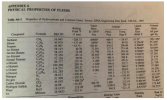 APPENDIX 6 PHYSICAL PROPERTIES OF FLUIDS Table A6-1 Properties of Hydrocarbons and Common Gases. Source: GPSA Engineering Data Book, 10th Ed. 1987 Critical Compound Temp. Normal Butane Normal Pentane ptane 652.0 Carbon Dioxide 1300 Hydrogen Sulfide H2S 546.9 -221.31 0.87476d 95.557 Mixture Heating Valuc 6 marks] Question 1.4: A pure n-butane exists in the two-phase region at 120°F and 70 psia. Calculate the density of the coexisting phase by using the following equations of state: a. Van der Waals b....
State whether the following properties of zinc are chemical or physical: A. It reacts slowly with...
State whether the following properties of zinc are chemical or physical: A. It reacts slowly with oxygen gas at elevated temperatures to form zinc oxide, ZnO. B. When zinc granules are added to dilute sulfuric acid, hydrogen is given off and the metal dissolves. C. Zinc melts at 420 degrees Celsius. D. Zinc has a hardness on the Mohs scale of 2.5 and a density of 7.13g/cm³ at 25 degrees Celsius.
 Properties and Changes of Matter propenses both and properties and can undergo physical or chemical changes Physica properties are those that a substanoe displays without changing ts but not its compositon. are evident only during a chemical change (also called a chemical reaction) in contrast when physical change, it may change appearano, Part A Cassity each of changes as a physical change or a Drag each item to the appropriate bin.
 About physical chemistry quanta, matter, and change by
atkins / topic46 problem46.4.
Could you solve this for me?
46.4 A certain molecule fluoresces at a wavelength of 400 nm with a half-life of 1.0ns. It phosphoresces at 500 nm. If the ratio of the transition probabilities for stimulated emission for the S* →S to the T-S transitions is 1.0× 10⁵, what is the half life of the phosphorescent state?
46.4 A certain molecule fluoresces at a wavelength of 400 nm...
About physical chemistry quanta, matter, and change by
atkins / topic46 problem46.4.
Could you solve this for me?
46.4 A certain molecule fluoresces at a wavelength of 400 nm with a half-life of 1.0ns. It phosphoresces at 500 nm. If the ratio of the transition probabilities for stimulated emission for the S* →S to the T-S transitions is 1.0× 10⁵, what is the half life of the phosphorescent state?
46.4 A certain molecule fluoresces at a wavelength of 400 nm...
 9. Which one of the following properties of matter is WRONG Select one: a. Water boils at 100°C at sea level - extensive property O The density of gold at 20°C is 19.35 g/mL-intensive property c At room temperature, hydrogen p oxide decomposes - chemical property d. CH is combustible-chemical property e Copper is ductile-physical property CC-TDI
 APPENDIX 6 PHYSICAL PROPERTIES OF FLUIDS Table A6-1 Properties of Hydrocarbons and Common Gases. Source: GPSA Engineering Data Book, 10th Ed. 1987 Critical Compound Temp. Normal Butane Normal Pentane ptane 652.0 Carbon Dioxide 1300 Hydrogen Sulfide H2S 546.9 -221.31 0.87476d 95.557 Mixture Heating Valuc 6 marks] Question 1.4: A pure n-butane exists in the two-phase region at 120°F and 70 psia. Calculate the density of the coexisting phase by using the following equations of state: a. Van der Waals b....
Most questions answered within 3 hours.
-
Where is the error in this code sequence?
String s1 = "Hello";
String s2 = "ello";...
asked 10 months ago -
Financial data for Joel de Paris, Inc., for last year
follow:
Joel de Paris, Inc.
Balance...
asked 10 months ago -
Consider this reaction:
Al2(SO4)3 (aq)+ BaCl3
(aq) Al2Cl6 (aq)- +
3BaSO4(s) . What is the...
asked 10 months ago -
Suppose that Savneet is considering increasing her
recent random sample from 20 car rentals to 40...
asked 10 months ago -
Trucks arrive at an unloading terminal at an average rate of 120
per hour.
Trucks arrive...
asked 10 months ago -
Why are methanol and ethanol completely soluble in water while
octanol is not very little soluble....
asked 10 months ago -
A facilities manager at a university reads in a research report
that the mean amount of...
asked 10 months ago -
When the CuSO4 is rehydrated by adding water to the anhydrous
compound, is this an endothermic...
asked 10 months ago -
A ray of sunlight is passing from diamond into crown glass; the
angle of incidence is...
asked 10 months ago -
A block of mass 0.249 kg is placed on top of a light, vertical
spring of...
asked 10 months ago -
how do the kidneys compensate in the presences of acidosis
a) trigger hyperventilate
b) reserve acid...
asked 10 months ago -
Question 501 pts
The rental rate of capital to the firm increases. Which of the
following...
asked 10 months ago